Apalachee High School shooting: Judge grants change of venue for Colt Gray trial

By WUPA News Staff

Click here for updates on this story

    WINDER, Georgia (WUPA) — The trial of Colt Gray, the teenager accused in the deadly shooting at Apalachee High School, will be moved out of Barrow County after a judge ruled that extensive media coverage has made it impossible to seat a fair and impartial jury locally.

In an order filed Friday, Barrow County Superior Court Judge Nicholas Primm granted Gray’s motion for a change of venue, citing widespread local, statewide and national coverage of the case, including the recent trial of Gray’s father, Colin Gray, which was livestreamed daily.

“The nonstop coverage, coupled with the widespread pretrial publicity, makes it clear that a trial with Barrow County jurors would be inherently prejudicial,” Primm wrote in the order.

Neither prosecutors nor defense attorneys recommended a new location for the trial. The judge said he will consider potential venues, including Columbia County, and will consult with judges in other judicial circuits before selecting a new location.

The order comes days after a status hearing in which Primm indicated the case remains on track for a possible trial this fall.

According to a separate scheduling order filed Friday, prosecutors have already turned over all discovery currently in their possession and will continue providing additional materials, including telephone calls made from the youth detention center, as they become available.

The court ordered prosecutors to provide their witness list by Aug. 31, while the defense must turn over its witness list and any discovery by Sept. 11. All motions in the case must be filed by Aug. 28.

The case is tentatively scheduled for trial on Oct. 12.

The order also sets a July 15 deadline for Gray to notify the court if he intends to enter a guilty plea. If he chooses to enter a non-negotiated plea, a plea hearing would begin July 24 and continue into the following week if necessary.

Gray has pleaded not guilty to all charges.

He faces 55 counts, including malice murder, aggravated battery and aggravated assault, in connection with the Sept. 4, 2024, shooting at Apalachee High School in Barrow County that left four people dead and nine others injured.

Investigators allege Gray, who was 14 at the time, brought a semiautomatic rifle to school in his backpack, left class and opened fire in a classroom and hallway before surrendering to school resource officers.

The venue decision comes months after a jury convicted Colin Gray on 27 charges, including second-degree murder, involuntary manslaughter and cruelty to children, for his role in the case. His sentencing hearing is scheduled for July 28 and 29.

Please note: This story was provided to CNN Wire by an affiliate and does not contain original CNN reporting. This content carries a strict local market embargo. If you share the same market as the contributor of this article, you may not use it on any platform.

Garlic mustard is on the Prohibited Plant List in Massachusetts. Here’s why.

By Breana Pitts

Click here for updates on this story

    BOSTON, Massachusetts (WBZ) — Garlic mustard might look like an innocent wildflower, but conservationists say it’s one of the most invasive plants in Massachusetts.

Despite its serrated leaves, delicate white flower and unmistakable scent, garlic mustard is on the state’s Prohibited Plant List.

“It’s like wildfire,” said Lisey Good, founder of Wild Cohasset, a nonprofit dedicated to restoring native habitats and removing invasive species. “I hate garlic mustard so much.”

The biennial plant, originally brought to New England by European settlers hundreds of years ago as a food source and herbal remedy, has since become a major ecological threat. While some people still use garlic mustard in salads, soups, and pesto, the plant can quickly overwhelm forests and crowd out native species. Good said each stem has “tons of seeds in there.”

“This plant might have 7,000 seeds,” she told WBZ-TV. “Next year this plant will die, but all around it will be 7,000 new baby garlic mustards.”

That’s why Good founded Wild Cohasset in 2015. As garlic mustard spreads, it pushes out native plants that local wildlife, like ruby-throated hummingbirds and butterflies, depend on for survival.

“They’re putting out a kind of chemical warfare,” she said. “It’s a poison that’s similar to cyanide, but it’s not harmful to humans. It’s just a mild amount. But it’s enough to change the soil chemistry so that nothing else can grow around it.”

Recently, Cohasset High School seniors helped Good remove the plant from Wheelwright Park.

“I play at the baseball fields, I’ve been around here awhile, so I just want to make sure it’s going to be here, be healthy for the next generation,” said senior Ronan Carnes.

“We should stop it while it’s just one weed, rather than like 7,000,” added fellow senior Emma Lee.

Timing is critical when it comes to garlic mustard removal. Experts recommend pulling the plant as early in the spring as possible, once the ground has thawed. May is often the easiest time to identify garlic mustard because its distinctive white flowers are in bloom.

The goal is to remove the plants before they set seed. After about June 20, conservationists say the risk increases dramatically. The seeds can spill from the stems during removal and spread to new areas.

Garlic mustard often spreads when people remove it from their yards and place it in compost piles. Seeds end up at municipal compost sites, transfer stations, or in community mulch piles, where they’re unknowingly redistributed and introduced to new areas.

Instead, experts recommend bagging the plants and throwing them in the trash.

For Good, the work is about more than removing a weed. It’s about helping people understand the connection between plants, wildlife, and healthy ecosystems.

“It’s so gratifying to see that people learn what to do,” she said. “People are planting more native plants in their yards for wildlife, and I think people have really started to understand the connection between plants and the creatures that live with us.”

There may also be a natural solution on the horizon.

Good points to a native wildflower called golden ragwort, which pollinators love, and researchers have found can successfully compete with garlic mustard. She recommends planting it in areas where garlic mustard has taken hold.

“It’s something people can do that tangibly helps birds and butterflies and bees and whole forests,” she said.

More information on removing garlic mustard can be found here.

Please note: This story was provided to CNN Wire by an affiliate and does not contain original CNN reporting. This content carries a strict local market embargo. If you share the same market as the contributor of this article, you may not use it on any platform.

Scotland World Cup fans arrive in Boston, say they ran out of beer on flight: “I’m going to find Cheers”

By Mike Sullivan

Click here for updates on this story

    BOSTON, Massachusetts (WBZ) — Scotland will play in the first World Cup match at Boston Stadium in Foxboro, Massachusetts Saturday night, but many of their fans are already in town and fired up.

Several landed at Logan Airport Wednesday dressed in uniform, ready for the games. Some Scottish fans crossed the pond in a kilt for the entire flight. It’s part of their ethos. They are known for three things, those kilts, their chants, and their drinking.

“Been drinking since one o’clock in the morning when I got up,” said David Wood as he arrived.

“We ran out of beer, that was my only complaint,” Darren Wilson said of his flight. “We had a round of applause when we landed. I don’t know if you do that here. That’s a very Scottish thing.”

The pilot on his flight told WBZ-TV when the beer ran out, they switched to wine.

“I’m going to go have a nice whiskey at my digs, then I’m going go about the town,” said Wood, holding up a bag with a large whiskey bottle. “I’m going to find Cheers. That’s what I want do. I want to find Cheers. I watched it when I was younger, and I want to find the bar.”

It’s the spot where everyone knows your name, but by the end of the weekend, Boston will know the Scots, especially by their attire. Graham Howieson and his two sons wore their kilts on the flight here.

“It’s a bit hot and sweaty,” said Howieson. “It’s a bit uncomfortable, but we wanted to represent Scotland didn’t we.”

Fans showed up ready for the match against Haiti Saturday with some shelling out thousands of dollars to see the team play in the World Cup for the first time in 28 years.

“When they first went on sale they were about 1,200 (British pounds). Now they aren’t selling and are down to $500,” said Allan Begg who has tickets for a Scotland match.

Carole McNamara bought her tickets online, and it turned out to be a scam. She is out more than $1,300, but she and her family are finding ways to have fun without going to the game.

“We got scammed is what it is, but we are still smiling,” said McNamara. “We are going to the fan zones, and we got tickets to one of the pubs.”

She’s lucky to be in Boston. Some fans struggled to get into the states after their visa waiver applications switched from approved to pending or rejected in the process known as the Electronic System for Travel Authorization (ESTA).

“Checking every day just in case. Loads of people spent thousands of thousands of pounds and you can’t get your money back,” said McNamara. “When you waited 28 years, it’s a kick in the teeth.”

“We were talking to some guys in the pub last night, and they were all nervous too,” said Howieson.

“There’s been a lot on social media, a lot of people getting knocked back and not getting across and stuff, so it has been a bit of an eyeopener, but we’re here now, just about outside, so we are nearly on American soil,” said Scotland fan Justin Longmuir.

U.S. Customs and Border Patrol told WBZ-TV in a statement, in part, “ESTAs are continuously vetted and travelers must be complete and truthful. Failure to disclose arrests or convictions constitutes misrepresentation and can lead to ESTA denial, revocation or a permanent bar from entering the United States.”

The French national team also landed at Logan Airport Wednesday afternoon. Fans packed Boylston Street trying to get autographs and photos of players as they entered the Four Seasons Hotel in Boston.

Please note: This story was provided to CNN Wire by an affiliate and does not contain original CNN reporting. This content carries a strict local market embargo. If you share the same market as the contributor of this article, you may not use it on any platform.

Idaho Supreme Court weighs cases at BYU-Idaho

David Pace

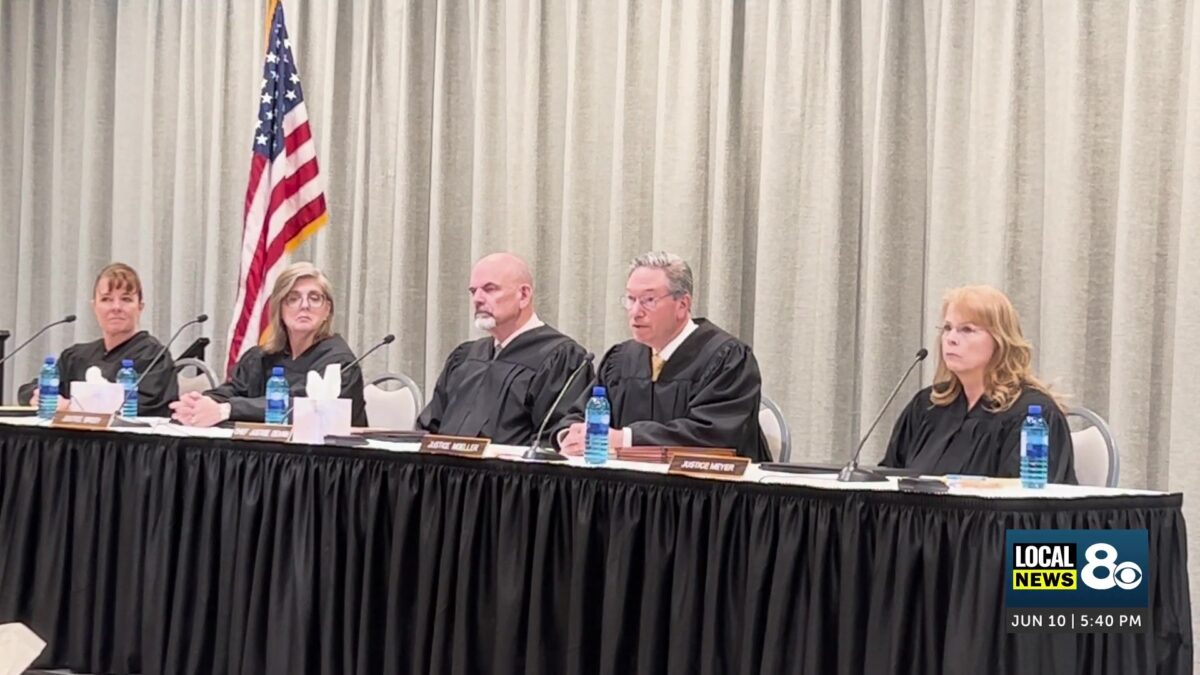
REXBURG, Idaho (KIFI) – Five justices of the Idaho Supreme Court visited Brigham Young University-Idaho Wednesday to hear oral arguments in three cases from eastern Idaho.

The justices heard from lawyers in an appeal of a domestic battery conviction, a probate case and a dispute from Bonneville County over court records fees.

In State of Idaho v. Tony Crombie, Crombie appealed his conviction for domestic battery.

“The unwaived constitutional right that was violated here was Mr. Crombie’s right to fair notice of the charges against him. He had no idea that he was on trial for felony domestic battery, and he did not tailor his defense to the elements in that charge,” argued his lawyer Stacey Donahoe. “… We think that the only proper remedy in this case is to vacate his conviction.”

Idaho Deputy Attorney General Neil Paterson disagreed with that characterization.

“Crombie has not shown a violation of an unwaived constitutional right because the variance between the jury instruction and the pleading document was not fatal. Likewise, the record does not show that there was a clear error because there was not a failure to object, but rather a strategic decision to object on a basis that best fit his defense that he did not touch the victim, ” he said.

The second case, Travis Bowen v. Dana Penrod consisted of a dispute between a brother, Travis Bowen, and his sister, Dana Penrod.

After their sister, Deborah Bowen, and their father passed away, Travis was appointed as the personal representative for Deborah’s estate, while Dana oversaw her father’s estate.

Travis alleges that some of Deborah’s property was sold by Penrod at a July 2020 auction along with their father’s belongings, and requested that the value of Deborah’s property be sent to her estate.

His lawyer Stephen Adams argued that “he filed the petition to try and find out where the property went to and to collect it.”

Penrod was represented by lawyer Nathaniel Wadsworth, who stated a “three year statute of limitation applies, and the court properly dismissed the complaint, and the district court properly affirmed that dismissal.” 

The third case, Bryan Smith v. Penny Manning (in her official capacity as Bonneville County Clerk), Smith challenged the Bonneville County Clerk’s Office after he was charged a $352 fee for public records.

The fee was assessed after Smith requested judgments from 169 cases on an electronic thumb drive.

The District Court ruled that “the Clerk had absolute quasi-judicial immunity from suit and dismissed both claims without addressing whether Smith had been overcharged,” the docket states.

“It cannot be the law that the government can take your property, overcharge you, and then when you ask for your money back, they say we’re immune,” Smith said.

Bonneville County Prosecuting Attorney Randy Neal disagreed, stating, “Where did the overcharge occur? If that requires an interpretation of the law, then I have to say my client is probably either 1) not the person who interpreted the law, so we go to the administrative district judge, or 2) you’re asking her to do something which was not ministerial or administrative.”

In each case, the justices peppered lawyers with piercing questions.

The Idaho Supreme Court took Wednesday’s cases under advisement and will release its decisions at a later time.

Following the hearings, the judges discussed their roles and decision-making process in the court, while answering questions from students and guests at the university.

“We are elected officials. We need to act like it in the sense that we understand we are responsive, that we’re transparent as we can be to the public, and that we strive to be out and about,” said Chief Justice G. Richard Bevan.

Another question dove into whether or not the judiciary has been politicized.

“It isn’t about politics. It’s about deciding the cases,” said Justice Cynthia Meyer. ”It’s about following the rule of law, looking at the facts that are developed throughout the case, and making the right decision regardless of whatever political winds may be blowing at the time.”

Justice Gregory Moeller, former District Judge for the Seventh Judicial District, affirmed that a judge’s duty is to uphold the rule of law.

“We have to understand that the decisions we make are much bigger than our own personal views,” Moeller said. “We often make decisions that we personally don’t like. For us, the only vindication is that we follow the law. We want the law to win. We want the rule of law to govern, and if that happens, it doesn’t really matter who won or lost.”

Idaho Supreme Court Justice Colleen Zahn, Justice Robyn Brody, Chief Justice Richard Bevan, Justice Gregory Moeller and Justice Cynthia Meyer (left to right) held hearings at Brigham Young University-Idaho on Wednesday.

Click here to follow the original article.

Number of roads in Macon, Chariton counties closed due to flooding

Ryan Shiner

COLUMBIA, Mo. (KMIZ)

A number of roads in Macon and Chariton counties are closed because of flooding after storms went through the area on Wednesday evening.

The potential threat of storms and heat led to the ABC 17 News Stormtrack Weather Team to issue a Weather Alert Day for Wednesday, and the most-northern counties in the station’s viewing area were under a tornado watch in the evening.

The Traveler Map from the Missouri Department of Transportation shows Routes DD and PP between Macon and Shelbina were closed because of flooding. Route Y was closed, but “road damage” was cited as the reason why on the map.

Route HH near Macon was closed because of flooding, according to MoDOT and the Kansas City office of the National Weather Service.

Route E near Rothville in Chariton County was also closed from flooding, per the NWS.

The Missouri State Highway Patrol’s Troop B — which covers areas just north of Boone County — had given residents a reminder earlier in the day on social media to not drive through floodwaters.

“With all the storm cells working through the Troop B region and heavy rainfall please don’t drive through flood waters. Plan accordingly turn around don’t drown,” the post says. “Please report any traffic conditions to your local authorities.”

Not too many people were without power around 10 p.m. in our viewing area, with Macon County seeing 11 customers of the Tri-County Electric Cooperative Association without power.

However, just north of the viewing area, Adair County saw 850 Tri-County Electric members without power and another 21 Ameren customers without power.

Check back for updates.  

Click here to follow the original article.

Free community shred event in La Pine this Saturday

Triton Notary

LA PINE, Ore. (KTVZ) The Deschutes County Sheriff’s Office and Republic Services are partnering to host a free Community Shred Event this Saturday, June 13, in La Pine. Residents can dispose of sensitive documents, unwanted medications and worn American flags and also donate non-perishable food items.

The event will take place from 10:00 a.m. to 12:00 p.m., or until the truck is full, at the Sheriff’s Office La Pine Substation, located at 51340 Highway 97.

This residential-only shred service is not intended for business or commercial use. Residents are limited to four boxes of documents per household.

The Deschutes County Sheriff’s Office encourages residents to take advantage of this opportunity to securely dispose of unwanted items while supporting the local community.

The event includes safe medication disposal, accepting prescriptions, patches, ointments, over-the-counter medications, vitamins, samples and pet medications.

However, certain items are not accepted. For document shredding, plastic bags and three-ring binders cannot be accepted, though paper clips and staples may remain attached. For medication disposal, sharps, thermometers, inhalers, aerosols and other pressurized containers are prohibited. Those with more than four boxes of documents should contact Republic Services at 541-352-2263 for additional disposal options.

Community members may also bring worn or tattered American flags for proper retirement. Non-perishable food donations will be accepted on-site and will be given to a local food bank.

Two additional community shred events are scheduled. The next event will be on Saturday, July 18, at the Sheriff’s Office Substation at 703 N. Larch in Sisters. A final event is scheduled for Saturday, Sept. 19, at the Terrebonne Community School, located at 1199 B Ave. in Terrebonne.

Click here to follow the original article.

Bend’s 15th Street and Ferguson Road intersection to close for construction

Triton Notary

BEND, Ore. (KTVZ) Construction on the roundabout at the intersection of 15th Street and Ferguson Road in Bend, Ore., will begin June 22. The intersection will fully close to safely complete the work, with detours in place for motorists.

The project is a voter-approved 2020 Transportation GO Bond initiative. The work includes constructing a new roundabout, road resurfacing and creating a new shared-use path. The intersection closure is timed with summer break to help reduce traffic impacts and construction is expected to wrap up in the fall. The full closure will occur only after Ferguson Road near 27th Street reopens to two-way traffic.

The new shared-use path is a component of the larger Bend Bikeway Project.

Residents can learn more about the project, view detour information and sign up for updates by visiting the city’s website.

Click here to follow the original article.

Moberly man pleads guilty in federal fraud cause

Ryan Shiner

COLUMBIA, Mo. (KMIZ)

A Moberly man pleaded guilty on Wednesday to fraudulently obtaining $284,840 through COVID-19 pandemic-era financial assistance, according to a press release from the Department of Justice.

Steven Hendren, 33, pleaded guilty in St. Louis to one count of wire fraud. He will be sentenced on Tuesday, Sept. 8.

Hendren was indicted in December 2024 and was previously charged with three counts of wire fraud and a count of aggravated identity theft, previous reporting shows.

Previous reporting shows that Hendren had applied for rental assistance through the Missouri Housing Development Commission, had listed himself as a landlord and included fake lease agreement, financial statements and inflated rent amounts.

He faces up to 20 years in prison, the release says.

Click here to follow the original article.
‘It’s all worth it, in the end’ – Cadets Celebrate completion of the Oregon Youth Challenge

Tyson Beauchemin

BEND, Ore. (KTVZ) — The 71st class of the Oregon Youth Challenge graduated today. The formal ceremony took place at the Riverhouse Convention Center in Bend, and marks the completion of an intensive 22-week program.

The program focues on regimented behavior and education. It offers youth a second chance, if they’re struggling with school or other problems.

Upon enrolling, students become ‘cadets’. Cadets are rigorously trained and drilled, on top of attending classes. For the duration of the program, they live on site in barracks with other students. The curriculum is designed to foster personal responsibility along side physical improvment

The program is challenging, and not everyone completes it – but the cadets who make it through say it transforms them. Graduation marks the completion of a hard-earned journey, and the beginning of something new.

Gabriel Tacia, a graduating cadet and a team leader, reflected on his journey within the program, “I’ve learned a lot of different things.” said Tacia, “From the beginning, I didn’t take this place seriously and I just wanted to go home. But now, like, I’ve gained a lot of new brothers and friends and I’ve never been as smart, I think.” Tacia went on to thank one of his cadre leaders named Yutes, for telling him to stick with it, when he felt lke quitting

Eli Hess, another cadet, is joining the Army National Guard following his graduation. The program didn’t just change Hess’ path, he says it saved him “If I didn’t go the challenge… (if I didn’t) join the challenge and go to the program… I’d probably be arrested or dead. So it’s a good thing,” Hess said.

Keira Rodriguez, a graduating cadet, encouraged others to focus on the long-term benefits of the program. “Definitely. Just think about the end goal, because it’s all worth it, in the end. Time is going to fly by,” Rodriguez said. Rodriguez said her experience was actual fun, in the end.

Cadets leaving the Oregon Youth Challenge pursue a variety of different directions. Some work to earn a G.E.D. or are planning to attend college. Other graduates return to high school to pick up where they left off. A rare few are so inspired by the program’s discipline and order that they choose to enlist in the armed forces.

Click here to follow the original article.

Public input meeting held on Columbia’s proposed irrigation ordinance

Mitchell Kaminski

COLUMBIA, Mo. (KMIZ)

Columbia residents had an opportunity to weigh in on a proposed irrigation ordinance Wednesday night that city officials say is necessary to manage growing water demands.

A public hearing was held at 6 p.m. at City Hall, where City of Columbia Utilities officials presented details of the ordinance to 13 residents in attendance, including Ward 6 Councilwoman Betsy Peters.

Under the ordinance, lawn watering would be restricted to designated days and times. If approved, even-numbered addresses would be allowed to water their lawns on Sunday, Tuesday and Thursday, while odd-numbered addresses would have irrigation days on Monday, Wednesday and Saturday.

The ordinance would apply to in-ground irrigation systems and unattended hose-end devices.

“The proposed schedule would permit irrigation on your scheduled day before 10 a.m. and after 7 p.m. for a maximum of 30 minutes per irrigation zone,” according to information from the city.

The proposal is designed to reduce strain on the water system by limiting when outdoor irrigation can occur and requiring water-saving technology on certain irrigation systems.

According to city officials, daily peak water usage during the summer can exceed 170% of winter demand, while the highest hourly demand during summer months can reach roughly 240% of peak winter hourly use.

Joe Strodtman, Columbia Water Utility engineering supervisor, said the city’s goal is not to reduce overall water consumption but to spread demand more evenly throughout the week.

“The thought process behind the ordinance is, looking to spread irrigation water usage out across, multiple days, multiple hours, to reduce the, system impact at the at our peak usage,” Strodtman told ABC 17 News. “We’ve been looking at this, seriously for a few years now. The first impacts for started, looking at the need for something was back in 2016 and then we really picked up the efforts, probably two years ago, in order to get an ordinance drafted.”

The proposal would also require moisture-sensing technology on new irrigation systems to prevent watering when sufficient rainfall has occurred.

“On initial review of the ordinance, people don’t like requirements, but as they look more into the details, I think a lot of people are finding that there’s a lot of reasonableness built in. We’re not looking to reduce water usage; we’re looking to spread that out. Tonight, a lot of the questions were based on more specific areas of the city, where we’re really trying to focus on a more citywide approach,” Strodman said when asked about feedback the city has received.

However, the proposal has drawn criticism from the COMO Safe Water Coalition, which says the ordinance leaves several important questions unanswered.

Julie Ryan, co-founder of the coalition, said the group supports efforts to manage irrigation but believes some parts of the proposal need additional clarification.

“I do think that there are more opportunities to improve upon this, especially where it connects to what our, needs are for the infrastructure in our community,” Ryan said.

One concern involves language in the ordinance regarding irrigation schedules.

“One of the things was maybe just a language piece,” Ryan told ABC 17 News. “When it talked about the days and times of weeks for schedules for people to abide by, it specifically said residential and it did not include commercial.”

The coalition has also questioned proposed requirements for irrigation meters and smart sensors tied to certain system upgrades or repairs.

“The big thing, I think, too, is really the idea of the meters and the upgrading sensors,” Ryan said, adding that she questioned who would determine what qualifies as a significant upgrade and whether irrigation meters are intended primarily to generate additional revenue.

Enforcement remains another major concern. Under the ordinance, violations could be identified through city staff observations, public reports and water meter data. Penalties would include a $50 fine for a first offense, a $250 fine for a second offense and a $350 fine and water service disconnection for a third offense.

City officials said Wednesday that no fines would be issued in 2026. Instead, the city would focus on public education and warnings.

“We don’t want a situation, I think, in Columbia where we have neighbors calling about other neighbors to tell on something that they’re doing,” Ryan said. “I do know that the staff we have with Water in Light are exceptionally busy, and we need them to be doing things besides monitoring who’s running the irrigation and when they’re running it.” 

Another concern raised during the meeting centered on future growth and whether additional changes to the ordinance could become necessary as Columbia’s population expands.

Questions were also raised about exemptions included in the ordinance.

According to the coalition, commercial agricultural operations are specifically exempted under portions of the proposal, while residential and community gardens may not receive the same treatment unless watering is done by hand.

The group also wants more clarity regarding an exemption allowing irrigation to preserve turf subject to heavy public use, including how that determination would be made and who would establish the criteria.

Ryan said the coalition believes broader infrastructure concerns should be addressed alongside conservation efforts.

“We have actually talked about an irrigation ordinance with city leaders in the past, primarily because if we want to hold certain areas of the city accountable for a day in a time of the week voluntary irrigation schedule, we felt that that needs to be done throughout the system,” Ryan said.

She added that the city also needs to address questions about future infrastructure needs as development continues in growing areas of Columbia.

Instead of the current proposal, the coalition is urging city leaders to consider a drought-stage approach similar to policies used in other communities, where watering restrictions become more stringent during periods of drought and relax when water supplies are adequate.

City officials maintain that reducing peak water demand is critical to maintaining reliable service and avoiding costly future infrastructure investments.

A second public input meeting is scheduled for 6 p.m. June 17 at the Activity and Recreation Center.“Whenever the feedback is detailed and constructive, that’s very helpful to us,” Strodtman said. “I got a couple of tips tonight that I’ll go back and also review the actual language of the ordinance. We might make a couple small adjustments based on that. We really prefer feedback that’s detail based and can be constructive rather than just saying, we get a lot of comments that ‘we don’t want this, you’re just trying to control us.’”

Click here to follow the original article.