Public input meeting held on Columbia’s proposed irrigation ordinance

Mitchell Kaminski
COLUMBIA, Mo. (KMIZ)
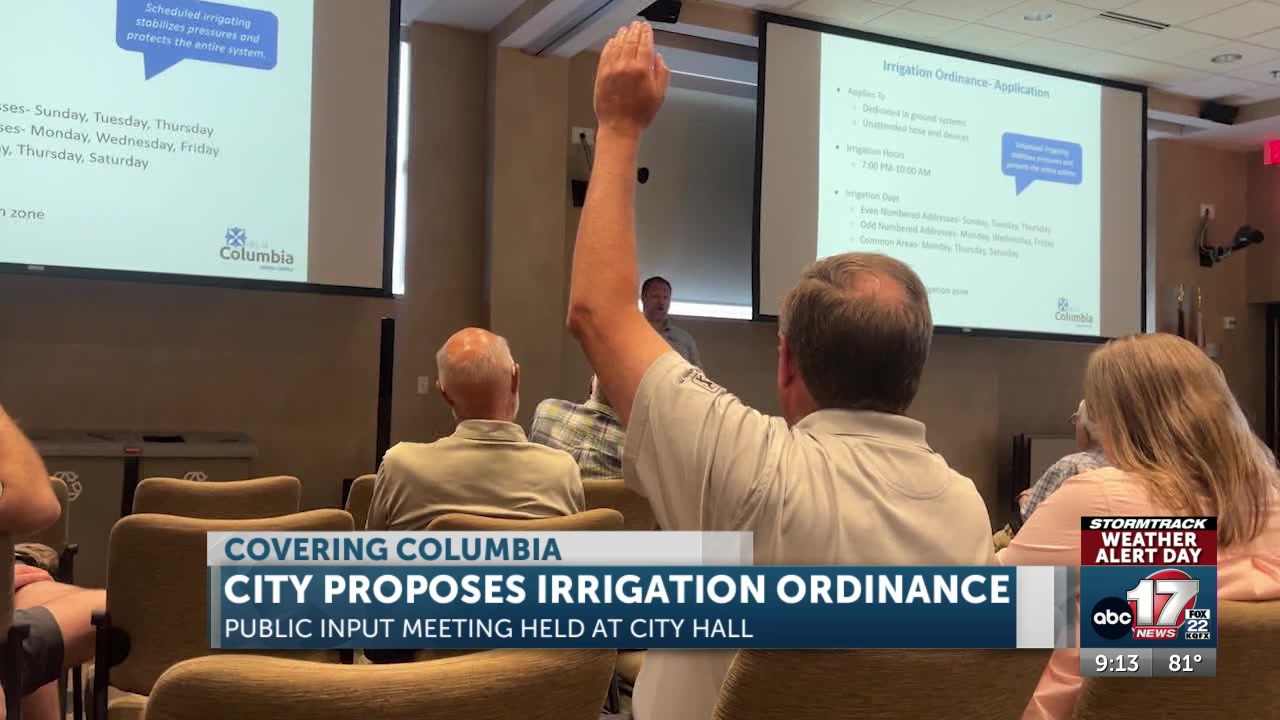
Columbia residents had an opportunity to weigh in on a proposed irrigation ordinance Wednesday night that city officials say is necessary to manage growing water demands.
A public hearing was held at 6 p.m. at City Hall, where City of Columbia Utilities officials presented details of the ordinance to 13 residents in attendance, including Ward 6 Councilwoman Betsy Peters.
Under the ordinance, lawn watering would be restricted to designated days and times. If approved, even-numbered addresses would be allowed to water their lawns on Sunday, Tuesday and Thursday, while odd-numbered addresses would have irrigation days on Monday, Wednesday and Saturday.
The ordinance would apply to in-ground irrigation systems and unattended hose-end devices.
“The proposed schedule would permit irrigation on your scheduled day before 10 a.m. and after 7 p.m. for a maximum of 30 minutes per irrigation zone,” according to information from the city.
The proposal is designed to reduce strain on the water system by limiting when outdoor irrigation can occur and requiring water-saving technology on certain irrigation systems.
According to city officials, daily peak water usage during the summer can exceed 170% of winter demand, while the highest hourly demand during summer months can reach roughly 240% of peak winter hourly use.
Joe Strodtman, Columbia Water Utility engineering supervisor, said the city’s goal is not to reduce overall water consumption but to spread demand more evenly throughout the week.
“The thought process behind the ordinance is, looking to spread irrigation water usage out across, multiple days, multiple hours, to reduce the, system impact at the at our peak usage,” Strodtman told ABC 17 News. “We’ve been looking at this, seriously for a few years now. The first impacts for started, looking at the need for something was back in 2016 and then we really picked up the efforts, probably two years ago, in order to get an ordinance drafted.”
The proposal would also require moisture-sensing technology on new irrigation systems to prevent watering when sufficient rainfall has occurred.
“On initial review of the ordinance, people don’t like requirements, but as they look more into the details, I think a lot of people are finding that there’s a lot of reasonableness built in. We’re not looking to reduce water usage; we’re looking to spread that out. Tonight, a lot of the questions were based on more specific areas of the city, where we’re really trying to focus on a more citywide approach,” Strodman said when asked about feedback the city has received.
However, the proposal has drawn criticism from the COMO Safe Water Coalition, which says the ordinance leaves several important questions unanswered.
Julie Ryan, co-founder of the coalition, said the group supports efforts to manage irrigation but believes some parts of the proposal need additional clarification.
“I do think that there are more opportunities to improve upon this, especially where it connects to what our, needs are for the infrastructure in our community,” Ryan said.
One concern involves language in the ordinance regarding irrigation schedules.
“One of the things was maybe just a language piece,” Ryan told ABC 17 News. “When it talked about the days and times of weeks for schedules for people to abide by, it specifically said residential and it did not include commercial.”
The coalition has also questioned proposed requirements for irrigation meters and smart sensors tied to certain system upgrades or repairs.
“The big thing, I think, too, is really the idea of the meters and the upgrading sensors,” Ryan said, adding that she questioned who would determine what qualifies as a significant upgrade and whether irrigation meters are intended primarily to generate additional revenue.
Enforcement remains another major concern. Under the ordinance, violations could be identified through city staff observations, public reports and water meter data. Penalties would include a $50 fine for a first offense, a $250 fine for a second offense and a $350 fine and water service disconnection for a third offense.
City officials said Wednesday that no fines would be issued in 2026. Instead, the city would focus on public education and warnings.
“We don’t want a situation, I think, in Columbia where we have neighbors calling about other neighbors to tell on something that they’re doing,” Ryan said. “I do know that the staff we have with Water in Light are exceptionally busy, and we need them to be doing things besides monitoring who’s running the irrigation and when they’re running it.”
Another concern raised during the meeting centered on future growth and whether additional changes to the ordinance could become necessary as Columbia’s population expands.
Questions were also raised about exemptions included in the ordinance.
According to the coalition, commercial agricultural operations are specifically exempted under portions of the proposal, while residential and community gardens may not receive the same treatment unless watering is done by hand.
The group also wants more clarity regarding an exemption allowing irrigation to preserve turf subject to heavy public use, including how that determination would be made and who would establish the criteria.
Ryan said the coalition believes broader infrastructure concerns should be addressed alongside conservation efforts.
“We have actually talked about an irrigation ordinance with city leaders in the past, primarily because if we want to hold certain areas of the city accountable for a day in a time of the week voluntary irrigation schedule, we felt that that needs to be done throughout the system,” Ryan said.
She added that the city also needs to address questions about future infrastructure needs as development continues in growing areas of Columbia.
Instead of the current proposal, the coalition is urging city leaders to consider a drought-stage approach similar to policies used in other communities, where watering restrictions become more stringent during periods of drought and relax when water supplies are adequate.
City officials maintain that reducing peak water demand is critical to maintaining reliable service and avoiding costly future infrastructure investments.
A second public input meeting is scheduled for 6 p.m. June 17 at the Activity and Recreation Center.“Whenever the feedback is detailed and constructive, that’s very helpful to us,” Strodtman said. “I got a couple of tips tonight that I’ll go back and also review the actual language of the ordinance. We might make a couple small adjustments based on that. We really prefer feedback that’s detail based and can be constructive rather than just saying, we get a lot of comments that ‘we don’t want this, you’re just trying to control us.’”