WyoFile
By Maya Shimizu Harris, WyoFile.com
Originally Published: June 12, 2026
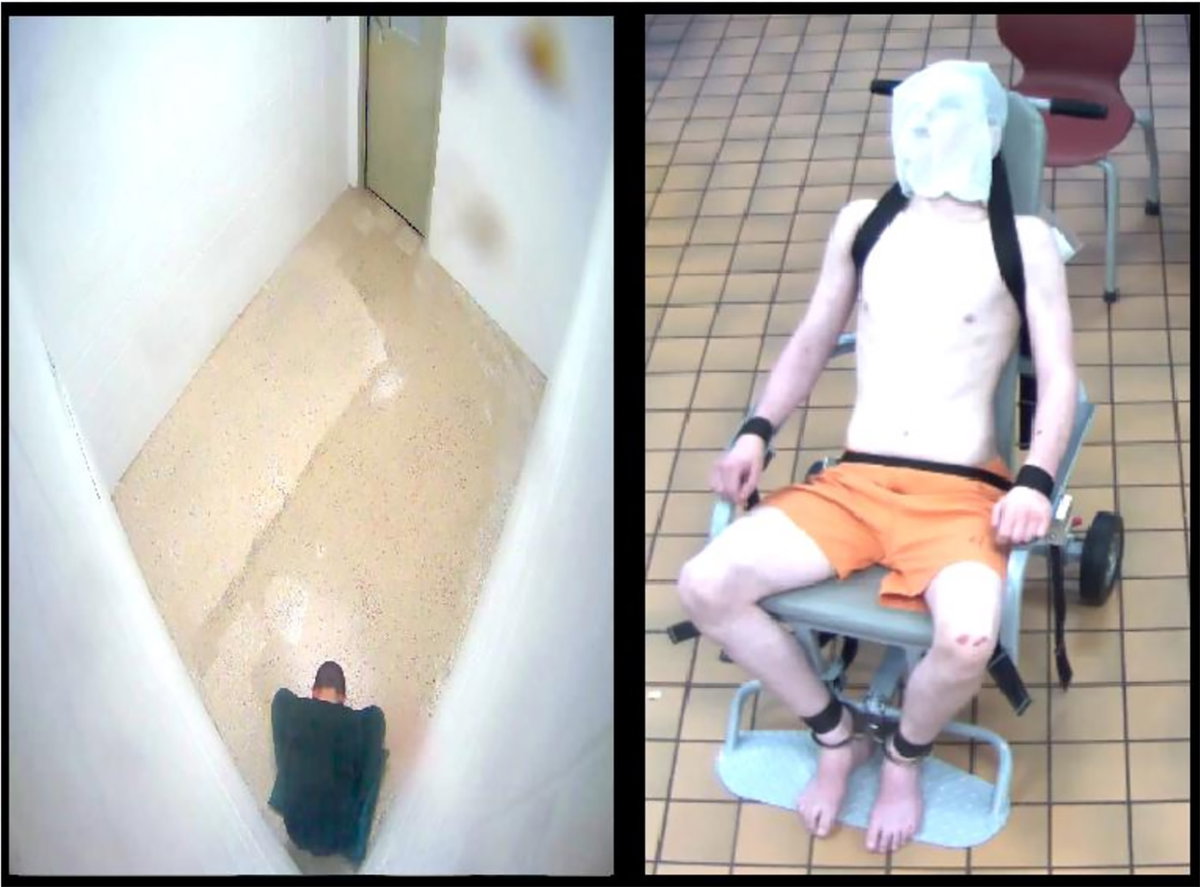
WYO (Wyofile) —The beginning of the plaintiffs’ response in a case alleging abuse at a state facility for delinquent boys features two video footage stills. In one, a boy cowers in the corner of a solitary confinement room. In the other, a boy is strapped to a restraint chair with a white mask over his head.
Above the photos is a quote attributed to one of the defendants, staff member Thad Shaffer: “[The] best part of the chair is watching the kids cry and scream like a *&%$ing child . . . that’s what makes it worth it.”
In 2024, six former residents — Blaise Chivers-King, Dylan Tolar, Charles “Rees” Karn, D.H., Haiden Willis and Koby Cranford — joined a lawsuit alleging abuse at the Wyoming Boys’ School, including extended periods of solitary confinement and physical harm. The school, which accommodates delinquent boys ages 12 to 21, is a 38-acre facility near Worland that’s overseen by the Wyoming Department of Family Services.
 Footprints in the snow lead to the Wyoming Boys’ School on Dec. 10, 2021 in Worland. The state-run facility houses delinquent boys ages 12 to 21. (Lauren Miller/Casper Star-Tribune)
Last month, the defendants, which include the Wyoming Department of Family Services, the Wyoming Boys’ School and 10 school employees, responded to these allegations and urged the court to decide the matter in the state’s favor before the case goes to trial.
The plaintiffs’ response, filed on Thursday, brings forward new information from video footage, photos and depositions — testimony given under oath — that paints a picture of how staff members used force and allegedly falsified reports.
Boys’ school staff said in depositions that leadership frequently ordered them to falsify and downplay the use of force in incident reports. The response also disputes the defendants’ assertion that the boys’ basic needs were met when they were kept in solitary confinement. It states that some of the plaintiffs’ parents complained to the school about their children’s treatment, contrary to the defendants’ description that parents didn’t intervene or follow the school’s grievance policy. The document provides vivid descriptions of how staff members used force against the former residents, often when they weren’t posing a safety threat.
Wyoming has, for decades, incarcerated juvenile offenders at the highest rates in the nation, according to data collected by the U.S. Department of Justice. While Wyoming’s juvenile incarceration rate declined according to the most recent data collected in 2023, adjudicated delinquents — young people convicted of crimes — were removed from their homes and placed in public and private facilities at over twice the national average.
Falsified reports
Boys’ school staff said in depositions that people working at the facility “frequently” falsified records, including incident reports.
“[A]lmost every incident report” at the school from 2022 to 2024 was falsified, one staff member said in a deposition. School leadership told staff to report that “student behavior” caused the use of force, according to the staffer’s testimony.
A staffer recalled raising concerns about falsified reports “on multiple occasions, but supervisors ignored his concerns,” a staffer said in his deposition. Once, the staffer told Shaffer he wouldn’t sign a report because it was “untruthful.” Shaffer, according to the deposition, told him to “[s]ign it or find a new job.”
A Feb. 23, 2023 incident report, the new court document describes, “whitewashed” Shaffer’s use of force against one of the plaintiffs, Chivers-King. The report, according to the document, states that Shaffer placed Chivers-King in the corner and then gave the boy “verbal commands to sit in the corner.” But the response describes video footage that shows Shaffer “violently slamming” Chivers-King into a corner with a riot shield after staff told him to “get back” and Chivers-King “immediately complied.”
Solitary confinement
Boys’ School Superintendent Dale Weber testified that the school “concedes that a student who is suffering from severe depression and self-harm should not be kept in solitary confinement,” the plaintiffs’ response states. But “the record shows” that the school “repeatedly punished” the former residents “with additional time in solitary when they engaged in self-harm.”
 Dale Weber, superintendent of the Wyoming Boys’ School, sits for a portrait on April 19, 2022 in Worland. He took over in January 2022. Prior to that, he’d been the school’s clinical director for several years. (Victoria Eavis/Casper Star-Tribune)
Solitary confinement at the boys’ school is “significantly harsher” than in a “typical adult prison,” the document states. Adult prisoners in solitary are usually allowed to read books, make phone calls, take part in educational programming, exercise and look out a window.
By contrast, photos and depositions paint the school’s solitary confinement rooms as small and bare. They are about 8 by 10 feet with concrete floors and cinderblock white walls, the response describes. The typical room has two cameras, a metal toilet-sink combination and a drain in the floor. No windows look outside. Staff “punitively cover” the small interior window on the door “with a large magnet ‘every time a student’ is in the room.” “During the day, a boy in solitary has ‘nothing to sit on,’” the document states. “At night, the boy receives a thin mattress to sleep on the floor.”
The school bars boys from listening to music, watching T.V. and keeping personal items while they are in solitary, according to a staffer’s deposition, nor does the facility typically allow residents to participate in any activities. It rarely lets boys in solitary have books or educational materials, staffers said. The boys don’t receive educational instruction or therapy while in solitary.
Video footage shows that no mental health provider or teacher entered the detention room to provide therapy or education to Chivers-King, Karn or Willis.
Kids in solitary confinement aren’t allowed to interact with peers or to talk with family on the phone, according to staff testimony.
 The Wyoming Boys’ School solitary room in Dorm 3 is shown in this photo. (Court filing)
Boys in solitary would “stand at the door to try to interact with their peers,” including “yell[ing] underneath the door,” staffer and defendant Amanda Turner testified. In response, school staff “put a towel underneath the door,” Chivers-King, one of the former residents, said in his deposition.
The school rarely lets kids out of solitary confinement for exercise, staffers testified. They said that staff usually check on isolated boys via camera without communication. When staff members do visual checks, they typically remove the magnet, “peek in and look through the window,” then put the magnet back on. Kids in solitary can only communicate with staff by using “hand signals to the camera” or yelling, defendant Darryl Coronado testified. Dorm directors sometimes barred staff from talking with boys in solitary.
The school, according to a deposition, “places no upper limit on how long a boy can be held in solitary confinement,” the court document states. It also often places kids in solitary confinement for pre-determined amounts of time, which the document described as “punitive.”
“To be released from solitary, a child must satisfy strict and arbitrary expectations,” the document states. “The child must ‘sit in the co[r]ner of the detention room without falling asleep’ and must ‘raise hand and
wait to be addressed for questions,’” according to the document. Willis, one of the plaintiffs, for example, “would earn a negative day” if he spent “a majority of his day laying down,” staffer Tate Adams, a defendant, said in his deposition.
“Such expectations are abusive,” the document states.
One of the former residents, Willis, spent 75% of his time at the school in solitary confinement, the document states. Staff took away his mattress, making him sleep on the floor most nights, often without a pillow, Willis testified.
 The Wyoming Boys’ School solitary room in Dorm 3 is shown in this photo. (Court filing)
While in solitary, some of the former residents attempted suicide. Karn tried to hang himself. Chivers-King tried to kill himself by hitting his head against the wall, after which staffer and defendant Mike Nelson made the boy “clean his blood from the walls,” according to a Wyoming Department of Family Services contact log.
The document cites case law acknowledging the harm of solitary confinement, particularly for children. “Courts uniformly recognize that solitary confinement is particularly harmful to children and to people with mental health disabilities,” the document states.
“Even if Plaintiffs were occasionally placed in solitary confinement for arguably legitimate purposes, the duration of their confinement was ‘excessive’ in relation to that purpose,” the response states.
“Even where there exists an initial, legitimate safety reason for placing a child in confinement, it is unconstitutional to keep the child there ‘for extensive periods’ after the safety threat has ‘dissipated.’”
The school’s use of solitary confinement was unlawful and violated the former residents’ 14th Amendment rights, the document reiterates.
Restraint chair
In 2016, the boys’ school bought a restraint chair with shoulder, lap, wrist and ankle straps, WyoFile reported in a 2022 investigation. These high-back chairs made international news at the Guantanamo Bay detention camp, where they were used to torture and force-feed detainees.
Photos included in the plaintiffs’ Thursday response show that the school’s restraint chair bears a warning label that states: “Warning: Use of the safety restraint chair without first reading and thoroughly understanding the instructions could cause injury or death. . . Do not leave detainees in this chair for more than TWO hours.”
Despite this warning, the school put the former residents in the restraint chair for more than two hours, according to the new court document.
 Two photos from a court filing show, at left, a restraint chair, and right, a close-up of a label on the chair warning not to leave detainees restrained in the chair for more than two hours. (Court filing)
In June 2021, for example, Weber, the school’s superintendent, approved putting Karn in the chair from 11:50 a.m. to 7:30 p.m., according to the response. He stayed in the chair for more than two hours on other occasions. Staffers also restrained Willis, another plaintiff, in the chair for about five hours in 2019, according to an incident report, even though the boy “was ‘relaxed’ after less than an hour in the chair,” the document states.
Staff members often put Karn in the restraint chair “half-naked, wearing only his shorts,” the document states. The response describes video footage that shows staffers also “shackled [Karn] to the restraint chair with a mask over his head for multiple hours.”
Shaffer taunted Karn by stating, “You sure love that chair,” and “last time you cried like a baby for like an hour,” according to the document.
Use of force
The former residents’ new court filing describes several instances when boys’ school staff used force when the boys appeared compliant and non-threatening. Some of those confrontations resulted in serious injuries.
During an incident in one of the dorms, Shaffer broke Karn’s left wrist and tackled him, the plaintiffs’ response states. According to a staffer’s testimony, Shaffer later bragged about this to other staff, saying that “he heard the kid’s arm break.” On another occasion, staffer John Schwalbe “shoved [Karn’s] face into broken glass” and said: “If you’re going to break shit, then this is pretty much what you’re going to get,” the document describes.
In 2021, according to video footage and Shaffer’s testimony, Shaffer “charged into” the solitary room where another plaintiff, Chivers-King, was being held. Someone yelled, “get back, get back.” Chivers-King “immediately complied.” But Shaffer “violently slammed” the boy into the wall with a riot shield. “Shaffer and six others then forced [Chivers-King] to the ground and piled on him,” the document states. Shaffer’s justification for entering the room, according to the court filing, was to prevent Chivers-King “from engaging in self-harm.”
 A type of restraint used when transporting boys or when they’re a threat to themselves or others is seen on Dec. 10, 2021 at the Wyoming Boys’ School. (Lauren Miller/Casper Star-Tribune)
Video footage from 2020 shows another altercation between plaintiff Willis and staff members. Willis had “backed away from the door, walked to the far corner of the room, and faced the wall” before Shaffer “opened the door and charged” him. Willis “immediately dropped to the floor and went into the fetal position, covering his face with his hands,” the document states. Shaffer “grabbed Willis and body-slammed him into the floor.” Four staff members then restrained him as Shaffer “slammed” Willis’s head on the ground “several times.”
“Defendants frequently employed significant force to address minor misbehaviors that did not pose any safety threat,” the document states. “And Defendants often unreasonably interpreted benign gestures, such as [Karn] turning his head, as license to employ force.”
Violence at the boys’ school was documented in police reports obtained for a WyoFile investigation.
‘Deliberate indifference,’ disability discrimination
The plaintiffs’ attorneys asserted that the defendants were “deliberately indifferent” to the former residents’ medical needs and violated their 14th Amendment rights.
Defendant Kevin McGinty, the response states, “knew that [Karn] faced a substantial risk of suicide because he saw [Karn] hanging from a make-shift noose.” But he didn’t immediately intervene, instead watching Karn “from outside the door for three minutes.”
“By failing to take any prompt steps to assist [Karn] during the suicide attempt, McGinty violated [Karn’s] clearly established rights,” the response states.
The attorneys also assert that Olson, Schwalbe and Weber were “deliberately indifferent” to plaintiff Tolar’s “serious medical need when they withheld his leg brace.” Tolar “needs the leg brace to help him walk,” the response states. But his leg brace was “withheld” from him at the school, according to the court filing. School staff still required him to “walk, lift weights, and do jumping jacks” without the brace, the filing states. Tolar testified that he now needs surgery to fix a structural deformity in his knee and ankle.
Rather than accommodating plaintiffs’ disabilities, the school “extended punishment for disability-related behaviors and exacerbated their mental harm by depriving them of access to mental therapy while in solitary confinement,” the response states.
The former residents are asking the court to reject the defendants’ request to decide the matter in the state’s favor and allow the case to proceed to trial.
WyoFile is an independent nonprofit news organization focused on Wyoming people, places and policy.
Editor’s Note: This article has been retitled for this platform. All photographs, court documents, and original reporting elements were obtained in accordance with WyoFile’s republishing guidelines and remain the sole property of the original creators and photographers.
Click here to follow the original article.