Blue-green algae bloom offends Lake Monona residents’ nostrils

By Zoey Thomas

Click here for updates on this story

    Wisconsin (madison.com/Wisconsin State Journal) — Linda Thompson, 71, bought her condo for its view of the north shore of Lake Monona. But on Monday morning, she couldn’t open her window to admire it without an odor akin to “pig manure” filling her living room.

The culprit: a blue-green algae bloom spreading across the shoreline outside Thompson’s complex at the corner of Monona Drive and Buckeye Road. Though Thompson said the blooms have been ongoing since she and her husband moved to the condo nearly 10 years ago, this most recent instance was the worst she’d seen.

“The problem has been getting worse and worse each year,” she said. “It’s smelly, it’s very unattractive.”

On Monday, the powder-blue swath of algae floating on the surface of the lake outside Thompson’s window clustered thickly enough to obstruct the lake’s bottom entirely. People could even smell it across the street at a local wood sculpture festival, she added.

Blue-green algae isn’t an uncommon sight in the Madison chain of lakes, said Caitlin McAleavey, the watershed program director for the Clean Lakes Alliance nonprofit. The microscopic organisms aren’t actually algae at all, but a bacteria called cyanobacteria that can grow in single cells or irregular globs.

Rainfall brings soil, fertilizers and pet waste into the lakes in the form of runoff, McAleavey said. That means on the sunny, still days — like Monday — following a period of rain, conditions are ripe for the blooms to form. The north shore of Lake Monona, she added, is particularly susceptible.

“That area is a tricky one, because … the wind often pushes all of that material up into that bay, and it’s also very shallow,” she said. “So when you have shallow water, cyanobacteria is more likely to proliferate.”

The blooms produce toxins that can make people, pets and wildlife sick, McAleavey said. Though they can be found in any lake, they’re prominent in the Madison chain because its urban setting leads to the phosphorous and nitrogen runoffs that fuel blooms.

Identifying year-over-year trends proves difficult, she added, because the blooms mostly correlate with constantly changing weather patterns.

But Thompson and her husband, Allen May, 72, suspect the increased weeds, decomposing plants and blue-green algae surrounding their shore might be connected to the county’s weed harvesting program.

Under the program, the county hires seasonal employees to harvest aquatic plants between May and August in several bodies of water, including Lake Monona, in order to improve waterflow and recreational access.

Though the program hauls 80% to 90% of the weeds it collects to remote compost sites, May said those weeds remaining in the lake inevitably drift toward his swath of the shore.

“Whatever you don’t capture with your weed cutters, whatever doesn’t get captured in any other debris pickup on the other side of the lake, all of it moves into our area,” he said.

Search for solutions

As the head of his condo association, May has contacted the city, county and Department of Natural Resources and even attended an informal meeting at the DNR office to discuss the issue, he said. But none of those agencies have offered viable solutions.

“I can’t tell you how frustrating it is, but today is truly the apex of it all,” he said. “To walk across the street and have people go, ‘What is that smell?’ You have to say, ‘Well, it’s actually us.’”

May would like to see the county implement a program similar to its Suck the Muck project, which was first implemented in 2018 to remove phosphorous-laden sediments from streambeds in the Yahara watershed, or even dredge his portion of the lake entirely, in order to address the issue, he said.

In the meantime, May’s wife and another resident have taken it upon themselves to rake in some of the accumulated weeds with pitchforks as part of the county’s Pier Pickup program. Though they put in 10- to 15-hour weeks gathering nuisance plants for the pickup barges to collect, they say they’ve barely made “a dent.”

Dane County Lake Management Supervisor David Rowe said he doesn’t see a correlation between the amount of plants harvested and a blue-green algae bloom. Part of the DNR permit under which the county operates stipulates they can’t harvest so many plants as to change the lake’s ecology, he said.

Harvesters work together to remove nearly all cut material from the lake, which is another stipulation of the DNR permit, he said.

“If you go back and look at the records of the thousands of pounds of plants that have been removed through aquatic plant harvesting, all those nutrients that are removed from the system … the idea that we’re leaving it in the lake to decompose and fuel algae is completely inaccurate,” he said.

Nutrient-rich environment

Rowe said he understands the urge to point fingers at a specific program or person when blooms occur. The reality, he said, is that the lakes simply have too many nutrients, which cause excessive plant growth throughout the entire system. There’s no ecological correlation between plant removal and algae blooms, he said.

The county has no plans for a dredging project on the north side of Monona, he added.

Neil Stechschulte, the Monona city administrator, called the north Lake Monona shoreline an “obvious issue” but one larger than the city can resolve. Their jurisdiction, Stechschulte said, only covers the shoreline but doesn’t extend into the water itself.

When approached by residents, his approach has been to connect them with partners like Dane County and the DNR to find larger solutions — though none have yet presented themselves. But there’s not much the city can do directly, he said.

“We would love to see it get cleaned up as much as anybody,” he said. “We know those residents deal with it in their backyard every day, so we certainly understand that concern.”

Please note: This story was provided to CNN Wire by an affiliate and does not contain original CNN reporting. This content carries a strict local market embargo. If you share the same market as the contributor of this article, you may not use it on any platform.


Fire-Rescue crew delivers baby in parking lot of Food City grocery store

By Jim Keithley

Click here for updates on this story

    TURNER, Maine (WMTW) — Three young first responders from Turner Fire-Rescue delivered a baby for the first time, a proud moment for the department.

Officials said a man was driving his wife, who was in labor, to a Lewiston hospital in the early morning hours of Wednesday, June 17. But the baby would not wait, so dispatch told the man to pull over and he stopped in the Food City parking lot along Route 4 in Turner.

Turner Fire-Rescue was dispatched to the parking lot shortly before 2:30 a.m.

Emergency medical technicians (EMTs) Chris Bellefleur and Sean Connelly were the first to arrive.

“We were waved down by an excited male,” Bellefleur said. “When I hopped out of the rescue, I grabbed a couple pieces of equipment. I went over and [the father] said he could see the baby’s head. I made contact with the mother, introduced myself and noted that the baby’s head was crowning.”

“From there, we went straight into the delivery process,” Bellefleur continued. “One minute later, we had a healthy baby girl in my hands.”

Turner Firefighter Camden Pack also arrived to assist in the transport of the baby and her parents, all of whom were eventually taken to the hospital.

“It was definitely my first, of course,” Pack said. “We have a lot of training here, as well, so that helps prepare you for that type of call.”

“Mom and dad were both very grateful that we arrived when we did,” Bellefleur said.

“Everything went so smoothly and they did a fantastic job. It is definitely a chief’s proud moment,” said Turner EMS Chief Lisa Bennett.

Bennett took to social media to tell the world how proud she was of her young first-responders, who have earned their first stork pin. She also said the department’s ambulance will receive a stork decal to indicate that they had a baby delivery.

“If you had a girl delivery, you’ll get a pink stork. If you had a boy, you would get a blue one,” Bennett said.

“Amazement is what I was feeling. Just being part of something like that was pretty – for lack of a better term – it was pretty cool, in my opinion,” Bellefleur said. “But it was stressful.”

Bennett said she had not heard from the proud parents as of Monday. She would love to get an update to see how mom, dad and baby are all doing.

Please note: This story was provided to CNN Wire by an affiliate and does not contain original CNN reporting. This content carries a strict local market embargo. If you share the same market as the contributor of this article, you may not use it on any platform.
Man arrested for allegedly ‘upskirting’ a child during a Massachusetts concert

By Tim Nazzaro, David Bienick

Click here for updates on this story

    MANSFIELD, Massachusetts (WCVB) — A Middleborough, Massachusetts, man was arraigned Monday after he allegedly secretly recorded beneath a child’s skirt during a concert at the Xfinity Center in Mansfield.

Brandon Cora, 27, was charged with photographing sexual or intimate parts of a child.

According to Mansfield police, officers were working at the Xfinity Center during a Black Crowes concert when they were told by venue security that a man had been using a cell phone to record beneath a 13-year-old girl’s skirt.

Security personnel were alerted by a witness. The victim and her family immediately met with officers on the scene.

Officers said Cora told them he has Asperger’s Syndrome and that he has “problems with sexual attraction,” and that he’s done this before.

Cora was arraigned in Attleboro District Court on Monday.

“The defendant makes numerous, noting that he had done it earlier in the day but was not caught. Also, when asked if this is something he does regularly, he said, ‘Somewhat yeah,” Assistant District Attorney Amelia DeMelo said.

Cora’s lawyer noted in court Monday that he has no criminal record and that he is married and undergoing therapy.

A judge Monday ordered Cora to remain under house arrest with GPS monitoring and that he must not have any contact with young children while he awaits trial.

Cora allegedly told the arresting officer he took a similar recording a few weeks ago at a Target store. Police have not said which Target location.

“I want to commend the witness who promptly reported what she observed, as well as the victim’s family and the on-site security personnel who took action and immediately notified police,” said Mansfield Police Chief Ronald Sellon. “Their response allowed officers to quickly intervene, secure evidence and begin a thorough investigation into these serious allegations. We take incidents like this extremely seriously and will always work to protect our children from abuse and exploitation. This kind of invasive and disturbing behavior has no place in our society.”

Please note: This story was provided to CNN Wire by an affiliate and does not contain original CNN reporting. This content carries a strict local market embargo. If you share the same market as the contributor of this article, you may not use it on any platform.

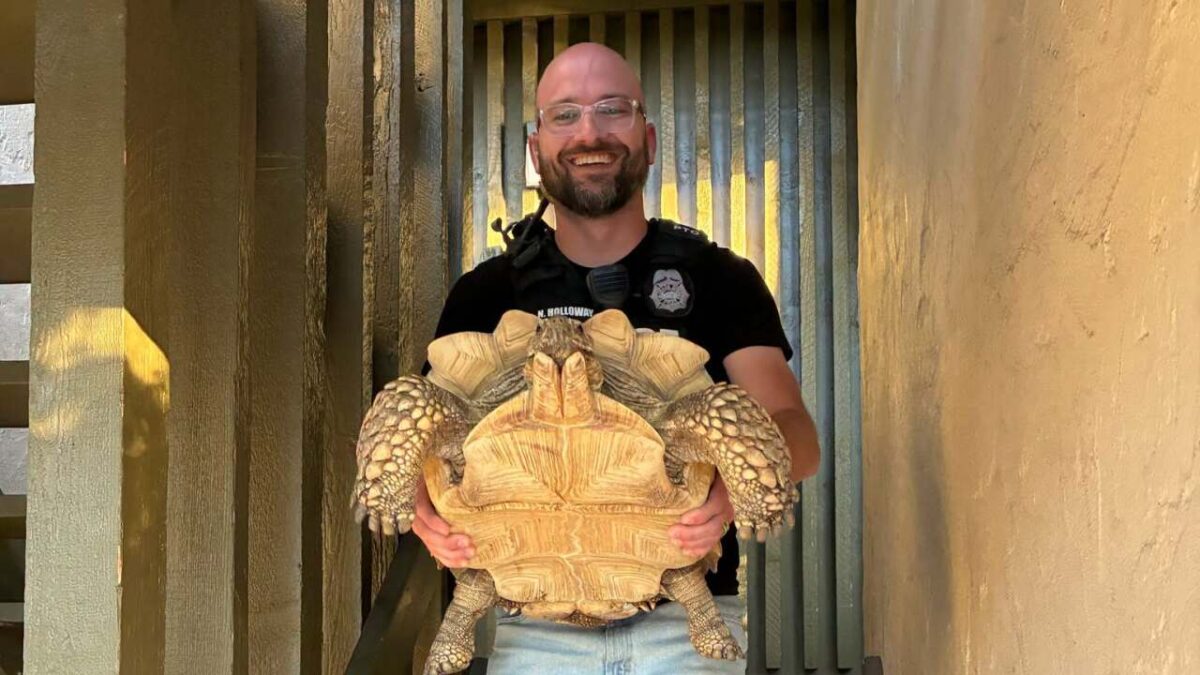
Beloved tortoise reportedly stolen from shop now home safe

By Tony Keith

Click here for updates on this story

    COLORADO SPRINGS, Colorado (KOAA) — A Colorado Springs business says their longtime resident tortoise that was allegedly stolen Wednesday night is now home safe, according to the Colorado Springs Police Department.

A Colorado Springs business was asking for the public’s help after its longtime resident tortoise was allegedly stolen Wednesday night.

According to a social media post from Scales ‘N Tales, a person took a tortoise named Howard from an outdoor enclosure in front of the store around 6:40 p.m. on June 17. The store is located at on North Academy Boulevard just south of Woodmen Road.

The business said Howard, a fixture at the store since 2011, is well known to customers who frequently interact with him during their visits. Howard is regularly placed in an outdoor pen in front of the store to receive sunlight and fresh air.

Store owners said the suspect removed Howard from the enclosure and placed him into a vehicle before driving away.

Colorado Springs Police shared more information on their social media channels. According to the department, Justin Edwards, 37, was quickly found and arrested on Thursday.

When officers took Edwards into custody at a local hotel, Howard was not there. Following more interviews, they were able to locate Howard and bring him home safely.

This case is a great example of what can happen when the community partners with law enforcement. Information shared by the pet store, witnesses, and members of the public through social media helped detectives develop the leads needed to bring Howard home safely,” said CSPD in its social media updates, “Thank you to everyone who shared information and assisted in the investigation. Your partnership makes a difference. “

“Many of our customers know Howard and love interacting with Howard on their visits to the store,” the business wrote in its original post at the time of the alleged theft. “We are asking the community of Colorado Springs and the entire reptile community to help reunite us with Howard.”

Please note: This story was provided to CNN Wire by an affiliate and does not contain original CNN reporting. This content carries a strict local market embargo. If you share the same market as the contributor of this article, you may not use it on any platform.

Skateboarder completes 3,000-mile journey across America, sets sights on Guinness record

By Todd Wilson

Click here for updates on this story

    VENICE BEACH, California (WPTV) — Chad Caruso skateboarded more than 3,000 miles across America, pushing off from Venice Beach, California, on May 1 and rolling into Jacksonville, Florida, on June 8.

The journey took him through Joshua Tree, across Arizona, deep into the heart of Texas, and along Florida’s Panhandle — averaging 72 miles a day, skating up to 16 hours with no days off.

“I’d basically wake up and try to skate by 4:30 in the morning and finish by like seven at night. So, I would do 12 to 16 hours a day with no days off. … I think I averaged about 72 miles a day,” Caruso said.

The trip nearly never happened. Caruso tore his meniscus before the journey, underwent surgery and recovery, and then re-tore it just 2 months before his planned departure.

“Right before the trip, I tore my meniscus and had a cyst. Got surgery, did all the recovery, I was ready to do this trip, and then two months before the trip I re-tore it,” Caruso said.

The idea for the cross-country skate originated from an earlier, unrealized plan.

“It actually started with an idea of doing it across Italy, which is much thinner, and I ended up not doing it. And then the idea stuck in my head and I started researching. I saw no one had really done it for the Guinness record, and that’s what hooked me initially,” Caruso said.

Along the way, strangers offered food, water, and cash donations.

“People would just hand me water bottles, food, money, donations, a lot of the time they would hand it to me there. I mean in the hundreds,” Caruso said.

The trip also had at least one frightening moment.

“I was pushing into the dark, and out of nowhere, a dog gets spooked and runs across the highway, and like three feet in front of me. And just making eye contact with it, you know, I think I’m done for the day,” Caruso said.

Caruso described the mental challenge of the journey as relentless.

“So, the whole thing was just this constant facing of the hardest day of my life and barging into the unknown,” Caruso said.

He said the experience changed how he sees the country and the people in it.

“America taught me that everyone has a huge heart and wants to be nice and there for each other. If you come to a situation with a positive attitude or a smile, that’s most likely what you’ll get back,” Caruso said.

Caruso funded the entire adventure on his credit card.

Please note: This story was provided to CNN Wire by an affiliate and does not contain original CNN reporting. This content carries a strict local market embargo. If you share the same market as the contributor of this article, you may not use it on any platform.

Teen sentenced for causing train derailment so he could record it, post video online

By Lori Pilger

Click here for updates on this story

    Nebraska (Lincoln Journal Star) — A young Bennet man who intentionally caused a costly train derailment as a 17-year-old in hopes of posting a viral video has been sentenced to five years of probation.

Zachary Hertzler, who pleaded no contest to felony criminal mischief for the incident April 22, 2024, declined an opportunity to say anything first.

His attorney, Jon Braaten, argued briefly for probation based on Hertzler being assessed as a low risk to reoffend.

On the other side, Chief Deputy Lancaster County Attorney Christopher Reid called what happened serious.

“This was an intentional act and took sophisticated knowledge of how the rail systems work,” the prosecutor said.

He said Hertzler had tampered with a padlocked train switch that day, causing the train to veer onto a sideline next to the grain elevator and strike an empty coal car before coming to a rest just west of the crossing.

Had the engineer not noticed the train switch in the wrong position and not gone into an emergency stop, Reid said, the derailment of a fully loaded eastbound BNSF coal train at a railroad crossing in Bennet at Monroe Street and Nebraska 43 could have resulted in serious injury or death to employees that night.

He said Hertzler apparently had done it in an attempt to gain notoriety on YouTube.

The teen, a railroad fan who spoke to investigators at the scene, posted a video of the derailment, which he’d taken on his cellphone, and got more than 300,000 views.

“The real question for the state is what is an appropriate outcome for this case that adequately punishes Mr. Hertzler for his actions and deters him from ever engaging in this conduct again?” Reid said.

Given the teen’s lack of criminal history, he said he could not say Hertzler wasn’t an appropriate candidate for probation. He is now a convicted felon, and his actions likely impacted his goal of working for the railroad one day.

“The state does hope that is enough of a wake-up call for him to not do this sort of act again,” Reid said.

Lancaster County District Judge Andrew Jacobsen said he didn’t know if Hertzler ever expressly admitted this was an intentional act.

“You wanted video of a train derailment, so you set up to make the video, and you got what you wanted,” the judge said. “Unfortunately, it was at the expense of others.”

Jacobsen said the incident caused upward of $250,000 in damage to the rail line, owned by Omaha Public Power District, and to two BNSF locomotives and two rail cars.

He said it also led to an extensive investigation by the railroad and law enforcement and significant use of manpower and hours.

But, Jacobsen said, Hertzler is now a convicted felon, which carries some consequences of its own. And he sentenced him to five years of probation, plus 90 days of jail, the first 30 of which start Monday and can be on house arrest. The remaining 60 days would be in 15-day increments once a year in June unless waived by his probation officer.

Hertzler, 19, had faced up to two years in prison.

Please note: This story was provided to CNN Wire by an affiliate and does not contain original CNN reporting. This content carries a strict local market embargo. If you share the same market as the contributor of this article, you may not use it on any platform.

‘How are you holding us accountable?’ Marine vet’s family in back-and-forth with VA over $81,000

By Hannah McDonald

Click here for updates on this story

    NASHVILLE, Tennessee (WTVF) — “It’s just hard. It’s very hard,” said Joannta Burnley.

Joannta’s husband, Marine veteran Maurice “Reese” Burnley, communicates by blinking.

“He’s saying yes when he blinks. That’s how he talks,” Burnley said.

Burnley served in the Marine Corps. A leg injury led to an infection and ultimately an amputation. Then in January 2022, he suffered a massive stroke that left him unable to move on his own or speak.

He is currently receiving hospice care. His VA disability benefits cover most of that cost.

Recently, the VA began withholding about $1,000 a month from his benefits to recover an overpayment. Joannta says the VA told them it overpaid him more than $81,000 in a lump-sum disability award. Those deductions have forced her to let go of a caregiver.

“It’s leaving me where I don’t have a lady that was coming three times a week at night,” Burnley said.

A VA press secretary said the overpayment appears to center around attorney payments. Before his stroke, Reese hired an attorney to fight the VA on a separate disability issue. He won that case, but the VA said it mistakenly paid money intended for their attorney directly to the Burnleys.

When I brought that explanation to Joannta, she pointed to a June 2025 email from the attorney indicating the attorney had already been paid.

After more than a year of trying to get clarification, and with deductions from her husband’s monthly benefits beginning this spring, Joannta reached out to NewsChannel 5 for help.

Please note: This story was provided to CNN Wire by an affiliate and does not contain original CNN reporting. This content carries a strict local market embargo. If you share the same market as the contributor of this article, you may not use it on any platform.

Rare little brown bat gives Nebraska researchers, conservationists big hope

By Zachary Hammack

Click here for updates on this story

    Nebraska (Lincoln Journal Star) — A little brown bat captured in eastern Nebraska is one big discovery for researchers.

Last month, Nebraska Game and Parks biologists and University of Nebraska researchers confirmed the first sighting of a live little brown bat in eastern Nebraska since 2016.

On May 24, the rare cave-dwelling bat was captured in a mist net over Decker Creek at Platte River State Park in Cass County during a spring migration survey. Researchers believe the bat likely lives locally and did not migrate from another state.

The little brown bat, one of 13 known bat species in the state, is considered a Tier I species, a designation for the state’s most at-risk creatures that are vulnerable to extinction.

Brett Andersen, wildlife diversity program manager for Nebraska Game and Parks, said the little brown bat has always been rare in eastern Nebraska.

“In the Panhandle, we would catch 50 to 100 a night in some places, but in eastern Nebraska, I think I had only ever caught one since I started netting in 2014,” Anderson said in a Monday news release.

But cave bats have become increasingly difficult to find in Nebraska following the emergence of white-nose syndrome, a fungal disease that affects hibernating bats.

The disease, which has decimated bat populations across the eastern U.S., was first spotted in Nebraska in 2017 when a team of biologists discovered several dead bats during a survey of an inactive limestone mine in Cass County.

The disease doesn’t pose a threat to humans, pets or livestock, but is highly fatal in bats. Researchers believe “cave bats have all but disappeared in eastern Nebraska,” the release said.

Unlike its more common relative, the big brown bat, which lives in houses, barns and attics, little brown bats are more selective, according to Game and Parks. In the winter, they hibernate in hard-to-find caves and mines.

Andersen said the chances of catching the bats in mist nets — which are commonly used to capture small birds and other creatures for tagging purposes — are low. But researchers will continue to conduct cave and mine surveys.

Other efforts to track the bats include the Motus migration project, a global initiative that uses signals to track the movement of small flying animals.

The network has not detected the bat researchers tagged. Andersen said that’s likely because the bat has already moved out of the area and is roosting somewhere the signal can’t reach.

“Unfortunately, because we only know of a few mines in eastern Nebraska, it is difficult to determine whether there are any more (bats) left,” Andersen said.

Please note: This story was provided to CNN Wire by an affiliate and does not contain original CNN reporting. This content carries a strict local market embargo. If you share the same market as the contributor of this article, you may not use it on any platform.

90-year-old living with multiple sclerosis competes in Tennessee Senior Olympics

By Forrest Sanders

Click here for updates on this story

    FAIRVIEW, Tennessee (WTVF) — It was a foggy morning on the Fairview High track that brought out a whole bunch of driven people. It was the Tennessee Senior Olympics.

The crew competing in one event just leapt out to me. There was newer athlete Sara Dutton.

“I was 71 when I did my first marathon!” she said.

There was in-it-to-win-it competitor Terry Coulter.

“What do I think about that?” Coulter laughed. “Well, yeah!”

Annette Fenech was motivated by her runner granddaughter.

“Is grandma a fast runner?” I asked Fenech’s granddaughter.

“Oh yeah! Lightning McQueen fast!”

Then, there was competitor Eleanor Pendergraft.

“I’m the only 90-year-old woman out here!” she laughed.

They were all the one-mile power walkers.

“You have to keep one foot on the ground at all times,” Coulter explained.

“You move your arms and your hips!” Dutton added.

What was striking about this group was the stories they shared.

Fenech has lived through back surgery. Coulter’s lived through knee surgery.

“That’s when I began a journey of strength training,” Coulter said. “I got into weight lifting, which led me into body building, body building competitions.”

Then, there’s Pendergraft’s story.

Pendergraft wasn’t always sure she she could do something like this. For a while, she was spending a lot of time in her apartment.

“I started falling and dropping things,” she remembered. “They finally determined I had MS. I gradually got worse and worse.”

It was getting hard for Pendergraft to move. She was told she couldn’t drive. Pendergraft joined a gym and got stronger.

“When a friend suggested I enter the Senior Olympics, I laughed at her,” Pendergraft remembered. “I said, ‘you’ve gotta be kidding. I haven’t been athletic my entire life!’ It was the best thing I’d ever done.”

“Ladies and gentlemen, we are ready to start our competition!” a voice announced.

“Building new friendships, I’m a richer person for it,” Coulter said.

“Yeah, you get to meet people, hear their stories,” said Fenech.

“I can do it, so I do it!” Dutton laughed.

“It’s the friendships with all of these people, that’s the main thing,” said Pendergraft.

The power walking competition began. The group took off with Coulter in the lead. What’d I tell you? Coulter was in-it-to-win-it.

“I’ve trained so hard,” she said. “I’m telling myself, ‘Terry, you’ve worked hard. Just go do what you’ve been doing!'”

Pendergraft continued a strong stride around the track.

“When my doctor said my MS was getting worse, wasn’t getting better, it hit that stubborn streak,” Pendergraft said. “I determined he was wrong.”

Medals went out to all different age divisions with gold medalists for the one-mile power walk including Coulter, Dutton, and Pendergraft.

“Never done one before!” Dutton said of the power walking competition. “Shows what you can do. God is good.”

“That’s so exciting you can get older and still get better,” Coulter added. “What a great thing.”

“I don’t know what I’ll be able to do when I’m 100, but we’ll see!” Pendergraft said.

Please note: This story was provided to CNN Wire by an affiliate and does not contain original CNN reporting. This content carries a strict local market embargo. If you share the same market as the contributor of this article, you may not use it on any platform.

Canadian man gets 3 years in prison for $1.2 million in fraud of US victims, some from Wisconsin

By Jeff Richgels

Click here for updates on this story

    Wisconsin (madison.com/Wisconsin State Journal) — A Canadian man has been sentenced to 3 years in prison for defrauding U.S. victims, some from Wisconsin, out of more than $1.2 million, authorities reported.

Michel Poirier, 60, of Montreal, was sentenced on June 10 by U.S. District Judge William M. Conley for mail fraud, a charge he pleaded guilty to on March 20, following his extradition from Canada, U.S. Attorney Chadwick M. Elgersma said in a statement.

Between 2011 and May 2016, Poirier orchestrated a mass marketing fraud scheme from Canada that targeted printing companies and consumers in the U.S.

Using aliases, Poirier contacted printing companies in the U.S., representing that he was working for direct mail companies looking for U.S. suppliers to handle mass mailings of brochures. After the companies spent money printing and mailing the brochures, they received checks from Poirier that drew on either closed accounts or accounts with insufficient funds. When the companies sought alternative forms of payment, Poirier stopped answering emails and telephone calls.

The brochures promoted weight loss products sold by Poirier and they contained numerous false statements and material omissions, including testimonials from fictitious clients, statements of product authenticity from fictitious doctors, and a fictitious money back guarantee.

Consumers who received the brochures and purchased weight loss products were defrauded out of their money.

The charge against Poirier was the result of an investigation conducted by the U.S. Postal Inspection Service and IRS Criminal Investigation, with assistance from the U.S. Department of Justice Office of International Affairs. Assistant U.S. Attorney David J. Reinhard was the prosecutor.

Please note: This story was provided to CNN Wire by an affiliate and does not contain original CNN reporting. This content carries a strict local market embargo. If you share the same market as the contributor of this article, you may not use it on any platform.