Rare little brown bat gives Nebraska researchers, conservationists big hope

By Zachary Hammack
Click here for updates on this story
Nebraska (Lincoln Journal Star) — A little brown bat captured in eastern Nebraska is one big discovery for researchers.
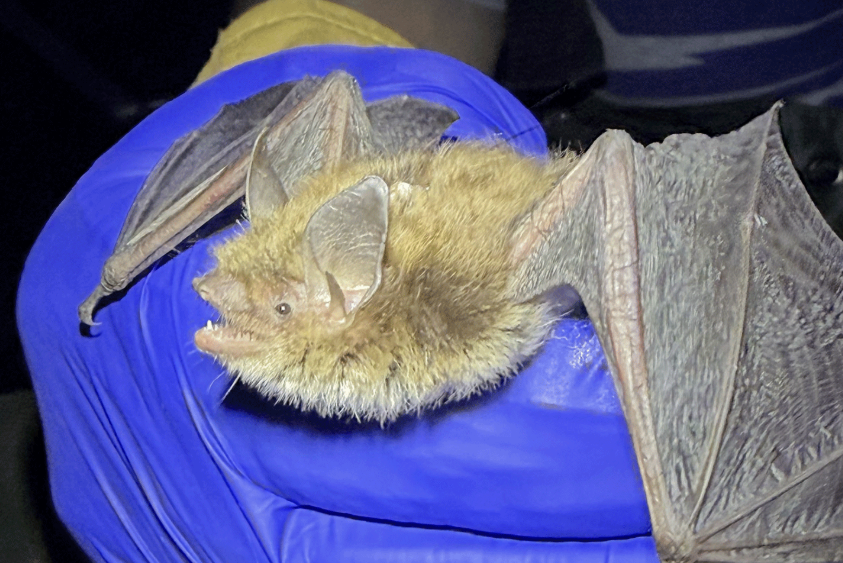
Last month, Nebraska Game and Parks biologists and University of Nebraska researchers confirmed the first sighting of a live little brown bat in eastern Nebraska since 2016.
On May 24, the rare cave-dwelling bat was captured in a mist net over Decker Creek at Platte River State Park in Cass County during a spring migration survey. Researchers believe the bat likely lives locally and did not migrate from another state.
The little brown bat, one of 13 known bat species in the state, is considered a Tier I species, a designation for the state’s most at-risk creatures that are vulnerable to extinction.
Brett Andersen, wildlife diversity program manager for Nebraska Game and Parks, said the little brown bat has always been rare in eastern Nebraska.
“In the Panhandle, we would catch 50 to 100 a night in some places, but in eastern Nebraska, I think I had only ever caught one since I started netting in 2014,” Anderson said in a Monday news release.
But cave bats have become increasingly difficult to find in Nebraska following the emergence of white-nose syndrome, a fungal disease that affects hibernating bats.
The disease, which has decimated bat populations across the eastern U.S., was first spotted in Nebraska in 2017 when a team of biologists discovered several dead bats during a survey of an inactive limestone mine in Cass County.
The disease doesn’t pose a threat to humans, pets or livestock, but is highly fatal in bats. Researchers believe “cave bats have all but disappeared in eastern Nebraska,” the release said.
Unlike its more common relative, the big brown bat, which lives in houses, barns and attics, little brown bats are more selective, according to Game and Parks. In the winter, they hibernate in hard-to-find caves and mines.
Andersen said the chances of catching the bats in mist nets — which are commonly used to capture small birds and other creatures for tagging purposes — are low. But researchers will continue to conduct cave and mine surveys.
Other efforts to track the bats include the Motus migration project, a global initiative that uses signals to track the movement of small flying animals.
The network has not detected the bat researchers tagged. Andersen said that’s likely because the bat has already moved out of the area and is roosting somewhere the signal can’t reach.
“Unfortunately, because we only know of a few mines in eastern Nebraska, it is difficult to determine whether there are any more (bats) left,” Andersen said.
Please note: This story was provided to CNN Wire by an affiliate and does not contain original CNN reporting. This content carries a strict local market embargo. If you share the same market as the contributor of this article, you may not use it on any platform.