Mid-Missouri law enforcement responses differ to Flock records requests

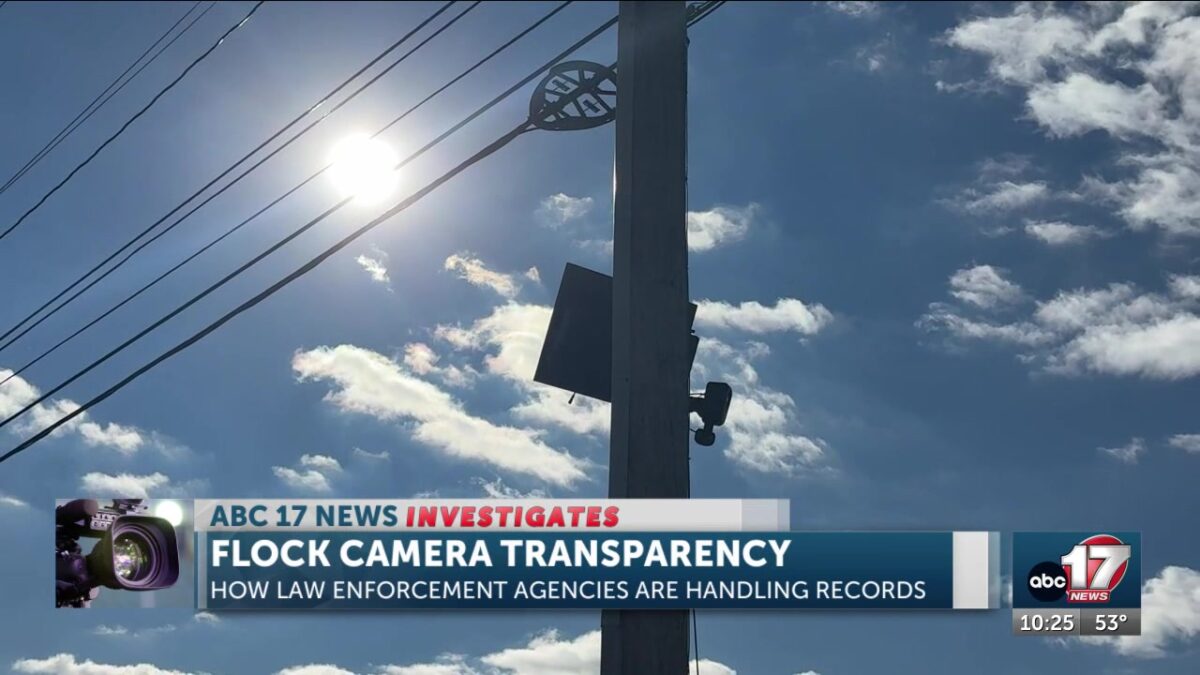
COLUMBIA, Mo. (KMIZ)
The Columbia and Fulton police departments say they will not release data collected through the agencies’ Flock surveillance cameras.
This raises questions about transparency, access, privacy and accountability in the public’s ability to know how a police department is using the taxpayer-funded cameras.
ABC 17 News requested Flock data from Sept. 26 to Oct. 26 of this year from the Fulton Police Department, Columbia Police Department and Jefferson City Police Department through Missouri Sunshine Law requests.
The law guarantees public access to meetings, records, votes, deliberations and business emails of public governmental bodies.
The City of Columbia responded by saying it can’t legally provide Flock records.
“The City is authorized to acquire and use Flock data for law enforcement investigative purposes only,” the response states. “The City is not authorized to acquire and access this data for non-law enforcement purposes. The City may not utilize its investigatory tools to run an inquiry into the Flock system for non-law enforcement or private use.”
The city also cited Gov. Mike Kehoe’s executive order issued on Sept. 16. 2026. The order states all automated license plate reader system data must remain the sole and exclusive property of the law enforcement agency.
The executive order also has a 30-day deletion rule for captured license plate and vehicle imagery, along with requirements for logging searches that include user identity and an active case number or specific law enforcement justification, and penalties for unauthorized use and sharing.
During a public hearing on Flock cameras held by the Columbia City Council on Nov. 9, ABC 17 News approached Columbia Police Chief Jill Schlude to ask why the department would not release the requested records. Schlude declined an on-camera interview.
However, while responding to questions from City Council members during the hearing, Schlude addressed concerns about making Flock data available to the public.
“You have to have some level of trust in the police chief and the command staff that we’re running the police department appropriately. I know that doesn’t resonate with some folks,” Schlude said.
“I understand that perspective, but the reality is personnel records are not things that are open, and now the executive order is closed. The Flock information, so you have to take my word for it, and I know some people don’t like that,” she said.
CPD has 114 Flock cameras spread across the city and a transparency portal regarding the data, but the portal does not share the name of the officer making the search or the search type. However, it does include the day and time when a search was made and the offense type.
There have been concerns about officers potentially misusing the Flock system for their personal benefit.
This year in Greene County, Missouri, former Lt. Jennifer Flood was charged with four counts of misuse of official information by a public servant.
According to KY3 in Springfield, Greene County deputies found 200 inquiries associated with Flood’s account involving the same license plate number occurring between July 1 and Oct. 16, 2025.
During the Columbia City Council public hearing, Schlude discussed how the department monitors employee use of the system and what measures are in place to prevent misuse.
“One of the reasons I think we have been successful … is we have been very explicit with our employees from the very beginning about what the penalties are,” Schlude said. “So they’ve known from day one the system’s being audited.”
Before the council’s Nov. 9 public hearing, ABC 17 News reached out to Columbia Police three times by email requesting an on-camera interview. The department did not respond to those requests.
The Fulton Police Department also denied a request for Flock data from Sept. 26 to Oct. 26. The department cited its contract with Flock, which does not allow FPD to share data.
Fulton has 13 Flock cameras.
Police Records Clerk Angela Woodruff wrote in an email to ABC 17 News that sharing is only allowed with other law enforcement agencies who use Flock and are granted access.
Flock Safety spokesperson Trevor Chandler said every city and every state has different laws regarding sharing public information.
Woodruff said the Fulton Police Department is implementing a transparency portal within Flock. She added that information will be statistical data regarding captures from Flock.
“At no time does the Fulton Police Department share personal data such as plate information and those persons associated to that place,” Woodruff wrote in an email.
ABC 17 News submitted the same request to the Jefferson City Police Department through its records portal. There are 21 Flock cameras in Jefferson City.
The department’s Flock records provided the names of the officer who made the search, when the search was made, the reason for the search and the search type.
The records show there were searches related to hit-and-run crashes, a wanted person, weapons offenses, assault and larceny.
In addition to providing the requested Flock camera data, the Jefferson City Police Department also provided records identifying state and out-of-state law enforcement agencies that access or use JCPD’s Flock camera network.
Those agencies include departments in Tennessee, Georgia and Ohio, as well as the FBI and other states.
Columbia and Fulton police did not provide records identifying what agencies have access to their Flock data.
DeFlock is a crowd-sourced map that shows the location of Flock cameras.
Mid-Missouri Civil Liberties Association President Dan Viets said the Missouri Sunshine Law strictly states that government records are accessible to the public.
“The default position should always be that information in the possession of our government is public information. It belongs to the public; it’s our tax money that purchased that technology. The information gathered about all of us certainly should be available to use through the news media,” Viets said.
Viets says there are exemptions to the law, like investigative purposes, but that cannot be an agency’s sole reason to deny a records request.
“There are laws that grant certain exemptions from the open records law for law enforcement activity. One of those is information that relates to an ongoing investigation, but if they’re going to argue that all Flock data relates to an ongoing investigation, I don’t believe the courts are going to accept that,” Viets said.
Freedom Center of Missouri Senior Legal Adviser Dave Rolland said investigative purposes are not enough to deny a request.
“They are allowed to keep closed investigative records. No. 1, there has to be an actual investigation taking place, and that would almost certainly be tied to an incident,” Rolland said. “So you can’t have an investigation unless there’s first an incident, but then investigations have a start and an endpoint.”
Rolland said investigative records become open when the investigation becomes inactive. He said police departments using the investigative reasoning would need to go on a case-by-case basis and say whether an investigation is open or closed.
Flock has contracts with over 5,000 law enforcement agencies across the country, with cameras in more than 6,000 communities, according to its website.
Rolland says a law enforcement agency cannot use private contracts to avoid duties under Missouri’s Sunshine Law. He points to a provision in Missouri’s open records law that addresses information held by third parties on behalf of government agencies.
“As far as the sunshine law is concerned, there’s a provision that says the government is not allowed to contract its way out of transparency,” Rolland said. “It specifies that although the government can enter into certain contracts where third parties hold certain information on behalf of the government, they cannot set that up in such a way that the information is not accessible to the public.”
However, Rolland said applying the Sunshine Law to Flock records may be more complicated because the law does not specifically address surveillance recordings collected and stored by private companies on behalf of government agencies.
“It does complicate the questions because they don’t look precisely like the kind of government recordings that were used to write, even though the government has access to these, if they’re being stored by a third party, it at least gives them basis for arguing,” he said.
The law was created before the invention of license plate readers and hasn’t caught up.
With surveillance technology advancing year after year, Rolland says stronger restrictions are needed to address the growing use of surveillance cameras on government property.
Click here to follow the original article.