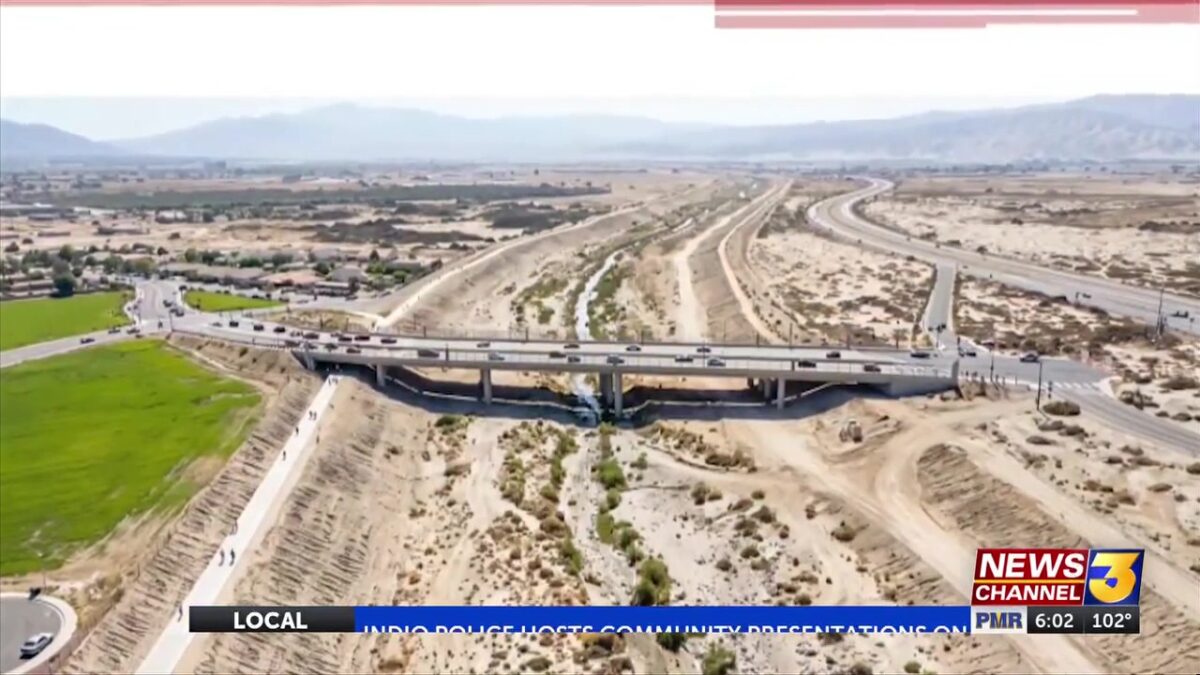
Lane, sidewalk on Cherry Street to close Thursday

Ryan Shiner

COLUMBIA, Mo. (KMIZ)

A portion of the westbound lane of Cherry Street in downtown Columbia will be closed on Thursday, the city announced in a Wednesday press release.

The street and north sidewalk between Eight and Ninth streets will close at 7 a.m. as a crane will be used to “to lift a rooftop air conditioning unit onto 29 S. Ninth St.,” the release says.

Work is expected to be completed by 1 p.m.

Detour and no-parking signs will be posted.

Click here to follow the original article.

One dead, one injured in Imperial Avenue crash

Dillon Fuhrman

EL CENTRO, Calif. (KYMA) – The El Centro Police Department (ECPD) is investigating a crash which left one person dead and one person injured.

ECPD said the crash happened in the area of N. Imperial Avenue, near Central Drain, at around 1:30 a.m. Wednesday.

Upon arrival, ECPD said officers found a man on the “dirt shoulder along the southbound lanes of Imperial Avenue suffering from severe injuries,” and said they found another man who was also seriously injured “inside a nearby canal drain.”

Paramedics responded to the area and provided treatment to both men, ECPD said.

While one of the men, a 20-year-old Imperial resident, died at the scene, ECPD said the other man was taken, via air ambulance, to the hospital for further treatment.

During the investigation, ECPD said a black Dodge and a white Toyota were driving northbound on Imperial Avenue when the vehicles crashed.

As a result of the crash, ECPD said the Dodge overturned, causing its occupants to be ejected from the vehicle, and said, “The occupants in the Toyota were not injured.”

The cause of the crash remains under investigation. If anyone has information regarding the crash, call 760-352-2111, visit ECPD headquarters in-person, or contact ECPD through their social media platforms.

Press Release – Traffic Collision 9-23-2026Download

Click here to follow the original article.

Man accused of injuring Palm Springs partygoers due in court next week

City News Service

INDIO (CNS) – A 35-year-old man accused of hurling glass bottles during a melee at a Palm Springs pool party, injuring four women and two men, is slated to be arraigned next week.

Milad Thamer Youssef of El Cajon was arrested last month following a Palm Springs Police Department investigation.

Youssef is charged with six counts of assault with a deadly weapon, with sentence-enhancing great bodily injury allegations.

The defendant, who is being held in lieu of $60,000 bail at the Benoit Detention Center, is due for arraignment Tuesday at the Larson Justice Center in Indio.

According to police, at 1:30 a.m. Aug. 9, a fight erupted during the Splash House music celebration at the Palm Springs Air Museum on Gene Autry Trail.

Youssef was in the thick of it, and during the altercation, he allegedly retrieved glass bottles at poolside and hurled them at attendees, police said.

It was unclear whether he was aiming at anyone in particular. Court papers identified the victims only by their initials, with the four women listed as “A.C.,” “I.A.,” “N.G.” and “S.P.,” while the two male victims were identified as “A.P.” and “D.G.”

Officers assigned to work security at the venue were immediately summoned, but by the time they reached the scene the defendant had allegedly fled, according to the police department.

The victims were either treated on-site by paramedics, or taken to nearby Desert Regional Medical Center for evaluation and treatment. Their injuries were generally described as minor and all stemming from contact with broken glass.

Youssef turned himself in to investigators five days later and was booked into jail. Prosecutors filed a criminal complaint against him last week.

He has no documented prior felony convictions in Riverside County.

Click here to follow the original article.

Better Business Bureau: Are you smarter than a scammer?

Jalen Fong

YUMA, Ariz. (KYMA) – Do you know someone who lost money to a scam and thought that would never happen to you? Maybe, maybe not.

Test your knowledge by taking the “Are you smarter than a Scammer” BBB Quiz.

1. You get an email or a text that you were charged for something you did not order. You’re asked to call if it’s a mistake. What do you do?

A. Call the number as soon as possible.

B. Log into your bank or credit account and check for bogus charges.

C. Google the customer service number for your bank and call to explain.

2. You buy something from a door to door salesperson. Later that day, change your mind. What are your rights?

A  You signed a contract, second thoughts don’t matter.

B  You have three business days to cancel.

C Prove there’s a problem and you can get a refund.

So are you smarter than a scammer?

Question 1. You get a text about being charged for something you didn’t order. The best answer is B. Log into your account and contact customer service is the safest way. Doing an online search can also work. But we have seen too many fake and sound-a-like websites with fake customer service.

Question 2. You buy something from a salesperson in your home and change your mind. The best answer is B. The Federal Trade Commission (FTC) allows a three business day cooling off period for sales made at your home or several other areas. 

Let the business know by certified letter so you have proof of the date and time sent.

If someone is at your door selling something, ask them to leave information and then research the business at bbb.org and with a general online search for complaints. It’s the best way to prevent a hasty and costly bad decision.

Better Business Bureau offers more advice on how to spot scams: https://www.bbb.org/all/spot-a-scam.

For more information

Before trusting any business, check out reviews, complaints and for trusted Accredited Businesses at BBB.org and visit BBB’s Scam Tracker.

Check out BBB scam warnings at joeknowsbetter.com.

If you have compromised your personal information, you can report the incident to law enforcement and the FTC.

For additional romance scam resources, visit BBB.org/romance. Read the BBB Tip: Spot the red flags of fake text messages.

Read more about similar scams, such about text messages with surprise offers.

Click here to follow the original article.

Columbia police name man detained during standoff

Madison Stuerman

COLUMBIA, Mo. (KMIZ)

Columbia police officers arrested a man after a standoff on Wednesday in the northeast part of the city.

ABC 17 News saw several police officers on the scene with some of them pointing guns at the home on Hidden Creek Court, a cul-de-sac off of Rice Road and Hanover Boulevard.

Columbia Police Department spokesperson Colin Imhoff confirmed officers were serving a search warrant in the area. Another spokesman said officers were looking for a man with assault charges.

CPD spokesman Brian McNeill told ABC 17 News at the scene that the man who was detained was the suspect.

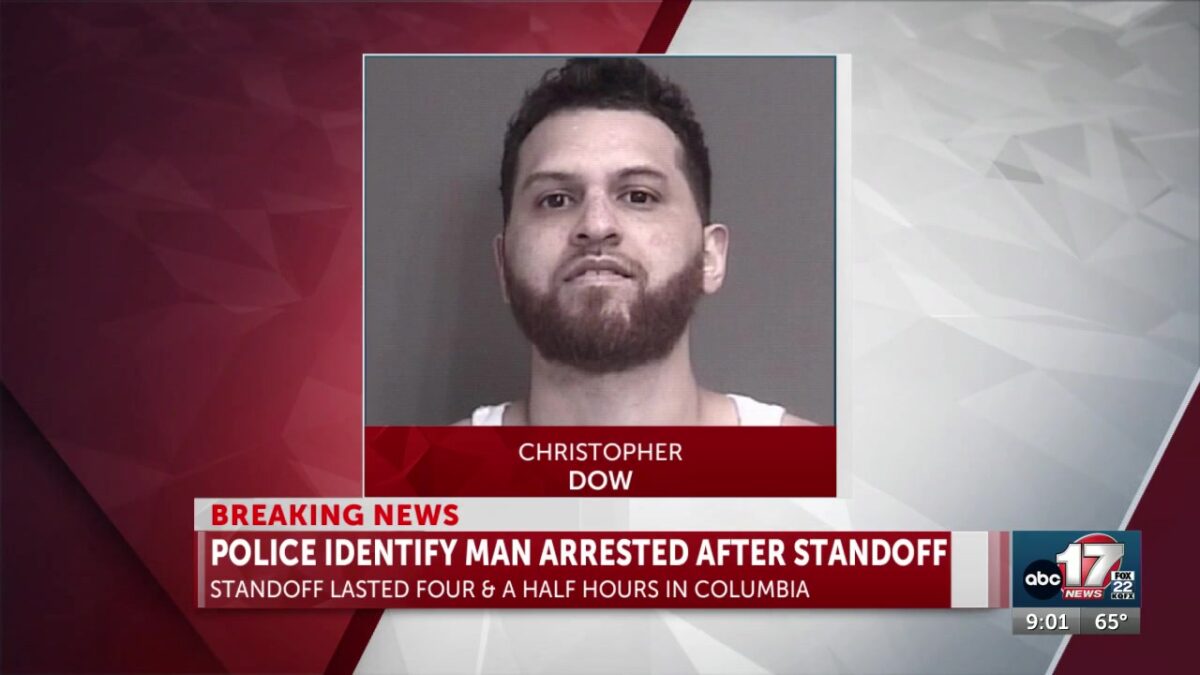
Police later wrote that the suspect’s name is Christopher Dow, 34, of Columbia. He was arrested on suspicion of third-degree domestic assault, resisting arrest and first-degree making a terroristic threat. He is being held at the Boone County Jail. Charges have not yet appeared on Casenet.

CPD wrote that when officers arrived, Dow threatened to “explode the residence.”

Resident Angie Martinez said in the 20 years she has lived in the neighborhood, she has never seen anything like Wednesday’s police response. Martinez added that she saw police visit the street three times from Saturday to Sunday, which she said is not typical.

Officers were heard yelling for a person to come out of the home. A K-9 was brought to the scene shortly after 2 p.m.

The road was blocked off by police.

Police had escorted students off a school bus at some point in the afternoon. Another school bus drove by at 4 p.m. and officers told the driver to drop off students at the next bus stop.

A SWAT team vehicle was brought in front of the home at 3:33 p.m.

Officers drove an armored vehicle forward and multiple dogs appeared after the vehicle pulled back out. Police used a flash bang at 4:51 p.m.

A man was detained by police shortly before 5 p.m. The armored vehicle was still parked in front of the home after the man was detained.

Court filings show that Dow was also charged in May with misdemeanor illegally possessing drug paraphernalia. A hearing in that case was scheduled for Wednesday afternoon.

This is a developing story.

Click here to follow the original article.

Bianco says he’ll obey Supreme Court order on Prop. 50 ballots, county won’t say when they’ll be destroyed as group asks court to preserve them

Garrett Hottle

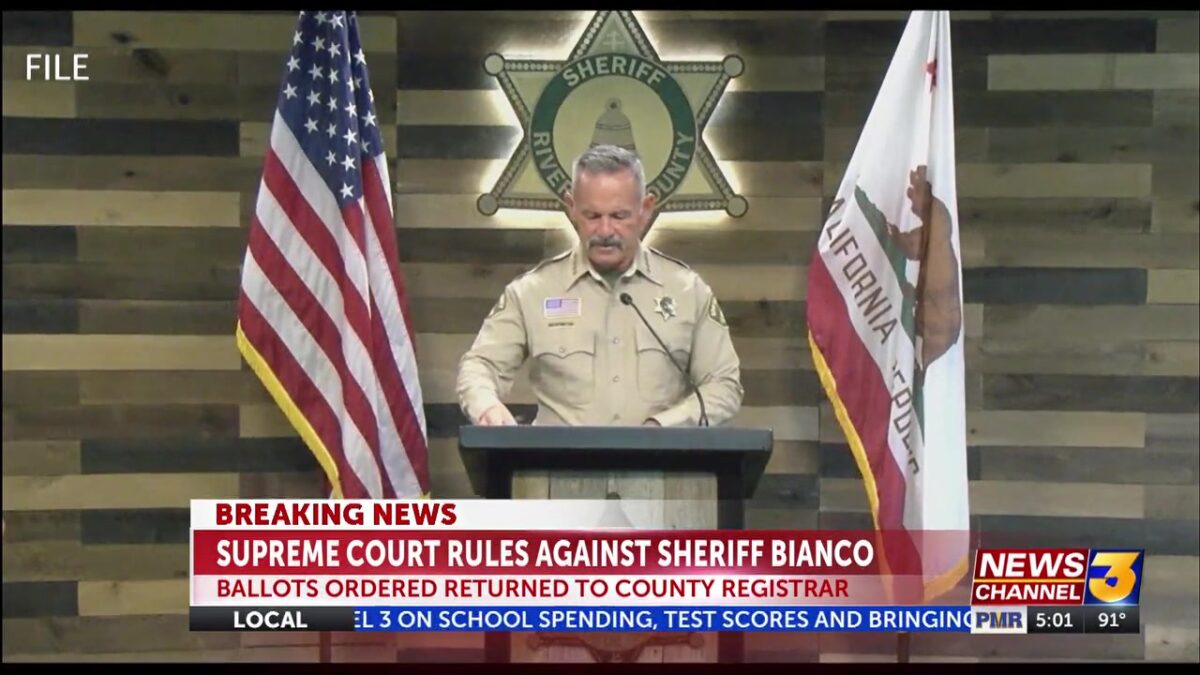
RIVERSIDE, Calif. (KESQ) The California Supreme Court ruled unanimously Thursday that Riverside County Sheriff Chad Bianco broke state election law when he seized the ballots from the November 2025 Proposition 50 special election. The justices ordered him to return them to the Riverside County Registrar of Voters immediately.

A second unanimous ruling, released at the same time, went to Attorney General Rob Bonta. The court said Bonta had every right to order the sheriff to stop, and that Bianco had no choice but to listen.

“Sheriff Bianco broke the law, violated the law, acted illegally,” Bonta told reporters Thursday. “We acted because we had to.”

Bianco now has to halt his investigation while Bonta reviews it, hang onto everything else he seized and turn over his case files to the attorney general.

The sheriff sent this statement Thursday evening:

“We are very disappointed and wholeheartedly disagree with the court’s ruling. The investigation was a lawful and legal investigation into potential election fraud. The facts of this case have never been disputed, this was an obvious legal attempt to prevent the investigation from occurring that was successful. By granting the attorney general the ability to prevent lawful investigations, this ruling will have negative consequences for public safety in California.

Confidence in our elections is essential. This ruling and the destruction of potential evidence without answers undermines the public trust in our systems.

Riverside County residents should be assured that as long as I am their Sheriff, I will continue to fight crime and corruption regardless of where it comes from.”

The county, meanwhile, says the ballots will be returned. County Executive Officer Jeff Van Wagenen released this statement Thursday:

“The California Supreme Court today provided clear direction regarding the custody of the ballots from the November 2025 Special Election. The Registrar of Voters will work with the Sheriff’s Department to ensure the ballots are returned promptly and handled securely in accordance with established election procedures.

California law provides detailed protections governing the custody, handling, and counting of ballots. These safeguards include strict chain-of-custody requirements, oversight, and public transparency. These are fundamental to protecting the integrity of our elections.

The County has confidence in Registrar Art Tinoco and the dedicated professionals in the Registrar of Voters office. They have continued to perform their responsibilities under extraordinarily difficult circumstances while remaining focused on the work ahead.

With today’s rulings providing clarity on the legal issues before the Court, our focus remains where it has been throughout this matter: administering secure, accurate, and transparent lawful elections, and preparing for the November 3 General Election.”

News Channel 3 asked the county Friday whether the ballots are back yet and when they’ll be destroyed. Spokesperson Brooke Federico said there’s no update on the timeline, and that the registrar’s office will not be available for interview as they prepare for the November 3 general election.

How the fight over Riverside County’s ballots started

It began in February, when a citizens group went to the sheriff’s department and said the numbers didn’t add up. The Riverside Election Integrity Team had gone through handwritten ballot intake logs kept by election workers and concluded the county counted 45,896 more ballots than it took in.

Tinoco said the real gap was 103 ballots, and that it came down to human error. The handwritten logs are rough estimates filled out in the field, he said, and the group’s math left out about 6,000 ballots.

Bianco already had a search warrant by the time Tinoco walked the Board of Supervisors through all of that. He’d gotten it the day before, and sheriff’s personnel sat in on the presentation. Two weeks later, when the department went back for a second warrant, it told the judge the registrar “has not given a reason for the discrepancy.”

Deputies hauled about 1,000 boxes of ballots out of the registrar’s office on Feb. 26 and started counting them by hand a week later.

Bonta ordered the sheriff to stop. Bianco got a third warrant without telling him and seized more. In April, the Supreme Court froze everything.

Nobody in the case, Bianco included, disputes that the discrepancy couldn’t have changed the result.

Prop. 50 passed in Riverside County with 56 percent of the vote.

What the court said

State law says voted ballots stay with the county elections official, and the court found no exceptions to that, not for a criminal investigation and not for a search warrant. Bianco “had no authority to seize the ballots,” Chief Justice Patricia Guerrero wrote.

The second ruling settled something bigger. The state constitution has given the attorney general direct supervision over sheriffs since 1934, but in all that time no court had said what that actually means. Now one has. The attorney general can give a sheriff orders, and the sheriff has to follow them.

What happens now

The ballots go back to the registrar. What happens to them after that is the next fight.

State law only required the county to keep the 2025 ballot packages for six months, and that clock ran out in May. The Supreme Court’s April order is the only reason they still exist, and it expires once Thursday’s ruling becomes final.

A Riverside County nonprofit called the Election Accountability Project is trying to keep them around longer.

On Sept. 21, it asked the Supreme Court to block the county from destroying records from the 2025 special election and the November 2024 general election, according to the court’s docket. The group won a temporary restraining order in Riverside County Superior Court in August, but says the judge later sided with the county and the Court of Appeal turned down an emergency appeal.

The group isn’t alleging fraud. It wants the county to reconcile its paper ballot logs with its machine count, and it wants the records kept until that’s done. The Supreme Court hasn’t ruled on the request.

This story will be updated with additional information as it becomes available.

Click here to follow the original article.

Coachella power capacity concerns raise bigger questions about valley growth

Raymond Kalra

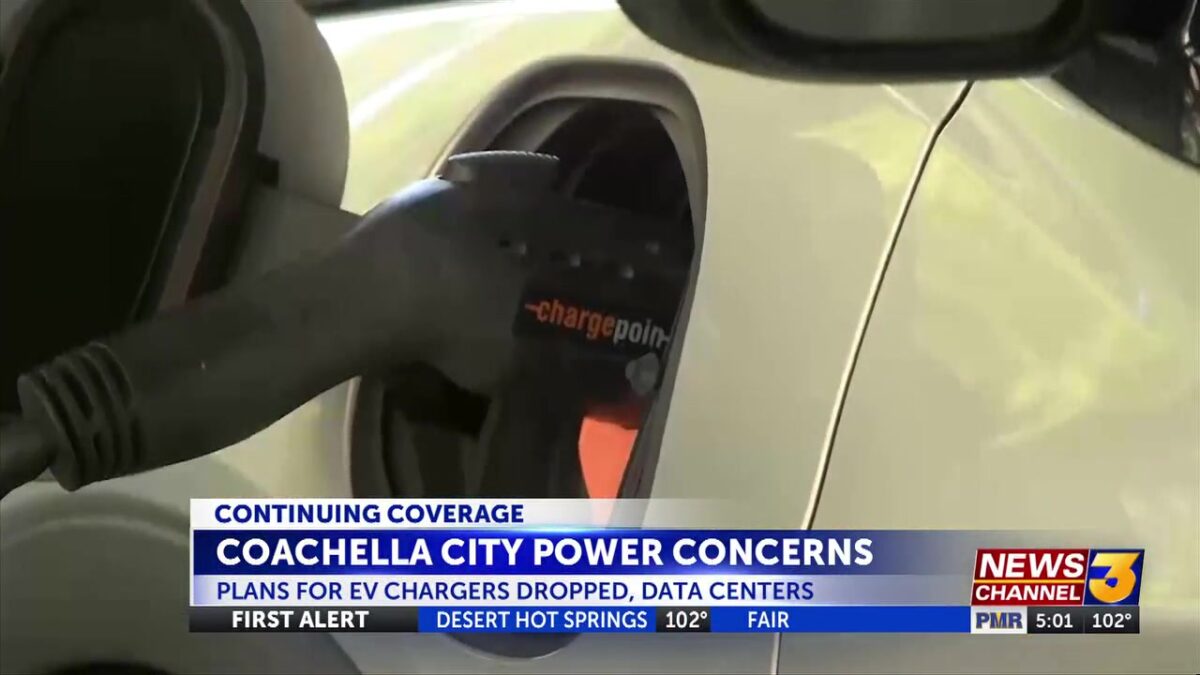
COACHELLA, Calif. (KESQ) – Plans for 30 new electric vehicle chargers at Rancho Las Flores Park are off the table as the City of Coachella scales back a major expansion project, with city leaders pointing to both cost and limited access to power.

But the decision is raising a much bigger question for one of the fastest-growing areas of the Coachella Valley: Does the city have enough power for what it wants to build next?

Coachella Mayor Frank Figueroa told News Channel 3 that the planned chargers were removed from the park project because of a combination of costs and access to electricity.

“I think, you know, that presentation earlier this week, it was a mixture of both costs and I think electricity, electrical access,” Figueroa said. “And I know that we have low capacity.”

The issue comes as Coachella studies where additional public EV chargers will be needed as electric vehicle use grows.

Figueroa said adding those chargers depends on first making sure the electrical system can support them.

“We can’t really proceed with that until we resolve our power access and ensuring that we have those substations and infrastructure there, then we can talk about EV charging,” Figueroa said.

The data center connection

The power issue also adds another layer to Coachella’s recent fight over data centers.

Earlier this year, the city had an agreement with Stronghold Power Systems tied to a proposed technology campus and the development of Coachella’s municipal electric utility.

Under those plans, the proposed data centers were expected to become large initial customers of the municipal utility, while Stronghold would play a role in developing the electrical infrastructure needed to serve the project and support the utility’s buildout.

The city terminated its agreement with Stronghold in June following months of community opposition and later approved a permanent prohibition on data centers.

The data center proposal went away, but Coachella’s need for additional electrical infrastructure did not.

Figueroa said the city’s ability to continue attracting development will depend on addressing that need.

“Economic development and growth in our city is going to be tied to the energy infrastructure, which we’re working on,” Figueroa said. “We’re working to move forward with IID. We have a joint powers authority. We’re moving forward with that.”

In March, IID and Coachella formed the Coachella Electric Financing Authority, a joint powers authority designed to help finance electrical infrastructure improvements as the city grows.

The authority provides a framework for the city and IID to identify needed projects and pursue financing for those improvements.

Could power affect housing growth?

The implications could extend beyond EV charging.

Figueroa told News Channel 3 that a new housing community coming online could, for now, be among the last developments able to move forward based on available power access.

Mayoral candidate Jesus Kino Gonzalez also pointed to the power grid as a major issue facing the city.

“The reality right now in the City of Coachella is that our grid is at maximum capacity,” Gonzalez said. “So even if a development wanted to come into the city, it currently can’t. So I think that that’s a major issue because we need to develop the city to raise our tax base.”

IID’s response to News Channel 3 adds important context to that characterization.

The utility says there is no single threshold determining whether another project can be served. Instead, IID says a project’s impact depends on how much electricity it needs, where it would connect and how much capacity is available nearby.

IID says it studies proposed projects individually before determining whether upgrades are necessary.

Gonzalez told News Channel 3 he believes the city should work with other government agencies to expand electrical infrastructure while avoiding additional costs for residents.

News Channel 3 also reached out to the other candidates for Coachella mayor and had not received responses by the deadline for this story.

How much power could a data center need?

IID’s newly approved Large Load Tariff applies to customers requesting at least 20 megawatts of electricity, although the utility says some proposed projects could require considerably more.

For comparison, IID told News Channel 3 demand from all of its customers combined reached 1,126 megawatts at this year’s summer peak.

IID says that does not mean every large project can automatically be connected to the system.

Even if a data center or other large customer agreed to pay for all of the infrastructure needed to serve its project, IID says payment alone would not determine whether the project could move forward.

The utility would first evaluate the project’s electricity needs, available power supply, capacity on the electrical system and any improvements necessary before deciding whether reliable service could be provided.

Who would pay for the upgrades?

That’s also where IID’s new Large Load Tariff comes in.

IID’s Board approved the tariff on Sept. 15 amid growing interest from projects requiring very large amounts of electricity.

Under the tariff, a qualifying large customer would be responsible for electrical infrastructure needed to serve its project.

Depending on IID’s studies, that could include construction of new facilities or upgrades to the existing electrical system.

The customer would also be responsible for the costs and financial risks of securing the electricity needed for the project.

IID told News Channel 3 the goal is to prevent those project-specific costs from being shifted to its existing customers.

“IID’s new tariff requires large customers to bear the costs and financial risks associated with their projects, rather than shifting those project specific costs to existing customers,” the utility said in a statement to News Channel 3.

California adds new data center rules

IID’s changes come as California is also implementing new rules governing data centers.

Gov. Gavin Newsom signed a package of data-center legislation this week addressing issues including electricity, water use, infrastructure and costs to ratepayers.

IID approved its Large Load Tariff before the new state laws were signed.

The utility told News Channel 3 its tariff already requires qualifying large customers to bear the costs and financial risks associated with serving their projects.

IID says it is now reviewing the new state laws to determine whether they create any additional requirements for the utility.

Are more large projects coming?

IID confirmed to News Channel 3 that it has received inquiries from prospective large-load customers, but the utility would not identify individual projects.

IID emphasized that its role is limited to determining whether it can provide electric service under its Large Load Tariff.

Whether a data center or another development can actually be built at a proposed location is ultimately decided by the city or county with jurisdiction over the project.

For Coachella, that distinction is especially important.

The city has prohibited data centers within its boundaries, but its need for additional electricity and infrastructure remains as leaders plan for more housing, businesses and electric vehicles.

The question now isn’t only how much Coachella wants to grow, but what it will take to power that growth.

Click here to follow the original article.

Socorro ISD completes corrective actions to end state conservatorship

Gabrielle Lopez

EL PASO, Texas (KVIA) — The Texas Education Agency (TEA) announced it’s removing conservators from the Socorro Independent School District. SISD said it finished exit criteria and corrective actions.

In March 2024, TEA and SISD agreed to appoint two conservators after an investigation revealed the district graduated students who didn’t meet requirements, failed to disclose a potential conflict of interest with a vendor and didn’t pay $283,000 in unauthorized stipends.

Michael Hinojosa and Andrew Kim acted as the district’s conservators.

In Wednesday’s announcement, TEA said the district “stabilized district leadership and rectified identified issues.”

The announcement noted the district chose a permanent superintendent, restored a balanced budget, resolved a $42 million deficit, implemented stronger academic compliance and transparency. For example, SISD “strengthened its graduation credit review processes. “

“TEA’s announcement marks the end of conservatorship in Socorro ISD and reflects the significant work completed over the past two years to strengthen governance, improve financial and operational systems, increase transparency, address academic compliance concerns, and support long-term student success,” SISD said in a news release.

Kim shared the following statement on the conservator removal:

“I appreciate our partnership and collaboration with Socorro ISD’s Board of Trustees and staff in addressing longstanding challenges and the district’s commitment to sustained compliance moving forward. Through newly established systems in budgeting, procurement and governance, Socorro ISD will be able to restore public confidence and better support its mission of serving students, families and its community.”

TEA broke down its findings after two years of conservatorship with SISD:

Restoration of a balanced budget and resolution of a $42 million deficit

Stronger budgeting, operational planning and accountability systems. Compensation plan processes corrected to ensure stipends receive proper authorization. Added enhanced controls and monitoring systems for budgeting, procurement, compensation and operational oversight. Established oversight systems to prevent unauthorized expenditures.

Implementation of stronger controls and monitoring systems to address academic compliance concern

Stronger graduation credit review process. Improved attendance monitoring, loss-of-credit procedures, transcript analysis and ADA reporting. Implemented graduation verification procedures and controls to make sure students meet state and local requirements. Established stronger attendance monitoring, transcript accuracy and academic achievement record compliance. Developed systems to address monitoring deficiencies found in previous audits and reaffirmed in the TEA investigation. Corrected deficiencies related to graduation certification, academic records and accountability reporting that led to the conservator appointment.

Improved transparency and community engagement practices that support public trust and accountability

Expanded community engagement with advisory committee, budget process, facility planning, surveys and public updates. Public meeting environments have stabilized and reflect improvement. Click here to follow the original article.

Coachella’s long-awaited Avenue 50 bridge gets $48.7M green light

Matthew Pearce

COACHELLA, Calif. (KESQ) — The Coachella City Council voted to award a $48,709,821.10 construction contract to Riverside Construction Company Inc. to build the Avenue 50 Bridge. The infrastructure project will replace the existing Avenue 50 low-water crossing over the Coachella Valley Stormwater Channel.

Rendering from City Council Meeting on September 21

The bridge project will move forward without requiring any allocations from the city’s general fund, with funding supplied through the Highway Bridge Program, the Coachella Valley Association of Governments, Measure A, Senate Bill 1 funds and local water funds.

Total construction costs, including a 10% contingency of $4,870,982.10, came in approximately $7 million under the city’s original budget estimate.

The new bridge will span the channel to eliminate regular flooding and address deteriorating asphalt conditions at the low-water crossing.

Phase one of the project includes realigning Tyler Street and shifting the CV Link trail beneath the new structure, with a temporary reconnection to the existing signalized intersection at Highway 86. A planned second phase will eventually construct a full interchange at Highway 86 and Avenue 50.

The city first received federal bridge funding authorization for the project in 2014 and completed the environmental review phase in 2019. The subsequent right-of-way acquisition and design phase faced delays due to eminent domain proceedings, coordination with tribal and regional entities and disruptions during the COVID-19 pandemic.

The city issued a notice inviting bids on July 9, held a mandatory job walk on July 28 and opened public bids on Sept. 3. Seven companies submitted bids for the contract. Including $7.9 million in construction management fees, the total project cost stands at $61,551,444.

Primary funding includes approximately $49 million in state bridge funds and nearly $9.5 million from the Coachella Valley Association of Governments.

Local costs are covered by $1.6 million from Measure A and $1.73 million from SB 1 revenue, which city leaders intentionally set aside over multiple years to protect general fund reserves.

During the City Council meeting Monday, Mayor Dr. Frank Figueroa praised municipal staff and regional partners for securing non-general-fund financing to move the project into construction.

“This is a big win for the city of Coachella and we should all be very proud,” Figueroa said. “This is a massive project for the city, Coachella and I can’t wait to do the groundbreaking.”

Groundbreaking for the Avenue 50 Bridge project is scheduled for Oct. 15.

Click here to follow the original article.

Montwood Extension Project breaks ground, aims to cut driving time

Gabrielle Lopez

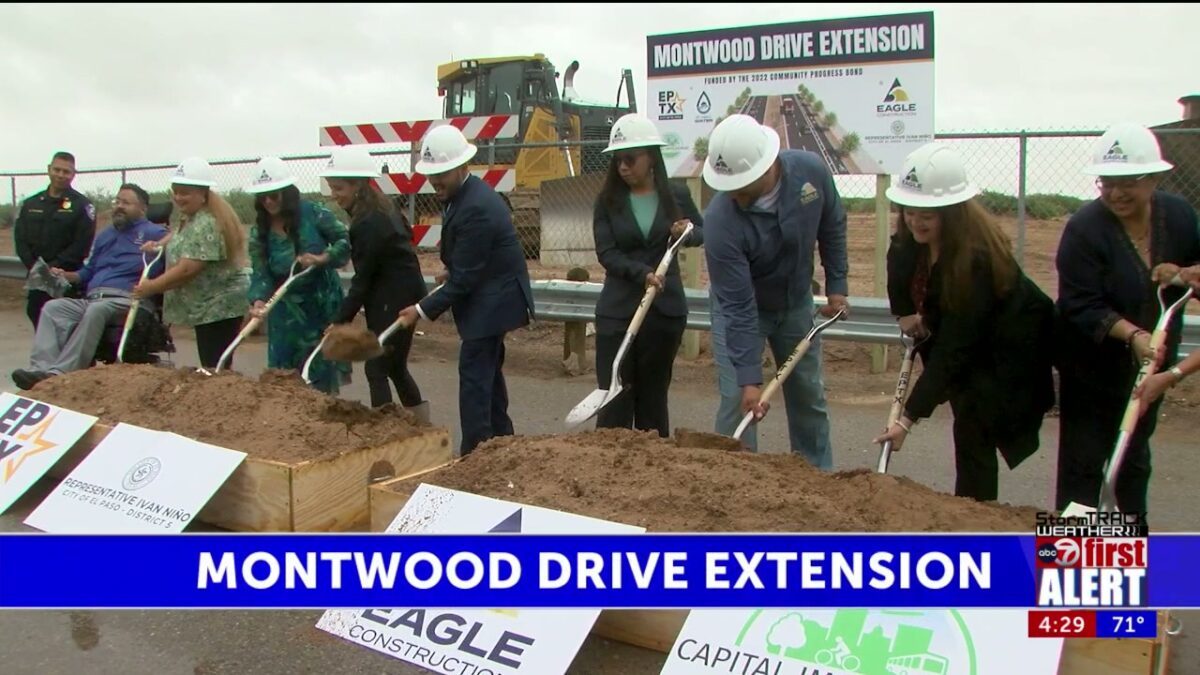
EL PASO, Texas (KVIA) — Wednesday, the City of El Paso broke ground on the Montwood Drive Extension Project. The $18.2 million investment will extend Montwood from Shreya Street to Rich Beem Boulevard.

The city said once the project is done, residents will see a dramatic improvement in access to homes, schools and businesses in the area. Plus, reduced travel times.

City Representative Ivan Niño said District 5 saw a 47% growth from 2010-2020.

“With that growth there was a lot of lacking infrastructure” Niño said.

On Sept. 1, city council awarded $30.8 million in construction contracts for the Montwood Drive and Resler Drive projects. Voters approved the 2022 Community Progress Bond, which will fund the two projects, the city said.

International Eagle Enterprises took the contract for the Montwood project. IT includes 1.4 miles of new roadway, landscaping, storm sewer systems, ADA-compliant facilities and street lights.

Construction for the project has an anticipated end date for spring 2028.

Click here to follow the original article.