Coachella power capacity concerns raise bigger questions about valley growth

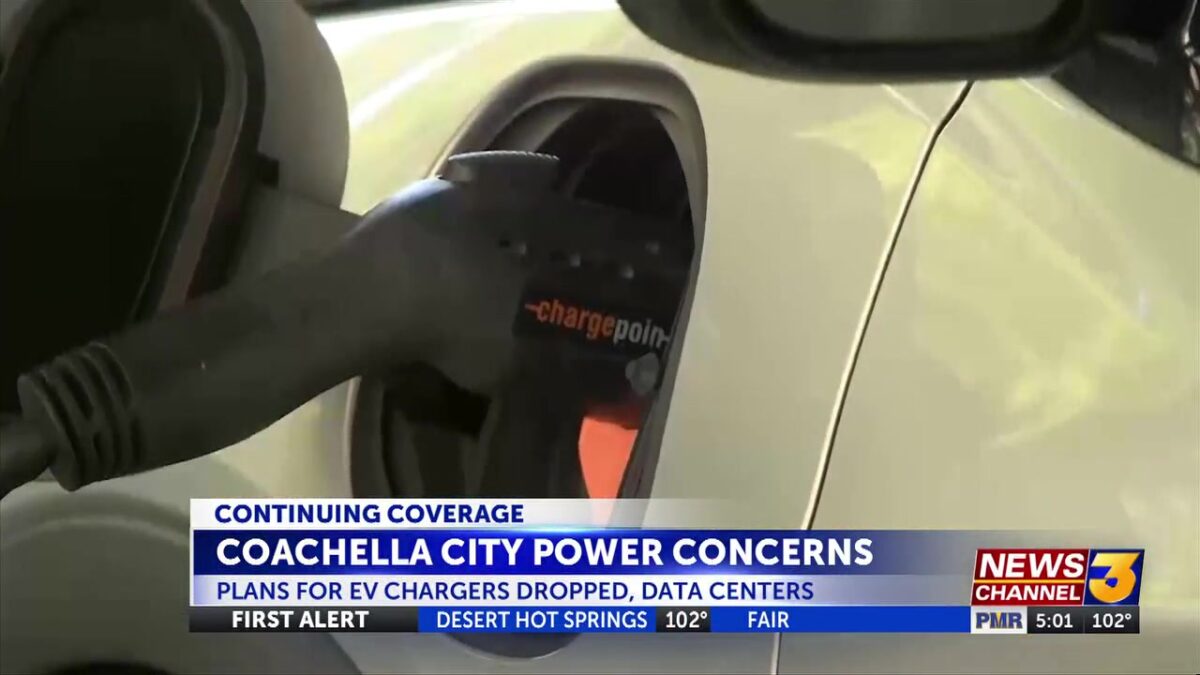
COACHELLA, Calif. (KESQ) – Plans for 30 new electric vehicle chargers at Rancho Las Flores Park are off the table as the City of Coachella scales back a major expansion project, with city leaders pointing to both cost and limited access to power.
But the decision is raising a much bigger question for one of the fastest-growing areas of the Coachella Valley: Does the city have enough power for what it wants to build next?
Coachella Mayor Frank Figueroa told News Channel 3 that the planned chargers were removed from the park project because of a combination of costs and access to electricity.
“I think, you know, that presentation earlier this week, it was a mixture of both costs and I think electricity, electrical access,” Figueroa said. “And I know that we have low capacity.”
The issue comes as Coachella studies where additional public EV chargers will be needed as electric vehicle use grows.
Figueroa said adding those chargers depends on first making sure the electrical system can support them.
“We can’t really proceed with that until we resolve our power access and ensuring that we have those substations and infrastructure there, then we can talk about EV charging,” Figueroa said.
The data center connectionThe power issue also adds another layer to Coachella’s recent fight over data centers.
Earlier this year, the city had an agreement with Stronghold Power Systems tied to a proposed technology campus and the development of Coachella’s municipal electric utility.
Under those plans, the proposed data centers were expected to become large initial customers of the municipal utility, while Stronghold would play a role in developing the electrical infrastructure needed to serve the project and support the utility’s buildout.
The city terminated its agreement with Stronghold in June following months of community opposition and later approved a permanent prohibition on data centers.
The data center proposal went away, but Coachella’s need for additional electrical infrastructure did not.
Figueroa said the city’s ability to continue attracting development will depend on addressing that need.
“Economic development and growth in our city is going to be tied to the energy infrastructure, which we’re working on,” Figueroa said. “We’re working to move forward with IID. We have a joint powers authority. We’re moving forward with that.”
In March, the Imperial Irrigation District and Coachella formed the Coachella Electric Financing Authority, a joint powers authority designed to help finance and develop electrical infrastructure improvements as the city grows. IID said the authority gives the city and utility a framework to jointly identify projects and finance upgrades through mechanisms including bonds.
IID meeting records from March estimated approximately $42 million in necessary electrical infrastructure at the time.
Could power affect housing growth?The implications could extend beyond EV charging.
Figueroa told News Channel 3 that a new housing community coming online could, for now, be among the last developments able to move forward based on available power access.
Mayoral candidate Jesus Kino Gonzalez also pointed to the power grid as a major issue facing the city.
“The reality right now in the City of Coachella is that our grid is at maximum capacity,” Gonzalez said. “So even if a development wanted to come into the city, it currently can’t. So I think that that’s a major issue because we need to develop the city to raise our tax base.”
Gonzalez’s description of the grid being at “maximum capacity” has not yet been independently confirmed by IID.
Gonzalez told News Channel 3 he believes the city should work with other government agencies to expand electrical infrastructure while avoiding additional costs for residents.
News Channel 3 also reached out to the other candidates for Coachella mayor and had not received responses by the deadline for this story.
New rules for large power usersThe questions surrounding Coachella’s power supply come as both the state and IID take new steps to address massive electricity users such as data centers.
California Gov. Gavin Newsom signed seven data-center bills this week addressing electricity, water and land use. Among the provisions are requirements aimed at making data centers cover grid upgrade costs associated with serving their projects rather than shifting those costs onto existing ratepayers. The package also includes new disclosure requirements for electricity and water use.
IID has also been preparing for growing electricity demand. Its large-load framework calls for major new electricity users to fund infrastructure, power supply and system upgrades required to serve them without shifting those costs and risks onto existing customers.
The utility is separately investing approximately $23.5 million to replace aging transformers at the Monroe and North La Quinta substations and the Coachella Switching Station. IID says those projects are intended to improve reliability and prepare its system for growing energy needs.
News Channel 3 asked IID specifically about the power limitations affecting Coachella, where constraints are most significant and what upgrades will be needed to accommodate future development.
IID has been in communication with News Channel 3 but said the earliest it could provide a statement addressing those questions is Thursday morning.
News Channel 3 will update this story when that response is received.
Click here to follow the original article.