Palm Springs couple after their LGBTQ cruise is denied permission to dock in Turkey and Egypt

Peter Daut

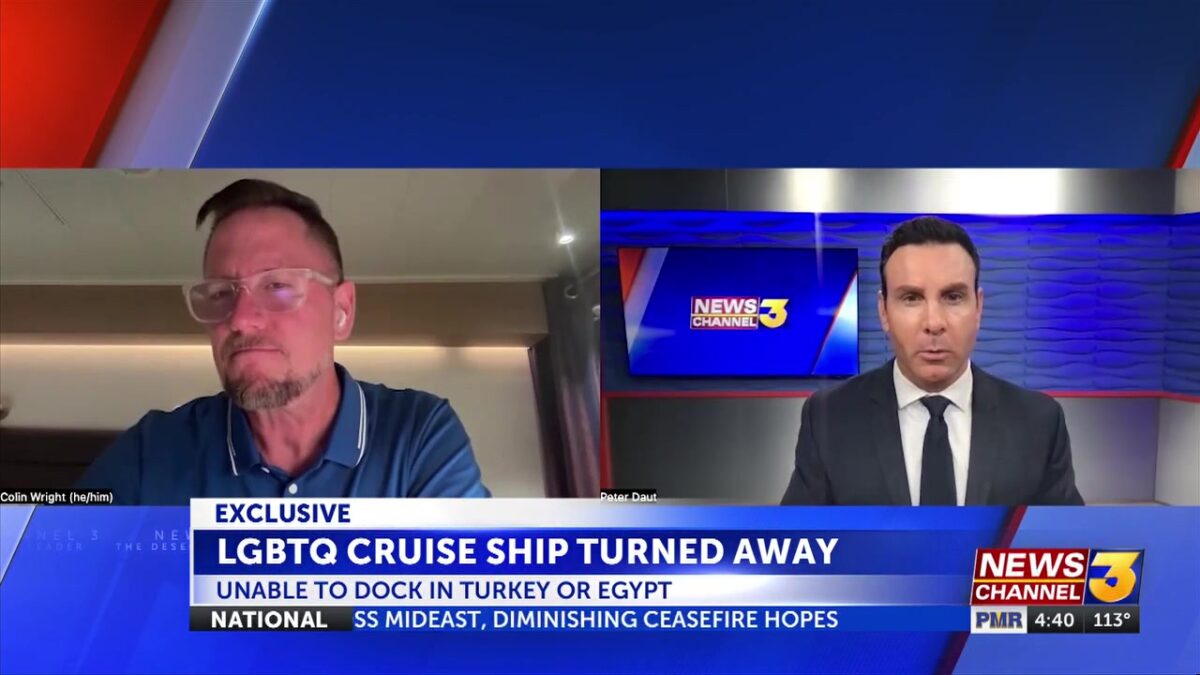
PALM SPRINGS, Calif. (KESQ) – A Palm Springs couple aboard the LGBTQ cruise ship “Scarlet Lady” is speaking out after the ship was denied permission to dock in Turkey this week, and has now also been denied permission to stop at its substitute port in Egypt.

Colin Wright and his husband are among the 2,000 passengers onboard Virgin Voyages’ Scarlet Lady, who say they were notified in the middle of the night that the ship’s stop in Alexandria had been abruptly canceled.

The Palm Springs couple departed Athens on Sunday for a 10-day Mediterranean cruise with several stops.

Alexandria was selected as a substitute port after officials in Turkey denied the ship permission to dock.

The provincial government in Turkey posted that groups on the ship were known for quote “behavior incompatible with our society’s structure and moral values.”

The Egyptian government has not provided an official explanation, but many of the ship’s passengers say they’re concerned it could be a sign of growing hostility toward LGBTQ people.

((SOT Colin Wright/Passenger, Virgin Voyage’s Scarlet Lady 2:45 “It’s just more disappointing it’s led to this. We were very respectful. This cruise line has been in operation for more than thirty years. They’ve been to both Turkey and Egypt multiple times and never had any problems at all. But because of the political climate that we’re in right now, this is unfortunately what happened.” 3:06 BUTT 4:46 “We’re obviously a minority in the world, and so we’re kind of an easy target for a lot of people. And unfortunately that’s just where we are. I do think there is some increased hostility, but I also think that perhaps it’s a pendulum swinging and we’re seeing one end of the swing. Hopefully things will come back to a more moderate stance on issues that affect us.” 5:11))

Meanwhile, the company running the cruise, Atlantis, says this is unheard of, adding the ship had received approval to visit Egypt, as the company has done twice in the last two years.

The ship is now on its third itinerary, with new stops in Crete and Montenegro.

The LGBTQ cruise had been planned for more than a year and Atlantis says it has never had one of its charters denied permission to dock in its 36-year history.

Now, it has happened twice in a single week.

Click here to follow the original article.

Judicial misconduct complaint against Ninth Circuit judge moved to Fourth Circuit

Par Kermani

IDAHO FALLS, Idaho (KIFI) — Chief Justice John Roberts has transferred a judicial misconduct complaint involving Ninth Circuit Judge Ryan Nelson to the Judicial Council of the Fourth Circuit, which moves the matter outside Nelson’s home circuit for further review.

The complaint comes from a altercation that occurred in June that led to the misdemeanor criminal charges against Judge Nelson.

RELATED: Ninth Circuit Judge accused of breaking man’s sunglasses in altercation outside Brio Home Health and Hospice

During the April incident, Judge Ryan Nelson and another man were involved in a dispute over a parking space that allegedly escalated into a physical confrontation. Prosecutors allege Nelson grabbed the man’s sunglasses, threw them across the parking lot and stepped on them, damaging the glasses. Nelson has acknowledged damaging the sunglasses but has pleaded not guilty to misdemeanor battery and misdemeanor malicious injury to property charges.

According to a news release issued Tuesday, Roberts approved a request from Murguia to transfer the matter under Rule 26 of the Rules for Judicial-Conduct and Judicial-Disability Proceedings. The transfer includes the complaint and all related proceedings.

The rule allows a judicial misconduct matter to be assigned to another circuit when doing so would promote impartiality and public confidence in the process. The complaint will now be handled by the Judicial Council of the Fourth Circuit rather than the Ninth Circuit.

The complaint is a formal review that focuses on whether the judge’s conduct violated standards expected of members of the federal judiciary.

Under the definitions of Misconduct and Disability, the misconduct review will determine whether the alleged conduct meets the judiciary’s definition of misconduct under Rule 4 of the Rules for Judicial-Conduct and Judicial-Disability Proceedings.

Possible outcomes can range from dismissal of the complaint to corrective action or disciplinary measures by the judicial council overseeing the case.

At this time, the Ninth Circuit has not announced a timetable for the Fourth Circuit’s review.

Click here to follow the original article.

E-bike safety concerns grow after fatal crashes in Idaho

Kaelyn Blessinger

IDAHO FALLS, Idaho (KIFI) —As e-bikes continue to surge in popularity, safety experts and medical professionals are raising concerns about the risks associated with the high-speed bicycles, particularly for children and teenagers.

The renewed focus on e-bike safety comes after two recent fatal crashes in Idaho. A Boise teenager was killed in an e-bike crash, while just a week earlier, a North Idaho man died after losing control of his e-bike near Spirit Lake.

Yet, e-bikes’ popularity shows no signs of slowing down.

“It’s definitely the fastest-growing segment in the cycling industry. There are city cruisers, there are gravel, there are racing road bikes, and there are mountain bikes in the e-bike world,” said David Wilding, owner of Idaho Mountain Trading.

Available in a variety of styles, including commuter, road, gravel, and mountain bikes, some models can reach speeds of 20 miles per hour or more, with certain high-powered versions capable of traveling significantly faster.

With their increasing popularity has come a rise in safety concerns. Communities across the region are considering new ordinances aimed at improving safety for cyclists, pedestrians, and motorists.

“Some cities have particular ordinances that have designated bike lanes or bike lanes and some of those for safety,” said Sgt. Bryan Lovell of the Bonneville County Sheriff’s Office. “If it’s on a bike path or that’s also being shared by pedestrians, so you still have a responsibility to ride safely in those areas, even though it’s not a traveled roadway or a city street.”

Health experts are also reporting an increase in serious injuries tied to e-bike crashes. According to the Centers for Disease Control and Prevention, more than 100,000 cyclists visit emergency departments each year for crash-related injuries. Locally, doctors say e-bike accidents have led to head injuries and broken bones.

“E-bikes and E-scooters could cause things like head traumas,” said Dr. Jaren Dickey. “Broken arms would be the main ones. They might get a big cut on their head, something like that. However, sometimes it can be a lot worse. Can even include bleeds inside the brain”

Because of those risks, the American Academy of Pediatrics recommends that children younger than 16 not ride e-bikes, citing the combination of higher speeds and limited riding experience among younger users.

Despite those recommendations, neither Idaho nor Wyoming currently sets a minimum age requirement for riding an e-bike. Neither state requires adults to wear helmets while riding.

Even without a legal mandate, medical professionals and cycling experts strongly encourage riders of all ages to wear helmets every time they ride.

Doctors say helmets have been proven to significantly reduce the risk of serious head injuries and urge families not to wait for laws to require the use of protective gear.

“Helmets have been shown to prevent a lot of these. Don’t wait for it to be a legal requirement to do the thing that’s right for your kid,” said Dr. Dickey.

Cycling advocates echo that message, noting that crashes are a risk you take when riding and that wearing a helmet can make the difference between a minor injury and a life-threatening one.

“It’s pretty much a must,” says Wilding. “It’s not an if but a when, because you will crash at some point”

Click here to follow the original article.

Kehoe requests federal assistance for 34 Missouri counties for June storms

Ryan Shiner

COLUMBIA, Mo. (KMIZ)

Gov. Mike Kehoe on Thursday requested federal assistance for 34 Missouri counties that experienced storm damage from June 4-18.

A press release says FEMA assistance was requested for: Adair, Andrew, Callaway, Camden, Cape Girardeau, Dade, Daviess, Gasconade, Gentry, Grundy, Harrison, Hickory, Holt, Jasper, Knox, Lewis, Linn, Macon, Marion, Mercer, Miller, Moniteau, Morgan, Newton, Nodaway, Osage, Polk, Putnam, Scott, Shelby, Sullivan, Vernon, Webster and Worth counties.

If approved, local governments and nonprofits can seek federal assistance for reimbursement of emergency response and recovery costs.

Click here to follow the original article.

Labor dispute threatens the future of geothermal power and lithium extraction

Lynette Niebla

IMPERIAL COUNTY, Calif. (KYMA) – A tense, multi-layered contract dispute is unfolding in the Imperial Valley as newly unionized geothermal power generation workers at CalEnergy accuse their multi-billion dollar parent company of bad-faith bargaining and employee retaliation.

The standoff puts front-line machinists and plant operators against BHE Renewables, a division of Berkshire Hathaway Energy.

While labor representatives point to staggering corporate wealth as proof that local employees are being left behind, corporate management counters that the union walked away from a highly competitive compensation structure to chase an unrealistic 60% hourly wage increase.

The roots of the current friction date back to August 14, 2025, the very day CalEnergy workers filed to organize under the International Brotherhood of Electrical Workers (IBEW) Local 465.

According to union leadership, management retaliated that same afternoon by modifying scheduling logistics, ultimately resulting in an annual pay cut of more than 10% for multiple frontline technicians.

Despite intense corporate opposition, workers voted 101-to-40 to unionize on December 9, 2025. Employees campaigned heavily on a message of “Power in Partnership,” expressing a desire to help the Imperial Valley’s clean energy and burgeoning “Lithium Valley” infrastructure thrive.

However, after six months of bargaining across 12 deadlocked negotiating sessions, union officials say the initial hope for collaboration has dissolved into confrontation.

Local 465 representatives claim that Berkshire Hathaway Senior Vice President Rob Lasich has repeatedly berated employees at the bargaining table, walking out of sessions and telling dissatisfied personnel that they are free to quit if they are unhappy.

To document the toll of these operational strategies, IBEW Local 465 compiled anonymous employee testimonies detailing deep physical and personal strain:

Work-Life Hardships: “Now the schedule changed to 10-hour shifts, but honestly, we’re working more and making less money.”

Custody & Stress Issues: “I’m on the verge of possibly losing the custody of my kids.” “The long hours, the stress, and lack of balance have started affecting me mentally, physically, and personally.”

Staff Exhaustion: “More employees are calling in sick or taking time off because they’re exhausted…I had to work 13 hours to compensate for the lack of employees caused by the ineffective scheduling changes.”

“They take it personal that we want better pay,” said Erwin Ricardo Sanchez, a maintenance machinist at the Salton City facility. “We want a better work environment, we want our schedule back, we want a decent wage, and we want to live our lives. We want to work. It’s not like we want to be lazy.”

The financial divide remains a primary talking point for the union. In 2025, Berkshire Hathaway reported roughly $67 billion in annual earnings, while BHE Renewables posted $128 million in first-quarter 2026 earnings.

“A company that has that much success is leaving its workers behind,” argued Nate Fairman, IBEW Local 465 Business Manager. “It’s asking its workers to make sacrifices and take lower pay to continue to drive those record-making profits, and that is wrong.”

BHE Renewables is firing back against what it describes as inflammatory and untruthful characterizations propagated by union leadership. Corporate officials emphasize that their primary goal remains securing an equitable contract.

Addressing the core friction surrounding stagnant compensation, corporate management highlights that their field staff is already heavily compensated compared to local standards.

“We’re proud to say the median total cash compensation in 2025 for employees covered by these negotiations was over $122,000,” BHE Renewables noted in an official corporate response. “That’s double the county’s median household income. The union came to the table demanding a 60% hourly wage increase.”

The company flatly denies cutting base pay or leveraging shifts to punish employees who voted to organize. Management specifies that operations require continuous coverage, meaning scheduling adjustments are a standard baseline across the energy sector.

“Operational scheduling decisions are made based on the needs of geothermal power plant operations that must run safely and reliably around the clock,” the company stated. “The schedules being utilized are neither unique nor unusual within the power generation industry. The union claims earning opportunities have been reduced. The truth is that hourly wage rates are not impacted by the schedule changes. The company offers our employees plenty of overtime earning opportunities through call-out, picking up additional work shifts, and working additional hours.”

Corporate leaders also directly addressed the explicit allegations lodged against Senior Vice President Rob Lasich, claiming the quotes leaked to the media were stripped of their true context.

Management asserted that Mr. Lasich never instructed personnel to quit, adding that company representatives have endured frequent verbal abuse from union bargainers during closed-door sit-downs, including being labeled “liars and thieves.”

Furthermore, BHE Renewables dismissed the three Unfair Labor Practice (ULP) charges recently filed by the union with the National Labor Relations Board (NLRB), which allege bad-faith bargaining and illegal scheduling retaliation.

“The unfair labor allegations are false and have no merit,” management stated. “They were filed without any evidence to support their claims. Two of the charges were coincidentally just filed this week after the union abruptly ended negotiations. We look forward to refuting them during the NLRB review process.”

BHE Renewables maintains it is ready to immediately resume contract parameters, adding, “We reached agreements on dozens of contract provisions, but the union still walked away. We’re ready to have respectful negotiations if the union comes back to the table.”

With both sides firmly entrenched, the labor dispute appears poised to transition away from the boardroom and into the public eye.

Because negotiations remain frozen, Local 465 organizers state that workers are aggressively organizing informational pickets and community rallies across the Imperial Valley.

Despite the friction, frontline workers note they understand the responsibility riding on their shoulders.

“We have to understand that there’s got to be sacrifices that need to be made,” Erwin Ricardo Sanchez reflected. “Nothing in this world has changed without sacrifices needing to be made.”

Click here to follow the original article.

Green Room Theater Company works to expand cultural programs in the East Valley

Peter Daut

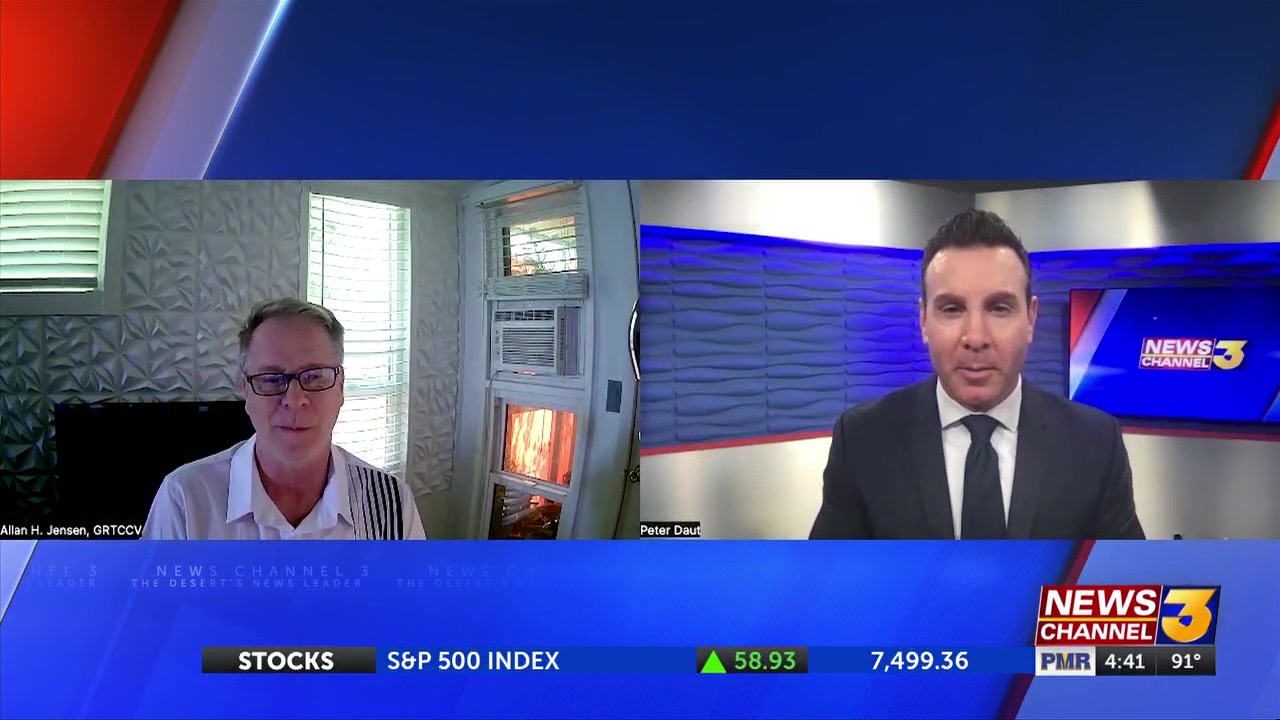
PALM SPRINGS, Calif. (KESQ) – A local nonprofit is working to expand cultural programs in the East Valley.

“Green Room Theatre Company” just received a $100,000 grant from the “Tammis Day Foundation,” which will allow it to grow and focus on underserved communities.

Half the grant will go to producing mainstage artistic productions, while the other half will allow the theatre to expand its staff.

Green Room takes theater directly to communities throughout the valley.

“There are a lot of communities out there that don’t have the opportunity either by lack of theater themselves or financials, that do not have the ability to see theater. And we feel that the arts is something needed in our communities,” said Allan H. Jensen, Managing Director of GRTCCV.

A big portion of the theater company is its “ballet folklorico.”

For more information, visit https://grtccv.org/

Click here to follow the original article.

Cole County lawsuit questions whether pit bull should be euthanized after biting deputy

Mitchell Kaminski

COLUMBIA Mo. (KMIZ) 

A Cole County family is asking a judge to stop the county from euthanizing its pit bull, arguing the dog does not meet Missouri’s definition of a dangerous dog and that previous biting incidents occurred only when law enforcement officers entered the family’s property without advance notice.

Keith Nilges filed the lawsuit Monday against Cole County Animal Control Officer Andrea Putnam after receiving a notice ordering the family’s pit bull, Scooby, to be euthanized. The petition asks the court to block the order while the case moves forward.

The lawsuit comes as local officials say the state law ( RSMo 578.024) used to penalize owners of dangerous dogs is rarely applied.

Cole County Sheriff John Wheeler said his office has pursued only two cases under the statute, the current case and another in 2024. According to Wheeler, in the 2024 case, a judge allowed the dog to be relocated outside Cole County instead of being euthanized after a disposition hearing.

Boone County Animal Control Supervisor Kevin Meyers said his office generally relies on local dangerous or vicious dog ordinances before seeking charges under state law.

“I can only think of one time that I have charged someone with Missouri State Statute 578.024 for keeping a dangerous dog,” Meyers said in a statement. 

According to Meyers, that case involved a dog previously declared vicious that had bitten multiple people and whose owners repeatedly failed to comply with county requirements. A Boone County judge ultimately found “overwhelming evidence” that the dog should be euthanized under state law.

Meyers said most dog bite investigations never reach that point.

“We frequently quarantine dogs that have bitten people,” Meyers wrote. “Most dog bites are provoked and the dog is quarantined at home if it’s bitten an owner or family member.”

In cases involving unprovoked bites, Boone County typically issues warnings or classifies dogs under local ordinances before considering the state statute if bites continue, Meyers said. He added the county’s advisory board has heard several appeals over the years, but he could recall only one instance in which a dog’s vicious designation was ultimately revoked.

“Overall, we do not typically jump to that state charge, though it is an option in cases in which owners refuse to comply with ordinances and their dogs continue to bite people,” Meyers said.

According to court records, Scooby bit a Cole County deputy June 27 after the deputy arrived at the family’s rural property while no one was home. The deputy was treated at a hospital for what court documents describe as a “Level 4” bite. Scooby was impounded before being released July 1. The following day, the family received a letter informing them the dog had been declared dangerous and must be euthanized within 10 days.

However, the lawsuit argues Scooby was inside an invisible electric fence at the time of the incident and that warning signs alerted visitors that dogs were on the property. It also claims the dog had to be forced out of the fenced area because it had been “rigorously trained to adhere to that fence line.”

The petition acknowledges Scooby has bitten people on three occasions but argues each incident happened when someone came onto the family’s property unexpectedly while no family members were present.

Christian Melhado, an attorney representing the Nilges family, said those circumstances distinguish Scooby from dogs that routinely threaten the public.

“You see the report, you see that this is the third incident and that obviously rings alarm bells. And it did for me when I first heard, when I was first contacted by my client. What’s important to know is that each of these incidents occurred on their property involving someone who was there unannounced and when no one was present at the home,” Meldado told ABC 17 News. “So it’s very different from a case where you hear of a dog constantly escaping from his backyard, running down the street, terrorizing the community, biting random people. Scooby does not leave the property.”

According to Melhado, the first incident occurred when a Missouri State Highway Patrol trooper came to notify the family about a crash on their property and was bitten in the leg by Scooby. After investigating, the Cole County Sheriff’s Office determined Scooby was not a dangerous dog.

Melhado said law enforcement instead recommended the family install an invisible fence, and reached an informal agreement to call before coming onto the property so the dog could be secured before officers arrived.

A second incident occurred when a sheriff’s deputy responded to a report of a child driving a four-wheeler on the property. Melhado said Scooby jumped on the deputy, scuffing the deputy’s vest.

The current incident happened after another deputy arrived to notify the family that a vehicle with a flat tire had been moved from someone else’s property. Melhado said the family believed they had an understanding with law enforcement that officers would call before entering the property.

“I’m not trying to blame the sheriff, and the deputies are trying to do their job, and we understand that,” Melhado said. “Regrettably, we think that the parties had come to an understanding about how to avoid these incidents and that for whatever reason no call was received in advance of each of these cases.”

He added that Scooby has not shown aggression in other settings.

“He’s never posed an issue to his vet that looks at him once a year. The people at the pound didn’t suggest they had any issues when he was there, this last time. My client told me that when he went to pick up Scooby on July 1, the worker at the pound came out with Scooby, and then when they were outside of the pound, he dropped the leash and Scooby ran over to my client. I think these incidents that have occurred are avoidable.”

Melhado said the family is willing to accept restrictions, including using a muzzle and taking additional precautions, if Scooby is allowed to remain with them.

Missouri law makes it a crime to own a dangerous dog if a dog that has previously bitten a person or domestic animal without provocation bites someone again.

The statute generally requires the dog to be seized and, after written notice, destroyed. However, owners have the right to appeal the impoundment and proposed euthanasia in circuit court. During that appeal, the dog remains impounded until a judge decides whether it should be euthanized.

Dr. James Crosby — who is a canine aggression expert, retired police officer, former animal control director and research associate with Harvard University’s Canine Brain Project — questioned why officers continued approaching the property without first contacting the family, if prior incidents had established a pattern.

“If the police department knew that there had been problems with officers coming on to the property without letting the owners know, which appears to be the case, then why in the world didn’t they just pick up the phone and give him a call this time?” Crosby said.

Crosby also said invisible fencing can unintentionally increase the risk of aggression when unfamiliar people approach.

“The fact that there was an electronic invisible fence involved could be a player in any or all three of these supposed cases,” Crosby said. “Because if a dog is confronting a stranger and hits the zap zone, dogs tend to interpret that as a potential attack and will turn and focus on the nearest person.”

Drawing on his own investigations, Crosby said he has handled fatal attacks involving invisible fences and believes officers should carefully evaluate warning signs before entering private property. He also argued many departments do not adequately prepare officers for encounters with dogs.

“Part of the problem is departments do not train adequately for their officers to go to less lethal and non-lethal means in dealing with animals,” Crosby said. “Back in the day when I was first a police officer in the late ’70s, yeah, it was shoot ’em.  Now we’ve come a lot further. There are a lot more options, including a  course called Law Enforcement Dog Encounters training that has been approved by the Department of Justice.” 

Crosby said that course, developed in partnership with the National Sheriffs’ Association, is offered free of charge and gives officers the tools they need to safely handle encounters with dogs. However, he added that many agencies still underestimate the importance of that training.

“There’s two things, basically. No. 2, the value of dogs has changed over time,” Crosby said when asked why more departments don’t utilize the training. “They have gone from being working tools that the farmer would round up the sheep with to being companions and parts of our family. That’s part of the change police departments have to adjust to. There’s a perception that they don’t have the time and money to invest in that training.”

Rather than resorting to deadly force or escalating encounters, Crosby said officers already carry effective alternatives to help prevent getting bitten.

“The officers already have less-lethal tools that are highly effective. They’re carrying O.C. or pepper spray. Pepper spray works almost all of the time, even more than it does with humans. A baton. Not for hitting them, but to sling it out and then use that as a space-gaining alternative. A dog tends to bite the closest thing to them,” Crosby said. 

ABC 17 News reached out to the Cole County Sheriff’s Office about the lawsuit. Wheeler said the department does not comment on pending litigation.

Click here to follow the original article.

Power returns in Cole County; Osage County sees hundreds without power

Ryan Shiner

COLUMBIA, Mo. (KMIZ)

Nearly 1,300 Ameren customers were without power in Cole County on Thursday.

The outage began at 7:14 p.m., after a strong cell entered the area. There were 1,264 customers without power at 7:54 p.m. Power was mostly restored before 9:50 p.m.

Ameren’s map then showed Osage County having 537 customers without power at 9:50 p.m. It received its first outage report in that county before 8:30 p.m. Another 56 Osage County members of Three Rivers Electric Cooperative were without power at 9:50 p.m.

High winds were the cause of concern for Thursday, with the ABC 17 News Stormtrack Weather Team declaring Thursday a Weather Alert Day.

Check back for updates

Click here to follow the original article.
Semi-truck leaking canola oil causes delays on Highway 95

Adrik Vargas

YUMA COUNTY, Ariz. (KYMA) – A semi-truck leaking canola oil caused delays Thursday morning on Highway 95 in Yuma County.

Yuma Proving Ground (YPG) says the large spill was on the highway near Dam Road at around 4:30 a.m.

YPG says the scene has since been cleared, but drivers are urged to use caution near the area as crews continue to work and clean the oil.

KYMA reached out the Arizona Department of Public Safety for more information, and is waiting to hear back.

Click here to follow the original article.

Wellton residents concerned over water quality

Lauren Duffel

WELLTON, Ariz. (KYMA) – Wellton, a town of about 3,000 residents, is under the microscope after its water system recently violated a drinking water standard.

Locals in Wellton don’t trust the tap water. Instead, they’re using these water filling stations.

Valerie Petry has been a Wellton resident for seven years. She’s currently a manager at an RV park in Wellton, where she says people don’t trust the tap water.

“None of us have drunk the water here. In fact, we don’t even use it to water our plants. I’ve lost three palms using the bad water,” Petry said.

The residents of Wellton have been dealing with water quality concerns for some time now. But most recently, the concerns have been amplified after a drinking water system violated a standard.

The town’s water had too much TTHM, which stands for total trihalomethanes. These are chemical byproducts that can form when disinfectants used to treat water react with natural materials in the water.

A notice sent to residents revealed the level was above the legal limit.

Petry says she relies on water filling kiosks because she doesn’t want to risk it.

“When I first moved here, it actually smelled like chlorine so bad that I didn’t want to take the chance,” Petry said.

The Town of Wellton said in the notice that the water is safe to drink for now, and residents do not need to boil it.

We reached out to Wellton town officials for an on-camera interview, but they denied our request and responded through a written statement saying in part:

“The TTHM issue was inherited by the previous administration. Since Town Manager Richard Marsh joined the town in 2022, improving the water treatment system has been a top organizational priority.”

We also asked if the town’s water is safe for drinking. They said, “According to the ADQ and the EPA, elevated TTHM do not constitute an emergency,” and “alternate drinking water remains available to all town utility customers at designated distribution locations.”

For now, the locals in Wellton are resorting to safer water quality options and are hopeful that water quality will improve.

Town of Wellton – Responses to KYMA QuestionsDownload

Click here to follow the original article.