Doctors say woman in El Paso ICE detention center urgently requires surgery that she is being denied

Texas Tribune

by Lomi Kriel, The Texas TribuneMay 20, 2026

The 911 call came two days after immigration agents detained the 23-year-old Guatemalan woman in Minnesota as she was driving her mother and two young siblings to their jobs cleaning houses.

“Excruciating pain,” the employee at the El Paso immigrant detention facility reported.

Emergency responders rushed Andrea Pedro Francisco to the hospital from Camp East Montana on Feb. 7 — just four days before she had been scheduled to receive surgery to remove an ovarian cyst about the size of a lime that had caused her months of intense abdominal pain.

Physicians discharged Pedro Francisco back to the Camp East Montana detention facility with written warnings that if she experienced certain symptoms, including pain in her back, hip, stomach or while urinating, that she should urgently obtain critical care.

Yet in the four months that followed, Immigration and Customs Enforcement officials repeatedly denied Pedro Francisco surgery — or even outside medical opinion to confirm that she does not need it. Pedro Francisco has continued to suffer from excruciating pain, but has primarily been treated with over-the-counter medication such as Ibuprofen to manage her pain.

By contrast, eight OB-GYNs and an emergency physician who specializes in detainee care reviewed 200 pages of Pedro Fancisco’s medical records shared with The Texas Tribune and agreed that she is at “high risk” for a medical emergency and urgently requires surgery. The experts said that her treatment in ICE detention amounts to medical malpractice because it fails to provide the industry’s standard of care and contradicts what external doctors recommended.

Andrea Pedro Francisco, 23, has lived in Minnesota since 2019 and for years has suffered increasing abdominal pain. In January, doctors said she needs surgery for an overian cyst. Then ICE agents detained her.

If Pedro Francisco does not have that operation, experts warn that she could lose the ability to have children or suffer from other serious health complications. The doctors also said the cyst needs to be screened for cancer. Ovarian cancer, dubbed the “silent killer” because its symptoms can be hard to diagnose, is the fifth-leading cause of cancer among women, spurring more than 15,000 deaths annually.

“It is my medical opinion that Ms. Pedro Francisco will suffer irreparable harm if this treatment is not provided promptly,” wrote Dr. Louis Monnig, a Louisiana OB-GYN, in a legal petition demanding her release.

Leticia Zamarripa, a spokesperson for ICE, previously said in a statement that medical staff determined Pedro Francisco’s condition “does not make her a candidate for surgical intervention,” although they recommended a “periodic” ultrasound.

“ICE maintains longstanding practices to provide comprehensive medical care, including access to vaccines, medical, dental, and mental health services, as well as medical appointments and 24-hour emergency care,” Zamarripa wrote. “This is the best healthcare that many individuals have received in their lives.”

Late Tuesday night, an unnamed Department of Homeland Security spokesperson wrote in an email that Pedro Francisco had seen onsite medical staff seven times and been evaluated three times at a local behavioral health center, in addition to the ER visit.

The official, who declined to answer detailed questions, said that Pedro Francisco “refused pain medication at least twice and has not shown up to medical requests for examinations.”

As President Donald Trump has ramped up deportation efforts, Pedro Francisco is one of more than 60,000 people in ICE detention as the administration continues to pursue mass ICE warehouses in its push for expanded removals. Like her, the majority were arrested in the interior of the country and have no criminal convictions. At least 18 people have died in ICE custody this year, nearly a third of them in Texas. That record-breaking number is on pace to surpass the nearly three dozen deaths in 2025, which were the most ICE fatalities in more than two decades.

Experts say this is the result of the administration’s push to detain a far greater number of immigrants than some ICE facilities have capacity for while contracting with companies that either have problematic records or little experience in detention management. At the same time, many medical providers which work with ICE have been unpaid since the fall in a bureaucratic change made by the administration as it switched billing methods.

“Illness and death are the predictable consequences of keeping people in this system that has expanded so rapidly, using unproven contractors, without paying bills and firing staff tasked to oversee violations” at the Department of Homeland Security, said Scott Shuchart, an ICE official under former President Joe Biden and senior adviser during Trump’s first term to the department’s Office of Civil Rights and Civil Liberties, which investigates abuses.

Efforts to obtain Pedro Francisco’s release or treatment outside of ICE have so far failed. A federal judge denied emergency petitions. ICE rejected her humanitarian parole, although another claim is pending. And unlike in Trump’s first term and previous administrations, when detained immigrants could be released on bond, this administration has fought that avenue in the courts. A ruling this spring by the U.S. Court of Appeals for the Fifth Circuit, which oversees Texas, Louisiana and Mississippi, ended that option for most immigrants.

Pedro Francisco’s cause has captured international attention with human rights groups such as Amnesty International calling for her release. Minnesota and Texas congressional representatives who have visited with her also appealed to ICE. Her next immigration court hearing is May 20. Her lawyers fear that the judge could order her deported without a full hearing using a procedural tool known as “pretermission,” which allows judges to deny asylum claims without hearing testimony.

Asra Syed, one of Pedro Francisco’s lawyers, said the administration is denying Pedro Francisco legal recourse while “every day Andrea and a chorus of people that are advocating on her behalf are screaming for basic medical care and it’s still being ignored.”

Gaslit

A few weeks before she was detained, Pedro Francisco went to the hospital in January where she told doctors that she had a history of an ovarian cyst. She described chronic pain “for a year or more” that had recently worsened, according to her medical records.

Physicians prescribed her strong painkillers such as morphine and oxycodone. Her surgery was scheduled for the following month, which would be thwarted by her ICE detention.

In multiple grainy video interviews with the Tribune from two ICE facilities over the past two months, Pedro Francisco appeared in standard-issued grey prison garb as she described her deteriorating condition.

When she tries to walk, she said, she struggles because the pain from her stomach shoots into her legs and back. It hurts when she urinates.

About a month after her emergency room visit, Pedro Francisco requested from ICE a bottom bunk bed due to her pain. According to her medical records, ICE officials denied the request.

Instead of ICE providing Pedro Francisco with surgery, available documentation appears to show that the agency may be treating her “for a condition she doesn’t have,” according to Dr. William Weber, who practices emergency medicine in Minnesota and helps lead the Medical Justice Alliance, a nonprofit focused on care in detention facilities.

Excerpt from a report documenting Pedro Francisco’s condition. Dr. Louis Monnig, a Louisiana OB-GYN at Ochsner Health, a nonprofit health system, wrote in a legal petition requesting Pedro Francisco’s release that she would suffer “irreparable harm” if she doesn’t soon obtain surgery for her cyst.

Weber and four other experts who reviewed Pedro Francisco’s records said that they suggest that ICE medical staff may have incorrectly diagnosed her with Polyendocrine Metabolic Ovarian Syndrome, a common condition for women of reproductive age, that can lead to cysts that are not typically painful or dangerous.

Except her previous medical records don’t support that, Weber and other experts said. He added that it appeared that a male nurse practitioner in ICE provided that assessment without giving Pedro Francisco an ultrasound or the extensive examination a diagnosis for that condition requires.

“I’m concerned the nurse practitioner didn’t understand the difference between a single ovarian cyst and PMOS,“ he said. “These are very different conditions and misdiagnosing her could leave her with ineffective treatment.”

Based on her records, he said, “ICE never documented any rationale for diagnosing her with that, nor did they do any testing.”

Part of the treatment for PMOS was over-the-counter pain relievers, which Pedro Francisco said did nothing for her discomfort.

Dr. Lauren Thaxton, a Colorado gynecologist, said the treatment she is receiving in detention is “inconsistent” with what her gynecologist recommended. Thaxton added that her condition “should be surgically explored.” That Pedro Francisco’s pain has persisted over months necessitates an operation, Thaxton said.

Seven doctors reviewing Pedro Francisco’s medical records warned her ovaries are at risk of damage, which could affect her ability to have a baby.

Not operating soon means that Pedro Francisco’s ovary could become “nonfunctional within her body due to the lack of blood supply,” said Thaxton, echoing other experts. “This is not a reversible outcome.”

Dr. Kristyn Brandi, a New Jersey gynecologist, worries that her cyst could be cancerous.

“Removing it early would be important to stop the spread of disease,” Brandi said.

“It is inhumane for a patient having so much pain that she was scheduled for surgery to be held without treatment,” she added.

Monnig, the Louisiana doctor, wrote in Pedro Francisco’s humanitarian parole petition that if her cyst continues to remain untreated, it could rupture, killing one of her ovaries and causing complications such as sepsis and infertility, requiring greater surgical interventions that could result in “larger incisions, and pain, brain damage or death.”

Andrea Pedro Francisco.

Pedro Francisco said that it’s distressing to hear from attorneys and experts that the lack of medical care could imperil her ability to have children, whom she desperately wants.

“I love children, they are beautiful,” she said. “But I guess right now I first need to see what is going to happen to me.”

Ruby L. Powers, another of Pedro Francisco’s attorneys, said Pedro Francisco is being “gaslit” by ICE medical staff.

“What the ICE medical team is telling her simply doesn’t match up with what doctors in the outside world say,” Powers said. “This is barbaric treatment at best and deadly at worst.”

“Getting worse every day”

Pedro Francisco was born in the Guatemalan Western Highlands, the site of the Central American country’s worst civil war massacres. She and her mother said in interviews that as indigenous people, they suffered discrimination and poverty. Her mother was sexually assaulted. And Pedro Francisco’s relative was killed in what the family believes was a targeted gang-related attack. That spurred the mother to bring her then 16-year-old daughter to the U.S. in 2019, where they requested asylum at the border.

Trump’s first administration released them while their asylum cases proceeded in the backlogged civil immigration courts. They continued to Minnesota, where they had family and joined an evangelical church, found jobs, and set down roots. Pedro Francisco’s mother had two U.S. citizen children.

Pedro Francisco worked cleaning jobs with her mother and doted on her siblings. She played bass and sang for her church’s musical group.

Zoila Carrion Caceres, who knew Pedro Francisco from high school and played music with her in the church group, said she has “a way of making people laugh and feel comfortable.”

Carrion Caceres wrote in a declaration for Pedro Francisco’s humanitarian parole that she “not only brought leadership but also joy and a sense of unity.”

Another of Pedro Francisco’s friends, Laura Carrion, said that she served as a leader for the deacons, helping new members “in understanding the Bible.” To obtain that position, Carrion said, Pedro Francisco underwent “strict interviews and character evaluations with our Pastor.”

Pedro Francisco played bass and sang in her church’s musical group.Pedro Francisco played bass and sang in her church’s musical group.

Pedro Francisco had been suffering severe stomach pain for years, she and her family said, that escalated in recent months and prevented her from working. She said that she didn’t want to seek medical care because she worried about the cost. So her family and friends were relieved when she was scheduled for surgery, urged by Fairview Hospital staff in Minnesota, according to her records.

Then, this February, Pedro Francisco was driving with her mother and siblings when federal agents stopped them as part of Operation Metro Surge in Minnesota, an unprecedented immigration operation in that state that resulted in two U.S. citizen deaths and helped lead to the ouster of at least two top Homeland Security officials.

Neither Pedro Francisco nor her mother had a deportation order, according to her lawyers, since they had been released into the U.S. under Trump’s first administration. Later, the Biden administration dismissed their immigration cases in a judicial move known as prosecutorial discretion.

But the agents detained Pedro Francisco, allowing her mother, who holds the same immigration status, to leave with the U.S. citizen children, presumably because the kids, aged 1 and 5, have no other caretakers, attorneys said.

Along with about 3,400 immigrants from Minnesota, ICE flew Pedro Francisco to Texas and imprisoned her at El Paso’s Camp East Montana, a troubled detention facility where at least three immigrants died in the weeks before she landed.

Pedro Francisco’s lawyer, Syed, filed a legal claim known as a habeas petition for her in February. Data shows that such filings, which argue that people are wrongfully detained, have surged under Trump’s second administration. The largest number of filings are coming from the Western District of Texas which has jurisdiction over Camp East Montana and the South Texas Family Residential Center, known as Dilley, that is the only facility in the U.S. to currently hold parents with their children.

Syed’s petition landed in front of U.S. District Court Judge Leon Schydlower, a Biden appointee. But as with many of such appeals before him, Schydlower waited months to issue a ruling and when he finally did, the denial appeared to be a “copy and paste,” according to more than half a dozen other Texas lawyers who voiced the same complaint for similar petitions that have appeared before him. Schydlower did not respond to requests for comment.

“Andrea’s case is why habeas corpus exists,” said Powers, her attorney. “ICE arrested her five days before that surgery. The Constitution doesn’t have an asterisk for immigrants. When the government takes someone’s freedom, it takes responsibility for their life. Right now, it’s failing.”

Syed filed a temporary restraining order. Schydlower denied that, too.

Camp East Montana, site of a migrant detention center on Fort Bliss in East El Paso, under construction in East El Paso on August 11, 2025.Camp East Montana, site of a migrant detention center on Fort Bliss in East El Paso on August 11, 2025.

Camp East Montana has been under blistering criticism, not only for the three deaths there over a span of six weeks but internal inspection reports citing dozens of violations. In March, the administration suddenly changed contractors. Pedro Francisco was abruptly moved to the El Paso Processing Center, a separate ICE facility. But the transfer did nothing to ease her pain.

“I feel like I’m getting worse every day,” Pedro Francisco said in an interview last week. “At night I don’t sleep well and in the day I don’t feel like the same person.”

For now, she holds out hope, although it is waning.

So does her mother, who said that the family relies on Pedro Francisco, financially and emotionally. Her daughter has no one in Guatemala and her removal, the mother said, would leave her American siblings “ruined.”

This article first appeared on The Texas Tribune.

Click here to follow the original article.

Fort Bliss holds expo for transitioning service members, veterans

Gabrielle Lopez

FORT BLISS, Texas (KVIA) — Some veterans and service members leaving the military got help navigating into the civilian world with confidence at the 1st Armored Division and Fort Bliss Annual Transition Expo Wednesday.

The 1st Armored Division said service members, their families explored workshops and met with employers who are hiring, including the El Paso Police Department and U.S. Customs and Border Protection.

“It’s just a great stepping off point for veterans to leave and to either stay in the local area,” Bernie Sprute, a transition services specialist, said. “We really want separating members to stay in the local area, but if they go on, that’s OK too. We want to set them up for success with the transition assistance program.”

Veterans also learned about available resources. Sprute said the military prepared veterans with skills easily transferable to the civilian world.

Click here to follow the original article.

I-10 West at Exit 0 in Anthony reopens after crash

Gabrielle Lopez

UPDATE (6:35 p.m.) — Police said all lanes reopened at 5:43 p.m.

ANTHONY, Texas (KVIA) — A crash closed all westbound lanes on I-10 after Travel Information Center, El Paso police said on X Wednesday.

The Texas Department of Transportation said a car rolled over at I-10 at Exit 0.

Police said there’s traffic backed up to the Vinton exit. They’re expecting the lanes to reopen within an hour.

Click here to follow the original article.

Cesar Chavez Elementary in Las Cruces to be renamed ‘Desert Bloom Elementary’

Gabrielle Lopez

LAS CRUCES, N.M. (KVIA) — Cesar Chavez Elementary School in Las Cruces will take a new name in July, Las Cruces Public Schools announced Wednesday. The district’s board of educated voted to rename the campus to Desert Bloom Elementary.

The board voted to remove Cesar Chavez’ name from the campus April 21 after sexual abuse allegations against the labor rights leader came out in March.

The school’s community considered other names like Desert Sky, Desert Sage, Organ Mountain and Mountain View Elementary, LCPS said.

Students, parents and staff favored Desert Bloom. LCPS said a popular theme in name preferences referenced the city’s desert landscape. Tito the Coyotito will stay the school’s mascot.

Starting Tuesday, the district said it will rebrand the school and update signs. The school will officially adopt the new name July 1.

In a previous meeting, the board said the most expensive change will be the school’s lettering, which is estimated to cost $10,100.

Click here to follow the original article.

What to expect at the El Paso airport as Memorial Day weekend travel nears

Gabrielle Lopez

EL PASO, Texas (KVIA) — Wednesday, the Transportation Security Administration (TSA) and the El Paso International Airport shared advice for those flying for the summer.

Cassandra Davisson, the airport’s marketing and air service development manager, said Memorial Day weekend is usually the signal for a busy travel season as more people fly out of the airport.

She reminded travelers there’s a new parking system at the airport. Instead of a ticket system, new technology scans license plates and prompts travelers to make an account to pay.

Travelers should arrive early since wait times at the airport can peak unexpectedly, Davisson said. She suggested arriving at least two to four hours before your flight takes off.

Eric Guthier with the TSA suggested taking an extra two or three minutes to get your real ID ready before going through security.

TSA ended a rule where travelers had to take their shoes off at security. Guthier said some people may need to take their shoes off in some cases, but an officer will let them know if it’s necessary.

While the El Paso airport doesn’t have international fights, Guthier suggested arriving at least three hours before departure if you’re flying out of the country.

Guthier said the El Paso airport typically sees rish hours between 4-7 a.m.

He said listening to TSA officers’ orders can help make your security experience smoother.

“We just ask everyone to pack their patience,” Guthier said. “The officers are doing the best they can to get everyone through safely and securely, and that’s what we’re going to do.”

Click here to follow the original article.

Ysleta ISD facing $16.7 million budget deficit

Rishi Oza

EL PASO, Texas (KVIA) — The Ysleta Independent School District is facing a budget deficit of $16.7 million. The district discussed its quarterly report during their Board of Trustee meeting Wednesday.

The district said there was an issue with a software system across the state with certain Central Appraisal Districts. The state implemented a new methodology to calculate any losses that happened from that error.

It impacted many districts across the state including YISD, and left it with a loss of $11 million in state revenue and a budget deficit of $16.7 million.

The state also has a decrease in funding given to districts and it leaves YISD with cash flow challenges. It said they need a short-term loan this month.

District CFO Lynly Cambern said the district has an issue of spending it’s unassigned fund balance. As of now, they have $35 million in unassigned fund balance, but it’s been getting lower over the past 5 years.

Cambern said the district has been using that fund balance to help get the deficit down, when it should be used for other issues. This year, if they use the fund balance for their deficit, they’ll only be left with $13 million.

“My goal in June is to bring you a comprehensive plan for addressing fund balance, for making hard choices, so that in three years, you are back to a surplus in your fund balance,” said Cambern during the meeting.

Hard choices can mean a lot of things, but Superintendent Xavier De La Torre said layoffs are premature to talk about right now.

“It’s too early to run around and say that the sky is falling,” said De La Torre. “We still have opportunities to gain revenue and significantly cut expenditures.” 

De La Torre said that’s the plan and options will be exhausted before the budget needs to be finalized this upcoming June.

Click here to follow the original article.

Jury finds man not guilty in road rage death involving brother, father

Yvonne Suarez

EL PASO, Texas (KVIA) – A jury found Jose Alberto Orozco not guilty of murder Wednesday. The verdict comes nearly three years after Orozco, his brother and father were charged with murder after what police described as a road rage incident with another driver in El Paso’s Upper Valley. 

The elder Orozco, Raul Alberto Orozco, was driving on Doniphan when he started chasing Marco Fino Jr. 

Police records show Orozco called his two sons, Christian Bradley Orozco and Jose to help him “trap” Fino. 

Fino was in a car with three other people. One of Orozco’s son blocked Fino in front and the other in the back, and got into a fight with a passenger. 

The fight turned physical, and Jose Albert is accused of shooting Fino.

The men all drove off after the shooting and did not call police according to court records. Fino’s passenger, meanwhile, tried to drive Fino to the hospital, but stopped to flag down an officer

Click here to follow the original article.

Ciudad Juárez hosts free Xocerball Americup 2026 matches

Heriberto Perez Lara

JUÁREZ, Chihuahua (KVIA) — The Xokerball AmeriCup 2026 kicked off Wednesday with 16 national soccer teams set to play in Ciudad Juárez all week.

The tournament began at 9 a.m. and an opening ceremony will take place at 8 p.m. Following the ceremony, there will be a featured match between Mexico and the U.S.

This soccer federation tournament, which will be held for the first time in the border region of Juárez and El Paso, has already taken place in other Mexican cities, and even in some South American and European countries.

The tournament will feature national teams from Mexico, the United States, Canada, Brazil, Costa Rica, Honduras, Panama, Colombia, Argentina, Chile, Uruguay, Guatemala, Haiti, Bolivia, Paraguay, the Dominican Republic, and Belgium.

The matches began today and will continue until Sunday, when the finals will be played.

The president of the Xokerball Federation, Sergio Ibarra Molina, a native of Juárez, told ABC-7 he’s happy the Americup is happening here because he wanted to bring this type of event to the border for the community.

“I’m from Juárez, and I don’t expect anything different from what I’ve always experienced: warm, friendly, and enthusiastic people who believe in the projects we’re seeing and, above all, who embrace us,” Ibarra said. “We rarely have the opportunity to hold these kinds of events, and I’m sure the people of Juárez will embrace it as their own and take ownership of it. I have no doubt that the people of Juárez will react in a responsible and warm manner.”

Juárez and the Xokerball Federation say it’s not easy to bring events like this one home, and want this to be the first test of many to come.

“When we tried to promote the event, we didn’t sell Juárez, we sold the region along with El Paso, the unique and different appeal of the border, the lifestyle and the community that exists here,” Ibarra said. “The way of life here creates a bit of unease for others who live in other parts of the world, and when we brought it up, they didn’t understand.”

Both Xokerball and the city of Juárez invite the binational community to watch the free matches, located at the big Juárez red ‘X,’ next to the border.

“I hope people enjoy it, that they have a different experience, that they leave here happy and say, ‘I didn’t expect this,'” Ibarra said. “If we can bring out that side of people, mission accomplished.”

“Beyond the sporting aspect, I want people to see that it’s an organized event, a safe event, an event where anyone from the region can come together without any divisions, and where the rest of the world can see what this region is really like; unique, that we present a true image of life here, and that people from other countries say they didn’t expect this from Juárez.”

ABC-7 also spoke with the Mexico National Xokerball team head coach, Sergio López, with some of his players and with former Mexican pro-soccer player, Jonny Magallón.

The Mexico team has won this cup back-to-back in the past two years and for this year’s edition, the goal is clear: be champions again for the third time.

You can click here for more information about the event.

Click here to follow the original article.

Man charged for aggravated robbery at Segundo Barrio store

Gabrielle Lopez

EL PASO, Texas (KVIA) — El Paso police charged a 57-year-old man for aggravated robbery at a store in Segundo Barrio near the Paso del Norte Port of Entry. ABC-7 reported live from the scene when police thought the man was barricaded in the store.

The robbery happened May 6 at Levcomm International, which sells phones at 908 S Stanton.

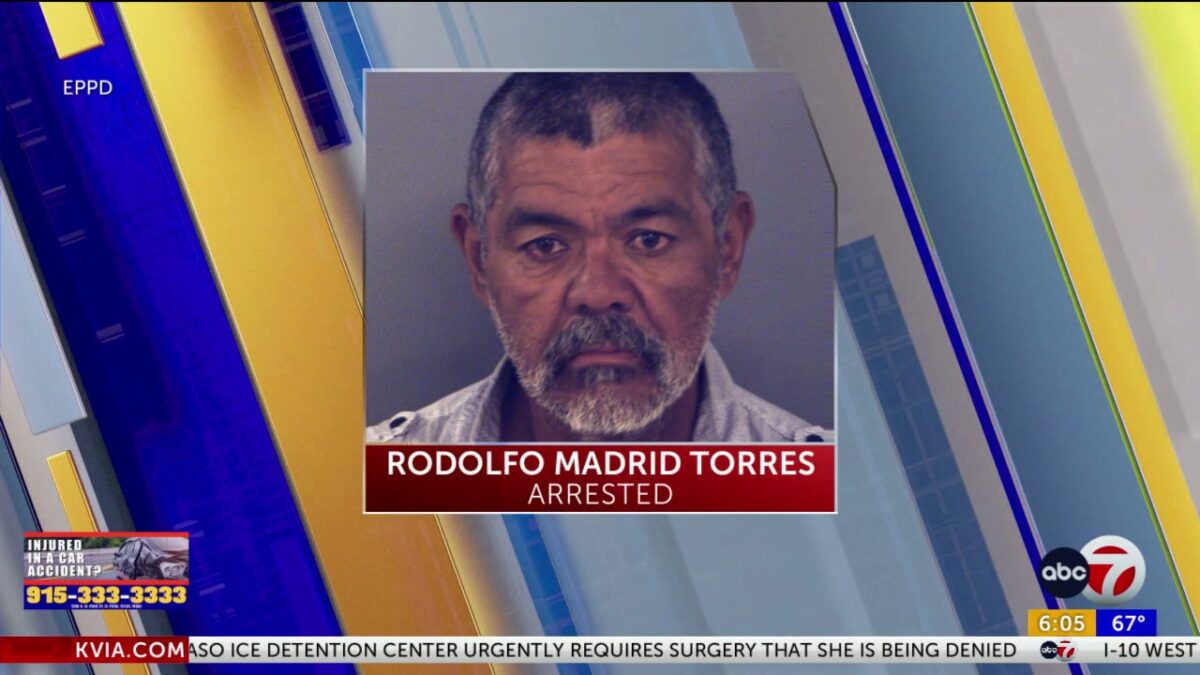
EPPD said Rodolfo Madrid Torres entered the business, assaulted the owner and demanded money. The owner broke free and locked Torres in the building.

When officers arrived, they believed Rodolfo was inside, but he left the building before they got there, police said. Investigators said he stole cash and the owner’s wallet.

Officers arrested and booked Torres into the county detention facility Monday.

Click here to follow the original article.

ABC-7 Xtra Investigation: Can the City of El Paso collect debt from Trump campaign rally without this key document? 

Lesley Engle

EL PASO, Texas (KVIA) — Seven years after thousands crowded the El Paso County Coliseum to see then-President Donald Trump campaign for re-election, the El Paso City Council has renewed its efforts to collect on a half-million-dollar bill for services related to the rally.

However, collecting payments may be more complex than they thought.

Records obtained by ABC-7 reveal that the City of El Paso did not discuss costs with President Trump’s campaign prior to his 2019 rally. The finding comes despite ongoing discussions among city leaders and elected officials about the $569,204.63 the city says the campaign still owes it. 

At a March council meeting, District 7 Representative Lily Limon requested an update on the outstanding Trump campaign debt and called for quarterly reports.  

Following that meeting, ABC-7 filed an open records request to determine whether any cost discussions or agreements existed before the February 11, 2019, rally.   

We reviewed the records the city sent, which did not show any discussions with the campaign, including cost estimates, quotes, draft agreements, or contracts, prior to the rally. ABC-7 found the city still does not have a formal cost-recovery plan in place for events such as political campaign rallies. 

“You cannot make people pay for things after the fact,” Carliss Chatman said. “If the city didn’t anticipate it, the city assumed the risk.” 

Carliss Chatman, a professor of law at the SMU Dedman School of Law, told ABC-7 that many cities fail to account for the scale of political events beyond basic venue rental fees. When a city provides services without a contract, the law may view the work as a “gift” or an “accord and satisfaction,” leaving the municipality responsible for the expenses. 

“It’s disappointing because we went into that and now we’re suffering the consequences,” Rep. Limon said. “But the good thing is it may lead to change. Those are important questions to ask—were we prepared, were we ready? I think we’ll be smarter moving forward.” 

The bill the Trump campaign did pay

Donald Trump announced his visit to El Paso on February 6, 2019, just five days before the rally. His “Make America Great Again” event filled every seat available inside the El Paso County Coliseum, with thousands more gathered outside.  

Records show the campaign paid a $5,000 rental fee and an additional $1,000 non-refundable deposit for the Coliseum, and ABC-7 obtained a copy of the wire transfer confirming the payment.

“I think that the one really critical person in this Trump visit was Brian Kennedy. He was the president of the Sports Commission, who, pretty much four hours before, said ‘hey if we don’t get payment by such a time your event is cancelled,’” Representative Lily Limon said. 

Kennedy told ABC-7 he negotiated a contract in advance with the Trump campaign. Under that agreement, the campaign was required to pay before Trump stepped on stage. The commission, which manages the Coliseum for El Paso County, also required the campaign to cover all venue-related expenses. 

No agreement with the City of El Paso 

A day after the Feb. 11 rally, city officials confirmed to ABC-7, in response to the station’s inquiry, that taxpayer resources were used to support the event. At the time, officials said costs were still being calculated and would be billed to the campaign once finalized.

The city billed Trump’s campaign more than $470,000 a month after the event, according to city records obtained by ABC-7 at the time. A one-time 21% delinquency fee later increased the total bill to nearly $570,000. 

Records show reimbursements covered a range of costs, including equipment, personnel and services such as security, cleanup, setup and logistics.  

According to City of El Paso billing records for the rally, the police department incurred the highest costs at $380,942.12, followed by the fire department at $60,630.84, Sun Metro at $15,577.52, Streets and Maintenance at $6,452, the Department of Aviation at $6,286.57 and the Health Department at $528. 

Security alone drew 476 officers from the El Paso and Anthony police departments and the El Paso and Socorro independent school districts, according to the itemized bill reviewed by ABC-7. That was in addition to El Paso County sheriff’s deputies and Secret Service personnel. 

ABC-7 asked to interview City Manager Dionne Mack and City Attorney Karla Nieman to walk us through the bill, explain how the city develops cost estimates for larger events, discuss how it plans to collect payment without an agreement, and any plans to create a policy to guide future event planning. 

City spokeswoman Laura Cruz-Acosta declined, saying there were no new developments to warrant additional interviews. “You’re welcome to reference prior interviews and KVIA’s previous coverage as the most current information available,” she wrote in an email.

City Representative Limon told ABC-7 she was not aware that the city had no prior agreements or documented discussions with the Trump campaign when asked. She described efforts to collect the outstanding amount as “uphill” but worth pursuing.

She said she placed the issue on the March 3 agenda to ensure the debt is not forgotten, and questioned why such a large amount of money has been left unpaid, comparing it to unpaid traffic violations or parking meter fees that are always collected. 

Chatman, the SMU professor who specializes in contract law, corporate governance, legal ethics, and fiduciary duties, said when cities host large rallies, they must look beyond simple venue rentals to consider the costs of additional security and the size of expected crowds.  

“The first is just a contract with the terms between the city or the county, whatever municipality is hosting and the organization that is hosting the rally,” Chatman said. 

Chatman says contracts for these events typically include provisions for police support that go beyond everyday operations, including the cost of closing or barricading roads to manage traffic.  

Chatman said some cities include clauses that allow them to charge more if the scale of the event exceeds what was originally anticipated. She said without those written terms, a city may have no legal mechanism to recover those costs. 

El Paso does not have a formal policy for recouping costs associated with large campaign events like Trump’s in 2019, according to city spokesperson Laura Cruz-Acosta. 

“So, there is no formal policy that is in place as it relates to it, but we do have procedures and forms that are filled out for special events, for example.” She said the city has a special events form where people can describe the event’s footprint and whether there will be a need for street closures for things like parades.   

“So, there’s really no one-size-fits-all when it comes to the process, but at the very minimum there’s a starting point in terms of filling out a form in order to capture all of the details and information related to that kind of special event,” Cruz-Acosta said. 

Cruz-Acosta said creating a formal policy for campaign events would require City Council action. She noted the council hired the Law Offices of Snapper L. Carr, which was in November of 2022, according to city records. We asked Cruz-Acosta how much it cost to hire the Austin-based law firm, which also serves as the city’s lobbying group during Texas legislative sessions, and she said an open records request would be required.

According to the records we obtained through our request, the city hired the firm on a contingency basis—meaning the law firm is paid only if it recovers money on the city’s behalf.

Limon believes cities need to become “smarter” about securing payment for services. She noted that providing services for campaigns is a “tremendous drain on public service,” particularly on first responders. She said if the $570,000 were recovered, it would directly benefit departments, which she said are often in need of funding. 

Limon stressed the need for a clear policy outlining expectations for campaigns. 

“We can’t just say, ‘well, welcome to the city and we’ll be there, we’ll protect you, um, we’ll close roads, we’ll do whatever is necessary, and then afterwards we’re going to send you a bill and we hope that you’ll pay for it,'” Limon explained. She affirmed the city’s responsibility to offer protection but asserted that entities using city services should pay for them, regardless of the campaign. “It’s — You have received a service from this city, and you should be paying for that service that you received. Whether it’s Bernie Sanders, whether it’s Donald Trump, it doesn’t matter who it is,” Limon said. 

Professor Chatman said large cities often have standardized protocols and checklists in place for event permits to ensure every host is treated the same regardless of their political affiliation. Chatman noted that smaller cities may lack these procedures because they do not regularly host large-scale events.  

“Best practices are to have checklists and standards and protocols in place so that you eliminate human error and human judgment and human bias. That’s what you want to do,” Chatman said. 

Chatman recommended that municipalities use a “360 approach” for future event planning, including evaluating the profile of speakers, the potential for counter-protests and the total burden on city resources.  

“Once it happens the first time and you see what a burden it is on a city budget, then you have to put protocols in place and have best practices for hosting these sorts of events,” Chatman said. 

In Tucson, Arizona, the city declined to pursue about $80,000 in public safety costs from a 2016 Trump rally and about $40,000 from a Bernie Sanders rally that same year, concluding legal action would cost more, Andy Squire, public information officer in the City Manager’s Office, told ABC-7. When Trump returned in September of that same year, however, the city required his campaign to prepay estimated public safety and facility rental costs—a total of $145,222, including nearly $116,000 for police. 

“In the end it came down to modifying the language in the facility use agreements at the Tucson Convention Center, which is city owned and operated under contract with Legends Global,” Squire said in an email response to ABC-7. 

ABC-7 reached out to the Republican National Committee seeking comment on the costs related to President Trump’s campaign rally in El Paso. A former campaign official said, “All questions related to local law enforcement and first responder costs we defer to the U.S. Secret Service.” 

A Secret Service spokesperson told ABC-7 that the agency coordinates security planning with local law enforcement partners but “currently lacks a mechanism to reimburse local governments for their support during protective events.” 

The spokesperson added that the agency will continue working with Congress to seek resources for state, county, and city law enforcement agencies assisting in security operations. 

Click here to follow the original article.