Amazon truck catches fire, causing major traffic issues on the EB I-10 in Indio

Jesus Reyes

INDIO, Calif. (KESQ) – A semi-truck fire is causing major traffic issues on the eastbound side of Interstate 10 near Golf Center Parkway in Indio.

According to the California Highway Patrol, an Amazon truck caught fire just after 7 p.m. on the eastbound lanes east of Golf Center Parkway.

Authorities confirmed the fire is burning cardboard in the trailer and there are no hazardous materials involved. Crews will remain at the scene overhauling for several more hours.

There were no reports of injuries.

All eastbound lanes were closed for nearly an hour. One lane was opened just before 8 p.m.; however, all lanes were shut down again shortly before 9 p.m. to allow for an excavator to get in position.

Traffic as of 9:20 p.m.

As of 9 p.m., eastbound traffic is backed up at Jefferson Street.

There is no word on how long the closure could last. No details are available. We’ve reached out to the CHP for info.

Stay with News Channel 3 for any updates.

Get the News Channel 3 app here. Click here to follow the original article.

Cathedral City’s gay community calls for action at upcoming council meeting

Gavin Nguyen

Update 09/15/26, 10:30 PM: This article has been updated to include a written statement from Sunshine Herrera, sent to our newsroom after our story aired.

CATHEDRAL CITY, Calif. (KESQ) – Every March, Cathedral City puts on a large event for the LGBTQ+ community, known as “LGBT+ Days.”

“We had over 12,000 visitors over the course of the weekend from 28 different states,” said Michael Westman, the marketing manager of Montage Events, the company that produces the celebration. “And so growing on that success, we want to continue to elevate the event.”

The path forward includes renaming “LGBT+ Days” to “Cathedral City Pride.”

“I think that describes more what the event really is. It’s your your you’re proud to be in Cathedral City to live in Cathedral City. The city is very supportive of the community. And so that’s really the point of of what we’re doing,” reasoned Westman.

Organizers also want to move the event back a week, to March 12th through 14th, in 2027.

The two changes are set to be considered during Cathedral City’s council meeting on Wednesday, September 16th.

A call-to-action is making the rounds on social media for members of the Coachella Valley’s LGBTQ+ community to attend Wednesday’s meeting. Several prominent voices on Facebook want to fill the council chambers in support of the event.

It comes two weeks after the city’s previous meeting on August 26th. During that meeting, public comments were made by Sunshine Herrera, who asked the council to look into the money that was being spent for LGBT+ Days and the 2027 Palm Springs International Film Festival.

In reference to LGBT+ Days, Herrera commented from the podium, “I would like to know what is the total cost of the LGBTQ plus days to Cathedral City, how much outside revenue is being generated, and what financial reporting is council receiving before additional payments are made.”

She continued, “This is a reoccurring city event and the city’s financial involvement goes way beyond the contract payment itself. I am asking council to consider a study session or a public presentation on the LGBTQ days before the next payment is made.”

“I am not asking this because I oppose the event,” Herrera clarified at the end of her comment. “I am asking because if the city is spending this amount of public money every year, council and the public should be able to see the complete financial picture.”

Herrera, who is also running for a seat on the Coachella Valley Water District board, sent News Channel 3 a statement, clarifying her position, seen here:

“I’m shocked and appalled that legitimate questions about public spending are being portrayed as opposition to the LGBTQ+ community. I support Cathedral City Pride, have earned the support of LGBTQ+ community members, and am proud that LGBTQ+ individuals serve on my campaign team.

The attached public contract pays Montage Agency $85,000 for the 2026 event and $90,000 for 2027. It states that sponsorship revenue should primarily offset event costs but allows Montage to retain excess sponsorship funds as additional compensation. If sponsorship increased by a reported 120 percent, Mayor Raymond Gregory and the City Council should explain why the City’s payment is also increasing.

Questions about a $175,000 public contract should be answered with financial records, not inflammatory accusations. Supporting Pride and demanding transparency are not opposing positions.

Pride belongs to the community. Public money belongs to the public. Both deserve protection.”

Sunshine Herrera

At the end of the meeting, Mayor Pro Tem Ernesto Gutierrez referenced Herrera’s comments: “We’ll be working on something possibly for our next meeting so we can possibly request a City Council study session as to our event that was mentioned earlier by our speaker.”

It led to some pushback from Mayor Raymond Gregory, who asked, “Will that be all events or are you going to single out a certain event?”

“Just one single event,” Gutierrez responded.

“Alright,” Gregory replied. “Well, I’ll be interested to see why you would want to single out a certain event.”

You can view the archived livestream from that meeting by clicking here.

A full agenda for Wednesday’s meeting can be found by clicking here.

“There have been pushbacks all over the country from pride events,” said long-time Cathedral City resident John Joiner. “It always concerns me. But if you stay active and you stay proactive, then you’re going to win more than you lose.”

For Michael Westman, he said he was hoping to see a large turnout at Wednesday’s meeting.

“It’s all about coming together, about being united. And, you know, having a great event and a great chance for the community to… show that.”

“It’s not anything new. We’ve been around a long time,” Joiner reasoned. “I’m not sure why we need to be studied. I think we just need to be celebrated.”

Click here to follow the original article.

Governor Newsom signs Agua Caliente gaming compact amendment

Tommy Gallegos

SACRAMENTO, CA (KESQ) — Gov. Gavin Newsom has signed legislation ratifying an amended tribal-state gaming compact between the State of California and the Agua Caliente Band of Cahuilla Indians.

Assembly Bill 2173, authored by Assemblymember Greg Wallis, R-Bermuda Dunes, extends the agreement through Dec. 31, 2061, while providing the tribe with additional flexibility for future growth, including up to 500 additional gaming devices.

The agreement also restructures the tribe’s contributions to California’s Revenue Sharing Trust Fund, which provides financial support to non-gaming and limited-gaming tribes across the state.

“Agua Caliente has been a tremendous partner to the Coachella Valley for generations, working closely with our local governments and investing in the communities we call home,” Wallis said. “This agreement respects tribal sovereignty, supports continued economic opportunity, and strengthens a partnership that has delivered real benefits throughout our region.”

The Agua Caliente reservation encompasses significant portions of Palm Springs, Rancho Mirage and Cathedral City. The tribe operates both gaming and non-gaming enterprises throughout the Coachella Valley and is one of the region’s major employers.

Agua Caliente Chairman Jeff Grubbe and tribal representatives worked with state officials throughout the compact amendment process.

The amended compact provides a long-term framework for the tribe’s gaming operations while maintaining its financial contributions to California’s tribal revenue-sharing system.

AB 2173 passed both houses of the California Legislature without opposition. As an urgency measure, the bill took effect immediately upon the governor’s signature.

The agreement represents a continuation of the longstanding relationship between the Agua Caliente Band and the State of California, while providing the tribe with additional flexibility to pursue future economic development in the Coachella Valley.

Click here to follow the original article.

Airports countywide awarded funds for variety of projects

City News Service

RIVERSIDE, Calif. (KESQ) – Five airports throughout Riverside County are set to be awarded $8.5 million in total for projects ranging from apron improvements to a new control tower, according to the U.S. Department of Transportation.

The agency released a complete list of 280 Airport Improvement Program grants Monday that will be distributed in the current fiscal year, and among the dozens of aerodromes in California slated for funding are Blythe Airport, French Valley Airport, Hemet-Ryan Airport, March Air Reserve Base and Palm Springs International Airport.

“As we continue to strengthen the National Airspace System, we are providing funding for airports to quickly put critical safety investments in across the country,” Federal Aviation Administration Administrator Bryan Bedford said.

The aggregate outlay nationwide is $3.77 billion. California’s share comes to $306.44 million, according to transportation officials.

Blythe Airport is designated to receive two grants totaling $905,667. They’ll cover expenses tied to apron rehabilitation and lighting.

French Valley’s earmark will be $3.43 million, all for construction of a control tower. The airport, which serves southwest Riverside County, has grown substantially in air traffic volume over the last several decades. Pilots currently coordinate their own arrivals and departures at the non-controlled field. The future tower will not be staffed by FAA personnel, but rather contract controllers, which are also deployed at Riverside Municipal Airport and San Bernardino International Airport.

Hemet-Ryan will receive the largest local grant at $6.15 million, stipulated for runway improvements.

March ARB’s $1.31 million grant will pay for apron re-surfacing, and Palm Springs International’s $140,600 grant will go toward equipment acquisitions, according to federal officials.

The complete list can be found at faa.gov/airports/aip/2026_aip_grants.

Click here to follow the original article.

Palm Desert ‘Scaminar’ to help seniors spot increasingly sophisticated scams

Peter Daut

PALM DESERT, CA (KESQ) – Scammers are becoming more sophisticated, using increasingly convincing tactics to target victims, and experts say artificial intelligence is making it even harder to tell what’s real and what’s a scam.

The issue is especially concerning for aging and senior populations, including communities across the Coachella Valley.

To help residents recognize warning signs and protect themselves, an upcoming “Scaminar” in Palm Desert will focus on some of the most common scam patterns being seen today and offer practical steps people can take to avoid becoming victims.

According to the IRS, financial crimes targeting seniors continue to be a growing concern, with more than $2 billion in reported losses last year, an eightfold increase since 2020.

Leeann Flores, a senior vice president with Bank of America, said fraud can affect people from all walks of life and often happens before victims realize they are being targeted.

“Fraud is on the rise, and innocent people lose their hard-earned money every day because of these scams,” Flores said. “While our bankers are trained to spot these scams, unfortunately by the time we see it, it is too late. And we really want to help people get ahead of it before it’s too late.”

The Palm Desert “Scaminar” will cover scam trends and techniques designed to make fraudulent calls, messages and other forms of communication appear legitimate.

Organizers say the goal is to give residents the information they need to recognize red flags, slow down when something feels suspicious and take steps to protect their finances and personal information.

The event will be held September 25 at the Bank of America Palm Desert branch.

The “Scaminar” is free and open to the public.

Click here to follow the original article.

Beaumont city treasurer charged with perjury, identity theft, and forgery

Jesus Reyes

BEAUMONT, Calif. (KESQ) – The elected City Treasurer of Beaumont has been charged with multiple offenses following a public corruption investigation, the Riverside County District Attorney’s Office announced on Tuesday.

Anup Giresh “AJ” Patel, 39, was charged with providing false information on Transient Occupancy Tax (TOT) return forms regarding a motel he operated in the city, and subsequently stealing another individual’s identity to communicate with the city and make false claims regarding the TOT he owed, resulting in six felony counts:

• Count 1: Penal Code section 118(a), Perjury, on or about April 5, 2021• Count 2: Penal Code section 118(a), Perjury, on or about August 19, 2022• Count 3: Penal Code section 118(a), Perjury, on or about March 13, 2024• Count 4: Penal Code section 530.5(a), Identity Theft, on or about May 6, 2025, through May 30, 2025• Count 5: Penal Code section 470(d), Forgery, on or about May 6, 2025• Count 6: Penal Code section 529(a)(3), False Personation, on or about May 30, 2025

According to the DA’s office, an investigation by its Public Integrity Unit revealed that Patel submitted multiple Transient Occupancy Tax (TOT) return forms to the City of Beaumont, signed under penalty of perjury, that stated he received $0 in gross rent for occupancy of rooms from April 2020 through December 2023 in a motel he operated in the City.

In January 2025, the city initiated an audit on all motels/hotels from January 2021 through December 2023. The audit showed Mr. Patel’s motel collected $1,667,300.68 in gross rent from January 2021 through December 2023. Mr. Patel, as owner of the motel, owed the city $166,730.07 in TOT plus additional penalties for the timeframe.

Additionally, Patel stole another individual’s identity and used it to create a fraudulent lease agreement and communicate with the city of Beaumont regarding the Transient Occupancy Tax owed to the city.

If convicted on all counts, Patel faces a maximum of six years, four months in state prison.

Patel posted bail in the amount of $30,000 and is scheduled to appear in court for an arraignment hearing on October 26, 2026.

The case is being prosecuted by Deputy District Attorney Natasha Sorace of the District Attorney’s Public Integrity Unit.

Click here to follow the original article.

Raju Mehta named Grand Marshal of 20th anniversary Paint El Paseo Pink

Jesus Reyes

PALM DESERT, Calif. (KESQ) – Raju Mehta, owner of El Paseo Jewelers, will be the Grand Marshal of the 20th Anniversary Paint El Paseo Pink, the Desert Cancer Foundation (DCF) announced on Tuesday.

Paint El Paseo Pink will take place Saturday, October 10, 2026, on El Paseo in Palm Desert. The event supports the Desert Cancer Foundation, uniting the Coachella Valley in the fight against cancer. Thousands of participants are expected to join.

Organizers said Mehta was selected for the honor in recognition of his years of dedication, generosity and philanthropic support of Desert Cancer Foundation and the local residents it serves.

“Raju has been an incredible friend and supporter of Desert Cancer Foundation for many years,” said Mark Scheibach, Executive Director of Desert Cancer Foundation. “His generosity and genuine compassion for our community embody everything Paint El Paseo Pink represents. As we celebrate this milestone 20th Anniversary, we could not think of anyone more deserving to lead us down El Paseo.”

Through El Paseo Jewelers and his personal philanthropy, Mehta has a longstanding history of giving back to the Coachella Valley. His support of DCF has helped the Foundation continue its mission of ensuring that local residents facing cancer can access the care and treatment they need, regardless of their ability to pay.

“It’s an honor to be Grand Marshal of Paint El Paseo Pink 2026 for a cause that is near and dear to my heart. Cancer is a terrible disease that affects not only the patients but also their families. Desert Cancer Foundation does amazing work supporting patients with any type of cancer throughout their treatment, and in turn lessens the burden to the families allowing them to be present for their loved ones”, Mehta expressed.

Proceeds benefit Desert Cancer Foundation, a 100% donor-funded nonprofit providing financial assistance for cancer-related medical care to residents of the Coachella Valley and surrounding communities. To register for Paint El Paseo Pink, please visit www.desertcancerfoundation.org

Click here to follow the original article.

Against All Odds: What Remains — The challenges facing our local Tribes

Angela Chen

PALM SPRINGS, CA (KESQ) – In Part 1 of Against All Odds, we looked at the role that tribal casinos have played in the Coachella Valley and how they have become a major part of the region’s economy and identity. But the pain behind the prosperity remains, with the bands now grappling to honor the culture and language.

Ravaged by disease in the 1800s, the Augustine Band of Cahuilla Indians in Coachella were federally recognized as the smallest tribe in the entire United States at just one woman in 1972 — Roberta Augustine. The numbers grew when she had children. But it was to be short-lived, because Roberta died, and all of her children died soon after.

Except for one — her daughter Mary Ann Martin.

And so, it was again, the weight of an Indian nation, solely on one woman’s slim shoulders.

“My mom’s biggest struggle was being alone. She didn’t have elders to rely on. She didn’t have people to guide her,” said Amanda Augustine, the Chairwoman of the Augustine Band of Cahuilla Indians.

Amanda, as a child, watched her mother grapple with that isolation.

“She missed her family. She struggled with having to learn everything by herself and understand everybody is not your friend,” said Augustine. “”The tribes are here. They’ve been here. They’re not going anywhere. We can’t go anywhere.”

Now, in 2026, they have boosted their numbers to 20, to become the second smallest tribe in the U.S.

Augustine is one of 9 bands of the Cahuilla tribe who have been here in the Southern California desert area — for decades — centuries — ruling the Coachella Valley long before white settlers — before Spanish conquistadors — before all else —

The Cahuilla are grouped into nine different bands; there are the Mountain Cahuilla, with the Ramon, Cahuilla, Santa Rosa and Los Coyotes bands and the Pass Cahuilla which encompasses the Morongo Band and the Agua Caliente as well as the Desert Cahuilla, which includes the Torres Martinez, the Cabazon Band of Cahuilla Indians, and the Augustine Band of Cahuilla Indians, whom Coachella Valley residents are most familiar with.

These bands spoke different dialects, but shared the same cultural traditions.

“Cahuilla clans spread out all over Southern California, and those independent clans would join together for different ceremonies and social gatherings, and Cabazon, both Cabazon the Elder and Cabazon the Younger, in this photo, they negotiated lands,” said Arkamez Blankenship, the Director of Cultural Affairs for the Cabazon Band of Cahuilla Indians.

For the past century, language and culture have been in danger of becoming lost to history entirely.

In the 1800s, kids were ordered to attend Indian assimilation boarding schools, like the Sherman Institute in nearby Riverside, where cultural eradication was the goal. The guiding philosophy by the founder of these schools, Richard Pratt, was “Kill the Indian in him and save the man.”

Native Americans today are still suffering the effects after being forced on to reservations about a century ago, facing the highest poverty rate at 19.3% of all racial groups, according to 2024 U.S. Census data. Reservations across the nation are often on isolated land that can be difficult to develop with few employment opportunities.

The wealth gap based on land location is apparent here in the Coachella Valley.

“One thing that I do want to say is that we’re Augustine, not Agua. I always get that,” said Augustine.

Most recently, young Indigenous people have lost interest. For some, it’s been an uneasy lifelong identity struggle, with elders sometimes refusing to teach the next generation. When asked about the resistance, Michael Mirelez, a lineal descendant of the Torres Martinez Desert Cahuilla, pinpointed one particular reason:

“Shame,” said Mirelez. “They were ashamed because they couldn’t answer once I got to a certain point of asking more in-depth questions. They were ashamed because they couldn’t answer, and it made them feel bad. They didn’t realize what they had was for us. We considered it gold. We do consider it gold. For them, they think ‘it’s not enough, it’s not enough,’ and so shame takes over, and then they get angry, and all it was a reminder of what they don’t know.”

The director of cultural affairs for the Cabazon Band is one of a handful of people in the world right now who can still speak Cahuilla.

“It’s a lot of loss, and over the years, you lose more and more, and eventually there aren’t a lot of people left to speak to or use the language,” said Blankenship.

But, in recent years: some hope. Blankenship says that young people here have begun expressing an interest in learning the Cahuilla language again.

As bands grapple with preserving tradition while managing modern living, misconceptions by outsiders are still rampant.

“And still to this day, people still think that we live in tipis and we all wear feathers, and that that one image encapsulates us all, and it’s not,” said Mirelez.

“I’ve been asked the questions: Where’s your long hair? How do you get your food? Do you live in a tent?” said Doug Welmas, the Chairman of Cabazon Band of Cahuilla Indians. “Certain things like that. I go to the store just like. I live in a house. I got to tell them they’re kind of shocked or surprised.”

“I think that most people think because there are so many casinos out here that we’re just bathing in money, we’re like Scrooge McDuck, just swimming in a vault of money, that is not true,” said Augustine.

These desert bands, who all own casinos, contribute robustly to the Coachella Valley with back-to-school drives, Thanksgiving meals and more.

“We also do a lot of donating, Martha’s Village, Coachella Valley Rescue Mission, Ophelia Project. We do a lot of donating around this valley, and so it’s not that we’re just enriching ourselves, but we’re enriching the families around us,” said Augustine.

“We try and help out as much as we can. We’ve helped with the Ronald McDonald House, the Hanson House, which is local, Martha’s Village and Kitchen,” said Welmas.

Still, in the face of so much loss of culture and history and language, there is resilience.

Amanda has been carrying out her mother’s dream. No longer the last of the Augustine — Amanda has led the expansion of the Augustine Casino in Coachella, opened Temalpakh Farms, and built a solar panel field.

“She just saw a vision, and she went for it. I know a lot of tribes do the resorts and big casinos,” said Augustine. “She wanted to do something else that would help strengthen our sovereignty, standing alone, not needing any other entity.”

A note from News Channel 3: the valley’s largest tribe, the Agua Caliente, is missing from this story.

They agreed to an interview in September, but canceled. They have rescheduled for mid-October.

To see more on the impact of the tribes on Coachella Valley’s history and economy — watch part 1 of anchor Angela Chen’s series “Against All Odds” — now online at kesq.com.

Click here to follow the original article.

IID board unanimously approves large load tariff

Tommy Gallegos

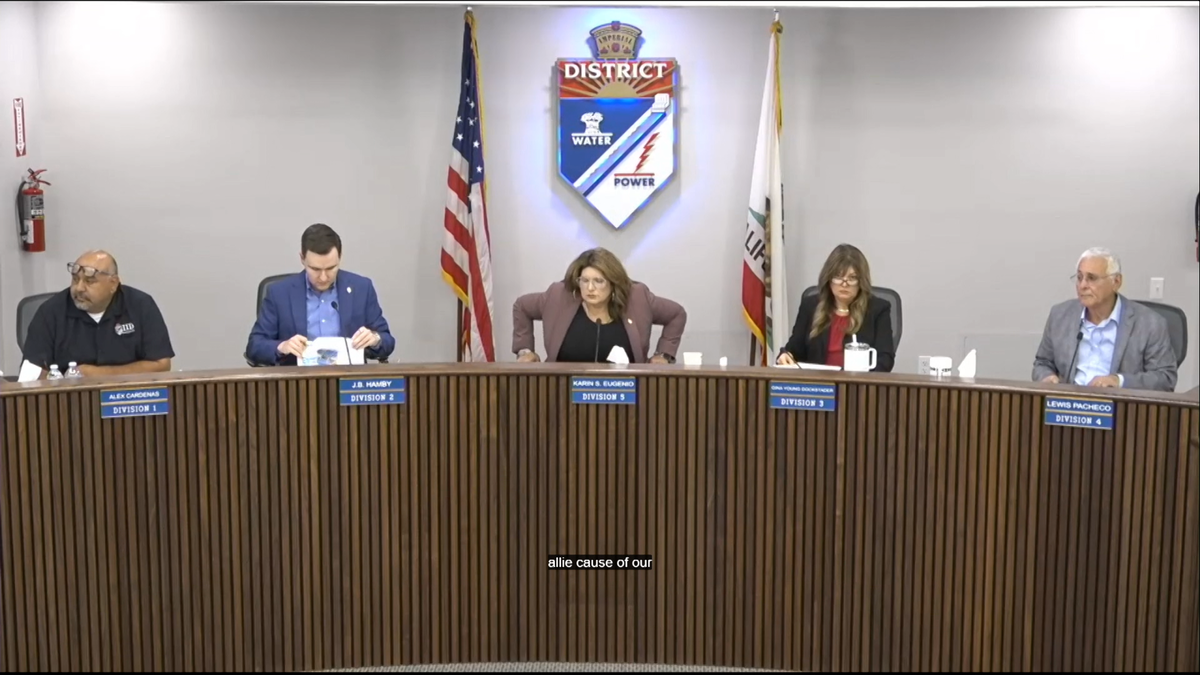
IMPERIAL, Calif. —(KESQ) The Imperial Irrigation District Board of Directors unanimously approved a new Large Load Tariff Tuesday, establishing a formal framework for how the utility will evaluate and serve very large electricity users, including data centers and other high-demand projects.

The tariff applies to customers seeking at least 20 megawatts of electric demand and meeting an 80% minimum load factor.

Under the new framework, large-load customers will be responsible for the costs and financial risks associated with serving their projects. That includes infrastructure, power supply and other system improvements that may be necessary to provide electric service.

IID said the approach is intended to prevent costs associated with large new loads from being shifted to existing ratepayers while allowing the utility to evaluate opportunities for economic development.

The board’s action follows months of public review. IID received 243 comments on the proposed tariff before revising the proposal for consideration by the board.

The tariff also creates a formal process for determining whether IID can reliably serve a proposed large-load customer and what improvements to the electric system may be required before service can be provided.

IID’s review will focus on its ability to provide electric service and the conditions under which that service could be delivered. Decisions involving land use, zoning and project siting remain under the authority of local cities and counties.

The new policy comes as IID has seen increasing interest from customers requiring substantial amounts of electricity. When the draft tariff was released in May, the District reported nine large-load proposals or inquiries at various stages of evaluation.

The tariff builds on principles adopted by the IID Board in December 2025, including protecting existing customers, maintaining system reliability and ensuring that costs associated with new large loads are recovered while continuing to support economic development opportunities.

With Tuesday’s unanimous vote, IID now has a formal process for evaluating large electricity users and determining the financial and infrastructure requirements associated with serving them.

Click here to follow the original article.

Board declines to adopt majority of grand jury’s recommendations for jails

City News Service

RIVERSIDE (CNS) – Riverside County supervisors today signed off on an Executive Office report — and a separate one filed by Sheriff Chad Bianco –that asserted the county will not implement some recommendations from a grand jury to improve jail operations, but will take others under consideration.

“The action of the Board of Supervisors today does not create or reject a specific oversight model,” county CEO Jeff Van Wagenen said Tuesday.

“The county’s position is that transparency and accountability matter.”

The Executive Office and Sheriff’s Department each issued responses to the 19-member civil Grand Jury’s findings, published in June, that emphasized the need for a change in how the county’s five detention facilities are operated, and what policy measures are overdue to ensure deficiencies thatjurors believe contributed to fatalities in previous years are resolved.

“An alarming number of in-custody deaths, combined with questions about internal investigative practices and the absence of independent oversight, has raised ongoing concerns about safety, transparency and accountability of Riverside County jail operations,” the grand jury said in its 26-page report. “Failure to implement independent oversight and custodial reforms exposes the county to significant civil liability, particularly in cases involving in-custody deaths.”

Jurors determined through their own comprehensive investigation that the county would benefit from an inspector general’s office to monitor and report on correctional operations, or a civilian oversight board empowered to conduct independent investigations and make recommendations to the board — all of which is authorized, but not mandated, legislatively.

The Executive Office said the recommendation for an independent body “requires further analysis.” Officials further touted the formation in July of an ad-hoc committee to scrutinize jail policies and practices, saying the panel will likely achieve some of the results that the grand jury advocated.

The sheriff’s report replied that the proposal “will not be implemented because the recommendation is not warranted.”

Jurors also supported creation of a “five-year strategic plan for jail operations that includes measurable benchmarks, data transparency goals (and) compliance auditing procedures.” The sheriff’s department called the idea a “blatant disregard for current operating procedures and shows the complete bias of this supposed (grand jury) investigation to develop the report.”

The Executive Office’s response was tepid, saying that while a long-range plan might be appropriate, the ad-hoc committee would likely have a better answer on how to go about establishing operational objectives when it returns with findings for the board in January.

The Executive Office and Bianco jointly rejected jurors’ recommendation for dissolving the Sheriff’s Advisory Committee, which has been around since the prior decade, because SAC “has not demonstrated measurable advisory output” and has never published meeting minutes, “formal findings or written recommendations” accessible to the public, according to the jury.

It highlighted the National Association for Civilian Oversight of Law Enforcement’s components for achieving effective watchdog processes, recommending that NACOLE’s best practices be implemented.

The Executive Office answered that adoption of NACOLE’s standards is “not warranted or reasonable.” While officials acknowledged protocols might be “useful” at times, they don’t necessarily justify a new “operational framework,” officials said. The sheriff’s report went further, saying NACOLE does not “have any influence, control or ability to direct operations within the constitutionally formed office of the sheriff.”

The Executive Office was non-committal on jurors’ recommendation for hiring an “independent correctional health and custodial operations expert” to audit jail intake operations and procedures, imparting that the proposal might be worth considering. The sheriff’s department dismissed therecommendation entirely, insisting the grand jury’s effort was “a predetermined attempt to force or intimidate the board and the sheriff to comply with the demands of activists.”

Jurors’ recommendation for a quarterly online “dashboard” where the public can view data on in-custody deaths, use-of-force incidents, suicide attempts and medical emergencies was not opposed by the Executive Office, and the sheriff signaled acceptance of the proposal, saying it “will be implemented in the future.”

Citing “systemic deficiencies” in jail operations, the grand jury pointed to instances where the county had been successfully sued, with multimillion-dollar payouts to families of inmates who died in custody. The county ranks in the top three statewide for correctional system fatalities that occurred over the previous decade, according to published reports. The year 2022 was particularly bad, with around 20 documented deaths in county lockups.

The sheriff’s report countered that during that year, 110 inmates were resuscitated by deputies or medical personnel after they had ingested deadly drugs, while 96 suicide attempts were “thwarted,” and correctional staff “intercepted drugs on 438 occasions,” potentially savings hundreds more lives.

None of the supervisors offered individual responses to the grand jury, Executive Office or sheriff’s reports.

Click here to follow the original article.