CalFresh benefits rise as stricter eligibility rules take effect

Kiera McKinney

THOUSAND PALMS, Calif. (KESQ)- CalFresh recipients are seeing several changes to the food assistance program, including a small increase in maximum monthly benefits and stricter eligibility rules for some households.

Beginning Oct. 1, the maximum monthly benefit for one person increased from $298 to $306. For a family of four, the maximum increased from $994 to $1,023.

At the same time, work requirements have expanded in Riverside County to cover more adults ages 18 to 64. The changes began June 1 and include fewer exemptions. People who are subject to the requirements and do not meet them or qualify for an exemption can face a three-month limit on CalFresh benefits.

FIND Regional Food Bank Interim President and CEO Lorena Marroquin says the organization is already seeing more demand.

“Currently, we’ve seen an uptick of residents being served in our area, about 20%. We anticipate that that need will increase during the coming months.”

Marroquin says many of the people turning to FIND are already working.

“A lot of the neighbors we serve have, you know, one to two full-time jobs. So having this type of change to their already existing food income or budget is really going to impact those that we serve.”

Nationwide, SNAP participation fell by more than 5 million people, or nearly 13%, between July 2025 and June 2026, according to an analysis by the Center on Budget and Policy Priorities using USDA and state data.

Marroquin says changes to CalFresh and Medi-Cal could affect more than 380,000 Riverside County residents, according to a county collaborative FIND works with. She stressed that does not mean all of those residents will lose benefits.

“There is a fear. There’s misinformation about if they qualify for benefits or if their benefits are going to be reduced.”

FIND says it is preparing its mobile markets and partner agencies for the possibility of more people seeking food assistance.

“When grocery benefits shrink, the need for food doesn’t.”

People with questions about their CalFresh benefits are encouraged to contact Riverside County Department of Public Social Services before assuming their benefits have changed.

Click here to follow the original article.

New California car-buying rules take effect, adding protections for consumers

Kiera McKinney

THOUSAND PALMS, Calif. (KESQ)- New rules are changing the car-buying process in California, with new protections aimed at giving buyers a clearer picture of what they are paying before they sign.

The California Combating Auto Retail Scams Act, or CARS Act, took effect Oct. 1.

Under the new law, dealers must be more upfront about a vehicle’s total price. Optional add-ons, such as warranties, GAP coverage or theft protection, must also be clearly disclosed as optional before a buyer signs.

Dan Jessup, executive manager of Jessup Auto Plaza, said transparency is one of the biggest changes buyers will notice.

“The biggest disparity has been a lack of transparency. When a consumer sees a price of a vehicle online and then may approach the vehicle in person or via email or on the phone, only to find out the price online is different than what they’re getting quoted,” Jessup said.

Another major change applies to qualifying used cars valued at $50,000 or less.

Buyers now have three days to cancel the deal for any reason. The vehicle must still meet mileage and condition requirements when it is returned, and a restocking fee may apply.

For local driver Nayeli Fonseca, having that option brings some peace of mind.

“I feel like it gives me like an ease of mind. Like, if anything, I change my mind, or I feel like, oh, this car doesn’t feel right for me, it gives me an ease to be able to come back and look at another option,” Fonseca said.

Fonseca said clearer pricing could also help take some of the uncertainty out of buying a car.

“It’s one of the worries that you have going in buying a car. Like, oh, they advertise it at 30-thousand, and then you walk out and you get, oh, it’s actually 35,” she said.

The new rules apply to licensed California dealers selling or leasing qualifying vehicles. Buyers can find additional information about the CARS Act through the California DMV.

Click here to follow the original article.

Riverside County tests voting system Thursday ahead of Nov. 3 election

Garrett Hottle

RIVERSIDE, Calif. (KESQ) The Riverside County Registrar of Voters is testing its voting system Thursday morning, and the public is invited to watch.

Logic and accuracy testing starts at 10 a.m. at the Registrar of Voters office, 2724 Gateway Drive in Riverside. It’s part of the county’s preparation for the Nov. 3 general election.

Registrar staff will run test ballots through the system. The ballots are marked with selections for every candidate and every measure. Staff then tally the results to confirm the machines read and count each vote correctly.

“The public is encouraged to attend these tests to witness firsthand the accuracy and reliability of the voting system,” the county said in a news release.

County officials say every part of the voting process is open to public observation.

The registrar runs the same public test before every election, including the November 2025 special election and the June 2026 primary.

For more information, call the Registrar of Voters at (951) 486-7200.

Click here to follow the original article.

Breast Cancer Awareness Month: what to know about screening

Dakota Makinen

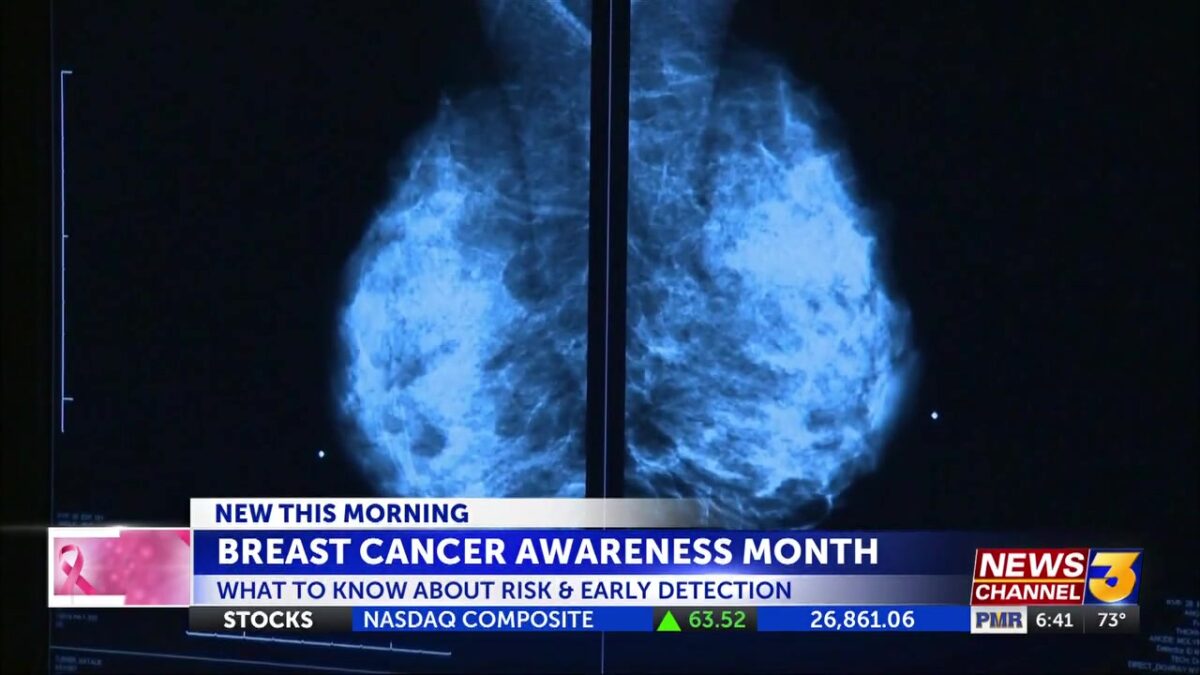
PALM SPRINGS, Calif. (KESQ) – October is Breast Cancer Awareness Month, highlighting the importance of early detection and regular screenings.

Dr. Judy Jackson and Dr. Laura Lee with Desert Regional Medical Center say knowing your personal risk and recognizing changes in your breasts can help with early detection.

A lump is one possible warning sign, but other changes can also require medical attention. Screening recommendations vary based on factors including age, family history and personal risk.

Doctors recommend talking with your healthcare provider about your individual screening schedule and any new or unusual changes.

Stay with KESQ for the latest updates.

Click here to follow the original article.

I-Team: Power Struggle Part 1

John White

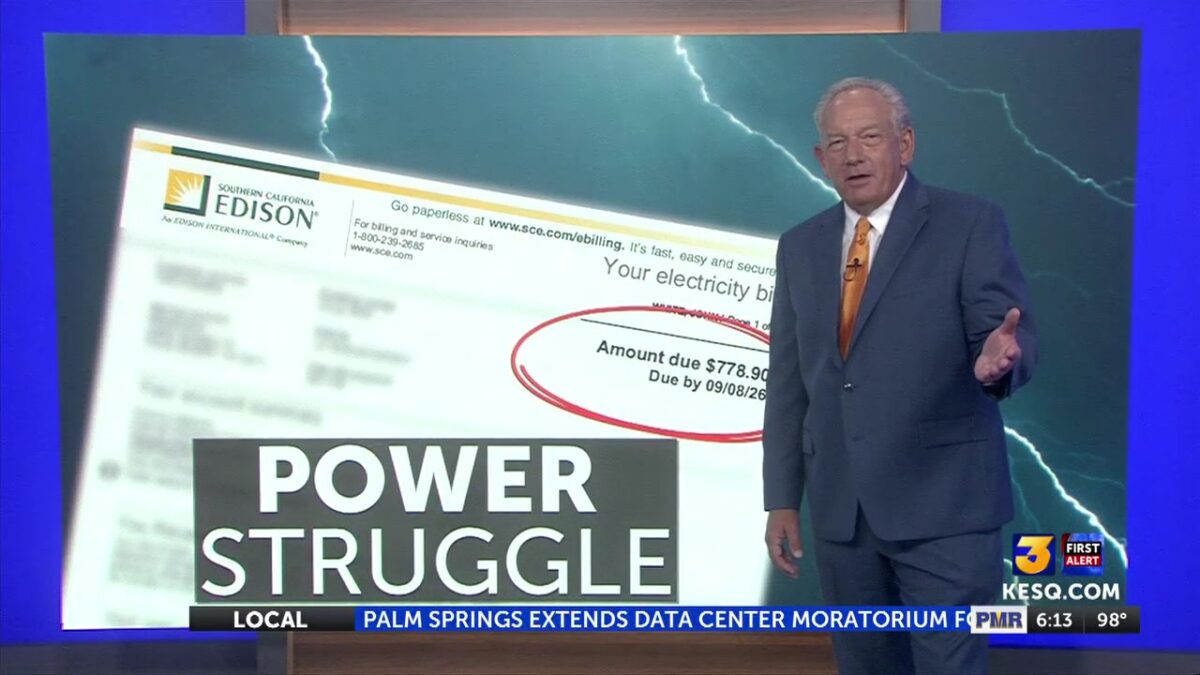
CATHEDRAL CITY, Calif. (KESQ) – Soaring temperatures and electric bills to match are a fact of life in the desert.

Ratepayers report struggling to manage those bills during the sizzling summer months.

Warren Horton, a Cathedral City ratepayer, uses thick window screens to block daylight, monitors weather conditions and keeps his thermostat in the low 80s, but still received summer power bills exceeding $400.

“Well, I think it could be affordable if you earn a million dollars a year,” Horton said.

News Channel 3 went to work to try to find out why Californians face the second highest electricity rates in the country, only behind Hawaii.

The California Independent System Operator (CAISO) runs the wholesale energy markets that power the grid for the state’s investor-owned utilities (IOUs).

Dede Subakti, Vice President of System Operations at CAISO, explains, “We’re like an air traffic controller, right?”

He explains that managing the state energy portfolio requires extensive coordination.

“I’ve seen a lot of growth in the coordination in both in the planning to make sure that we have the right mix and the right portfolio of resources being built in in California ISOs and being able to coordinate on the day-to-day operations for the day-ahead planning, as well as the real-time operation itself,” Subakti said.

Grid management relies on renewable generation and large-scale battery systems to maintain grid stability.

Overall, it’s working to increase supply and stabilize wholesale energy prices.

Wholesale electricity prices in California are often recorded between $.03 and $.07 a kilowatt hour(kwh).

In the desert, ratepayers, depending on their billing plan with SCE often pay much higher.

The “on-peak” rate for some ratepayers, at $.29, can reflect a mark-up for power generation of 800% or more.

News Channel 3 is working to get answers on that mark-up and the other side of the bill; delivery charges.

And that’s where “Power Struggle: Part Two” will pick-up, Thursday October 8th at 6:00 pm.

Click here to follow the original article.

Valley officials react to new law separating Riverside County Sheriff and Coroner offices

Jesus Reyes

SACRAMENTO, Calif. (KESQ) – Governor Gavin Newsom signed a bill that will require the Riverside County Board of Supervisors to separate the offices of county sheriff and coroner by July 1, 2027, as well as establish an independent office of the medical examiner.

The bill, authored by Senator Sabrina Cervantes, also creates clear requirements for the county to publicly report information regarding in-custody deaths on its website.

“Senate Bill 1379—which is a targeted solution to fix a long-broken system in my home county of Riverside—has been a long time coming. The goal of this new law is simple: When an individual dies in custody in a Riverside County jail, their family and the public deserve transparency,” Cervantes explained. “We owe the families the truth; we owe our communities accountability; and we owe county taxpayers a system they can trust.”

“Thank you to Senator Sabrina Cervantes and Governor Gavin Newsom for standing with Riverside County residents by enacting SB 1379. Removing the conflict of interest created when the Sheriff also oversees in-custody death determinations is a significant victory for transparency, accountability, and justice—and a vital step toward supporting families seeking answers after the death of a loved one in custody,” said Chani Beeman, member of the Riverside Sheriff Accountability Coalition.

According to the Inland Empire Lives Lost report by Care First California, 226 individuals died in custody in Riverside County jails between 2011 and 2022. The group added that during that period, Riverside County accounted for approximately 10 percent of all in-custody deaths in California despite comprising only about 6 percent of the state’s population.

In August, a federal jury found Sheriff’s personnel liable in an inmate’s fentanyl death, awarding his family $13.5 million in damages.

In 2024, the Board of Supervisors voted unanimously not to separate the coroner’s office from the Sheriff’s Department. At the time, the Executive Office determined that dividing the coroner’s office from the sheriff’s department would invite a string of complications, including likely opposition from the nearly 70 coroner’s employees — virtually the entire bureau — who are unionized and might choose to remain in the sheriff’s department, leaving major gaps in coroner’s operations that the county would have to rush to fill.

Earlier this month, the Palm Desert City Council also voted to issue a letter opposing the bill, citing legislature already enacted, AB 1108, that will require that determinations of the circumstances, manner, and cause of death for any in-custody death be made independently of the Sheriff-Coroner in every California county with a combined Sheriff-Coroner, including Riverside County. AB 1108 becomes operative on January 1.

“SB 1379 would require Riverside County alone to undertake a much broader structural reorganization only six months after that statewide independent-review requirement becomes operative and before its effectiveness can be evaluated,” read city documents.

Palm Desert’s letter also emphasizes the importance of preserving local control over the organization of local government.

01 Letter of Opposition – SB 1379 (Cervantes)Download

You can read more about Senate Bill 1379 here.

News Channel 3 spoke Thursday with both Cervantes and Riverside County Sheriff Chad Bianco about the newly signed law and what it will mean for the county moving forward.

Cervantes said the legislation was driven by concerns surrounding the number of deaths inside Riverside County jails and the need for greater independence when those deaths are investigated.

“There have been a number of different reports that have highlighted the amount of deaths in Riverside County jails,” Cervantes told News Channel 3.

She pointed to data showing 226 people died in Riverside County custody between 2011 and 2022, adding that the county accounted for roughly 10% of California’s in-custody deaths during that period despite representing about 6% of the state’s population.

Cervantes said SB 1379 is intended to respond to concerns raised by families whose loved ones have died while in county custody.

“This bill will now require the county Board of Supervisors to bring in an independent medical examiner, someone who is a licensed physician, a surgeon qualified as a specialist in pathology,” Cervantes said.

Under SB 1379, the Riverside County Board of Supervisors will be required to appoint a medical examiner who is a licensed physician and surgeon qualified as a specialist in pathology. The law also requires the county to post an initial incident report within 24 hours of an in-custody death and a preliminary report within 72 hours. Next-of-kin must also be notified regarding the cause of death within 72 hours after that cause has been determined.

Cervantes told News Channel 3 those reporting requirements are an important part of the legislation.

“There will be a website where within a certain time frame, that report will be made public to families as to what had occurred in our Riverside County jails,” Cervantes said.

She added that families and community advocates have raised concerns about unanswered questions following deaths in custody.

“This, again, is a step in the right direction when it comes to transparency that the public has been asking for and the accountability reforms that they have been asking for,” Cervantes said.

Bianco strongly opposes the separation

Bianco, who currently oversees the combined Riverside County Sheriff-Coroner’s Office, strongly criticized the law in an interview with News Channel 3.

He disputed the argument that the current structure creates a conflict of interest when someone dies in county custody.

“Because there is no conflict of interest. We don’t do our own death investigations. We never — we haven’t done that for years,” Bianco said.

Bianco said he believes combining the Sheriff and Coroner functions has allowed the county to provide death-investigation services more efficiently and at a lower cost.

He said separating the operations will require Riverside County to recreate systems and resources that are currently shared between the Sheriff’s Office and Coroner’s Bureau.

“There’s a lot of things that have to happen,” Bianco said.

According to Bianco, contracts and agreements currently held by the Sheriff’s Office for coroner services will need to be reviewed and, in some cases, renegotiated for the new medical examiner’s office.

He said the new department will also need its own records management system and other infrastructure currently provided through the Sheriff’s Office.

“They’ll have to get their own records management system. They’ll have to get their own, everything really,” Bianco said. “Policies have to be changed. Union negotiations have to happen and take place.”

Bianco also said the transition will affect employees currently working within the Coroner’s Bureau.

Those workers are currently Sheriff’s Office employees, but once the separation takes effect, Bianco said they would instead work under a separate county medical examiner’s department.

“There will be a lot of changes in people’s lives that didn’t necessarily want that,” Bianco said.

He said some employees who moved into the Coroner’s Bureau did so knowing they would remain part of the Sheriff’s Office, meaning the county will now have to address whether those employees transition to the medical examiner’s office, move into other positions within the Sheriff’s Office or are replaced by newly hired employees.

Disagreement over taxpayer costs

Cervantes and Bianco also offered sharply different assessments of what the change could mean financially for Riverside County taxpayers.

Cervantes described SB 1379 as a cost-saving measure, pointing to money Riverside County has paid to resolve litigation involving deaths in county custody.

“This is actually a cost saving measure, because the county has paid out over $100 million in settlement because of what has been occurring in our county jails that has cost taxpayers many, many millions of dollars,” Cervantes said.

Cervantes’ office has cited nearly $100 million in settlements related to in-custody deaths between 2014 and 2024 as part of its argument for the legislation.

Bianco rejected the argument that separating the offices will save taxpayers money.

He said the transition will instead require additional spending on equipment, technology, staffing and administrative systems that are currently shared.

“There is a lot going to go into this,” Bianco said. “The cost of new equipment, the cost of duplicate equipment, of redundant equipment — that’s why the offices were combined in the first place.”

Bianco did not provide News Channel 3 with a specific dollar estimate for the cost of implementing the new system during Thursday’s interview.

Transition already beginning

Despite his opposition to the legislation, Bianco said his office and Riverside County will comply with the law and are already beginning preparations for the separation.

Bianco said the goal is to make sure residents do not experience an interruption in services when the new structure takes effect.

“We are going to do everything in our power in this short time that we have to make sure that the split of these two offices is absolutely seamless,” Bianco said.

He added that county and Sheriff’s Office officials want the framework for the new system in place before the July 1 deadline.

“July 1st will be absolutely no different of a day than two weeks before that,” Bianco said. “It is our goal. It is our mission to provide the best service we can to Riverside County residents.”

Bianco said preparation began almost immediately after the bill was signed and will continue over the coming months.

“Death happens every single day, and death doesn’t stop for politics,” Bianco said. “So we have to make sure that we have the systems in place, that it’s going to be a seamless transition.”

For Cervantes, the measure of the new system will be whether families receive more information and greater transparency when someone dies in county custody.

“These are not just statistics,” Cervantes said. “Behind every number is a family that has been waiting for answers that often never come.”

Cervantes said she believes SB 1379 responds directly to concerns raised by those families and community groups.

“We want to make sure that these families’ voices are heard,” she said. “And that is what we’re doing.”

The separation must be completed by July 1, 2027.

Click here to follow the original article.

County fire stations open for tours during ‘Fire Prevention Week’

City News Service

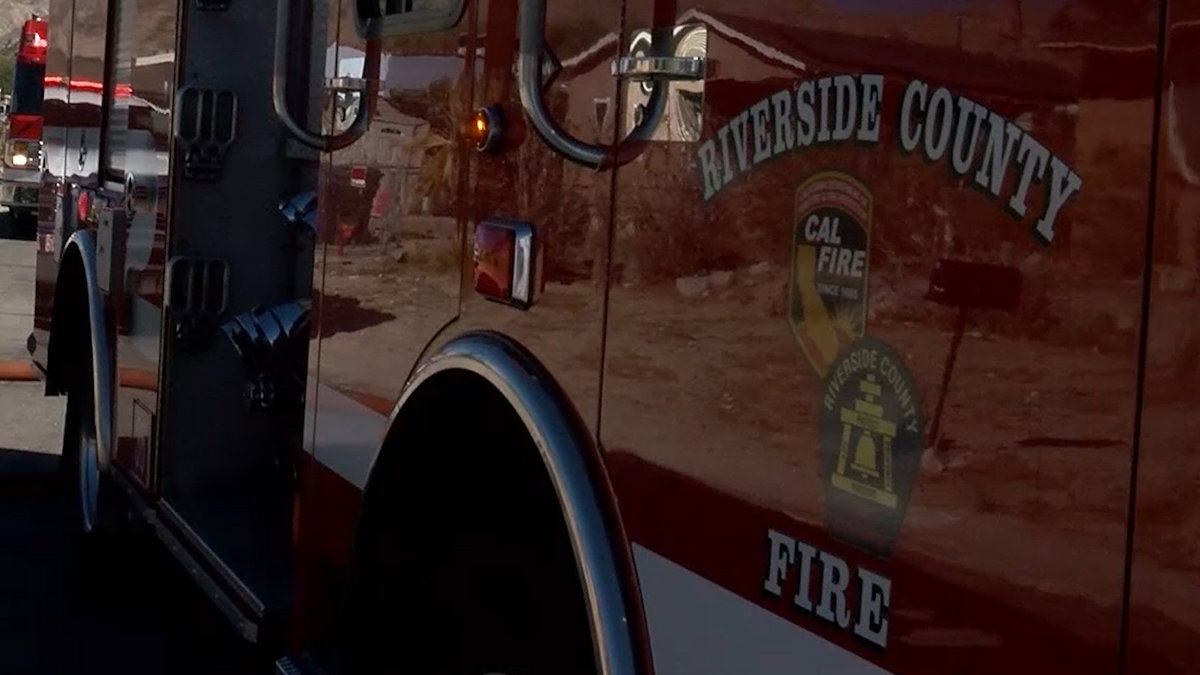
PERRIS, Calif. (KESQ) – The doors to more than a dozen Riverside County Fire Department stations will open to the public for one day in October, offering up-close views of fire apparatus, opportunities to ask questions of firefighters and learn how to reduce hazards while charging electronics during Fire Prevention Week.

“Meet your local firefighters, tour the stations, learn important fire safety tips and discover how small … habits can make a big difference,” according to an agency statement. “Activities are family-friendly and fun for all ages.”

The open houses are scheduled Saturday, Oct. 10, from 11 a.m. to 2 p.m.

One of the main points that crews will emphasize during visits will be how to properly charge electronic devices and reduce potential fire hazards, officials said. The theme will be “Plug in, power up, stay safe.”

The following stations will be available to tour during the three-hour period on Oct. 10: — Anza Station No. 29, 56560 Highway 371; — Beaumont Station No. 106, 2000 Western Knolls Ave.; — Coachella Station No. 79, 1377 Sixth St.; — Highgrove Station No. 19, 469 Center St.; — Indio Station No. 80, 81-025 Avenue 40; — Lake Elsinore Station No. 94, 22770 Railroad Canyon Road; — Lake Tamarisk Station No. 49, 43880 Lake Tamarisk, Desert Center; — Menifee Station No. 7, 28349 Bradley Road; — Moreno Valley Station No. 6, 22250 Eucalyptus Ave.; — Norco Station No. 47, 3902 Hillside Ave.; — Palm Desert Station No. 33, 44400 Town Center Way; — Perris Station No. 101, 105 S. F St.; — San Jacinto Station No. 25, 132 S. San Jacinto St.; — Temecula Station No. 12, 28330 Mercedes St.; and — Thousand Palms Station No. 35, 31920 Robert Road.

More information is available by contacting the department’s public affairs bureau at rrupio@fire.ca.gov.

Click here to follow the original article.

Palm Springs Aerial Tramway to start annual snow-guessing contest

City News Service

PALM SPRINGS, Calif. (KESQ) – Coachella Valley community members will have an opportunity tomorrow to enter the Palm Springs Aerial Tramway’s annual snow-guessing contest to win regular admission tickets.

The contest will start Thursday at One Tram Way and will continue until the first measurable inch of snow falls at the tramway’s mountain station, which has an elevation of 8,516 feet, officials said.

The first 10 guests to accurately select the day in which snow will fall at the facility will win four regular admission tickets and a special gift. If there are more than 10 correct entries, winners will be chosen by the earliest postmark date.

To submit an entry, participants must write their best guess on a postcard and mail it to Snow Guessing Contest, 1 Tram Way, Palm Springs, CA 92262. Officials said one date per postcard will be accepted.

More information, including contest rules, can be found at pstramway.com/snow-guessing-2026/.

Click here to follow the original article.

Dates announced for the 2027 Coachella Valley Invitational in Indio; MLS and NWSL teams to return

Jesus Reyes

INDIO, Calif. (KESQ) – MLS and NWSL clubs will return to the Empire Polo Grounds for the 2027 Coachella Valley Invitational, which will be held from January 30 to February 13.

It will be the sixth year of the Coachella Valley Invitational. CVI will host nearly half of MLS and NWSL clubs, including all of the Southern California-based clubs, creating the largest preseason gathering in North American professional soccer.

On Saturday, February 6, the 2027 CVI will reach another milestone with its first-ever MLS-NWSL matchday, bringing together clubs from both leagues for a unique experience for soccer fans and offering an unprecedented opportunity to celebrate the growth and momentum of the sport across North America’s premier professional leagues.

The preseason event takes place just before the MLS kicks off its new “Sprint Season,” a shortened 14-game season that will transition the league to its new summer-to-spring calendar, which will align the MLS season with the world’s top soccer leagues. The Sprint Season will run from February to May.

Advance Passes for all matchdays will go on sale to the public on Thursday, October 1, at 10 a.m. PT at coachellavalleyinvitational.com.

American Express Card Members have early access to purchase tickets for CVI before the general public starting Wednesday, September 30, at 10 a.m. PT. Terms apply.

CVI subscribers will get presale access starting Wednesday, September 30, at 12 p.m. PT. Sign up to be a CVI subscriber at coachellavalleyinvitational.com.

MLS clubs currently committed to the 2027 Coachella Valley Invitational: Austin FC, Charlotte FC, D.C. United, LAFC, LA Galaxy, Minnesota United FC, New York City FC, Portland Timbers, San Diego FC, San Jose Earthquakes, St. Louis CITY SC, and Toronto FC.

NWSL clubs currently committed to the 2027 Coachella Valley Invitational: Angel City FC, Bay FC, Chicago Stars FC*, Denver Summit FC, KC Current, San Diego Wave FC, Seattle Reign FC, and Utah Royals FC.

*Teams making their CVI Debut

EVENT DATESFull schedule of matchups to be released at a later date.

Saturday, January 30 (NWSL) Featuring local teams Angel City FC and San Diego Wave FC Saturday, February 6 (NWSL + MLS) Featuring local teams San Diego Wave FC and San Diego FC Sunday, February 7 (MLS) Featuring local teams LA Galaxy and LAFC Wednesday, February 10 (MLS) Featuring local teams LA Galaxy, LAFC, and San Diego FC Saturday, February 13 (MLS) Featuring local teams LAFC and San Diego FC Click here to follow the original article.
Palm Springs City Council approves extending data center moratorium

Luis Avila

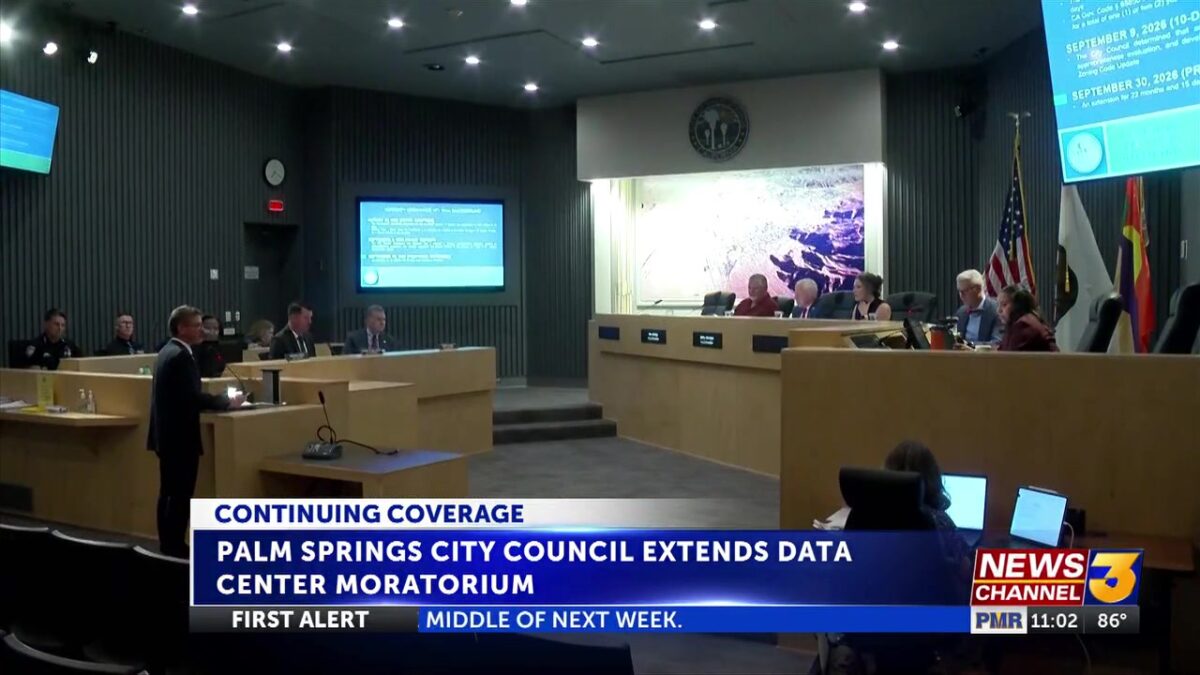
PALM SPRINGS, Calif. (KESQ) — The Palm Springs City Council voted unanimously Wednesday to extend the city’s temporary moratorium on new data center applications and permits, giving officials more time to study how the facilities could be regulated.

The council originally approved a 45-day moratorium on Aug. 26. That temporary ban was set to expire Oct. 10.

Under the extension approved Wednesday, the moratorium will remain in place for another 22 months and 15 days while the city works on potential regulations as part of its broader zoning code update.

Palm Springs’ current municipal and zoning codes do not specifically define or regulate data centers.

The city also plans to consider input from community members, technology experts and other Valley stakeholders as part of the process.

During public comment, resident Kylee Cabral questioned the city’s justification for using an emergency ordinance to impose the moratorium.

“It’s clear the city is still unsure of the exact nature of the threats it’s attempting to mitigate by invoking an emergency ordinance,” Cabral said.

Other questions focused on how broadly the city could define a data center. That could include facilities that house servers but serve another primary purpose, such as hospitals, colleges or other buildings.

Mayor Naomi Soto said the comprehensive zoning update gives the city an opportunity to take a closer look at what the community is open to and what potential impacts should be considered.

“It’s not the conversation is nixed completely,” Soto said. “We are trying to channel it to the appropriate process.”

Stay with News Channel 3 for more.

Click here to follow the original article.