4 birds still missing after break-in at Marysville falconry facility

By Richard Ramos

Click here for updates on this story

    MARYSVILLE, California (KMAX, KOVR) — A Yuba County falconry said someone broke into the facility and intentionally released nearly a dozen birds from their enclosures on Thursday night.

Staff at West Coast Falconry say the incident happened overnight, when someone entered the property, cut off tracking gear attached to the birds and forced them out of their enclosures.

The facility said 11 birds were released during the break-in. Most have since been recovered, but four remain missing: a barn owl, a great horned owl, a peregrine falcon and a dark morph red-tailed hawk.

Officials say the birds may resemble native species commonly seen in the area, but stress these animals were bred in captivity and are not capable of surviving on their own.

West Coast Falconry said the birds are imprinted on people and may behave differently from wild birds.

Authorities, including the Yuba County Sheriff’s Office, the California Department of Fish and Wildlife and federal wildlife officials, have been notified and are assisting in the response.

Search efforts are ongoing.

Please note: This story was provided to CNN Wire by an affiliate and does not contain original CNN reporting. This content carries a strict local market embargo. If you share the same market as the contributor of this article, you may not use it on any platform.


California lawmaker introduces bill to protect wildlife from euthanasia, create coexistence program

By Dean Fioresi, Lesley Marin

Click here for updates on this story

    CALIFORNIA (KCAL, KCBS) — A Southern California state senator has proposed a new law that would prevent euthanasia in the state’s wildlife just a month after a mother bear was put down for swiping at a woman in Monrovia, feet away from where her two cubs were located.

The legislation, SB 1135, which was introduced by Sen. Catherine Blakespear (D-Encinitas), calls for the establishment of a state program that promotes the coexistence with wildlife and codifies a wolf-livestock coexistence and compensation program. The move comes two years after funding for a similar wildlife coexistence program expired.

“We can and must responsibly support people and wild animals to exist in a California where we are all under growing pressures and cumulative threats like extreme heat, frequent drought and intense wildfires that animals respond to by moving in search of resources to survive,” Sen. Blakespear said in a statement. “That means investing in science-based, situation-specific, proactive strategies to minimize negative interactions and prevent escalation to conflicts that pose risks for people and animals. SB 1135 proposes a program to better protect people, wildlife and communities.”

The proposed coexistence program, which would be allocated nearly $50 million through the state’s 2026-27 budget, would build on the previous version, which deployed trained regional human-wildlife conflict staff around the state. The absence was noted by CDFW leaders during a state Assembly meeting in January, according to Blakespear.

“Over the last five years, wildlife incident reports logged by the California Department of Fish and Wildlife (CDFW) increased by 31 percent and calls, emails and field contacts rose by 58 percent,” Blakespear’s proposal says.

She noted the recent headline across the state, including “Blondie,” the Monrovia mother bear who was captured and put down by wildlife officials in March after it swiped at a woman near the home it was living under with its two cubs.

The home in question belongs to Richard Franco. He, along with many other Monrovia residents, has documented his encounters with bears over the years, even setting up a system of trail cameras to track the bears’ movements.

“Getting to know her, you could see what a devoted mother she was,” Franco said. “She was always building a nest.”

Franco and many of his neighbors were angered upon learning that CDFW officials had euthanized Blondie after her capture, which they credited to the fact that she had swiped at the woman days earlier and another person in 2025.

“Forcing them out, and then euthanizing the mom was just traumatic for us,” said one Monrovia couple. “It was just tragic, and there was no need for it; it was completely unnecessary.”

Situations like this are what caught Blakespear’s attention, leading to her proposal last week.

“It is really my desire to make sure that wild places stay wild, and not be having to resort to lethal measures like killing bears or killing wolves,” Blakespear said, while speaking with CBS LA. “We need to have a program that is up and going so we can be educating people.”

The program calls for focus on public education, maintaining a statewide incident reporting system and deploying devices like barriers, noise and light machines and other technology that would deter predators from places where they shouldn’t be.

SB 1135 passed on a 5-1 vote and will now be considered by the Senate Appropriations Committee.

Please note: This story was provided to CNN Wire by an affiliate and does not contain original CNN reporting. This content carries a strict local market embargo. If you share the same market as the contributor of this article, you may not use it on any platform.
Fish struggle in Jordan River as low runoff leaves water dangerously shallow

By Nate Larsen

Click here for updates on this story

    MURRAY, Utah (KSTU) — What should be the height of spring runoff is telling a very different story along the Jordan River — and it’s a concern that first came to light thanks to a local viewer.

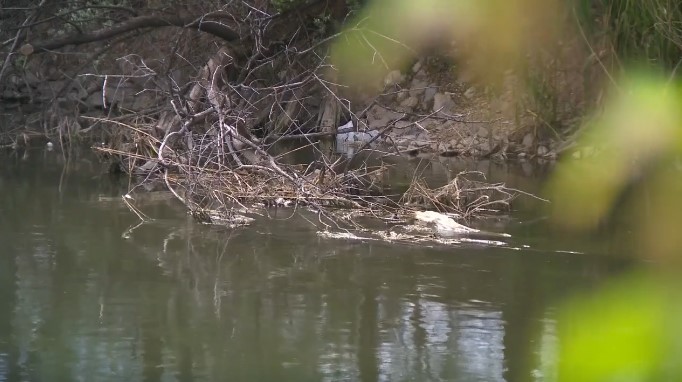
After noticing something unusual, Murray resident Chelsea LaRoe reached out to FOX 13 News, sharing video of fish struggling in shallow water along the river. In some areas, water levels have dropped so low that parts of the river are only a few inches deep, creating challenges for fish trying to survive.

“I was walking the trail today and I just kind of heard this ‘flip-flop’ noise in the water,” LaRoe said. “I looked over and noticed all the fish flopping around in the water… and I realized the water levels were very low.”

LaRoe says the shallow conditions are striking and concerning.

“You could probably walk to the middle of that and be less than knee-deep high in the Jordan River,” she said. “To have our waters down to nothing… it’s very frightening for Utah.”

After hearing from LaRoe, FOX 13 took a closer look at conditions along the river and found that the issue goes far beyond a single stretch. Hydrologists say low flows are being seen across much of the state.

“It’s a direct feedback loop from our record low snowpack that we saw this winter,” said Glen Merrill, a hydrologist with the National Weather Service.

Merrill says the lack of snow has already had a major impact on runoff timing.

“Many [rivers] have already been through their peak flows about a month to a month and a half early,” he said.

With less water moving through rivers and streams, fish are being forced into smaller, more crowded spaces — adding stress to already difficult conditions.

“There’s going to be lesser flows in streams… less area in the stream… same number of fish, less space for each of them,” said Trina Hedrick, Cold Water Sport Fish Coordinator with the Utah Division of Wildlife Resources.

As temperatures rise, the situation can become even more dangerous.

“As the water warms, it’s holding less oxygen as well,” Hedrick said.

Wildlife officials say that combination — low water, warmer temperatures, and reduced oxygen — can make it much harder for fish, especially cold-water species like trout, to survive. They’re encouraging anglers to take extra precautions, including fishing during cooler parts of the day and minimizing how much fish are handled before being released.

“If you are going to catch and release, don’t even take it out of the water,” Hedrick said. “The less you can handle a fish, the better.”

Experts also stress the importance of conserving water at home, noting that many of Utah’s rivers and reservoirs serve as key water sources for communities.

“The less we use in our homes, the more stays in those water bodies,” Hedrick said.

With streamflows already running well below normal, and little relief in sight, conditions like those seen on the Jordan River will likely continue, or worsen, in the coming months.

Please note: This story was provided to CNN Wire by an affiliate and does not contain original CNN reporting. This content carries a strict local market embargo. If you share the same market as the contributor of this article, you may not use it on any platform.
This farmer credits homemade ‘Hobbit Hole’ greenhouse with saving crops from freeze

By Mythili Gubbi

Click here for updates on this story

    OGDEN, Utah (KSTU) — Last week’s freezing temperatures hit Utah’s fruit farms hard, with experts saying most lost their entire crop. But one farmer in Ogden credits the produce he thinks he can harvest to his homemade contraption.

On Monday, Chad Midgley visited his farm for the first time since the freeze.

“It makes me want to cry, it’s really hard to be here,” he said looking at the plants that didn’t make it, like peaches, peas and pomegranates. “It started out as a jackpot, everything was real warm, blooming early, all kinds of fruit, thought we were going to have the biggest year we’ve ever had, and then in the last two weeks, it’s all crumbled.”

He has been farming for 30 years and has multiple farms, mainly in Davis County. But a common denominator on all his farms are his “Hobbit Hole Greenhouses.”

“There are compost piles mixed in between plastic layers like a hamburger, and water mass inside, and they actually throw enough heat out that it kept everything alive, even citrus trees alive,” Midgley explained.

The tomato, lemon, grapefruit, peach, blood orange and other plants inside the greenhouses were thriving.

“We have peaches that are good, and look here, look at this grapefruit, it’s like a Christmas ornament,” Midgley pointed out in the greenhouse.

But most fruit farms across the Wasatch front didn’t do so well.

“They’ve experienced almost 100 percent loss on all fruit crops, and so that includes peaches, cherries, pears, apples, all of it,” said Taun Beddes, a horticulturist with Utah State University Extension. “I’ve been in the green industry for 25 years, and have never seen this.”

Beddes said farmers have been dealing with one blow after another.

“Not only were they dealing with drought conditions, but now, you know, we don’t have much of a fruit harvest,” Beddes added.

Midgley called his greenhouses “a miracle.” He said the doors and windows of the greenhouse were open during the freezing temperatures, but the heat from inside protected the plants.

Midgley said he hopes people support local farmers this year, more than ever.

“There’s not going to be as many farmers selling things and supply is going to be a lot lower. We need your guys’ support to get through this year,” he said.

Beddes added that it’s important to support farms in any way possible, such as visiting for events and participating in various ways.

Please note: This story was provided to CNN Wire by an affiliate and does not contain original CNN reporting. This content carries a strict local market embargo. If you share the same market as the contributor of this article, you may not use it on any platform.

Federal magistrate recommends Colorado firebombing suspect’s family be released from ICE custody

By Austen Erblat

Click here for updates on this story

    BOULDER, Colorado (KCNC) — A federal magistrate in Texas has recommended that a judge order the release of the family of the Boulder, Colorado, firebombing suspect in a Monday court filing. A hearing is set for Thursday, April 23, at the federal courthouse in San Antonio, TX.

A lawsuit was filed on behalf of Hayam El Gamal and her five children seeking their release, as El Gamal has been experiencing serious medical issues, according to her legal team, and the FBI concluded months ago that the family knew nothing of Mohamed Soliman’s plans.

On June 1, 2025, Soliman allegedly threw makeshift incendiary devices at people who marched in downtown Boulder to bring attention to Israeli hostages who were being held in Gaza at the time, injuring over a dozen.

Weeks later, one of those people, 82-year-old Karen Diamond, died of her injuries, officials said, and Soliman was charged with first-degree murder, in addition to dozens of state and federal charges related to attempted murder, assault, use of incendiary devices, and hate crimes.

Soliman’s family had been living in Colorado Springs at the time of the attack and applied for asylum after their visas expired. Upon learning of their immigration status, former Homeland Security Secretary Kristi Noem ordered Immigration and Customs Enforcement to take the family into custody, where they’ve been for about 10 months.

In one of the court cases against Soliman, an FBI agent testified that the family knew nothing of the attack, and they had cooperated with the investigation. They’ve been held at the Dilley Immigration Processing Center in Texas for almost the entirety of their detention. They were denied bond by Immigration Judge Justin Adams in January, reversing his own decision from September 2025, which declared that they were eligible for release on bond.

El Gamal’s attorney, Eric Lee, said in a tweet that she “suffered a serious medical emergency due to systematic denial of medical attention by ICE.” He told CBS News Colorado previously that if the family were to be deported to Egypt, their cooperation with the FBI in the investigation would put them at risk.

El Gamal filed for divorce from Soliman after he was arrested.

On Monday, U.S. Magistrate Judge Elizabeth Chestney recommended that U.S. District Judge Fred Biery order the release of El Gamal and her children, aged 5, 5, 9, 16, and 18.

Chestney said the government has failed to prove that the family is dangerous or a flight risk, and wrote in her filing that there are “significant risks that the Government will intervene to again target Petitioners’ case and to prevent their lawful release.”

She wrote that “immediate release is the appropriate remedy” and that if the government wanted to detain the family, the efforts must comport with due process and involve an individualized bond hearing where the government must justify the detention.

The family’s attorney Eric Lee said, “We feel vindicated by the fact that a federal court has ordered the El Gamal family released, and ruled that the government’s ongoing detention of five children and their mother violates the Constitution.”

Democratic Rep. Joaquin Castro, of Texas, said last week that he met with El Gamal and her children and said that, in addition to El Gamal’s pain as a result of fluid near her heart, one of her daughters needs dental surgery but has been refused care.

The congressman previously helped get Liam Ramos, a 5-year-old boy from Minnesota, and his father released from the same facility.

“The children are bright, gracious, and innocent,” Castro wrote on social media. “The family must be released.”

Late Monday, DHS Acting Assistant Secretary Lauren Bis sent a statement saying:

“The facts of this case have not changed: Mohammed [sic] Soliman is a terrorist responsible for an anti-Semitic firebombing in Boulder. The judge wants to release this terrorist’s family onto American streets. Under President Trump, DHS will continue to fight for the removal of those who have no right to be in our country, especially national security threats.”

Please note: This story was provided to CNN Wire by an affiliate and does not contain original CNN reporting. This content carries a strict local market embargo. If you share the same market as the contributor of this article, you may not use it on any platform.

Towering, once-in-decades agave bloom draws crowds in St. George

By Chris Reed

Click here for updates on this story

    ST. GEORGE, Utah (KSTU) — It’s a rare sight.

An agave plant is blooming for the first time at the Red Hills Desert Garden in St. George, drawing crowds to see a stalk that resembles a giant asparagus.

The plant, currently standing at about 18 feet tall, is growing approximately a foot a day. Depending on the species, agaves take between 10 and 100 years to bloom.

Ryan White, a landscape education administrator for Washington County Water Conservancy, oversees the garden and its 15 agaves.

“Some of the fun questions I get is about: ‘Why does it look like a giant asparagus?’ And it’s because they are actually related,” White said.

While agaves are the primary ingredient in agave tea, sweetener, and tequila, White advises against eating this particular stalk.

“Once the stalk gets to be this size, it’s probably a bit too fibrous and chewy to eat,” White said.

The massive blooms can cause issues if they get too large.

“A couple years ago, there was one in the town of Gunlock that was 50 years old and it was about a 30-foot-tall bloom. When it fell over, it actually crushed the homeowner’s fence,” White said.

Dozens of people, along with owls nesting in the rocks above, have visited the garden to admire the rare sight.

“Every day, there’s people here just looking for that. Just looking for the agave,” White said.

Carol Fenn, an agave watcher from St. George, brought her niece to see the plant.

“I told my niece, she got in town last night, I said, ‘We have to go check this out because I saw it on Facebook and I’ve never seen an agave bloom,'” Fenn said.

Fenn’s niece, Rhiannon Garrard, is a geologist from Tropic.

“There’s something probably in the soil here, too, that makes the agave so abundant. A lot of the rocks we’re in, they have minerals from ancient environments, and the agave probably just love it,” Garrard said.

The agave will continue to bloom for another week to a month. After the bloom is complete, the plant will die.

“I see it more as a grand finale. You’ve grown this plant for a decade or more, and now you’re getting this spectacular bloom,” White said.

Please note: This story was provided to CNN Wire by an affiliate and does not contain original CNN reporting. This content carries a strict local market embargo. If you share the same market as the contributor of this article, you may not use it on any platform.

Records: Man accused of entering Blue Springs school with ‘ghost gun’

By Nick Sloan

Click here for updates on this story

    BLUE SPRINGS, Missouri (KMBC) — Charges have been filed against a man accused of bringing a loaded gun into a Blue Springs elementary school.

Cory Adams, of Independence, is charged in Jackson County with unlawful use of a weapon for allegedly carrying a loaded firearm into Sunny Pointe Elementary School on April 16.

Police were called to the school that morning on a report of a disturbance involving a man with a gun

Officers found Adams inside the building near the front office after he had entered through glass doors, according to court records.

A probable cause statement says Adams allegedly resisted before being taken into custody after a “brief struggle.”

Police said they recovered a 9mm handgun from his waistband loaded with 15 rounds.

Police later determined the gun appeared to be a “ghost gun,” meaning it did not have a serial number.

A woman who called police told officers she believed Adams was armed and feared he was coming to the school to harm her.

Please note: This story was provided to CNN Wire by an affiliate and does not contain original CNN reporting. This content carries a strict local market embargo. If you share the same market as the contributor of this article, you may not use it on any platform.

Water rushes into elementary school amid severe storm flooding

By Tanner Kahler

Click here for updates on this story

    JANESVILLE, Wisconsin (WISN) — Dramatic new video shows water breaching a school cafeteria door and flooding Washington Elementary School in Janesville during severe weather Friday.

Water rose several feet and caused significant damage to several rooms in the school.

In a Facebook post Monday, the School District of Janesville announced Washington Elementary will stay closed for the foreseeable future.

Approximately 400 students were displaced due to the flooding damage.

“There is significant impact on essential service areas including the kitchen, lunchroom, art room, mechanical systems and several classroom spaces,” the post said.

Classes at the school have been canceled for the rest of the week.

“We are thankful to our custodial staff who have been in all of our buildings all weekend, ensuring schools were ready for learning today,” Superintendent Mark Holzman said. “And for all the community’s support, reaching out to help, whether with childcare or in other ways. This community really shows up to support our schools.”

Please note: This story was provided to CNN Wire by an affiliate and does not contain original CNN reporting. This content carries a strict local market embargo. If you share the same market as the contributor of this article, you may not use it on any platform.

Burlington residents face flooding as Fox River overflows into homes, parks

By Duke Carter

Click here for updates on this story

    BURLINGTON, Wisconsin (WISN) — The Fox River continues to flood streets, parks, and homes in Burlington after last week’s storms, with residents working to manage the water’s impact.

Beaumont Park remains underwater Monday, with its playground and baseball and softball fields submerged.

“It’s for fishermen and tourists and kayakers and all kinds of people love to use it. So sometimes it’s our friend. Sometimes it’s our foe,” said Donna Minkly, who runs an Airbnb near the river.

Minkly’s basement is now flooded due to heavy rain.

“We’re looking at groundwater entering through an outlet in the bottom of my basement. It’s not a worry. I suppose afterwards, we’re going to have to get the electrician in here,” she said.

Rich Cassidy, who lives along the Fox River, said residents are using sump pumps to keep water out of their homes.

“I went from two pumps to five pumps. Pumping it out,” Cassidy said.

“Pumping it out?” WISN 12 News’ Duke Carter said.

“Yeah, because it came in this way. Pretty good. So what I did is I ran over to Menards, got a couple extra pumps,” Cassidy said.

Cassidy described the flooding as one of the worst he can remember, comparing it to flash flooding in 2017.

“We lost everything then. I totally went under, but people got nervous on this one, which I don’t blame them. You know, that’s a scary thought, but if you just take, you know, keep going at it. Keep fighting the water. You’ll get through it,” he said.

Despite the challenges, Cassidy remains optimistic about living near the river.

“I got a nice river. You’re not going to get that as a backyard anywhere. So, you got to deal with ups and downs,” he said.

Please note: This story was provided to CNN Wire by an affiliate and does not contain original CNN reporting. This content carries a strict local market embargo. If you share the same market as the contributor of this article, you may not use it on any platform.

Some Minnesota farmers skipping planting season amid rising fuel and fertilizer costs

By John Lauritsen

Click here for updates on this story

    Minnesota (WCCO) — Planting is underway and spring conditions have been good across much of Minnesota. But even so, some farmers are electing to sit out a year.

“It’s very dry for April 20. We have great field conditions, dry soil, the frost is out of the ground,” said Ryan Mackenthun.

For Mackenthun, getting off to a good start is key to getting good yields. On Monday, it was all about planting corn in McLeod County, despite challenges ranging from high fertilizer and fuel costs to trade wars and tariffs.

“As a farmer, I’m optimistic that eventually we’re going to have a market that will supports farming,” said Mackenthun.

Steve Zenk shares Mackenthun’s optimism, but with a volatile market, the Minnesota Department of Agriculture farm advocate is noticing a trend: more farmers are leasing out their property instead of farming it themselves.

“The neighbor will pay me $300 an acre and I can just take the year off. I mean yeah, it’s a very particular set of criteria for you to be able to do that,” said Zenk.

Zenk said it’s an option that makes sense for older farmers who have owned their land for decades and don’t believe they can make a profit this year.

Working with finances on a daily basis, Zenk said it boils down to sheer numbers. Right now, he foresees some farmers spending up to $900 to plant an acre of corn but getting a return of $800, a net loss.

While that’s not the case everywhere, Zenk knows many Minnesota farms are struggling to make a profit.

“I’m happy if I can get them to break even. There’s just not a lot of profitability in most farming operations right now,” said Zenk. “We will get better at this and we’ll get through this, and we have many times before, and then things will get better again.”

Zenk said he’s also seeing similar cases with cattle where high prices have some farmers choosing not to buy cattle and leaving their feed lots empty, for now.

Please note: This story was provided to CNN Wire by an affiliate and does not contain original CNN reporting. This content carries a strict local market embargo. If you share the same market as the contributor of this article, you may not use it on any platform.