By Nick Sloan & Beth Carlson
Click here for updates on this story
KANSAS CITY, Missouri (KMBC) — Kansas City has signed off on a $600 million commitment toward a new Royals stadium, advancing a $1.9 billion plan that calls for public sources to cover 60 percent of the project’s cost.
The Kansas City Council on Thursday approved an ordinance 11-2 authorizing a package of agreements for a new Royals stadium in the Washington Square Park and Crown Center area.
Under the agreement, the goal is for public sources to cover 60% of project costs up to $1.9 billion, or an estimated $1.14 billion. Private funding would cover the other 40%, or about $760 million.
The vote came after council members offered different views of what the stadium could mean for Kansas City.
Councilmember Johnathan Duncan, who voted against the ordinance, said he supports parts of the agreements, including labor protections and apprenticeship opportunities, but believes the city is giving up its negotiating leverage too soon.
“We only get one time to do this right,” Duncan said. “This is not just a deal for us. This is not just a deal for our children. It’s a deal for our grandchildren.”
Duncan said the city should continue negotiating for additional community benefits and stronger financial protections before authorizing the agreements.
“We are telling the Royals that we are moving forward on a deal that’s incomplete, that does not have the assurances that we need,” Duncan said.
He also questioned whether Kansas City is getting enough in return for its investment, pointing to the community benefits package and the city’s financial commitment.
“Our city deserves better. Our residents deserve better. We deserve better, and we have all the leverage,” Duncan said.
Councilmember Wes Rogers supported the deal.
He called Thursday “a really exciting day” and predicting the stadium development will generate jobs and bring millions of additional visitors into downtown Kansas City.
“I’m not celebrating because of baseball. I’m not celebrating it because of billionaires,” Rogers said. “I’m celebrating it because of the people who live and work in Kansas City and who believe in our city.”
Rogers spoke on the agreements involving organized labor and prevailing wages and said construction and surrounding development could provide billions of dollars worth of work.
He also argued the impact would extend beyond construction, with baseball fans spending money at restaurants, bars, hotels and other businesses.
“We have 3 million new people coming downtown every year,” Rogers said. “They’re going to walk by our restaurants. They’re going to walk by our bars. They’re going to walk by retail establishments. They’re going to stay in our hotels.”
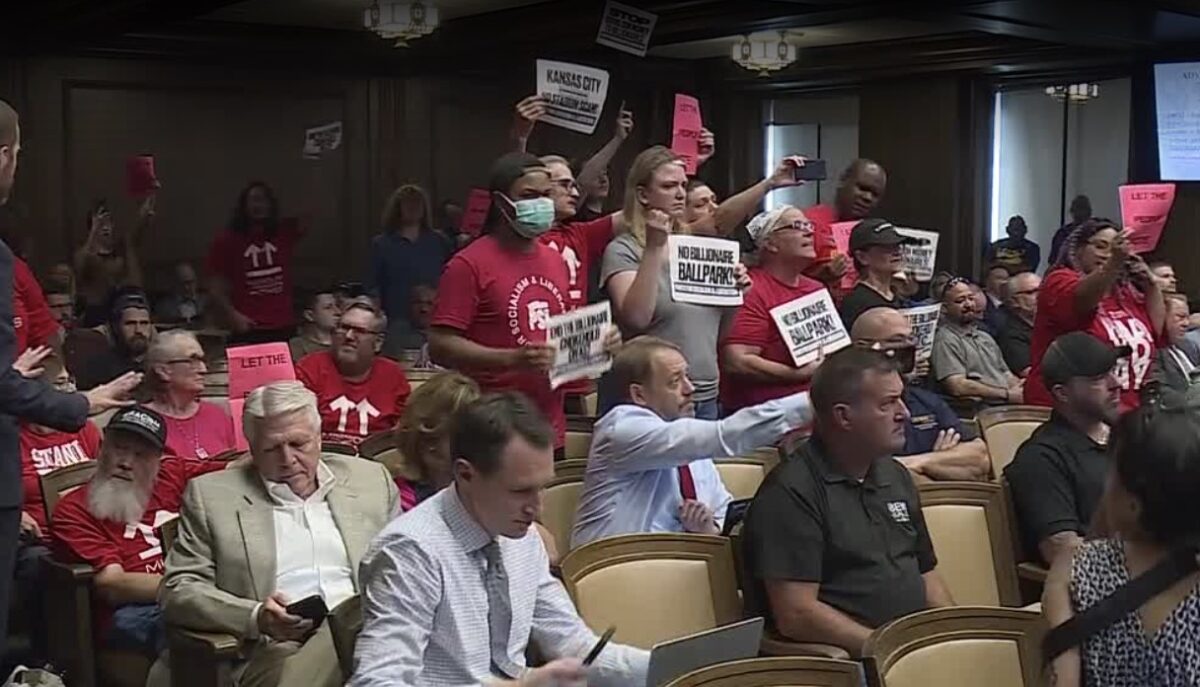
The council’s decision drew an immediate response from some people watching inside City Hall.
After the measure was approved, a crowd of demonstrators and residents could be heard yelling “Shame on you” and “Let us vote” at council members.
The Royals reacted after the vote, calling it a “major step forward.”
“The tireless work of our Mayor, City Manager and City Council today resulted in a major step forward for our team, our fans and for the hometown we love,” Royals Chairman and CEO John Sherman said after the vote on Thursday. “This step advances what will be the largest public-private economic development project in Kansas City. It will bring Royals baseball to the center of our city, creating jobs, housing and year-round economic activity, advancing Kansas City’s terrific momentum. We are grateful for the broad support from the community, surrounding neighborhoods and Royals fans everywhere. Ewing Kauffman founded the Royals in the spirit of making Kansas City better. We are proud stewards of that vision and intend to fulfill it by making the Royals Kansas City’s forever.”
Kansas City’s share of that public funding is $600 million.
Up to $90 million of the city’s commitment can go toward infrastructure.
The remainder is expected to be financed primarily through city-supported bonds, although the city can use other legally available funding sources.
Thursday’s ordinance starts that process by creating a “Special Obligation Downtown Stadium Bond Fund” and appropriating $20 million in bond proceeds toward the city’s contribution.
The Royals would not be responsible for repaying the city’s bonds.
The team does, however, take on significant financial responsibility if the project becomes more expensive or anticipated public money falls short.
What’s the next action needed on the Royals stadium proposal?
The council voted Thursday to commit its share of the funding, but it’s not the final city council action needed before the proposed stadium can move forward.
Kansas City Mayor Quinton Lucas said decisions are still ahead, including zoning, bond financing and tax increment financing, or TIF.
“The other agreements that we still have yet to vote on, first of all, include the zoning issues that will be before us in the first week of September, and then subsequent bond agreements or an ordinance authorizing such, and then fundamentally the TIF itself,” Lucas said.
He said the TIF and bond proposals will also undergo third-party analyses before the council considers them.
How the funding for the Royals stadium proposal in downtown Kansas City breaks down Funding remains one of the biggest pieces still to come together.
The total cost of the project is $1.9 billion.
Under the funding agreement, the goal is for public sources to cover 60 percent, or about $1.14 billion, while private funding from the Royals covers about $760 million.
The city’s portion of the public contribution is $600 million, including up to $90 million for infrastructure. The rest of the city’s commitment is expected to be financed largely through city-supported bonds or other legally available sources.
The agreement also includes $50 million in Missouri Development Finance Board tax credits, $23 million in MODOT economic development funding, $20 million through another MODOT cost-share program and $55 million previously appropriated by the state.
Please note: This story was provided to CNN Wire by an affiliate and does not contain original CNN reporting. This content carries a strict local market embargo. If you share the same market as the contributor of this article, you may not use it on any platform.