COCC educators and faculty rally as contract negotiations reach standstill

Spencer Sacks

BEND, Ore. (KTVZ)– For the first time in its 75-year history, Central Oregon Community College faculty and classified staff, represented by two separate unions, are joining forces to demand living wages.

Contract negotiations are never easy.

They can last for months and even years as employers and employees work to resolve their differences.

At Central Oregon Community College, it’s no different. After 10 months, classified workers and COCC have come to a standstill. The issue at the heart of negotiations is pay.

Scott Dove, an academic tech specialist, told KTVZ News, “We got here because the college is reluctant to offer us what we would consider a living wage and what we frankly consider that we need in order to be able to continue to live here in Central Oregon.”

 Greg Pereira, COCC’s President, told KTVZ News, “We really just hope it leads to a resolution. That’s the most important thing at this point, that we can find equitable and good outcomes that show that we value our staff, that show good financial stewardship, long-term for the institution.”

The classified workers’ union is entering a 14-day mediation period with COCC and a state mediator to hopefully solve the contract dispute. 

Classified workers include staff like custodians, counselors, and tech support.

At the same time, the college’s other major union, representing the faculty, is beginning its budget negotiation period to increase salaries. 

“So even though we live in the most expensive part of the state, our wages have fallen behind by quite a bit,” Mindy Williams, the lead of the faculty bargaining team, told KTVZ News. “So we’re looking to reclaim our worth in terms of our workload so we can better serve this community and serve our students.”

The faculty and COCC will have 145 days to reach an agreement before they reach a mediation stage.

Mediation between COCC and the classified workers will begin in February.

Click here to follow the original article.

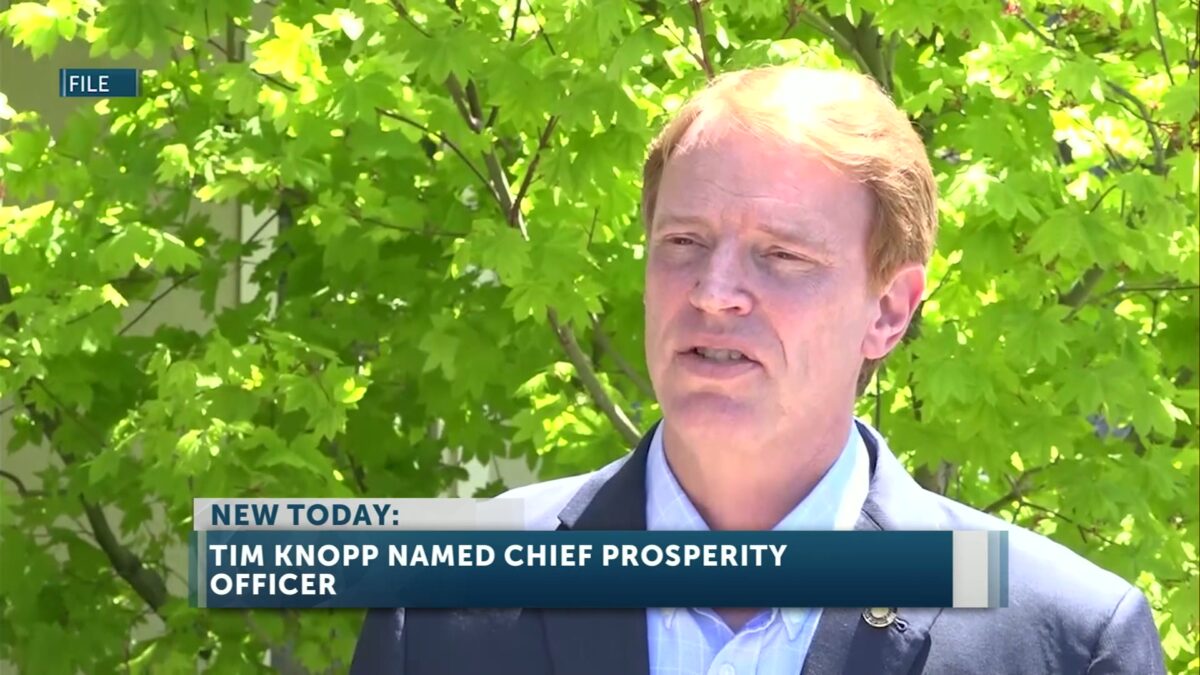
Bend’s Tim Knopp named Oregon’s new Chief Prosperity Officer

KTVZ – News Team

SALEM, Ore. (KTVZ) — Governor Tina Kotek has appointed former Oregon State Senator Tim Knopp of Bend as the state’s new Chief Prosperity Officer – a key role aimed at growing Oregon’s economy, creating good-paying jobs, and supporting local businesses.

Kotek announced the appointment Tuesday, saying Knopp’s business background and decades of public service make him well-suited for the position. “To be successful, this role demands a unique set of skills — an entrepreneurial spirit, a systems thinker, and equal parts pragmatism and persistence,” Kotek said in a statement. “Tim is going to be a great part of my team, and I am grateful that he has agreed to step up and serve Oregonians.”

Knopp, a lifelong Oregonian and longtime Central Oregon resident, served in the Legislature for more than two decades: first in the Oregon House from 1999 to 2005, and later in the Oregon Senate from 2013 until his retirement in 2025. During his time in the Senate, he represented much of Deschutes County and served as Senate Minority Leader.

His tenure also included a high-profile role in the 2023 Republican walkout that stalled the legislative session for weeks and later triggered enforcement of Ballot Measure 113, which barred several senators, including Knopp, from seeking re-election after accruing too many unexcused absences. Supporters framed the walkout as a stand on principle over controversial legislation, while critics said it undermined the democratic process.

In addition to his public service, Knopp has deep ties to the Central Oregon business community. He currently serves as executive vice president of the Central Oregon Builders Association, representing more than 800 local companies, and as executive director of Building Partners for Affordable Housing, a Bend-based nonprofit focused on housing solutions. He said he’ll be stepping down from both roles as he takes on this new statewide position.

“When the governor calls on you to drive prosperity for Oregonians across the state, grow the economy, and support Oregon businesses, the answer is yes,” Knopp said.

The creation of the Chief Prosperity Officer position is part of Kotek’s broader “Prosperity Roadmap” initiative — a strategic effort to boost Oregon’s GDP and expand opportunities for businesses and workers statewide. Knopp will also play a key role in supporting the governor’s newly formed Prosperity Council, which includes business leaders like Ampere founder Renee James and Port of Portland Executive Director Curtis Robinhold.

Knopp, who has lived in Central Oregon for more than 40 years, has also served on local boards including the Bend Chamber of Commerce and the nonprofit First Story.

He’s expected to assume his new role in the governor’s office next week.

Click here to follow the original article.

KTVZ Meteorologist Shannon Brady Signs Off, Moving to Arizona for New Opportunity

KTVZ – News Team

BEND, Ore. (KTVZ) — On Wednesday, January 14th, KTVZ Meteorologist Shannon Brady gave her final weather forecast on KTVZ News.

Shannon is moving back to Arizona where she attended Arizona State University before moving to Bend to work at KTVZ News. Shannon has loved ones in Arizona and is looking forward to being closer to her family and friends. She has accepted a position outside of news.

“Thank you so much for all the kind words and support you have offered me during my time here,” Shannon said to our viewers.

We will miss you, Shannon! Best of luck on your future endeavors!

You can follow along on Shannon’s journey in Arizona on her Instagram, @shannonbradywx

Click here to follow the original article.

Deschutes County seeks volunteers for Fair Board

Tracee Tuesday

REDMOND, Ore. (KTVZ) — Deschutes County is looking for community members interested in helping guide the future of the Deschutes County Fair & Expo Center.

Three volunteer positions are currently open on the Fair Board, which oversees the year-round operations of the Redmond facility.

One appointee will serve a one-year term, while the other two will be appointed to standard three-year terms. The board meets once a month, and members are expected to attend all 12 meetings each year.

Applications will be accepted through Monday, February 9.

Those interested in applying or learning more can find details on the Deschutes County website.

Click here to follow the original article.

New Bend school takes a different approach to learning

Tracee Tuesday

BEND, Ore. (KTVZ) — A new school in Bend is changing how students learn — and how teachers teach.

The Bend Leadership Academy opened its doors this month, offering an alternative approach where students are seen as leaders and teachers serve as coaches. The goal, school leaders say, is to build critical thinking skills and help children develop areas where they naturally excel.

When KTVZ visited the school, students were engaged in a “Socratic debate,” discussing a topic of the day and practicing respectful disagreement.

“The kids have to have conversations about it with the idea that maybe they’ll change their mind,” said Jenna Minard, founder and head coach of the Bend Leadership Academy. “It’s really about teaching civil discourse — how to disagree politely, and recognizing that’s a skill we can all learn.”

The academy currently serves students ages 5 to 13, teaching them in multi-age groups rather than traditional grade levels. Students who excel in a subject can move on to more advanced material at their own pace.

Leaders at Bend Leadership Academy say their mission is to help children develop life skills early so they’re better prepared for college and beyond.

Enrollment for the new school year is now open.

Click here to follow the original article.

Old Boss Rambler site cleared for new building

Tracee Tuesday

BEND, Ore. (KTVZ) — Demolition crews have cleared the site of the former Boss Rambler Taproom on Bend’s westside, paving the way for a major new development.

The property, located along Galveston Avenue, is being transformed into the two-story Galveston Supply Building. Plans call for restaurants and retail space on the main level and office suites on the second floor—part of a broader redevelopment vision from RSM Investments.

Company representatives say the project required removal of the old parking spaces but add that they’re working with the city to find replacement options nearby.

Construction on both the building and related street improvements is expected to begin this spring.

Click here to follow the original article.

Bynum applauds House passage of funding bill with nearly $1 million for Bend to replace aging water pipes

Barney Lerten

WASHINGTON (KTVZ) — The U.S. House on Tuesday approved a funding package that includes over $6 million for Fifth District water infrastructure projects in Rep. Janelle Bynum’s home district, including nearly $1 million to replace aging water pipes in Bend.

A City of Bend representative provided KTVZ News with this background from the grant application that detailed city plans for the funds, which still need Senate passage:

“Replacing galvanized pipes along Georgia Avenue will ensure clean drinking water continues to flow to the 21 homes that are connected to this part of the city’s water system.”

“Replacing these pipes will also improve redundancy of the water system, where identified pipes are 100 times more likely to break than the standard ductile iron pipes the city now uses, per internal analysis. This project will also ensure the adjacent hydrants connected to these pipes meet fire flow requirements.”

“The Bend City Council has expressed goals of water conservation and ensuring housing and other critical infrastructure can withstand wildfires. The proposed project will make meaningful steps towards water conservation through a reduction in wasteful pipe leakages and will ensure this part of our community is further protected from the devastating effects of wildfires.”

“This funding will save taxpayers money in the long run, as it will enhance the safety, efficiency, and quality of life for residents in adjacent neighborhoods and the community broadly.”

“Locating and repairing leaky or broken pipes is expensive and time-consuming. By proactively replacing the pipes with the highest chance of breaking, the city will mitigate future costly repairs and reduce water waste, in the meantime.”

“The city will measure performance in several ways, with a primary emphasis on the system’s ability to maintain fire flow pressure requirements, drinking water quality over time, and a reduction in water outages in this neighborhood due to damaged water infrastructure.”

“The funding requested will be used to purchase 1,250 feet of 8-inch ductile iron pipe, for an estimated cost of $933,400. The remaining $58,850 in requested funds will be used to support a portion of the design updates for the pipes.”

“This project compliments our broader effort to replace broken galvanized pipes throughout the city, but it is separate from that general work.”

Here’s the congresswoman’s news release on the funding package:

Bynum Advances Over $6 Million for Projects in Oregon’s Fifth District

Washington, DC – Today, Rep. Janelle Bynum (OR-05) voted to advance a package that contains over $6 million in federal funding for water infrastructure projects across Oregon’s Fifth Congressional District.

In July, Congresswoman Bynum fought on behalf of her constituents for over $14 million in Community Project Funding requests to be included in the draft Fiscal Year 2026 government funding bills. Today, funding for six of those projects was included in the Interior and Environment Funding Package that passed the House. This legislation will now go to the Senate, and if passed, to the President for final signature.

“Access to clean drinking water isn’t just essential to keep our communities healthy – it also unlocks more affordable housing and faster, cleaner public transit. That’s why I fought to secure this $6 million for water infrastructure projects in CD5,” said Rep. Bynum. “From Molalla, to Bend, to Halsey, to Oregon City, this money will help grow our economy and improve the lives of Oregonians across the district. I’m committed to bringing real money back home that will make a real difference, and to getting the rest of our projects across the finish line and fully funded.” 

The passage of this legislation would bring the full amount of money Congresswoman Bynum has secured for Oregon’s Fifth Congressional District through Community Project Funding to $8,075,250.

The projects receiving funding include:

$992,250 for Neighborhood Drinking Water Protection ProgramRecipient Name: City of BendProject Purpose: This project would replace fragile galvanized pipes in Bend to protect drinking water quality and improve water system redundancy. This project will also ensure nearby hydrants can meet fire flow requirements.

$700,000 for Halsey Municipal Water Well and Water Treatment ProjectRecipient Name: City of HalseyProject Purpose: This project would finish construction of a new drinking water well in the City of Halsey.

$1,092,000 for Molalla Water Intake ProjectRecipient Name: City of MolallaProject Purpose: This project would design and construct a new water intake structure on the Molalla River, the sole-source of Molalla’s water rights.

$1,092,000 for Oregon City Water Transmission Main, Phase 3Recipient Name: City of Oregon CityProject Purpose: This project would complete the final phase of Oregon City’s Water Transmission Main construction, enhancing the city’s water system reliability. By upgrading undersized pipes, these transmission main improvements will resolve inefficiencies, ensuring better performance and responsiveness during high-demand water usage seasons.

$1,092,000 for North Santiam Sewer ProjectRecipient Name: Marion CountyProject Purpose: Funds would help construct the Mill City Water Pollution Control Facility, also referred to as the Mill City – Gates Wastewater Treatment Plant, which will serve the cities of Mill City and Gates – two cities still recovering from devastation of the 2020 wildfires.

$1,092,000 for Clarifier Replacement ProjectRecipient Name: Oak Lodge Water Services AuthorityProject Purpose: The clarifier replacement project would replace the secondary clarifiers 1 & 2 at the Oak Lodge Water Services wastewater treatment plant, which are approximately 35 years old.

Click here to follow the original article.

Plea hearing delayed for truck driver facing manslaughter charges in deadly Highway 20 crash

Barney Lerten

BEND, Ore. (KTVZ) — A Deschutes County judge agreed Tuesday to postpone plea entry by a truck driver facing manslaughter charges after a newlywed couple crashed into his jackknifed rig on Highway 20 east of Bend and were killed.

It’s the second delay in entry of plea by Rajinder Kumar, 32, who faces two counts of first-degree manslaughter and three counts of recklessly endangering another person.

The Nov. 24 crash about 50 miles east of Bend killed driver William Micah Carter 25, and passenger Jennifer Lower Carter, 24.

Defense attorney Andrew Ince Jr. asked Circuit Judge Wells Ashby to reset the plea hearing for about six weeks out. Ashby agreed, but did not schedule it immediately. Instead, he told Kumar and others the date and time would be set by the end of the day.

Court records later Tuesday showed the plea hearing is now set for Feb. 25.

Kumar remains held on $500,000 and is the subject of a federal Immigration and Customs Enforcement arrest detainer, accused of being in the country illegally.

Click here to follow the original article.

Oregon and U.S. gas prices fall to lowest levels in nearly five years – but AAA says that could change soon

KTVZ

PORTLAND, Ore., – The national average for regular gas has been stable over the past week, and the Oregon average continues to fall. In fact, Oregon had the second-largest week-over-week decline for a state in the nation, AAA Oregon/Idaho reported Tuesday.

Both averages are at their lowest prices in nearly five years. The national average is at its cheapest price since March 2021 and the Oregon average is at its lowest price since May 2021.

However, crude oil prices have climbed above $60 per barrel this week, which could translate into higher pump prices, AAA says.

For the week, the national average for regular remains at $2.82 a gallon. The Oregon average falls five cents to $3.34 a gallon and Bend’s has dropped to about $3.23 a gallon. Oregon has the second-largest decline in the nation, behind the District of Columbia.
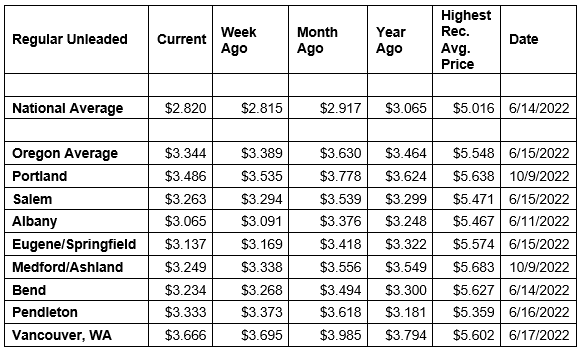
National State Local Gas Prices 1-13-26

“December and January are often when pump prices are at their lowest prices of the year, due to the seasonal factors of lackluster demand for gas as well as cheaper winter-blend fuel,” says Marie Dodds, public affairs director for AAA Oregon/Idaho. “However, with crude oil rising above $60 today for the first time since early December, that may put some upward pressure on pump prices.”

The Oregon average for regular gas began 2026 at $3.42 a gallon, which is the highest price of the year so far. The lowest price of the year so far is today’s price of $3.34.   

The national average began 2026 at $2.83 a gallon, which is the highest price of the year so far. The lowest price of the year so far is $2.795 on January 11.

The average price for the national average for regular gas in 2025 was $3.11 per gallon. The average price of the Oregon average for the year was $3.87.

Demand for gasoline in the U.S. gasoline decreased from 8.56 million b/d to 8.17 million b/d for the week ending January 2. This compares to 8.48 million b/d a year ago. Total domestic supply of gasoline increased from 234.3 million barrels to 242 million. Gasoline production decreased last week, averaging 9.0 million barrels per day compared to 9.5 million barrels the previous week.

Gas prices typically rise starting in mid-to-late winter and early spring as refineries undergo maintenance ahead of the switch to summer-blend fuel, which is more expensive to produce and less likely to evaporate in warmer temperatures. The switch occurs first in California, which is why pump prices on the West Coast often rise before other parts of the country. The East Coast is the last major market to switch to summer-blend fuel. Most areas have a May 1 compliance date for refiners and terminals, while most gas stations have a June 1 deadline to switch to selling summer-blend. Switch-over dates are earlier in California with some areas in the state requiring summer-blend fuel by April 1. Some refineries will begin maintenance and the switchover in February.

Gas prices usually drop in the fall, due to the switch from summer-blend to winter-blend fuel, which costs less to produce. The switch starts in September. Many areas, including Oregon, can sell winter-blend fuel starting September 15. However, Northern and Southern California require summer-blend fuel through October 31. Prices usually decline to their lowest levels of the year in late fall and early winter before increasing again in the late winter and early spring.

The U.S. price of crude oil (West Texas Intermediate) has mostly been in the upper $50s to mid-$70s since September 2024.

WTI is trading at $61 today, compared to $57 a week ago and $79 a year ago. In 2025, West Texas Intermediate ranged between $80.04 (January 15) and $57.46 (October 16) per barrel.  In 2024, WTI ranged between $66 and $87 per barrel. In 2023, WTI ranged between $63 and $95 per barrel. WTI reached recent highs of $123.70 on March 8, 2022, shortly after the Russian invasion of Ukraine, and $122.11 per barrel on June 8, 2022. The all-time high for WTI crude oil is $147.27 in July 2008.

Crude prices are impacted by economic news as well as geopolitical events around the world including the current economic uncertainty, the current situation in Venezuela, protests in Iran, unrest in the Middle East, the conflict between Israel and Hamas, and the war between Russia and Ukraine. Russia is a top global oil producer, behind the U.S. and Saudi Arabia. Crude prices were volatile after the attack on Israel by Hamas in October 2023. While Israel and the Palestinian territory are not oil producers, there were concerns that the conflict could spread in the Middle East, which could potentially impact crude production in other oil-producing nations in the region. Crude oil prices declined after October’s fragile peace agreement between Israel and Hamas. In addition, production cuts by OPEC+ in previous years tightened global crude oil supplies, which continued to impact prices. But in 2025, the cartel boosted production which put downward pressure on crude oil prices. For 2026, OPEC+ says it’s not planning any production hikes in the first quarter of the year due to lower demand.

Crude oil is the main ingredient in gasoline and diesel, so pump prices are impacted by crude prices on the global markets. On average, about 49% of what we pay for in a gallon of gasoline is for the price of crude oil, 14% is refining, 21% distribution and marketing, and 17% are taxes, according to the U.S. Energy Information Administration.

Meanwhile, crude oil production in the U.S. remains at or near record highs. The U.S. Energy Information Administration (EIA) reports that crude production in his country remains is at 13.81 million barrels per day for the week ending January 2. Production has been at 13.5 million barrels per day many times since October 2024. The U.S. has been the top producer of crude oil in the world since 2018 and has been increasing its oil production since about 2009.

Quick stats

Oregon is one of 33 states and the District of Columbia with lower prices now than a week ago. The District of Columbia (-5 cents) and Oregon (-5 cents) have the largest week-over-week decreases in the nation. Iowa (+15 cents) has the biggest week-over-week increase in the country. The average in Hawaii is flat.

Hawaii ($4.42) has the most expensive gas in the nation for the fifth week in a row. California ($4.21) is second. These are the only states with averages at or above $4 a gallon. This week six states and the District of Columbia have averages in the $3-range. There are 42 states with an average in the $2 range this week.

The cheapest gas in the nation is in Oklahoma ($2.23) and Arkansas ($2.39) and. No state has had an average below $2 a gallon since January 7, 2021, when Mississippi and Texas were below that threshold. At the time, the COVID-19 pandemic drove significant declines in crude oil and gasoline demand in the U.S. and around the world.

The difference between the most expensive and least expensive states is $2.19 this week, same as a week ago.

Oregon is one of 44 states and the District of Columbia with lower prices now than a month ago. The national average is 10 cents less and the Oregon average is 29 cents less than a month ago. Oregon has the largest month-over-month decline in the nation. Idaho (-24 cents) has the second-biggest month-over-month drop in the nation. Maryland (+8 cents) has the largest month-over-month increase.

Oregon is one of 49 states and the District of Columbia with lower prices now than a year ago. The national average is 25 cents less, while the Oregon average is 12 cents less. Utah (-40 cents) has the largest year-over-year drop in the nation. Alaska (+19 cents) is the only state with a year-over-year increase.

West Coast

The West Coast region continues to have the most expensive pump prices in the nation with six of the seven states in the top 10. It’s typical for the West Coast to have six or seven states in the top 10 as this region tends to consistently have fairly tight supplies, consuming about as much gasoline as is produced. In addition, this region is located relatively far from parts of the country where oil drilling, production and refining occurs, so transportation costs are higher. And environmental programs in this region add to the cost of production, storage and distribution.

Rank
Region
Price on 1/13/2026

1
Hawaii
$4.42

2
California
$4.21

3
Washington
$3.80

4
Alaska
$3.49

5
Nevada
$3.35

6
Oregon
$3.34

7
District of Columbia
$3.11

8
Pennsylvania
$3.01

9
Vermont
$3.00

10
New York
$3.00

As mentioned above, Hawaii has the most expensive gas in the country for the fifth consecutive week. California, Washington, Alaska, Nevada, and Oregon round out the top six. Arizona is 11th. Oregon slips to sixth after three weeks at fifth.

Six of the seven states in the West Coast region have week-over-week decreases: Oregon (-5 cents), Alaska (-5 cents), Arizona (-4 cents), California (-4 cents), Washington (-3 cents) and Nevada (-2 cents). The average in Hawaii is the same as a week ago.

The refinery utilization rate on the West Coast inched up from 79.6% to 80.0% for the week ending January 2. This rate has ranged between about 70% to 93% in the last year. The latest national refinery utilization rate is steady at 94.7%.

The refinery utilization rate measures how much crude oil refineries are processing as a percentage of their maximum capacity. A low or declining rate can put upward pressure on pump prices, while a high or rising rate can put downward pressure on pump prices.

According to EIA’s latest weekly report, total gas stocks in the region increased from 29.58 million bbl. to 31.35 million bbl. for the week ending January 2. An increase in gasoline stocks can put downward pressure on pump prices, while a decrease in gasoline stocks can put upward pressure on pump prices.

Oil market dynamics

Crude oil prices have climbed above $60 this week for the first time since early December as investors weigh the protests in Iran, the impacts from the U.S. action in Venezuela and how it might impact that country’s large oil reserves, and seemingly no progress in efforts to end the war between Russia and Ukraine.

Meanwhile, the EIA reports that crude oil inventories decreased by 3.8 million barrels from the previous week. At 419.1 million barrels, U.S. crude oil inventories are about 3% below the five-year average for this time of year. 

At the close of Friday’s formal trading session, WTI jumped $1.36 to close at $59.12. At the close of Monday’s formal trading session, WTI added 38 cents to settle at $59.50. Today crude is trading around $61, compared to $57 a week ago. Crude prices are about $17 less than a year ago. ($78.82 on January 13, 2025)

Drivers can find current gas prices along their route with the free AAA Mobile app for iPhone, iPad and Android. The app can also be used to map a route, find discounts, book a hotel and access AAA roadside assistance. Learn more at AAA.com/mobile.

Click here to follow the original article.

Two information nights set, applications open for new ‘choice’ high school in NE Bend

KTVZ

BEND, Ore. (KTVZ) — Bend-La Pine Schools is inviting the community to learn about its new “choice option” high school during two information nights this week and next at the Bend Technical Academy campus.  

This coming fall, the district will offer a new choice high school open to all students in the community. The soon-to-be-named high school will offer both Expeditionary Learning and Career and Technical Education, and will be located at the existing Bend Technical Academy campus on NE Fifth Street. 

The new high school will allow students to explore applied learning through interdisciplinary, project-based work; college-level Advanced Placement classes; and Career and Technical Education. The school will be led by current BTA Principal Dr. LaKisha Clark and current Realms High School Assistant Principal Zach Harju.  

A volunteer committee of staff, students and families will collaborate to create a name for the new choice high school, which will be announced later this spring.  

Interested students and families are invited to meet the new administrators and learn more about the school during two information nights hosted at the BTA campus, 1291 NE Fifth Street: 

Wednesday, January 14, 6:00 – 7:00 p.m. 

Tuesday, January 20, 6:00 – 7:00 p.m. 

Applications for the new choice option high school lottery must be submitted by this Friday, Jan. 23. Families can apply now at bls.fyi/options2026

Click here to follow the original article.