Week-long culvert replacement project begins on Grizzly Avenue

Seth Ratliff

IDAHO FALLS, Idaho (KIFI) — If your daily commute includes Grizzly Avenue, you may want to adjust your travel plans for the next week. Starting today, March 2nd, Idaho Falls Public Works crews are beginning a culvert replacement project at the Battle Creek Canal, which is set to affect traffic throughout the week.

From Monday through Wednesday, drivers can expect only minor lane closures with limited impact on travel times.

However, on Thursday at 6:30 a.m. Grizzly Avenue will be completely closed to all through traffic between Claredot Drive and the Skyline High School parking lot entrance. The closure will allow teams to excavate the roadway and install a new culvert pipe, designed to channel water beneath the asphalt.

Idaho Falls Public Works expects the road to remain closed until Friday afternoon. During this time, motorists will be detoured around the area using Skyline Drive and West 17th Street. While detour signage will be posted throughout the area, Pancheri Drive will remain fully open, and residents will be able to access their homes via Claredot Drive.

Public Works urges drivers to plan ahead, allow for extra travel time, and exercise caution when navigating near construction equipment. For more information about the project, contact the City of Idaho Falls Street Division at (208) 612-8490.

Click here to follow the original article.

New bill requires unexcused absence for student protests

Kevin Richert

Originally Published 2/27/2026 by IdahoEdNews

By Ryan Suppe and Kevin Richert

BOISE, Idaho — Public schools would not be allowed to grant excused absences for students attending political protests, under a new bill introduced Friday. 

Rep. Steve Tanner’s bill targets recent student walkouts over federal immigration enforcement. Leaving school for such protests would count as an all-day, unexcused absence. 

“While we recognize the First Amendment right to protest and to use political speech for all students, it’s a waste of taxpayer money for students to leave their classrooms in order to do so,” said Tanner, R-Nampa. “Students are free to protest at any other time.”

The bill would also require public schools to report annually to the state superintendent their total number of unexcused absences for political protests. The superintendent would then have to report the number to the Legislature. 

Idaho students from Boise to McCall to Idaho Falls have staged school walkouts in recent weeks to protest federal Immigration and Customs Enforcement. ICE agents shot and killed two people last month in Minnesota during an enforcement operation.

The House Education Committee voted to introduce the bill, setting the stage for a public hearing. 

But there were some questions. Rep. Jack Nelsen worried that restricting “political protests” would cast too wide of a net. The Jerome Republican wondered whether it would apply to students who testify at the Legislature, for instance, and whether it might discourage “political involvement from kids to get involved in things.”

The committee also voted to send two bills to the House floor, including: 

Senate Bill 1244, a DOGE Task Force bill that eliminates sections of state code that reference a regional library system that no longer exists.

Senate Bill 1227, which would direct the Idaho Department of Education to create a framework for the “responsible use of AI in K-12 education.”

The Senate has already passed both bills.

Click here to follow the original article.

ISP investigating weekend rollover crash on I-15 near Fort Hall

News Team

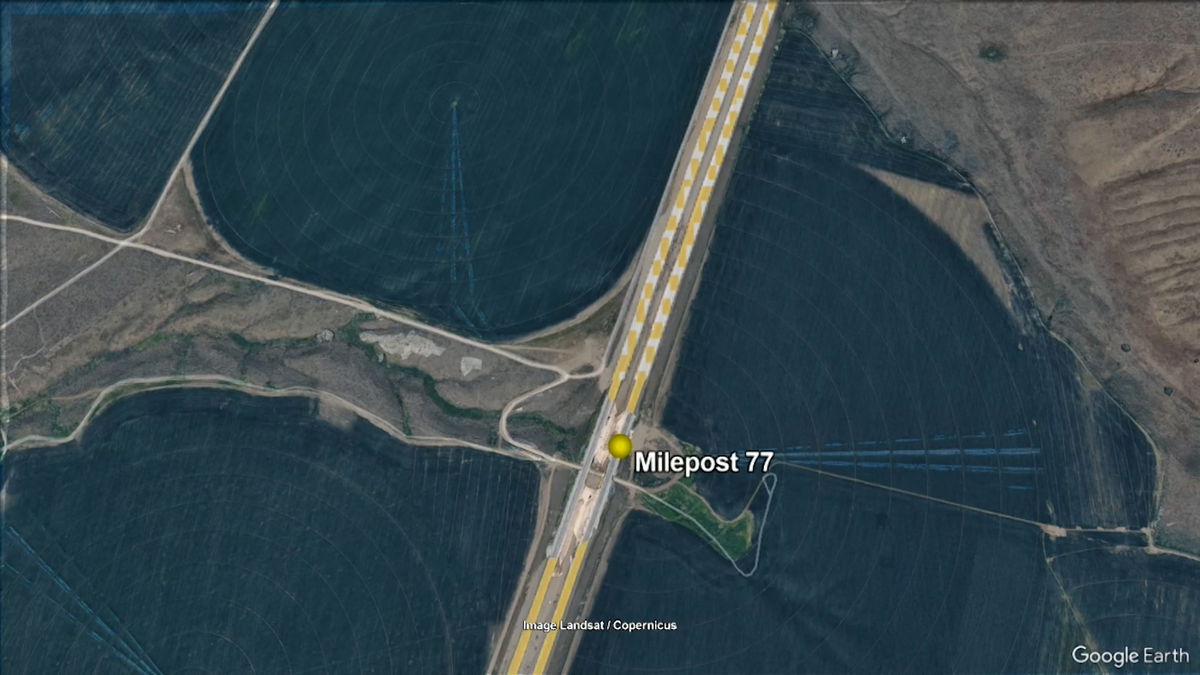
FORT HALL, Idaho (KIFI) — Idaho State Police is investigating a rollover crash on I-15 near milepost 77 in Bingham County, close to Fort Hall.

The crash took place on Sunday, March 1, 2026, at approximately 1:28 p.m. Troopers say a 74-year-old man from Idaho Falls was driving a Ford F-150 northbound in the left lane when a 39-year-old man from Stevensville, Montana, tried to pass him on the right in a Toyota FJ. As the Toyota moved back into the left lane before fully clearing the truck, the two vehicles collided.

The impact caused the Ford to spin out and roll over. The Toyota remained upright and came to a stop in the right lane.

Both drivers were wearing seat belts and were not injured. The right lane was blocked for about 25 minutes while crews cleared the scene. Two additional crashes were reported in the area as traffic backed up.

The crash is still under investigation.

Click here to follow the original article.

Twin Falls immigrants and refugees share their stories at ‘Becoming Idaho’ event

KIVI Staff

Originally Published: 27 FEB 26 13:14 ET

By Lorien Nettleton

Click here for updates on this story

    TWIN FALLS, Idaho (KIVI) — Two Magic Valley residents — a refugee-turned-advocate and a child of immigrants — are sharing their personal stories as part of a community storytelling event called “Becoming Idaho.”

Chandra Upreti, director of the Twin Falls office of the United States Committee for Refugees and Immigrants, is a refugee himself. He said his parents fled their home country of Bhutan when he was only 6 months old. After leaving Bhutan and before arriving in the United States, Upreti and his family lived in a refugee camp in Nepal for nearly 17 years.

“My parents fled when I was only six months old. I did not choose to become a refugee,” Upreti said. “Today I’m a very proud U.S. citizen, a parent, and also in a place where I’m able to help fellow refugees. It means a lot to me, and I’m looking forward to sharing my own personal story.”

Upreti is one of the guest speakers at the Feb 26 “Becoming Idaho” event, part of Idaho Solutions ‘The More You Know’ lecture series.

The event is an opportunity to highlight the diversity that has long defined Twin Falls.

“It’s really nice to see folks coming from different parts of the world,” added Upreti. “And live in a community that we all share.”

Twin Falls has welcomed refugees since the 1980s, resettling people from 47 countries over the past 46 years. Prior to the Trump administration’s restrictions on refugees, the office resettled about 200 individuals each year. Today, the center is on track to resettle fewer than half that number.

A pediatrician in Twin Falls and the child of immigrants from Honduras and Costa Rica, Dr. José Peña said he grew up in a bilingual household. He said those language skills allow him to connect with patients and community members who do not speak English.

“America has always been known as a land of opportunity, a land that’s welcoming to immigrants or to people that are from outside, and one of the ideals that I hope that a lot of people really cherish is that [we are] kind of a melting pot,” Peña said.

Peña said he hopes the event changes minds about immigration and diversity.

“I think it’s good to hear a different accent or hear someone speaking a different language,” Peña said. “My hope would be the people who can go to this experience and come away thinking ‘OK, this is actually a really good thing.'”

This story was reported on-air by a journalist and has been converted to this platform with the assistance of AI. KIVI verifies all reporting on all platforms for fairness and accuracy.

Please note: This story was provided to CNN Wire by an affiliate and does not contain original CNN reporting. This content carries a strict local market embargo. If you share the same market as the contributor of this article, you may not use it on any platform.

The-CNN-Wire™ & © 2026 Cable News Network, Inc., a Warner Bros. Discovery Company. All rights reserved.

Click here to follow the original article.

Idaho has $1.3 billion in rainy-day funds. Should that money help public schools?

Ryan Suppe

Originally posted on IdahoEdNews.org on March 2, 2026

By Ryan Suppe, Idaho Ed News:

BOISE, Idaho — Faced with a revenue shortfall heading into the legislative session, state leaders had three options to balance the budget: Reduce spending, tap reserves or restore tax revenue. 

The third option is unlikely in the GOP-dominated Legislature, which has overwhelmingly supported fast and furious tax cuts in recent years. But Democratic and Republican lawmakers this session have pushed for the second option, particularly as the impact of cuts comes into focus. 

Tapping the stockpile of state reserves could prevent budget cuts in the short term — including for public schools. Since the Great Recession, Idaho lawmakers and governors have socked away $1.3 billion in rainy-day funds, about 23% of state general fund spending. 

In a Feb. 12 press conference, Democratic leaders proposed spending $533 million in rainy-day funds to avoid cuts. Some Republicans, including Rep. Ben Fuhriman of Shelley, have also said they support using some of the reserves to bridge the revenue gap. 

But Republican Gov. Brad Little and the GOP chairmen of the Legislature’s powerful budget-setting committee want to preserve this money for a possible economic downturn in the future. Idaho’s economy continues to grow, and spending rainy-day funds could harm the state government’s stellar credit rating, they said. 

“When the economy is one of the top economies in the nation, that is not the time to be digging into our reserves,” said Sen. C. Scott Grow, R-Eagle, co-chair of the Joint Finance-Appropriations Committee.
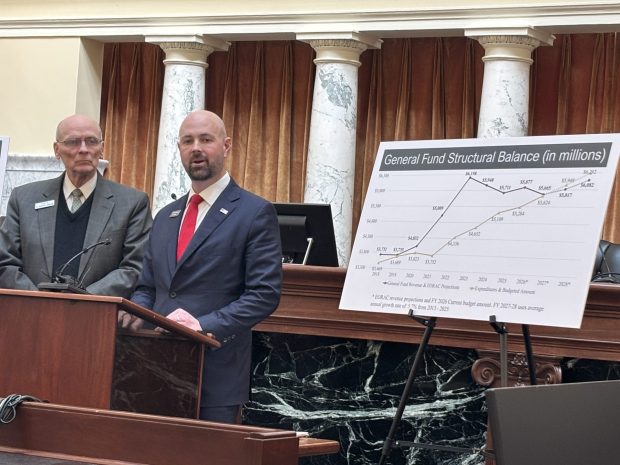
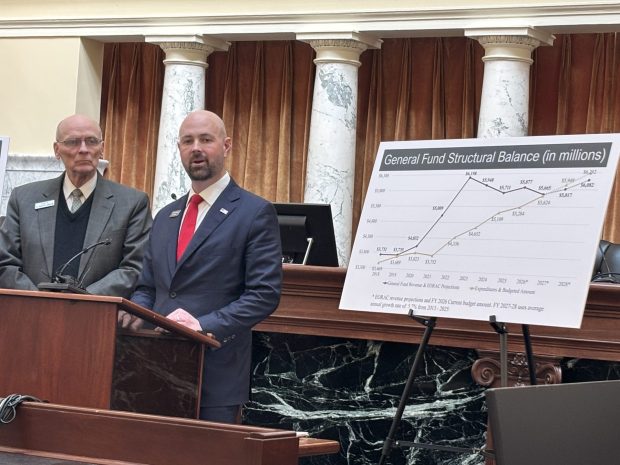
Budget committee co-chairs, Sen. C. Scott Grow (left) and Rep. Josh Tanner (right) discuss their budget cut plans with reporters on Feb. 19, 2026, at the Statehouse. (Kevin Richert/EdNews)

Lawmakers to vote on option one — reducing spending

Last year, the Legislature and governor enacted a suite of tax cuts and credits that reduced the state’s revenue by $453 million annually. At the same time, taxes that were still expected to come in started to miss projections.

By late summer, the governor’s office sounded an alarm. Little ordered most state agencies — excluding K-12 public schools — to cut their spending by 3% and to cancel any requests for budget increases during the 2026 legislative session.

Even after the governor’s cuts, the state faced a $40 million deficit for the current fiscal year, which ends June 30, and a $555 million shortfall next fiscal year, which starts July 1. This didn’t include the projected $155 million hit from conforming to federal tax changes in the One Big Beautiful Bill.

During his State of the State address Jan. 12, Little proposed more than $850 million budget cuts, reversions and transfers across both fiscal years — most of which would be one-time and aimed at bridging the shortfall until revenue rebounds.

Revenue has since improved. Tax collections are now tracking $112.6 million higher than projections for the fiscal year, according to the Legislative Services Office (LSO).
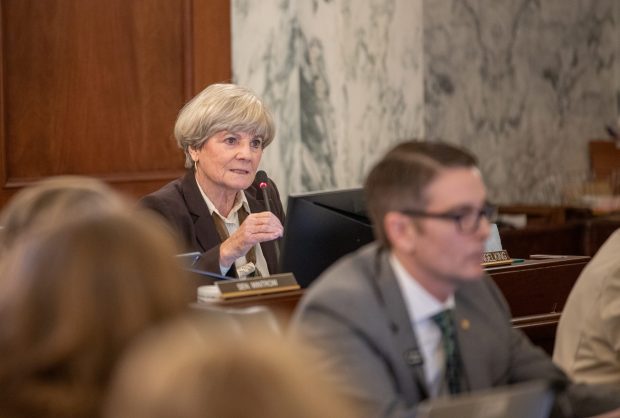
Sen. Janie Ward-Engelking at a JFAC meeting on Wednesday, Jan. 21, 2026. (Sean Dolan/EdNews)

But JFAC’s co-chairs are moving forward with deeper, ongoing spending cuts. They argue the cuts would ensure the state’s budget is “structurally balanced” and expenses line up with revenue. The House and Senate in the coming days and weeks will vote on additional 1% cuts this fiscal year and 2% next fiscal year. 

Colleges and universities would bear the brunt of the cuts, and layoffs and program reductions are already under way. Public school leaders are also preparing to cut their budgets or ask for new supplemental levies, even though K-12 is mostly exempt from both the governor’s and JFAC’s cuts. State funding hasn’t kept pace with rising costs to operate schools. 

“This is very disturbing, and this doesn’t need to be,” Sen. Janie Ward-Engelking, a Boise Democrat and JFAC’s longest-serving member, said during a recent committee debate on the cuts. “We have reserve funds. We have money. We could fix this.”

Idaho saves more than most other states

Idaho last year ranked in the top 10 nationally for rainy-day funds, according to a study by Pew Charitable Trust. The study, published in October, calculated how many days a state could operate on just its rainy-day funds. Idaho ranked eighth with 87.2 days. Washington was 49th with 12.8 days.

Rep. Josh Tanner, JFAC’s House co-chair, points to Idaho’s westerly neighbor as a cautionary tale. Washington lawmakers just passed the state’s first income tax after “borrowing from any stabilization fund they had,” Tanner, R-Eagle, told reporters during a Feb. 19 news conference. “They were unwilling to make hard choices, hard decisions to actually reel in their budget.”  

Amid a deficit, the Washington State Legislature is considering a 9.9% income tax on households that earn more than $1 million, among other budget proposals. But the tax hasn’t passed the full Legislature, only the Senate, and it would take effect in 2029. 

Idaho, on the other hand, has cut income taxes five times since 2021. Altogether, the cuts cost the state $4 billion in revenue over four years, according to the Idaho Fiscal Policy Center, a nonpartisan research group that’s been critical of state tax cuts, arguing they will cripple funding for services.

For Tanner, reducing revenue and giving money back to taxpayers is the goal. “We were growing in revenue at a massive rate,” he said. “We were trying to bring that revenue back down.”
study by LSO

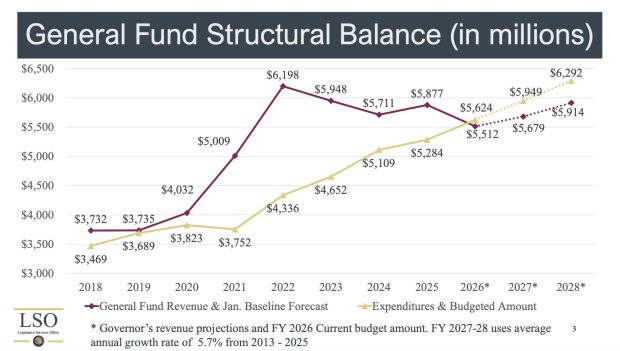
State revenue went from $3.7 billion in FY 2018 to a record $6.2 billion in FY 2022 amid population growth and a surge during the COVID-19 pandemic. In January, JFAC set a FY 2027 revenue target at $5.8 billion, which was 2.4% higher than a projection from the governor’s office.

Amid increasing revenue since the Great Recession, state spending has remained conservative, however. And state leaders bolstered rainy-day funds.

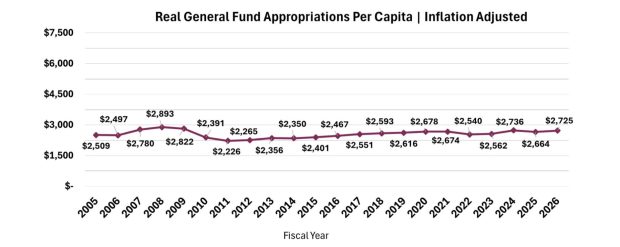
State general fund spending increased 0.4% per year, on average, since FY 2005 when adjusting for inflation and population growth, according to a study by LSO, a nonpartisan agency that supports the Legislature. But inflation-adjusted spending hasn’t returned to its two-decade high point in FY 2008, before the Great Recession.
After the state exhausted its reserves during the recession, GOP leaders have since put away $1.3 billion in rainy-day funds. If you include the fund balance — what’s left over on the bottom line after budgeted appropriations — total reserves were $1.72 billion, or about 31% of general fund spending, when lawmakers adjourned last year’s session.

But using rainy-day funds now would only be a temporary fix to keep services fully funded after the string of tax cuts. Grow compared it to the way Congress operates — spending money that’s not backed by ongoing revenue.

“Let’s right-size the budget, and then when we do have a recession or a challenge, then we can deal with it appropriately,” Grow said. “That’s what those funds are reserved for.”

AAA credit rating benefits ‘whole state’

While the governor’s office is fighting JFAC’s plan for additional budget cuts, Little agrees with the budget co-chairs that rainy-day funds should be preserved for economic recession. 

The second-term governor also said that spending rainy-day funds could harm the state’s credit rating. Idaho is one of more than a dozen states with the highest grade, AAA, from the three major rating agencies. 

Credit ratings assess state governments’ ability to repay debt. Higher ratings indicate lower risk to investors, leading to more favorable interest rates on borrowing. 

Idaho takes on less debt than most other states. It has the second-lowest total debt, and it’s 47th in debt per capita, according to national rankings from the Reason Foundation, a libertarian think tank. But on Feb. 17, Little told reporters that Idaho’s strong rating benefits “the whole state.” It helps local governments more easily borrow money as well, he said. 

This is true for public schools that issue bonds to finance major building projects. While school districts can be rated separately when they issue bonds, they typically use the state’s credit enhancement program. It allows districts to issue bonds backed by the state’s AAA rating, lowering interest costs. 

“It took us a long time to get a AAA credit rating, and we don’t want to give that up,” Little said.
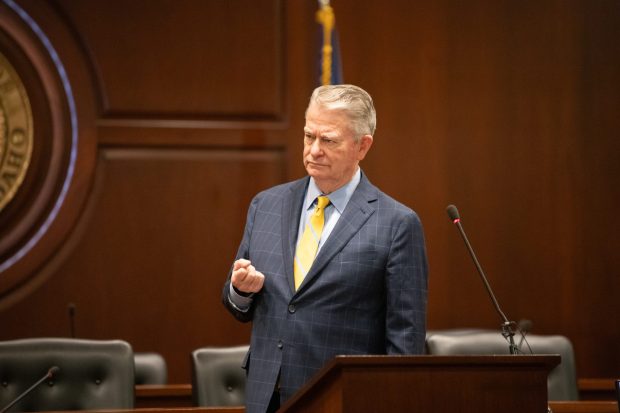
Gov. Brad Little listens to a question on Thursday, Jan. 8, 2026, at the Idaho Press Club’s Legislative Preview at the Lincoln Auditorium in Boise. (Sean Dolan/EdNews)

But this benefit is useful to public school districts so long as they can pass bonds, and that’s becoming increasingly difficult. Idaho is one of two states that requires supermajority voter approval for bonds. In 2023 and 2024, the Legislature and Little have cut in half — from four to two — the number of times per year that districts can hold elections. 

From 2001 to 2012, school bonds passed at a 58.4% rate, according to an EdNews analysis. From 2013 to 2023, the success rate fell to 42%. In the two years since the number of election dates were cut, just one of 12 bond measures have passed. 

“A concern and a worry that I have is any bonds being passed from here on out,” state superintendent Debbie Critchfield, a Republican, told EdNews in a recent interview. “With the threshold that they have anyway, (bonds are) going to be among the most challenging efforts that our districts make in the coming years.”

What about the third option — restoring taxes?

When state leaders forgo tax revenue and protect their savings it means less money is available for public schools. And unlike the state, public schools don’t have many levers they can pull to move revenue up or down.

Nearly 87% of public school funding comes from the state, while 10.5% comes from voter-approved bonds and levies and 2.7% comes from the federal government.

Some public school advocates, meanwhile, haven’t given up on the third option to balance the state’s budget — restoring taxes — which could also spare public education from cuts. 

And they’re invoking Shakespeare to plead their case. 

“To thine own self be true,” wrote TOADS, a nonprofit composed of current and former public school educators and administrators, in a recent news release.

The TOADS (Totally Optimistic Advocates Dedicated to Students) point to 89 state special interest tax exemptions, which write off about $2.8 billion a year that could help public schools and other agencies. 

The maxim from “Hamlet” urges state leaders — and the media — to look inward. “Are we ready to publicly admit Idaho’s agencies cannot be properly financed until we restore some of the tax base?”

Senate Assistant Minority Leader James Ruchti of Pocatello speaks during a news conference proposing alternatives to budget cuts on Feb. 12, 2026, at the Statehouse in Boise. (Ryan Suppe/EdNews)

Rep. Steve Berch, D-Boise, has called for a review of tax exemptions for years. House Minority Leader Ilana Rubel, D-Boise, is sponsoring a bill this session that would direct the Legislative Services Office to annually review exemptions and recommend whether they should continue. The House Revenue and Taxation Committee introduced the bill last week.

The legislation is among an assembly of Democratic budget proposals, which also call for restoring or pausing some of last year’s tax cuts.

After the state voluntarily reduced revenue for five years, people who rely on services will “pay the price,” said Senate Assistant Minority Leader James Ruchti, D-Pocatello.

“The Idaho Legislature blew it,” he said.

Click here to follow the original article.

Wet start to March with spring-like temperatures

Danielle Mullenix

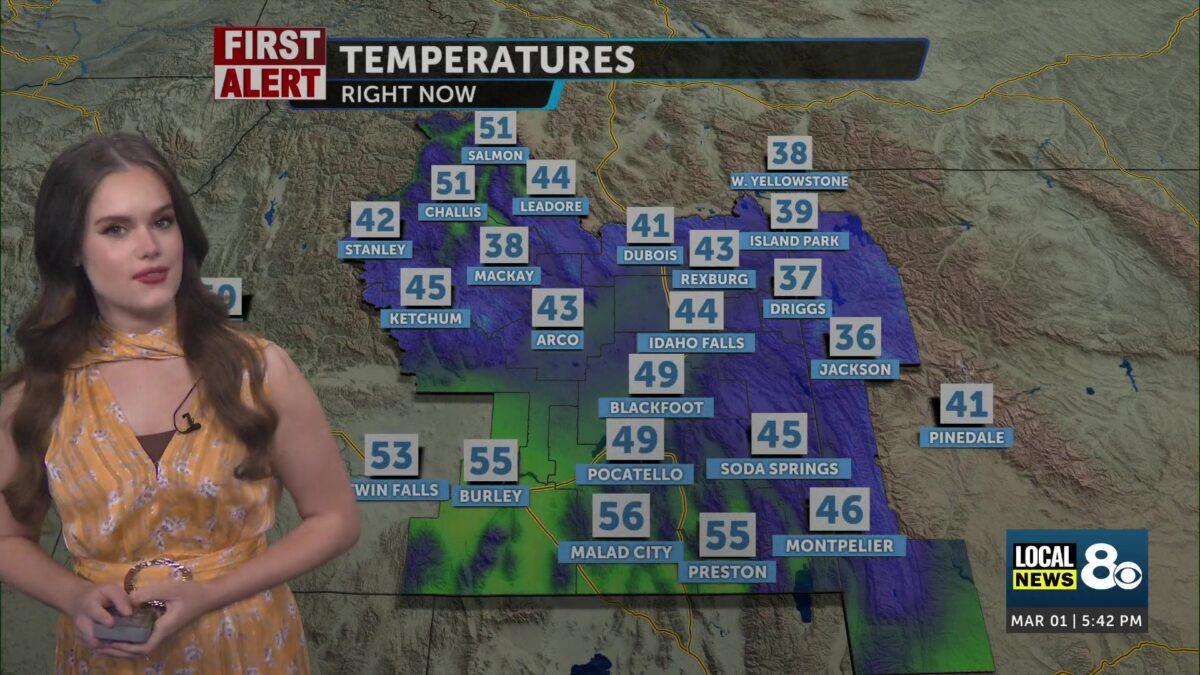
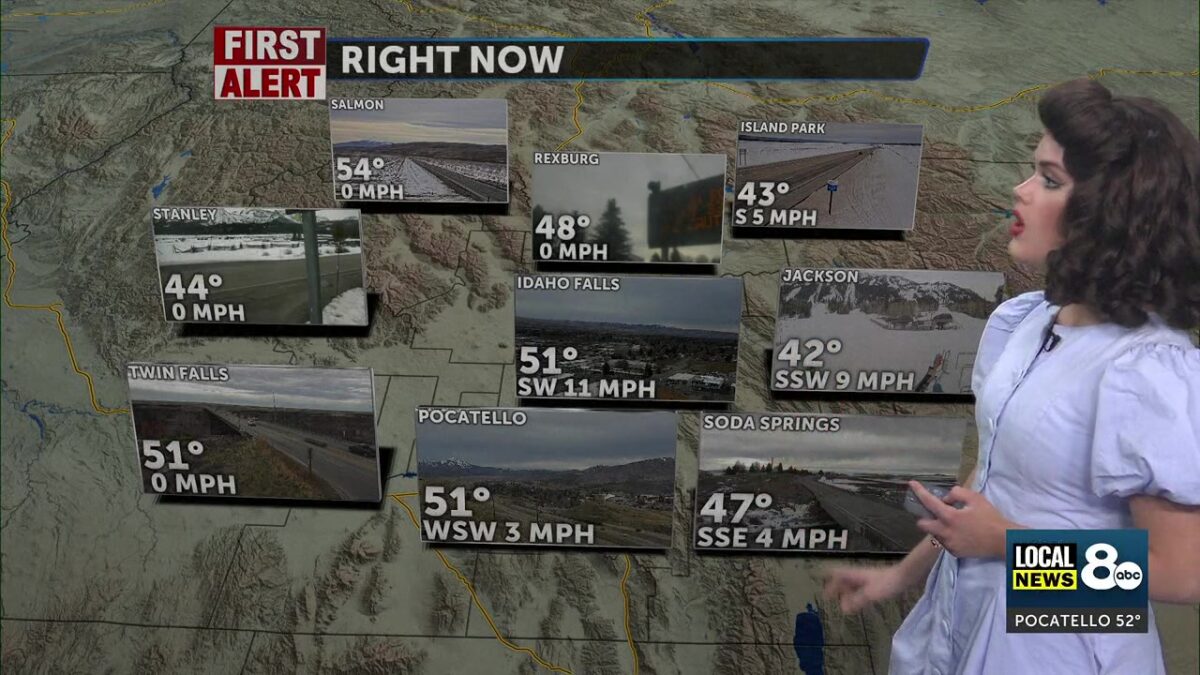
We start off the first day of March with lots of rain and snow around the region. Our temperatures remain above average this Sunday and the upcoming week, with highs ranging in the mid-50s and upper-40s. Expect to see on-and-off rain showers in the valleys through Monday evening, with little snowfall in the upper highland areas.

This Sunday, we will continue to see high temperatures in the mid 50s across the valley. Very mild, with a general range from the upper 30s to the mid 40s at higher elevations. There is a high chance of precipitation throughout this Sunday, with many places seeing a 60-80% chance, especially across the eastern mountains. Expect light snowfall, with limited mountainous areas seeing around 1 inch overnight. Fairly light wind speeds to accompany all of this for our first day of March – no gusts above the teens for the evening.

We will continue to see overcast skies and a continual influx of moisture moving in from the Pacific coast through today, tonight, and tomorrow. We see a few snow showers in levels between 6,500-8000ft through Monday night. Some lingering rain and snow showers could settle into the Eastern highlands until Tuesday afternoon.

Click here to follow the original article.
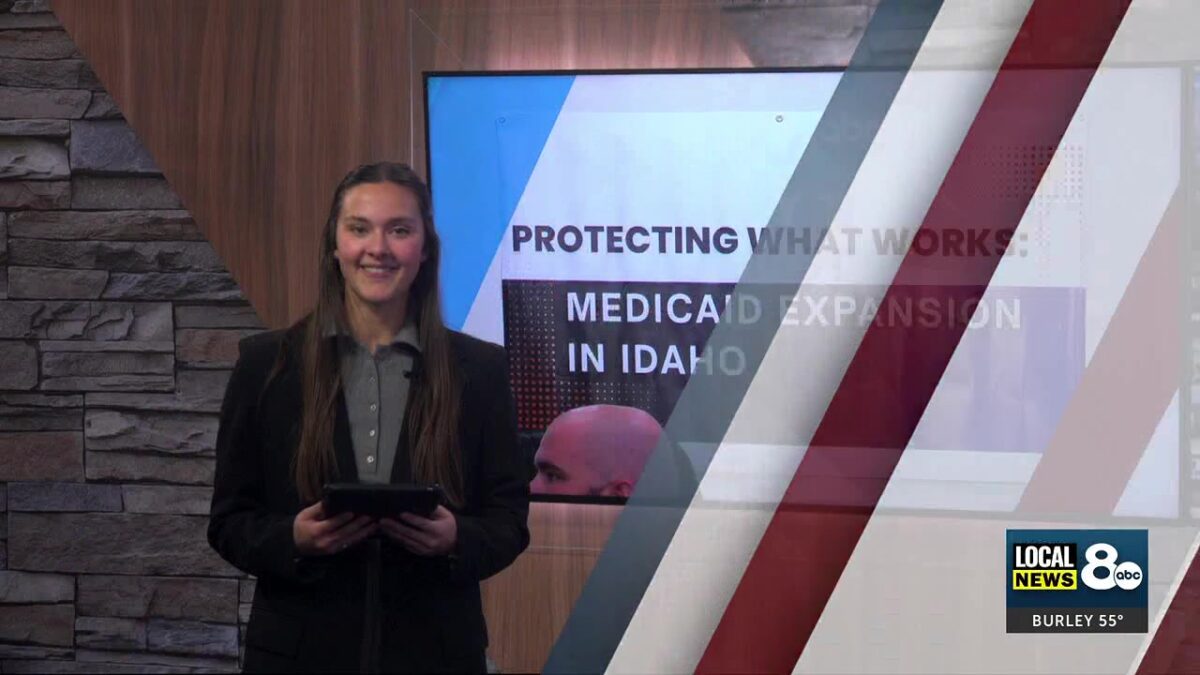
Protecting What Works: Medicaid Expansion in Idaho Town Hall Discusses Possible Repeal

Hadley Bodell

CHUBBUCK, Idaho (KIFI) – State legislators, panelists and community members met today at the Chubbuck City Hall for a forum titled “Protecting What Works: Medicaid Expansion in Idaho” hosted by the Pocatello-Chubbuck Chamber Legislative Council.

The purpose of today’s town hall meeting was to educate attendees about the possible repealing of the Medicaid Expansion program in Idaho. 61% of Idahoans voted for Medicaid Expansion, legislation that covers individuals in the health coverage gap, meaning they earn too much for traditional Medicaid, but too little to afford private insurance. Now, the state government is considering cutting the program in an effort to balance the state budget.

Those in support of Medicaid Expansion said the repeal would cost Idaho taxpayers $20 million, along with eliminating over 9,000 jobs. The program currently accounts for 3% of the growth in total Medicaid spending and 1.6% of Idaho’s General Fund appropriations.

90% of the Medicaid Expansion program is funded from the federal government. Senator Jim Guthrie said the Big Beautiful Bill has caused implications on the state budget, causing legislators to make decisions about where programs may be cut to save money.

“That 90% of federal funding, where does that go? If it goes to the hospital emergency rooms, that cost is exponentially higher,” Guthrie said. “Or it goes to the mental health services, law enforcement, and eventually it will raise insurance rates for all payer mixes that have insurance because they have to get the money from somewhere.”

A statewide poll conducted in 2023 found that 73% of Idahos still support the program and do not want it repealed. “Medicaid Expansion has become a critical part of Idaho’s healthcare system, workforce development, and overall economic health,” said Shantay Bloxham with the Chamber Legislative Council.

A main concern of attendees of today’s forum is the impact a repeal of Medicaid Expansion would have on rural healthcare in Idaho. Josh Sorenson with Bingham Healthcare commented on the effects this would have on rural hospitals.

“Our most rural and critical access hospitals, this would be detrimental,” Sorenson said. “I could see a scenario where many hospitals close.”

Another one of today’s panelists, Maggie Mann with Southeastern Idaho Public Health, gave examples of the people this repeal would directly effect. “I have a daughter who works two jobs,” Mann said. “One of them is for a very small local employer, which I think we would all agree that small businesses that serve at the local level are something we value. But because they are a small employer, they cannot afford to provide health insurance to the people that work for them.”

Contrary to the popular opinion that many individuals on Medicaid are reaping the benefits without cause, the panelists argue most of them are young, working professionals without employee insurance benefits.

Should the program be cut, the people on Medicaid Expansion would turn towards emergency services. Idaho Representative Rick Cheatum said the first major budget cut impacted mental health services, and that he’s wary of cutting this program.

“This is one area they’ve found the possibility of cutting some money out of the budget,” said Cheatum. “But in the long term, I’m not sure it’s the right solution.”

 Idaho legislators say the best way to get involved with this issue is to reach out to them over email or phone call and share a personal story about how you are effected by Medicaid Expansion.

Click here to follow the original article.
Sunny Saturday & moisture moving into Sunday

Danielle Mullenix

This weekend promises pleasant conditions on Saturday, with plenty of sunshine and warm temperatures to close out February. Lighter winds and mild temperatures are expected before an area of low pressure moves in on Sunday.

Saturday high temperatures will be in the mid 50s across the region, with no precipitation expected to appear on radar for the afternoon. Winds will be from the south-southwest around 10 to 15 mph, with gusts as high as 25 mph. For Saturday night, there is a slight chance of rain after 11 pm. Cloudy skies, with a low around 35°. Southwest winds will be around 5 to 10 mph.

A low-pressure system riding in from the West Coast will cruise into the area slowly on Saturday evening. We are not expecting a large impact from snow in higher-elevation areas, but do plan to see on-and-off rain showers and heavier winds around the region through Monday.

Cloudy skies for Sunday with a chance of rain in the Plain. High elevation snow showers with winds around 10mph. For the Snake River Plain, high temperatures will reach the upper 40’s.

More scattered showers for Monday with mostly cloudy skies. High temperatures will reach the upper 40’s and lower 50’s. Remaining spring-like temperatures through the midpoint of next week.

Click here to follow the original article.
What we know about why the US and Israel attacked Iran and Tehran’s retaliation

CNN Newsource

By Christian Edwards, Karina Tsui, Mitchell McCluskey, CNN

(CNN) — Joint US-Israeli attacks on Iran have killed Ayatollah Ali Khamenei, the country’s supreme leader for nearly four decades, thrusting the country into uncertainty and sparking a conflict that could draw in much of the Middle East.

Donald Trump announced Khamenei’s death on Saturday, which was also confirmed by Iranian authorities. The US president said the bombing will continue “uninterrupted throughout the week or, as long as necessary to achieve our objective of PEACE THROUGHOUT THE MIDDLE EAST AND, INDEED, THE WORLD!” Israel has continued to bombard Iran on Sunday.

Iran has responded with an unprecedented wave of strikes across the Middle East, targeting several countries that host US military bases, including Bahrain and the United Arab Emirates.

President Masoud Pezeshkian said Sunday that “bloodshed and revenge” is Iran’s “legitimate right and duty.”

Here’s what we know so far.

Why did the US strike Iran?

In a video on Truth Social announcing a “major” attack on Iran, Trump said the main US objective was “to defend the American people by eliminating imminent threats from the Iranian regime.” Those threats, he said, included Iran’s nuclear program – which the White House claimed to have “totally” obliterated when it briefly joined Israel’s war against Iran in June.

That 12-day war left the Islamic regime severely weakened. Since the turn of the year, it has also been battling an economic crisis which sparked nationwide protests. After a crackdown left thousands of protesters dead, Trump had promised to come to their aid, saying the US was “locked and loaded.”

For weeks, there had been a strange split-screen: while US envoys held regular talks with Iran over a new nuclear deal, the Trump administration was amassing the largest buildup of military materiel in the Middle East since the invasion of Iraq in 2003. Although the last round of talks ended Thursday with Iran agreeing to “never” stockpile enriched uranium, that was not enough to avert US military action.

In his video, Trump accused Iran of rejecting “every opportunity to renounce their nuclear ambitions,” and said the US “can’t take it anymore.” He said it has “always” been US policy that “this terrorist regime can never have a nuclear weapon,” without providing evidence that Iran was any closer to obtaining a nuclear weapon.

After nearly half a century of enmity between the US and the Islamic regime, Trump also seemed to suggest some score-settling was in order.

“For 47 years the Iranian regime has chanted ‘death to America’ and waged an unending campaign of bloodshed” against the US, he said, citing the 1979 hostage crisis and the 1983 bombing of the US embassy in Beirut. “It’s been mass terror. And we’re not going to put up with it any longer.”

The president also repeated his disputed claims that Iran is building ballistic missiles, which could reach the US mainland. CNN previously reported that an unclassified assessment from the Defense Intelligence Agency (DIA) from 2025 said that Iran could develop a “militarily-viable” intercontinental ballistic missile by 2035 “should Tehran decide to pursue the capability.”

Two sources said the claim that Iran will soon have a missile capable of hitting the US is not backed up by intelligence.

Why is Israel striking Iran?

Prime Minister Benjamin Netanyahu has long viewed Iran as Israel’s most dangerous adversary. After the fall of Bashar al-Assad’s regime in Syria, a key Iranian ally, and Israel’s crippling of the Iran-backed Hezbollah militia in Lebanon, Israel last summer launched a war against Iran itself.

Although Israel halted the conflict after the US struck Iran’s nuclear sites, analysts had long suspected that Netanyahu would take an opportunity to resume attacks on Iran. With elections due in October, Netanyahu may also see the return to war as a chance to shore up his standing domestically.

In a video statement Saturday explaining why Israel was resuming its strikes on Iran, Netanyahu also repeated his claim that the Islamic regime must not be allowed to acquire a nuclear weapon.

On Sunday, the Israeli military suggested the attack was revenge for the Hamas attacks of October 7, 2023, saying Israel “will not forget” the Iran-sponsored raid. “We will continue to pursue Israel’s enemies – from the architects of the attack to the terrorists who took part in the massacre,” a spokesman said.

Are the US and Israel seeking regime change?

In their statements, both Trump and Netanyahu were clear about their hopes for regime change in Iran, even before confirmation of Khamenei’s death.

Trump told the Iranian people “the hour of your freedom is at hand,” while Netanyahu urged them to “cast off the yoke of tyranny.” Trump also called on the Iranian Revolutionary Guards Corps (IRGC) to lay down its weapons or face “certain death.” Since the US attacks were from the air, not the ground, it was not clear to whom the IRGC would surrender.

There have been scenes of Iranians celebrating Khamenei’s death, but so far there is little sign of Iranians heeding Trump’s call and taking to the streets en masse. In Galleh Dar, in Fars province, people cheering Khamenei’s death were seen tearing down a monument as fires burned around them. But pro-regime crowds have gathered separately in Tehran at daylight on Sunday to mourn the loss of their leader, while a state TV news presenter cried as he confirmed Khamenei’s death.

What has been hit?

The opening salvo of the joint US-Israeli strike appeared to be a leadership-decapitation operation. Images showed severe damage at the site of a highly secure compound housing Khamenei’s residence and office in Tehran’s Pasteur distict.

Israel claimed on Sunday that a “majority” of Iran’s senior military leaders were killed in the initial strikes, including 40 commanders. Among them was Chief of Staff Lt. Gen. Abdoorahim Mousavi, Israel said. Iranian media also confirmed Mousavi’s death.

Several other Iranian cities were hit, including Minab, where a girls’ elementary school suffered one of the largest death tolls. Citing a local prosecutor, Iranian state media reported 148 people had died there, as images showed a row of small body bags laid outside a damaged building.

The US-based Human Rights Activists News Agency (HRANA) said as of late Saturday, at least 133 civilians had been killed in the joint strikes on Iran, with 200 injured. Iranian state media put the death toll at over 200, with more than 700 wounded.

Israel said it was carrying out a fresh wave of strikes on Tehran on Sunday. Video from the capital show several huge explosions in various parts of the city, including around the landmark Azadi Tower in the west of the city.

How has Iran responded?

Iran retaliated with an unprecedented wave of strikes across the Middle East, targeting Israel and several nearby countries that host US military bases. President Masoud Pezeshkian, who appears to have survived the strikes, said “bloodshed and revenge” is Iran’s “legitimate right.”

Blasts were reported in Jordan, Qatar, Bahrain, Kuwait, the United Arab Emirates and Saudi Arabia – Iran’s key regional rival, which vowed to take “all necessary measures” to defend itself. Even Oman, which mediated recent US-Iran talks, has come under fire.

The strikes indicate that, for Iran, “everything is on the table,” said Hasan Alhasan, a senior fellow for Middle East policy at the International Institute for Strategic Studies, a think-tank.

Iran’s calculus is to “ratchet up the pain on the Gulf states, in order to compel them to apply pressure on the Trump administration to bring a quick end to the war,” Hasan told CNN. But this strategy could well backfire, he said, since it is not clear how much leverage the Gulf states have over the Trump administration, and mass casualty events could prompt Gulf states “to start considering options up the escalation ladder.”

In the tourist and expat haven of Dubai, dramatic footage on Saturday showed people fleeing a smoke-filled passageway at the city’s international airport. Officials confirmed four staff had been injured. The Fairmont Hotel, in the city’s upmarket Palm Jumeirah islands development, also sustained damage with photos showing flames and a hole punched into an exterior wall.

One person was killed and seven injured at Zayed International Airport in Abu Dhabi, also in UAE. The Kuwait International Airport was also struck, as well as three buildings in Bahrain’s cities of Manama and Muharraq.

The clashes disrupted traffic in the Strait of Hormuz – a crucial shipping route located between the Persian Gulf and the Gulf of Oman.

The US hasn’t suffered any combat-related casualties in its operation against Iran and damage to US military installations has been minimal, US Central Command said in a statement.

Who is running Iran right now?

Iran’s priority is to appoint the next supreme leader – a task the regime has only completed once before, more than three decades ago. An elected body of 88 senior clerics, known as the Assembly of Experts, will select Khamenei’s successor.

Under the constitution, if the supreme leader leaves office, his powers transfer temporarily to a council comprising the president, the head of the judiciary, and a senior cleric from the Guardian Council until the Assembly of Experts selects a new leader.

On Sunday, Iran formed a provisional leadership council, naming President Masoud Pezeshkian, judiciary chief Gholam-Hossein Mohseni-Eje’i and senior cleric Ayatollah Alireza Arafi as members.

Trump told CBS News on Saturday evening that diplomacy with Iran is “much easier now than it was a day ago, obviously.” He said “there are some good candidates” to take power, but did not name them.

The last time the US struck Iran, in June, its operation was over within a few hours. This time, sources have told CNN that the US military is planning for several days of attacks, suggesting broader objectives.

The-CNN-Wire™ & © 2026 Cable News Network, Inc., a Warner Bros. Discovery Company. All rights reserved.

CNN’s Tal Shalev, Jeremy Diamond, Kareem El Damanhoury, Christian Sierra, Max Saltman, Catherine Nicholls, Frederik Pleitgen, Dana Karni, Gianluca Mezzofiore, Adam Pourahmadi and Lauren Kent contributed to this report.

Click here to follow the original article.

Who’s running?: List of candidates in May primaries released

David Pace

It looks like Governor Brad Little will have a little competition for the May primary. Seven people will be running against him in the upcoming Republican primary. 

Today was the deadline for candidates to register in order to run for office. The primary election will be held on May 19, 2026.

Governor – Republican Primary

On the Republican ballot, the two-term governor will be challenged by:

Daniel Fowler, of Nampa;

Ethan Giles, of Boise;

Justin Plante, of Kimberly;

Lisa Marie, of Eagle;

Mark Fitzpatrick, of Eagle;

Ron James, of Driggs; and

Sean Crystal, from Ammon.

Governor – Democratic Primary

In the Democratic gubernatorial primary, four candidates will face each other in the election:

Chanelle Torrez, of Nampa;

Jill Kirkham, from Pocatello;

Maxine Durand, from Twin Falls; and

Terri Pickens, from Boise will face-off in the election.

U.S. Senator – GOP Primary

U.S. Senator Jim Risch will be challenged by:

Denny LaVe, of Post Falls;

Joe Evans, of Boise; and

Josh Roy, of Lewiston.

U.S. Senator – Democratic Primary

Three Democrats will also be running for U.S. Senator, including:

Brad Moore, of Boise;

David Roth, of Idaho Falls; and

Nickolas 007 Bonds, of Post Falls.

U.S. House of Representatives – GOP Primary

In the U.S. House of Representatives District 2 race, Rep. Mike Simpson will face two Republican challengers in the primaries:

Brian Keen, of Twin Falls;

Perry Shumway, of Rexburg.

U.S. House of Representatives – Democratic Primary

Finally, in the Democratic race for District 2 of the U.S. House of Representatives, 

Ellie Gilbreath, of Ketchum; faces

Julie Wiley, of Boise.

You can find more information on all 382 candidates who filed for this year’s May primaries by visiting run.voteidaho.gov.

Click here to follow the original article.