Valley officials react to new law separating Riverside County Sheriff and Coroner offices


Jesus Reyes

SACRAMENTO, Calif. (KESQ) – Governor Gavin Newsom signed a bill that will require the Riverside County Board of Supervisors to separate the offices of county sheriff and coroner by July 1, 2027, as well as establish an independent office of the medical examiner.

The bill, authored by Senator Sabrina Cervantes, also creates clear requirements for the county to publicly report information regarding in-custody deaths on its website.

“Senate Bill 1379—which is a targeted solution to fix a long-broken system in my home county of Riverside—has been a long time coming. The goal of this new law is simple: When an individual dies in custody in a Riverside County jail, their family and the public deserve transparency,” Cervantes explained. “We owe the families the truth; we owe our communities accountability; and we owe county taxpayers a system they can trust.”

“Thank you to Senator Sabrina Cervantes and Governor Gavin Newsom for standing with Riverside County residents by enacting SB 1379. Removing the conflict of interest created when the Sheriff also oversees in-custody death determinations is a significant victory for transparency, accountability, and justice—and a vital step toward supporting families seeking answers after the death of a loved one in custody,” said Chani Beeman, member of the Riverside Sheriff Accountability Coalition.

According to the Inland Empire Lives Lost report by Care First California, 226 individuals died in custody in Riverside County jails between 2011 and 2022. The group added that during that period, Riverside County accounted for approximately 10 percent of all in-custody deaths in California despite comprising only about 6 percent of the state’s population.

In August, a federal jury found Sheriff’s personnel liable in an inmate’s fentanyl death, awarding his family $13.5 million in damages.

In 2024, the Board of Supervisors voted unanimously not to separate the coroner’s office from the Sheriff’s Department. At the time, the Executive Office determined that dividing the coroner’s office from the sheriff’s department would invite a string of complications, including likely opposition from the nearly 70 coroner’s employees — virtually the entire bureau — who are unionized and might choose to remain in the sheriff’s department, leaving major gaps in coroner’s operations that the county would have to rush to fill.

Earlier this month, the Palm Desert City Council also voted to issue a letter opposing the bill, citing legislature already enacted, AB 1108, that will require that determinations of the circumstances, manner, and cause of death for any in-custody death be made independently of the Sheriff-Coroner in every California county with a combined Sheriff-Coroner, including Riverside County. AB 1108 becomes operative on January 1.

“SB 1379 would require Riverside County alone to undertake a much broader structural reorganization only six months after that statewide independent-review requirement becomes operative and before its effectiveness can be evaluated,” read city documents.

Palm Desert’s letter also emphasizes the importance of preserving local control over the organization of local government.

01 Letter of Opposition – SB 1379 (Cervantes)Download

You can read more about Senate Bill 1379 here.

News Channel 3 spoke Thursday with both Cervantes and Riverside County Sheriff Chad Bianco about the newly signed law and what it will mean for the county moving forward.

Cervantes said the legislation was driven by concerns surrounding the number of deaths inside Riverside County jails and the need for greater independence when those deaths are investigated.

“There have been a number of different reports that have highlighted the amount of deaths in Riverside County jails,” Cervantes told News Channel 3.

She pointed to data showing 226 people died in Riverside County custody between 2011 and 2022, adding that the county accounted for roughly 10% of California’s in-custody deaths during that period despite representing about 6% of the state’s population.

Cervantes said SB 1379 is intended to respond to concerns raised by families whose loved ones have died while in county custody.

“This bill will now require the county Board of Supervisors to bring in an independent medical examiner, someone who is a licensed physician, a surgeon qualified as a specialist in pathology,” Cervantes said.

Under SB 1379, the Riverside County Board of Supervisors will be required to appoint a medical examiner who is a licensed physician and surgeon qualified as a specialist in pathology. The law also requires the county to post an initial incident report within 24 hours of an in-custody death and a preliminary report within 72 hours. Next-of-kin must also be notified regarding the cause of death within 72 hours after that cause has been determined.

Cervantes told News Channel 3 those reporting requirements are an important part of the legislation.

“There will be a website where within a certain time frame, that report will be made public to families as to what had occurred in our Riverside County jails,” Cervantes said.

She added that families and community advocates have raised concerns about unanswered questions following deaths in custody.

“This, again, is a step in the right direction when it comes to transparency that the public has been asking for and the accountability reforms that they have been asking for,” Cervantes said.

Bianco strongly opposes the separation

Bianco, who currently oversees the combined Riverside County Sheriff-Coroner’s Office, strongly criticized the law in an interview with News Channel 3.

He disputed the argument that the current structure creates a conflict of interest when someone dies in county custody.

“Because there is no conflict of interest. We don’t do our own death investigations. We never — we haven’t done that for years,” Bianco said.

Bianco said he believes combining the Sheriff and Coroner functions has allowed the county to provide death-investigation services more efficiently and at a lower cost.

He said separating the operations will require Riverside County to recreate systems and resources that are currently shared between the Sheriff’s Office and Coroner’s Bureau.

“There’s a lot of things that have to happen,” Bianco said.

According to Bianco, contracts and agreements currently held by the Sheriff’s Office for coroner services will need to be reviewed and, in some cases, renegotiated for the new medical examiner’s office.

He said the new department will also need its own records management system and other infrastructure currently provided through the Sheriff’s Office.

“They’ll have to get their own records management system. They’ll have to get their own, everything really,” Bianco said. “Policies have to be changed. Union negotiations have to happen and take place.”

Bianco also said the transition will affect employees currently working within the Coroner’s Bureau.

Those workers are currently Sheriff’s Office employees, but once the separation takes effect, Bianco said they would instead work under a separate county medical examiner’s department.

“There will be a lot of changes in people’s lives that didn’t necessarily want that,” Bianco said.

He said some employees who moved into the Coroner’s Bureau did so knowing they would remain part of the Sheriff’s Office, meaning the county will now have to address whether those employees transition to the medical examiner’s office, move into other positions within the Sheriff’s Office or are replaced by newly hired employees.

Disagreement over taxpayer costs

Cervantes and Bianco also offered sharply different assessments of what the change could mean financially for Riverside County taxpayers.

Cervantes described SB 1379 as a cost-saving measure, pointing to money Riverside County has paid to resolve litigation involving deaths in county custody.

“This is actually a cost saving measure, because the county has paid out over $100 million in settlement because of what has been occurring in our county jails that has cost taxpayers many, many millions of dollars,” Cervantes said.

Cervantes’ office has cited nearly $100 million in settlements related to in-custody deaths between 2014 and 2024 as part of its argument for the legislation.

Bianco rejected the argument that separating the offices will save taxpayers money.

He said the transition will instead require additional spending on equipment, technology, staffing and administrative systems that are currently shared.

“There is a lot going to go into this,” Bianco said. “The cost of new equipment, the cost of duplicate equipment, of redundant equipment — that’s why the offices were combined in the first place.”

Bianco did not provide News Channel 3 with a specific dollar estimate for the cost of implementing the new system during Thursday’s interview.

Transition already beginning

Despite his opposition to the legislation, Bianco said his office and Riverside County will comply with the law and are already beginning preparations for the separation.

Bianco said the goal is to make sure residents do not experience an interruption in services when the new structure takes effect.

“We are going to do everything in our power in this short time that we have to make sure that the split of these two offices is absolutely seamless,” Bianco said.

He added that county and Sheriff’s Office officials want the framework for the new system in place before the July 1 deadline.

“July 1st will be absolutely no different of a day than two weeks before that,” Bianco said. “It is our goal. It is our mission to provide the best service we can to Riverside County residents.”

Bianco said preparation began almost immediately after the bill was signed and will continue over the coming months.

“Death happens every single day, and death doesn’t stop for politics,” Bianco said. “So we have to make sure that we have the systems in place, that it’s going to be a seamless transition.”

For Cervantes, the measure of the new system will be whether families receive more information and greater transparency when someone dies in county custody.

“These are not just statistics,” Cervantes said. “Behind every number is a family that has been waiting for answers that often never come.”

Cervantes said she believes SB 1379 responds directly to concerns raised by those families and community groups.

“We want to make sure that these families’ voices are heard,” she said. “And that is what we’re doing.”

The separation must be completed by July 1, 2027.

Click here to follow the original article.
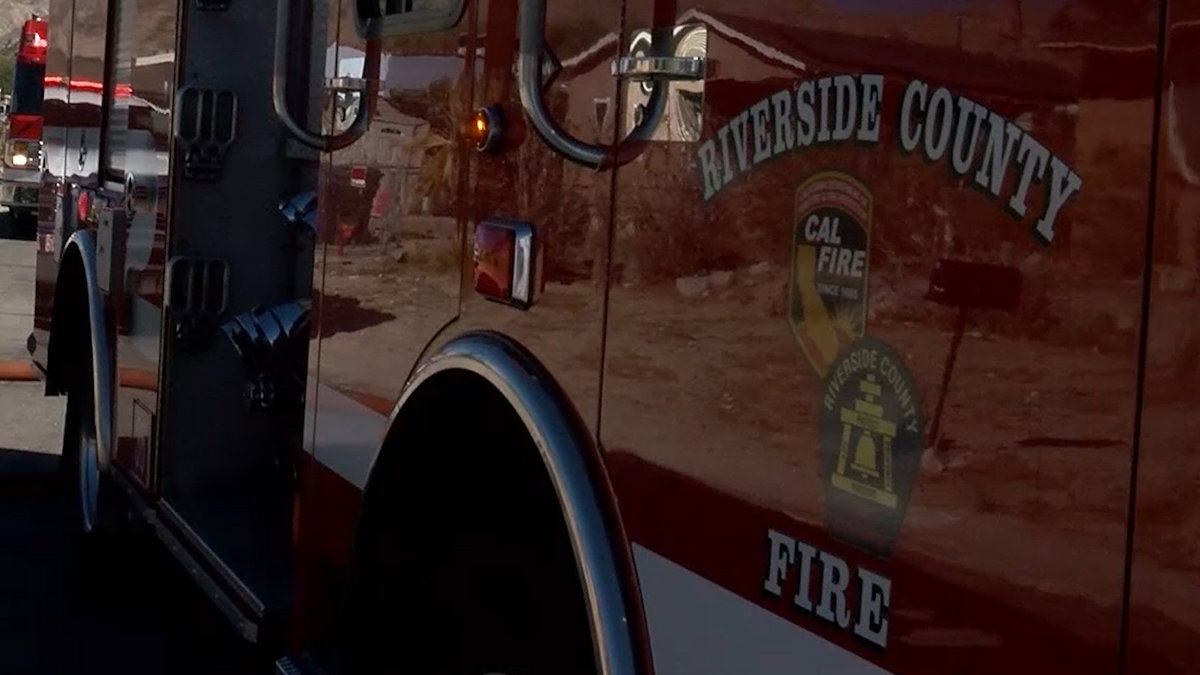

County fire stations open for tours during ‘Fire Prevention Week’

City News Service

PERRIS, Calif. (KESQ) – The doors to more than a dozen Riverside County Fire Department stations will open to the public for one day in October, offering up-close views of fire apparatus, opportunities to ask questions of firefighters and learn how to reduce hazards while charging electronics during Fire Prevention Week.

“Meet your local firefighters, tour the stations, learn important fire safety tips and discover how small … habits can make a big difference,” according to an agency statement. “Activities are family-friendly and fun for all ages.”

The open houses are scheduled Saturday, Oct. 10, from 11 a.m. to 2 p.m.

One of the main points that crews will emphasize during visits will be how to properly charge electronic devices and reduce potential fire hazards, officials said. The theme will be “Plug in, power up, stay safe.”

The following stations will be available to tour during the three-hour period on Oct. 10: — Anza Station No. 29, 56560 Highway 371; — Beaumont Station No. 106, 2000 Western Knolls Ave.; — Coachella Station No. 79, 1377 Sixth St.; — Highgrove Station No. 19, 469 Center St.; — Indio Station No. 80, 81-025 Avenue 40; — Lake Elsinore Station No. 94, 22770 Railroad Canyon Road; — Lake Tamarisk Station No. 49, 43880 Lake Tamarisk, Desert Center; — Menifee Station No. 7, 28349 Bradley Road; — Moreno Valley Station No. 6, 22250 Eucalyptus Ave.; — Norco Station No. 47, 3902 Hillside Ave.; — Palm Desert Station No. 33, 44400 Town Center Way; — Perris Station No. 101, 105 S. F St.; — San Jacinto Station No. 25, 132 S. San Jacinto St.; — Temecula Station No. 12, 28330 Mercedes St.; and — Thousand Palms Station No. 35, 31920 Robert Road.

More information is available by contacting the department’s public affairs bureau at rrupio@fire.ca.gov.

Click here to follow the original article.

Palm Springs Aerial Tramway to start annual snow-guessing contest

City News Service

PALM SPRINGS, Calif. (KESQ) – Coachella Valley community members will have an opportunity tomorrow to enter the Palm Springs Aerial Tramway’s annual snow-guessing contest to win regular admission tickets.

The contest will start Thursday at One Tram Way and will continue until the first measurable inch of snow falls at the tramway’s mountain station, which has an elevation of 8,516 feet, officials said.

The first 10 guests to accurately select the day in which snow will fall at the facility will win four regular admission tickets and a special gift. If there are more than 10 correct entries, winners will be chosen by the earliest postmark date.

To submit an entry, participants must write their best guess on a postcard and mail it to Snow Guessing Contest, 1 Tram Way, Palm Springs, CA 92262. Officials said one date per postcard will be accepted.

More information, including contest rules, can be found at pstramway.com/snow-guessing-2026/.

Click here to follow the original article.
Dates announced for the 2027 Coachella Valley Invitational in Indio; MLS and NWSL teams to return

Jesus Reyes

INDIO, Calif. (KESQ) – MLS and NWSL clubs will return to the Empire Polo Grounds for the 2027 Coachella Valley Invitational, which will be held from January 30 to February 13.

It will be the sixth year of the Coachella Valley Invitational. CVI will host nearly half of MLS and NWSL clubs, including all of the Southern California-based clubs, creating the largest preseason gathering in North American professional soccer.

On Saturday, February 6, the 2027 CVI will reach another milestone with its first-ever MLS-NWSL matchday, bringing together clubs from both leagues for a unique experience for soccer fans and offering an unprecedented opportunity to celebrate the growth and momentum of the sport across North America’s premier professional leagues.

The preseason event takes place just before the MLS kicks off its new “Sprint Season,” a shortened 14-game season that will transition the league to its new summer-to-spring calendar, which will align the MLS season with the world’s top soccer leagues. The Sprint Season will run from February to May.

Advance Passes for all matchdays will go on sale to the public on Thursday, October 1, at 10 a.m. PT at coachellavalleyinvitational.com.

American Express Card Members have early access to purchase tickets for CVI before the general public starting Wednesday, September 30, at 10 a.m. PT. Terms apply.

CVI subscribers will get presale access starting Wednesday, September 30, at 12 p.m. PT. Sign up to be a CVI subscriber at coachellavalleyinvitational.com.

MLS clubs currently committed to the 2027 Coachella Valley Invitational: Austin FC, Charlotte FC, D.C. United, LAFC, LA Galaxy, Minnesota United FC, New York City FC, Portland Timbers, San Diego FC, San Jose Earthquakes, St. Louis CITY SC, and Toronto FC.

NWSL clubs currently committed to the 2027 Coachella Valley Invitational: Angel City FC, Bay FC, Chicago Stars FC*, Denver Summit FC, KC Current, San Diego Wave FC, Seattle Reign FC, and Utah Royals FC.

*Teams making their CVI Debut

EVENT DATESFull schedule of matchups to be released at a later date.

Saturday, January 30 (NWSL) Featuring local teams Angel City FC and San Diego Wave FC Saturday, February 6 (NWSL + MLS) Featuring local teams San Diego Wave FC and San Diego FC Sunday, February 7 (MLS) Featuring local teams LA Galaxy and LAFC Wednesday, February 10 (MLS) Featuring local teams LA Galaxy, LAFC, and San Diego FC Saturday, February 13 (MLS) Featuring local teams LAFC and San Diego FC Click here to follow the original article.
Palm Springs City Council approves extending data center moratorium

Luis Avila

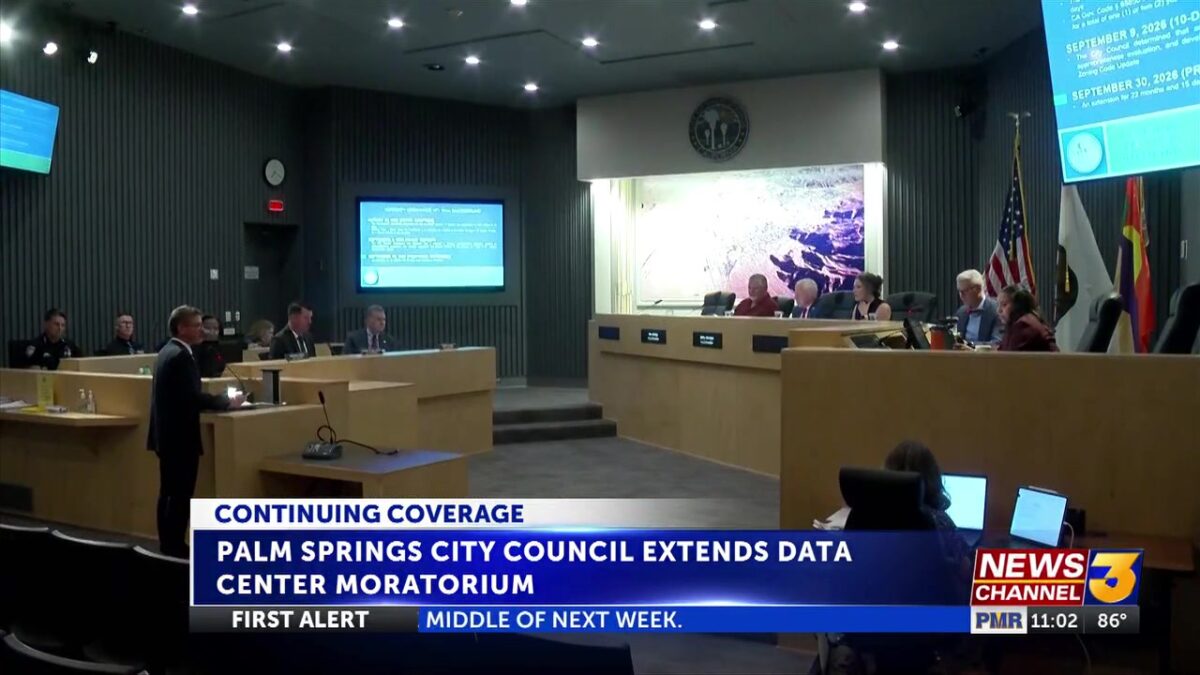
PALM SPRINGS, Calif. (KESQ) — The Palm Springs City Council voted unanimously Wednesday to extend the city’s temporary moratorium on new data center applications and permits, giving officials more time to study how the facilities could be regulated.

The council originally approved a 45-day moratorium on Aug. 26. That temporary ban was set to expire Oct. 10.

Under the extension approved Wednesday, the moratorium will remain in place for another 22 months and 15 days while the city works on potential regulations as part of its broader zoning code update.

Palm Springs’ current municipal and zoning codes do not specifically define or regulate data centers.

The city also plans to consider input from community members, technology experts and other Valley stakeholders as part of the process.

During public comment, resident Kylee Cabral questioned the city’s justification for using an emergency ordinance to impose the moratorium.

“It’s clear the city is still unsure of the exact nature of the threats it’s attempting to mitigate by invoking an emergency ordinance,” Cabral said.

Other questions focused on how broadly the city could define a data center. That could include facilities that house servers but serve another primary purpose, such as hospitals, colleges or other buildings.

Mayor Naomi Soto said the comprehensive zoning update gives the city an opportunity to take a closer look at what the community is open to and what potential impacts should be considered.

“It’s not the conversation is nixed completely,” Soto said. “We are trying to channel it to the appropriate process.”

Stay with News Channel 3 for more.

Click here to follow the original article.

PSP secures $5.5 million FAA grant for baggage system

Tommy Gallegos

PALM SPRINGS, CA (KESQ)- Palm Springs International Airport (PSP) has secured a $5.5 million FAA grant for its new outbound baggage handling system, bringing total federal funding for the approximately $93.6 million project to more than $66.5 million.

The $5,501,525 Airport Infrastructure Grant will fund the project’s final phase, including software integration, testing, commissioning, construction administration and project management.

Federal funding now covers more than 70% of the project’s total cost. The remaining funding includes $14.4 million in Passenger Facility Charge revenue and $12.6 million in airport funds. PSP said no city general fund or local taxpayer dollars are being used.

The new baggage system will expand PSP’s outbound baggage area, improve processing capacity and meet current TSA security standards. It is designed to accommodate projected passenger growth over the next 15 years.

“This investment is ultimately about making the travel experience at PSP better for our passengers,” said Victoria Carpenter, C.M., Interim Director of Aviation. “Modernizing this critical infrastructure will allow us to move checked bags faster, more accurately and more reliably.”

Construction is already underway while the airport continues operating its existing baggage system. The project is expected to be completed in late 2028.

The baggage system is part of Progress PSP, the airport’s broader initiative to modernize infrastructure and prepare for future growth.

Click here to follow the original article.

Desert Hot Springs students get hands-on look at aviation careers

Kiera McKinney

PALM SPRINGS, Calif. (KESQ)- Desert Hot Springs High School students got a firsthand look at aviation careers Wednesday through a program with Palm Springs Unified School District and the Palm Springs Air Museum.

Nine students are taking part in the aviation and aeronautics career exploration program. Five took part in discovery flights Wednesday, riding with a pilot and getting a closer look at how an aircraft operates.

For student Arleth Velazquez, the experience marked her first time on a plane. She said aviation had already been in the back of her mind, and the program has introduced her to career options she had not considered before.

Students are learning that aviation careers go beyond becoming a pilot. The program also introduces jobs in air traffic control, aircraft maintenance, machining and other parts of the industry.

During Wednesday’s flights, students heard communications between the aircraft and the control tower, learned about weather information and saw how the aircraft’s controls work.

Flight Operations Volunteer Dirk Ellis said students are able to get a basic introduction to the controls and see what happens during a flight from takeoff to landing.

The goal is to give students a chance to experience aviation firsthand and decide whether it is a field they may want to continue exploring.

Four more Desert Hot Springs High School students are expected to take part in discovery flights next Wednesday. The program is also being offered to students from other Palm Springs Unified high schools this year.

Click here to follow the original article.
DA says Feinbloom deal came down to one thing: T’Neya Tovar’s parents wanted to bury their daughter

Garrett Hottle

EL CENTRO, Calif. (KESQ) – EL CENTRO, Calif. (KESQ) Imperial County District Attorney George Marquez says he was ready to put Abraham Feinbloom in front of a jury. His witnesses were lined up. He’d even brought in help from the Riverside County District Attorney’s Office.

Then T’Neya Tovar’s parents told him what they needed.

“The victim’s family wanted to bury their child. They wanted to bury their daughter,” Marquez told News Channel 3 on Wednesday. “That was something that was very important to me. And they kept telling us, we want to give her a proper burial.”

So instead of a murder trial, Marquez made a deal. Feinbloom pleaded no contest Monday to torture and voluntary manslaughter, 13 years to life, and in return agreed to show investigators where T’Neya’s remains are.

One day later, investigators recovered remains in a Salton City wash they believe are hers. DNA testing still has to confirm it.

“When we advised the family, they did break down and start crying,” Marquez said, “because this was something that was so important to them.”

Why not murder

Marquez said the plea was built backward from one goal.

“The important thing for us was the life sentence. Torture gives us the life sentence. It gives us seven to life. The manslaughter gives us an additional six years,” he said. “So we were able to come up with an offer that comes close to what he would have gotten if we went to trial. So 13 years to life versus 16 years to life, in exchange for where the remains were, so the family could get closure and they could bury their daughter.”

Marquez said the decision wasn’t easy.

“Going to trial on this case was very tempting. It’s something that I would have loved to have seen, to be frank with you,” Marquez said. “But at the end of the day, being a father myself, I know how badly her parents wanted to put her to rest. So that played a very big part in my decision.”

Marquez said the Riverside County DA’s office had assigned a prosecutor to help try the case. “They were both ready to go to trial,” he said. “But given the fact that the family wanted to bury their daughter, we came to this resolution.”

A deal with no guarantee

Under the agreement, reviewed by News Channel 3, the murder charge is dismissed at sentencing only if investigators recover portions of T’Neya’s torso and head first. Nothing Feinbloom told investigators during the search can be used against him unless he testifies and contradicts himself.

Marquez admitted he didn’t know if Feinbloom would follow through.

“To be frank with you, I wasn’t sure,” he said. “But he ended up being truthful.”

He would not say what Feinbloom told investigators, how T’Neya died or why her remains were at more than one site. “We can’t comment on that,” Marquez said. “When the final sentencing hearing is held, we will be able to tell you more at that time.”

Investigators had already spent months looking. Marquez said his office, the FBI and the sheriff’s offices in Imperial and Riverside counties used ground-penetrating radar, helicopters and “the latest technology” and came up empty.

“This is a vast desert. There’s a lot of land,” he said. “That’s another reason why we knew we weren’t going to find it unless he provided a location.”

The defense’s account

Feinbloom’s attorney, Melanie Roe, gave News Channel 3 a different account of how the deal started.

In a written statement Wednesday, Roe said the defense made the first offer “several weeks ago”: a plea to voluntary manslaughter at the upper term, with conditions requiring Feinbloom to help law enforcement recover the remains. She said prosecutor John Harter, who signed the agreement for the DA’s office, countered, and the two sides reached a deal after meeting in his office last Friday.

Marquez said prosecutors came up with the resolution.

Roe said the plea was entered one day before a judge was set to hear her motion to dismiss the murder charge, and before the trial was to begin. That motion argued the evidence at the preliminary hearing did not support a murder charge because prosecutors “failed to produce any evidence of intent to kill, premeditation, deliberation and malice aforethought.”

Roe said Feinbloom “fully satisfied all conditions” of the agreement Tuesday. She said the Imperial County Sheriff’s Office can confirm the remains using rapid DNA equipment and that the defense expects “notice of confirmation shortly.”

Her full statement is at the bottom of this story.

‘Never sees the light of day’

Feinbloom becomes eligible for parole after 13 years. Marquez said that doesn’t mean he gets out.

“It’s very unlikely he’s going to be out at the 13-year mark. The likely scenario is he’s probably going to die in prison,” Marquez said. “I gave my word to the family. We’re going to do everything possible so this guy never sees the light of day again.”

The deal covers only T’Neya’s case, he said. “If he committed any other crimes that we’re not aware of, somebody can prosecute any crimes that aren’t part of this one.” Asked if his office knows of any, Marquez said no.

Marquez said he spoke with T’Neya’s father Tuesday and with both parents in court. “They thanked me from the bottom of their heart,” he said, “for making this disposition where they could find the remains and they could bury their daughter.”

“Obviously, she’s not coming back,” Marquez said. “But he’s being held accountable.”

T’Neya, of Hemet, was 17 when she went missing Dec. 1 after a friend dropped her off at Feinbloom’s Harlequin Court home. Her parents drove to Salton City repeatedly asking deputies to check on her. Partial remains were found in the same area three weeks later. Feinbloom was arrested Feb. 13 and told an FBI agent he did not know her.

Sentencing is set for Oct. 26 at Imperial County Superior Court in El Centro.

Full statement from defense attorney Melanie Roe

“The plea was entered on the record one day before the hearing of my 995 motion to dismiss the murder count and before Day 1 of trial.

“That motion urged the court to dismiss the case on the grounds the evidence at preliminary hearing was insufficient to support a holding order on murder as the People failed to produce any evidence of intent to kill, premeditation, deliberation and malice aforethought (the same elements they must prove for a conviction at trial).

“Several weeks ago, Defense made an offer to resolve the matter with a plea to a reduced count of voluntary manslaughter (upper term) with conditions precedent to the settlement requiring the Accused to assist law enforcement in the recovery of the remains.

“DDA Supervisor John Harter countered and a plea bargain was reached after the defense team met with Mr. Harter in his office last Friday.

“Mr. Feinbloom fully satisfied all conditions precedent to the agreed upon disposition yesterday. Sentencing is set for 10/26.

“DNA confirmation of the remains can be tasked to and completed by the Imperial County’s Scientific Unit using the Rapid DNA equipment. We expect notice of confirmation shortly.

“I refer you to my 995 motion which details the Defendant’s case. I note that very little of our case has been reported despite the presence of numerous reporters at the three day preliminary hearing. The arguments therein are echoed in my trial brief filed with the court. And you are free to review same to guide you in your reporting.”

Click here to follow the original article.

Recent fights raise safety concerns in downtown Palm Springs nightlife district

Raymond Kalra

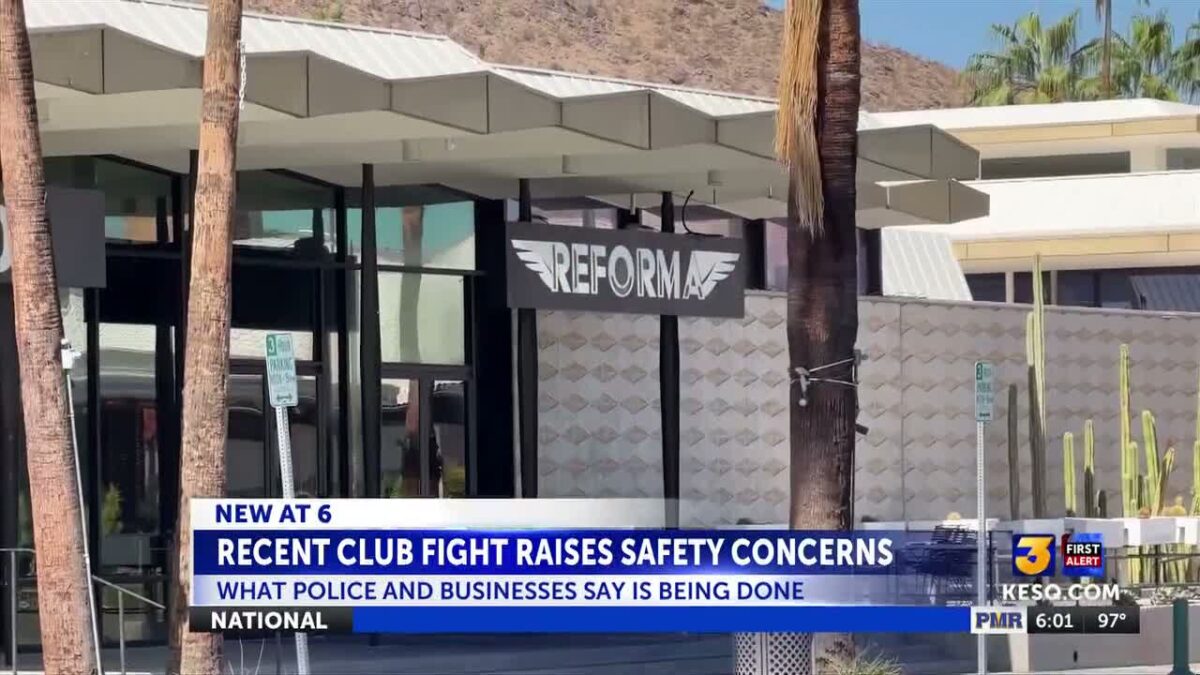
PALM SPRINGS, Calif. (KESQ) – Palm Springs police say they have seen an influx of altercations around the downtown nightlife area in recent months, with many of the problems happening around bar closing.

The Palm Springs Police Department said officers have increased their visibility in the area, particularly on weekends, as they work to get ahead of arguments and disturbances before they turn physical. Police said the biggest concern is around 2 a.m., when multiple bars and nightlife businesses close and large groups of people move into nearby streets, parking lots and parking structures.

PSPD also stressed that the issue should not be attributed to one business alone.

Police pointed to several nightlife businesses in the area that close around the same time, creating situations where groups from different locations can converge in the same place.

Andrew Hernandez, an operator and member of the ownership team at Reforma, said a busy night can mean hundreds of people leaving the business at once.

“We have a mass exodus of sometimes, you know, anywhere from 600 to 800 people, and so are the other bars that are just down the street,” Hernandez said. “So you have to understand that you have a lot of different groups kind of just merging at the end of the night.”

The recent concerns have gained more attention after videos of fights in the downtown area circulated on social media.

Hernandez said one recent fight near Reforma involved two people who had left the business without an issue before other individuals came from an adjacent street and a physical altercation began outside. He said Reforma security stepped in once the situation became a public safety concern.

Hernandez said Reforma works closely with PSPD and has added several preventative measures, including ID-scanning software and an “86 list” intended to help staff identify patrons who have caused problems before. He said the business also contacts police when issues arise and tries to stop problems before they begin.

“We do not want violence. We don’t condone violence. We have a zero policy about it,” Hernandez said. “But what could we do better? And that’s something that’s never going to stop.”

Police said they are also working with businesses on changes to nearby parking areas.

PSPD said the goal is to restrict access to some parking structures during overnight hours, with a proposed window of roughly 11 p.m. to 5 a.m. Police said they hope that will reduce the number of people gathering in the same areas around bar closing and help crowds disperse more evenly.

Hernandez said limiting access to some surrounding lots could make it easier for police to focus on fewer locations and monitor where crowds gather after businesses close.

Both PSPD and Reforma said they plan to continue working together as the downtown area gets busier.

Police said their focus is on maintaining a visible presence and preventing situations from escalating.

“We want them to have a good time in the city of Palm Springs,” a PSPD spokesperson said. “But what we’re doing is being very proactive and get in front of these issues. So hopefully we can have, once again, a safe environment for all.”

Click here to follow the original article.

Changes come to Coachella Valley Firebirds food and beverage offerings

Matthew Pearce

THOUSAND PALMS, Calif. (KESQ) — The Coachella Valley Firebirds are making changes to their food and beverage offerings ahead of the start of their fifth season in the valley.

Acrisure Arena Executive Chef Juan Hurtado and the arena’s culinary team began working on the new menu immediately following the final horn of last season. While traditional stadium favorites remain, several items have been revamped based on direct fan feedback.

“We hear again from the guests what they’re liking and what they’re not liking,” Hurtado said. “And we kind of brainstorm and we kind of come to a conclusion like, hey, this wasn’t selling so well, so let’s revamp it. Or maybe bring something different.”

One major addition to the dining lineup is a rotating food concept at The Oasis featuring the Truman Grill. The setup will offer a changing menu for every Firebirds game throughout the season.

“We have the Truman Grill, which is a really nice big grill that we do different concepts every Firebird game,” Hurtado said. “It could be like a tri-tip sandwich, it could be a mac and cheese and brisket. I mean, we have like 15 different menus that we’re going to be rotating through the truck and grill.”

In addition to rotating meat entrees, the arena expanded its plant-based options to cater to attendees with dietary preferences.

“We do have a different vegan options that you’re going to see today,” Hurtado said. “They’re going to be able to to meet those needs. Right. So you’ll see today as you kind of go through the food and see we do have different variety of of vegan and vegetarian options.”

One hockey fan praised the inclusion of vegetarian and vegan meals in stadium concessions.

“I actually accidentally grabbed the vegetarian and it was actually really good,” Wendy said.

The Oasis Grill will feature grilled carne asada as its first concept in the 15-item rotating menu during the Firebirds home opener this weekend.

Click here to follow the original article.