Indio invites public input on proposed 4,609-acre eastward expansion

Tommy Gallegos

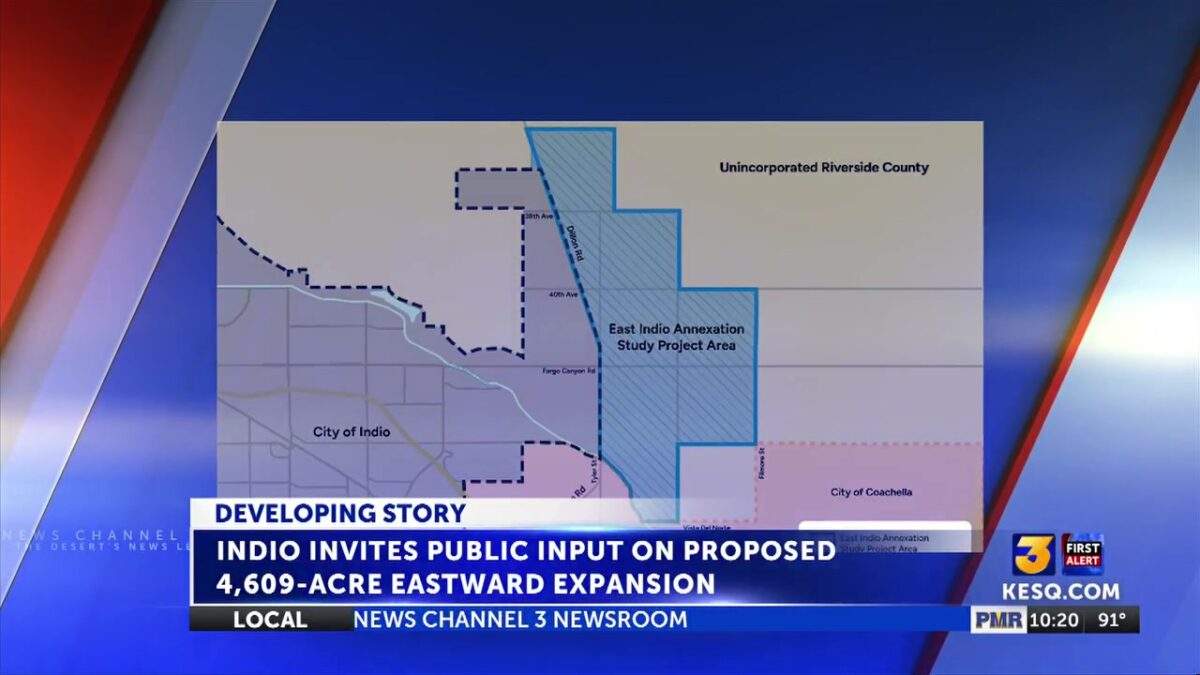
INDIO, Calif. (KESQ)— The City of Indio is inviting residents, property owners and other interested members of the community to participate in a virtual meeting next week as the city continues studying the potential annexation of thousands of acres of unincorporated Riverside County land along its eastern boundary.

The virtual meeting is scheduled for 5:30 to 6:30 p.m. Monday September 28, and will provide an overview of the East Indio Land Planning Annexation Study, including the proposed study area, the annexation process and project updates.

The city is examining the potential annexation of approximately 4,609 acres of unincorporated Riverside County land located immediately east of Indio. The area is already within the city’s Eastern Sphere of Influence, a designated area outside the current city limits where future municipal services or annexation may be considered.

The study does not itself annex the land. Instead, city officials say the planning effort is intended to determine which portions of the area could potentially be included in an annexation request and to prepare the materials needed for an application to the Riverside Local Agency Formation Commission, or LAFCO.

Proposed future employment hub

Indio’s vision for the area includes creating a future employment center with a mixture of uses intended to support job creation and economic diversification.

Potential uses identified by the city include:

Business park development Light industrial and logistics operations Office space Retail Workforce housing Open space

According to the city, the broader planning effort is intended to evaluate opportunities for business development, job growth and infrastructure improvements while determining where development may be appropriate and where sensitive or natural areas should be preserved.

The study includes analyses of land use, transportation, public services and utilities, hydrology, geology, biological resources, cultural resources and paleontological resources. A fiscal impact analysis and environmental documentation are also part of the planning process.

Development would face environmental and safety considerations

The proposed expansion area contains several environmental and physical constraints that could influence future development.

One significant consideration is seismic activity. Major regional faults, including the San Andreas and San Jacinto faults, run through the broader area. Potential hazards associated with faulting include ground shaking, surface rupture, liquefaction and landslides.

Flooding is another concern. The northern portion of the study area includes land within a floodplain with a one-percent annual chance of flooding. Planning recommendations call for flood-management measures and caution regarding development of uses that could be particularly vulnerable to flooding, including residential uses.

The area also contains habitat and conservation resources. Approximately 15 acres in the northeastern portion of the study area overlap the Desert Tortoise and Linkage Conservation Area, which is part of the Coachella Valley Multiple Species Habitat Conservation Plan framework.

That conservation area is intended to protect natural communities including Sonoran creosote bush scrub, Sonoran mixed woody and succulent scrub, Mojave mixed woody scrub and desert dry wash woodland. Any development proposed within the conservation area could be subject to additional biological analysis, avoidance requirements and mitigation measures.

The study’s environmental considerations also include potential habitat for a number of sensitive species, including the desert tortoise, Le Conte’s thrasher, summer tanager and Palm Springs pocket mouse.

Other wildlife considerations include American badgers and desert kit foxes, which have a high potential to occur in the project area but are not covered under the CVMSHCP. If they are found, additional consultation and mitigation could be required.

Nelson’s bighorn sheep, a fully protected species, is another consideration, particularly in the northeastern and eastern portions of the study area. Future development in those areas could require setbacks and additional avoidance or mitigation measures.

Surveys could be required before construction

Future development would also have to account for protected birds and bats.

The project area contains potential habitat for burrowing owls, raptors and other nesting birds. Pre-construction surveys would be required in circumstances covered by applicable state and federal protections, particularly when vegetation removal occurs during nesting season.

The planning materials also identify potential bat roosting habitat. Depending on the location and timing of construction, projects could need to avoid maternity-roosting periods or conduct pre-construction surveys and implement avoidance measures.

These requirements mean that potential annexation and future development would involve additional environmental review beyond the question of whether the land should become part of Indio.

Transportation and Dillon Road

Transportation infrastructure is another component of the planning effort.

Improvements to Dillon Road are identified as a covered activity under the Coachella Valley Multiple Species Habitat Conservation Plan, although the applicable improvements are limited to a maximum right-of-way width of 128 feet.

Where Dillon Road improvements overlap the East Indio Hills Conservation Area, additional avoidance, minimization and mitigation measures could apply, along with land-use adjacency requirements under the conservation plan.

The city’s current study also evaluates transportation access as part of its broader assessment of whether and how the area could accommodate future development.

Public participation sought

City officials are emphasizing community participation as the study progresses. The city says outreach is expected to include public workshops, online surveys and presentations to relevant city commissions and the City Council.

The upcoming virtual meeting will give residents an opportunity to learn more about the study area, understand the annexation process and hear about the latest project developments.

The city has said community input will be incorporated at key milestones as officials evaluate the potential annexation.

For additional project information, residents can visit the City of Indio’s East Indio Land Planning Annexation Study webpage, where the city is posting project reports, outreach information and updates.

Click here to follow the original article.

BLSS: Week 6 high school football schedule

Jesus Reyes

COACHELLA VALLEY, Calif. (KESQ) – Week 6 of the high school football season, including two big rivalry “Bell” games, Yucca Valley vs Twentynine Palms and Indio vs Coachella Valley.

All games kick off Friday at 7:00 p.m. unless noted otherwise.

Desert Hot Springs @ Miller 7:00 pm Desert Mirage @ San Gorgonio 7:00 pm Arrowhead Christian @ Cathedral City 7:00 pm La Quinta @ Roosevelt 7:00 pm Indio @ Coachella Valley 7:00 pm Valley View @ Shadow Hills 7:00 pm Yucca Valley @ Twentynine Palms 7:00 pm

Be sure to watch the Best Local Sports Show every Friday night.

Stay with News Channel 3 for continuing coverage of high school football throughout the season.

Click here to follow the original article.
Jurors deadlock in trial of man accused of repeatedly raping girl

City News Service

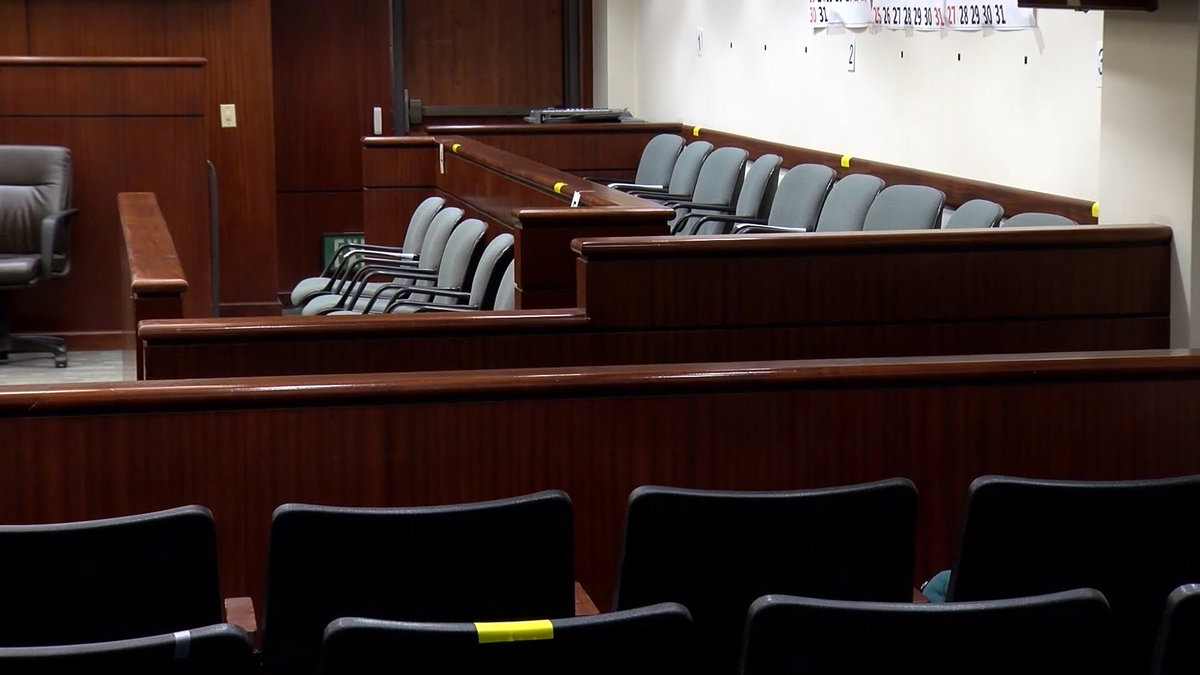
INDIO, Calif. (KESQ) – Prosecutors were undecided today as to whether to retry an Indio man who allegedly sexually abused a girl repeatedly, following a jury deadlock in deliberations regarding multiple rape allegations.

After two days of deliberations, an Indio jury on Tuesday afternoon informed Riverside County Superior Court Judge James Hawkins that it was unable to reach a unanimous verdict on five of 11 charges against Miguel Pedrero Tzompantzi, 40.

Jurors acquitted him of four counts of rape of a minor and convicted him of a misdemeanor charge of annoying a child. However, according to the District Attorney’s Office, the panel hung 11-1 in favor of convicting Tzompantzi of five remaining charges of rape of a minor.

Prosecutors had not decided Wednesday whether to seek a retrial. The judge tentatively scheduled a sentencing hearing for Oct. 14 at the Larson Justice Center. The DA’s Office may announce at that time, or before, if a retrial is planned.

The defendant is being held without bail at the Benoit Detention Center.

“This inexperienced child, who was at the will of an adult, was psychologically and physically abused for eight months,” Deputy District Attorney Jennifer Stevenson told jurors in her closing statement last week. “She was under his thumb.”

The prosecutor recalled how the then-16-year-old victim was entirely dependent on Tzompantzi, while her parents, both Mexican nationals, remained in their country.

Stevenson quoted the victim’s testimony when the young woman told the court, head down in grief, “I was scared of him. I didn’t know what to do.”

The alleged abuse began in October 2022 and continued until May 2023, by which time the victim was pregnant, Stevenson said.

Tzompantzi insisted that he and the then-teenager were in a relationship, according to testimony.

“His claims about this case from start to end are absolutely absurd,” the prosecutor told the jury.

An Indio Police Department arrest warrant declaration filed in 2023 alleged that the teen was threatened by her uncle, who reportedly told her that if she revealed what had been going on, “he would deny it and blame her for everything,” additionally asserting “no one wanted her, and that is why she was living with him.”

The allegations surfaced after the girl was seven months pregnant and had told her parents about the alleged assaults.

Deputy Public Defender Stephen Sadocha told jurors “it was a consensual relationship that turned sexual.”

“He was taking care of her — buying her food, taking her shopping,” the attorney said.

He questioned the legitimacy of the girl’s testimony and statements to law enforcement, arguing that there was one alleged instance when the victim initiated sexual contact with Tzompantzi in his car, parked outside a business.

“For eight months, there was no one suspicious about her behavior,” Sadocha said. “Not one person reported (anything) suspicious, not a teacher or a counselor.”

The attorney said there were “inconsistencies” in the girl’s descriptions of what Tzompantzi allegedly did, emphasizing the need for jurors to re-examine the circumstances before drawing any conclusions that could seal his client’s fate.

Tzompantzi has no documented prior felony convictions in Riverside County.

Click here to follow the original article.
Man accused of injuring Palm Springs partygoers due in court next week

City News Service

INDIO (CNS) – A 35-year-old man accused of hurling glass bottles during a melee at a Palm Springs pool party, injuring four women and two men, is slated to be arraigned next week.

Milad Thamer Youssef of El Cajon was arrested last month following a Palm Springs Police Department investigation.

Youssef is charged with six counts of assault with a deadly weapon, with sentence-enhancing great bodily injury allegations.

The defendant, who is being held in lieu of $60,000 bail at the Benoit Detention Center, is due for arraignment Tuesday at the Larson Justice Center in Indio.

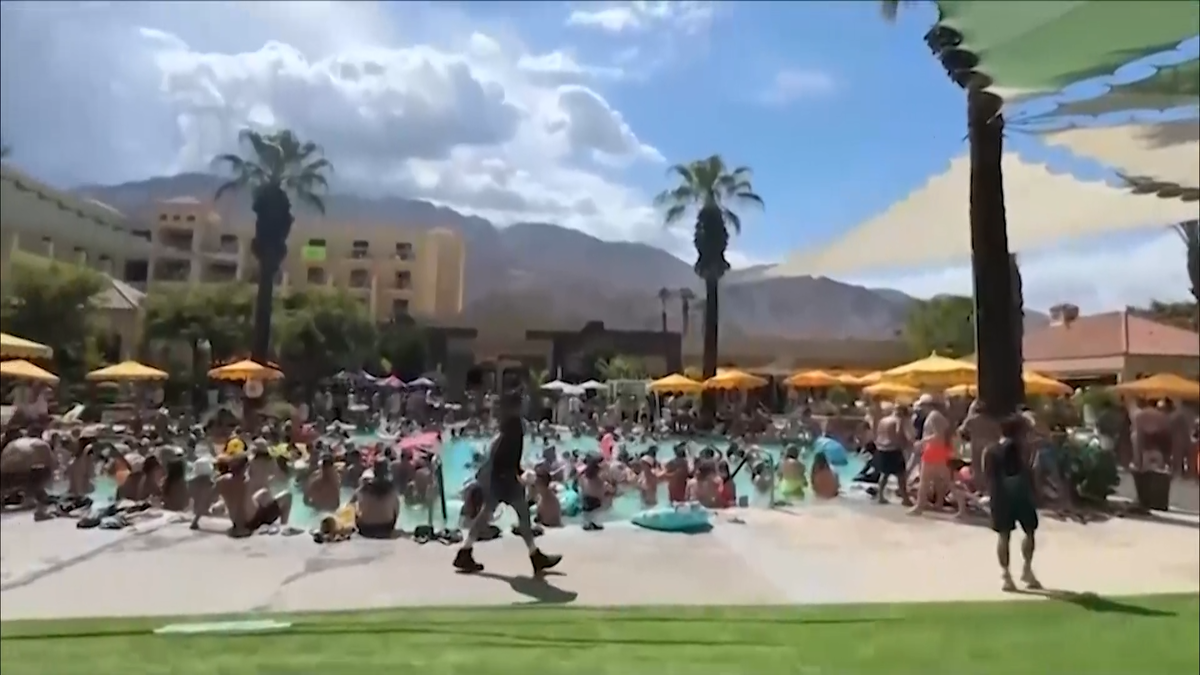
According to police, at 1:30 a.m. Aug. 9, a fight erupted during the Splash House music celebration at the Palm Springs Air Museum on Gene Autry Trail.

Youssef was in the thick of it, and during the altercation, he allegedly retrieved glass bottles at poolside and hurled them at attendees, police said.

It was unclear whether he was aiming at anyone in particular. Court papers identified the victims only by their initials, with the four women listed as “A.C.,” “I.A.,” “N.G.” and “S.P.,” while the two male victims were identified as “A.P.” and “D.G.”

Officers assigned to work security at the venue were immediately summoned, but by the time they reached the scene the defendant had allegedly fled, according to the police department.

The victims were either treated on-site by paramedics, or taken to nearby Desert Regional Medical Center for evaluation and treatment. Their injuries were generally described as minor and all stemming from contact with broken glass.

Youssef turned himself in to investigators five days later and was booked into jail. Prosecutors filed a criminal complaint against him last week.

He has no documented prior felony convictions in Riverside County.

Click here to follow the original article.
California Supreme Court rules Sheriff Bianco’s Prop. 50 ballot seizure was unlawful, orders ballots returned to Riverside County registrar

Garrett Hottle

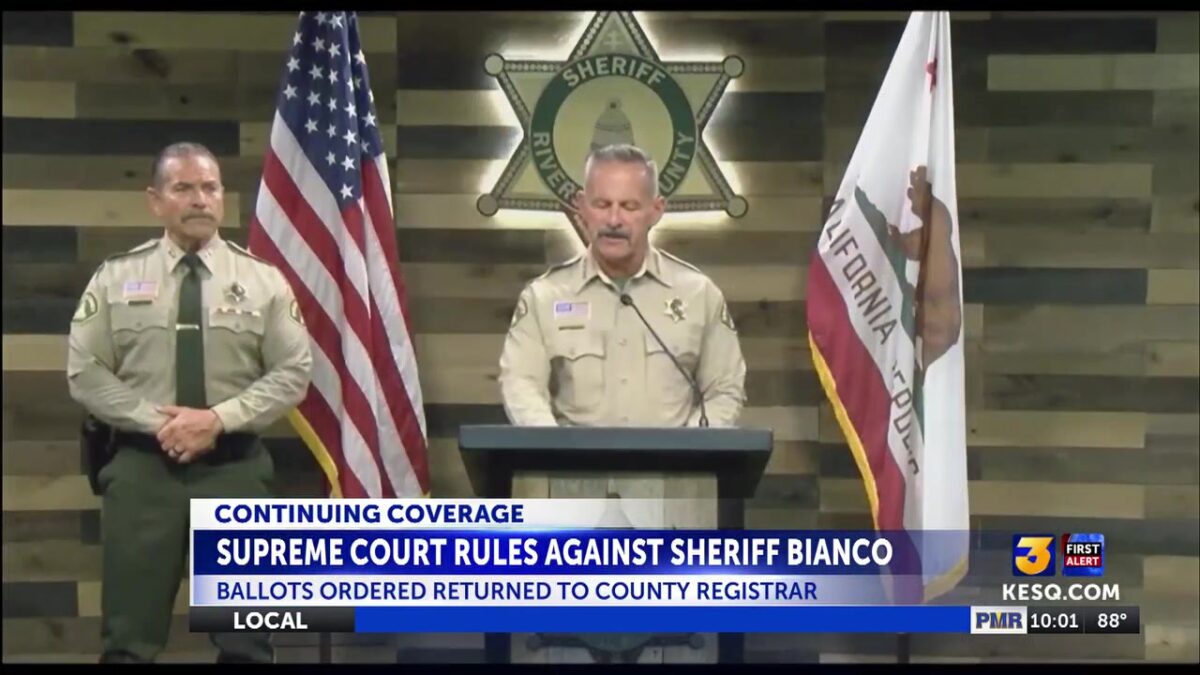
SAN FRANCISCO, Calif. (KESQ) SAN FRANCISCO, Calif. (KESQ) The California Supreme Court ruled unanimously Thursday that Riverside County Sheriff Chad Bianco’s seizure of ballots from the November 2025 Proposition 50 special election was unlawful, and ordered him to return them to the Riverside County Registrar of Voters immediately.

In a second unanimous ruling released at the same time, the court said Attorney General Rob Bonta had the authority to order the sheriff to stop, and that Bianco has no choice but to comply.

“Sheriff Bianco broke the law, violated the law, acted illegally,” Bonta told reporters Thursday. “We acted because we had to.”

The sheriff must halt his investigation while Bonta reviews it, hold onto everything else he seized and hand over his case files to the attorney general.

How the fight over Riverside County’s ballots started

The dispute began in February when a citizens group told the sheriff’s department the numbers didn’t add up. Using handwritten ballot intake logs kept by election workers, the Riverside Election Integrity Team claimed the county counted 45,896 more ballots than it received.

Registrar of Voters Art Tinoco said the real gap was 103 ballots, or 0.016 percent, and blamed human error. The logs were rough field estimates, he said, and the group’s math left out about 6,000 ballots.

By then Bianco already had a search warrant. He got it the day before Tinoco explained all of that to the Board of Supervisors, and sheriff’s personnel were in the room for the presentation. When the department applied for a second warrant two weeks later, it told the judge the registrar “has not given a reason for the discrepancy.”

Deputies hauled away about 1,000 boxes of ballots on Feb. 26. A week later, they started counting them by hand. Bonta ordered the sheriff to stop. Bianco got a third warrant without telling him and seized more. The Supreme Court froze everything in April.

Everyone in the case agrees the discrepancy, even if it were real, couldn’t have changed the outcome. Prop. 50 passed in Riverside County with 56 percent of the vote.

What the court said

State law says voted ballots stay with the county elections official. The court said that rule has no exceptions, not for a criminal investigation and not for a search warrant. Bianco “had no authority to seize the ballots,” Chief Justice Patricia Guerrero wrote.

The second ruling answered a bigger question. The state constitution has given the attorney general “direct supervision” over sheriffs since 1934, but no court had ever said what that means in practice. The justices said it means the attorney general can give a sheriff orders, and the sheriff has to follow them.

Justice Goodwin Liu went further in a separate opinion, writing that county lawyers refused to represent the sheriff and that the seven-month fight could have been avoided if Bianco had asked for their advice and followed it. “It should not have come to this,” Liu wrote.

What happens now

The ballots go back to Riverside County Registrar of Voters office. The rulings aren’t final for 30 days, and Bianco can ask the court to reconsider.

Whether the investigation ever restarts is up to Bonta. He said his office has seen no evidence of any election crime after more than six months, but he did not say Thursday whether he will shut it down for good. Asked if Bianco would face criminal consequences, Bonta pointed to the court’s orders and to a new state law that makes taking ballots a felony going forward.

Bianco has not been charged with any crime. He endorsed Republican Michael Gates, who is challenging Bonta in November and has promised to let the investigation finish. In July, Bianco told News Channel 3 Bonta was “an absolute complete fraud that is abusing the power of his office.”

This story will be update with additional info as it becomes available.

Click here to follow the original article.
Coachella power capacity concerns raise bigger questions about valley growth

Raymond Kalra

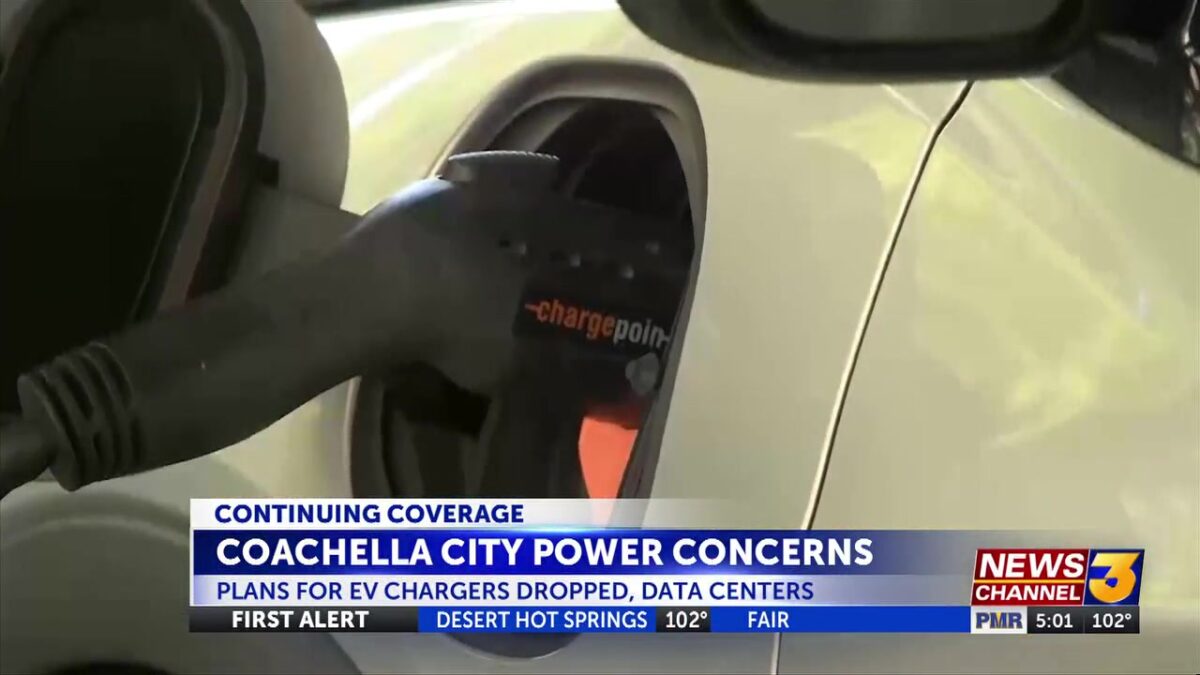
COACHELLA, Calif. (KESQ) – Plans for 30 new electric vehicle chargers at Rancho Las Flores Park are off the table as the City of Coachella scales back a major expansion project, with city leaders pointing to both cost and limited access to power.

But the decision is raising a much bigger question for one of the fastest-growing areas of the Coachella Valley: Does the city have enough power for what it wants to build next?

Coachella Mayor Frank Figueroa told News Channel 3 that the planned chargers were removed from the park project because of a combination of costs and access to electricity.

“I think, you know, that presentation earlier this week, it was a mixture of both costs and I think electricity, electrical access,” Figueroa said. “And I know that we have low capacity.”

The issue comes as Coachella studies where additional public EV chargers will be needed as electric vehicle use grows.

Figueroa said adding those chargers depends on first making sure the electrical system can support them.

“We can’t really proceed with that until we resolve our power access and ensuring that we have those substations and infrastructure there, then we can talk about EV charging,” Figueroa said.

The data center connection

The power issue also adds another layer to Coachella’s recent fight over data centers.

Earlier this year, the city had an agreement with Stronghold Power Systems tied to a proposed technology campus and the development of Coachella’s municipal electric utility.

Under those plans, the proposed data centers were expected to become large initial customers of the municipal utility, while Stronghold would play a role in developing the electrical infrastructure needed to serve the project and support the utility’s buildout.

The city terminated its agreement with Stronghold in June following months of community opposition and later approved a permanent prohibition on data centers.

The data center proposal went away, but Coachella’s need for additional electrical infrastructure did not.

Figueroa said the city’s ability to continue attracting development will depend on addressing that need.

“Economic development and growth in our city is going to be tied to the energy infrastructure, which we’re working on,” Figueroa said. “We’re working to move forward with IID. We have a joint powers authority. We’re moving forward with that.”

In March, IID and Coachella formed the Coachella Electric Financing Authority, a joint powers authority designed to help finance electrical infrastructure improvements as the city grows.

The authority provides a framework for the city and IID to identify needed projects and pursue financing for those improvements.

Could power affect housing growth?

The implications could extend beyond EV charging.

Figueroa told News Channel 3 that a new housing community coming online could, for now, be among the last developments able to move forward based on available power access.

Mayoral candidate Jesus Kino Gonzalez also pointed to the power grid as a major issue facing the city.

“The reality right now in the City of Coachella is that our grid is at maximum capacity,” Gonzalez said. “So even if a development wanted to come into the city, it currently can’t. So I think that that’s a major issue because we need to develop the city to raise our tax base.”

IID’s response to News Channel 3 adds important context to that characterization.

The utility says there is no single threshold determining whether another project can be served. Instead, IID says a project’s impact depends on how much electricity it needs, where it would connect and how much capacity is available nearby.

IID says it studies proposed projects individually before determining whether upgrades are necessary.

Gonzalez told News Channel 3 he believes the city should work with other government agencies to expand electrical infrastructure while avoiding additional costs for residents.

News Channel 3 also reached out to the other candidates for Coachella mayor and had not received responses by the deadline for this story.

How much power could a data center need?

IID’s newly approved Large Load Tariff applies to customers requesting at least 20 megawatts of electricity, although the utility says some proposed projects could require considerably more.

For comparison, IID told News Channel 3 demand from all of its customers combined reached 1,126 megawatts at this year’s summer peak.

IID says that does not mean every large project can automatically be connected to the system.

Even if a data center or other large customer agreed to pay for all of the infrastructure needed to serve its project, IID says payment alone would not determine whether the project could move forward.

The utility would first evaluate the project’s electricity needs, available power supply, capacity on the electrical system and any improvements necessary before deciding whether reliable service could be provided.

Who would pay for the upgrades?

That’s also where IID’s new Large Load Tariff comes in.

IID’s Board approved the tariff on Sept. 15 amid growing interest from projects requiring very large amounts of electricity.

Under the tariff, a qualifying large customer would be responsible for electrical infrastructure needed to serve its project.

Depending on IID’s studies, that could include construction of new facilities or upgrades to the existing electrical system.

The customer would also be responsible for the costs and financial risks of securing the electricity needed for the project.

IID told News Channel 3 the goal is to prevent those project-specific costs from being shifted to its existing customers.

“IID’s new tariff requires large customers to bear the costs and financial risks associated with their projects, rather than shifting those project specific costs to existing customers,” the utility said in a statement to News Channel 3.

California adds new data center rules

IID’s changes come as California is also implementing new rules governing data centers.

Gov. Gavin Newsom signed a package of data-center legislation this week addressing issues including electricity, water use, infrastructure and costs to ratepayers.

IID approved its Large Load Tariff before the new state laws were signed.

The utility told News Channel 3 its tariff already requires qualifying large customers to bear the costs and financial risks associated with serving their projects.

IID says it is now reviewing the new state laws to determine whether they create any additional requirements for the utility.

Are more large projects coming?

IID confirmed to News Channel 3 that it has received inquiries from prospective large-load customers, but the utility would not identify individual projects.

IID emphasized that its role is limited to determining whether it can provide electric service under its Large Load Tariff.

Whether a data center or another development can actually be built at a proposed location is ultimately decided by the city or county with jurisdiction over the project.

For Coachella, that distinction is especially important.

The city has prohibited data centers within its boundaries, but its need for additional electricity and infrastructure remains as leaders plan for more housing, businesses and electric vehicles.

The question now isn’t only how much Coachella wants to grow, but what it will take to power that growth.

Click here to follow the original article.
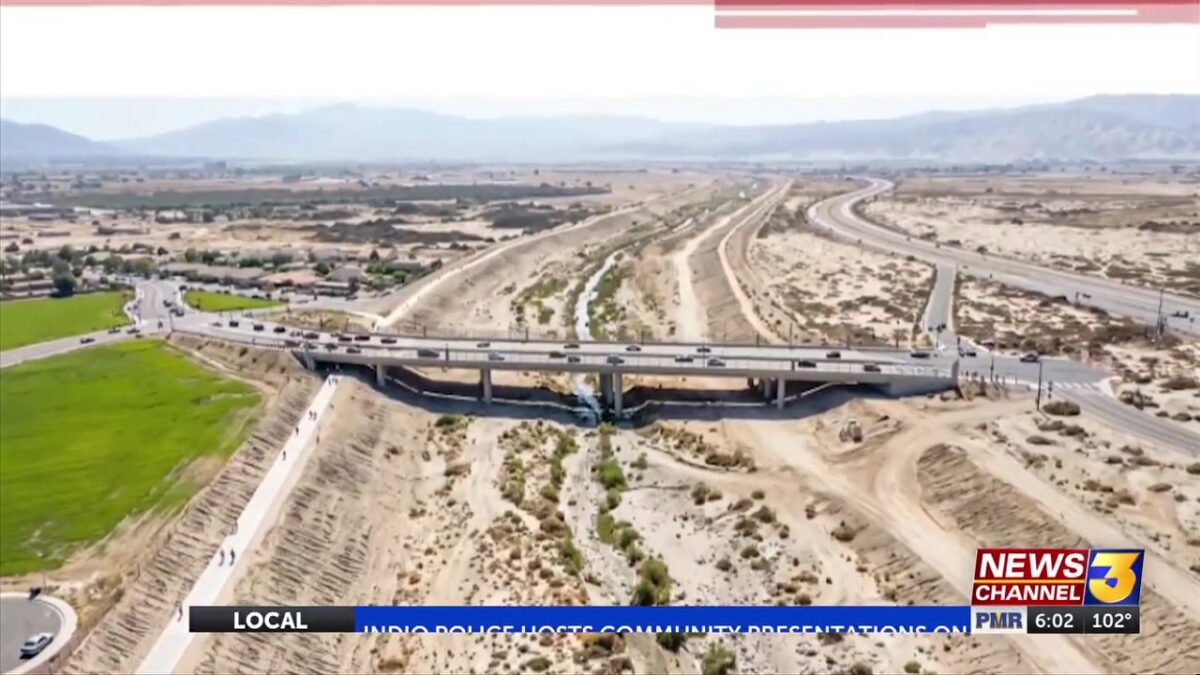
Coachella’s long-awaited Avenue 50 bridge gets $48.7M green light

Matthew Pearce

COACHELLA, Calif. (KESQ) — The Coachella City Council voted to award a $48,709,821.10 construction contract to Riverside Construction Company Inc. to build the Avenue 50 Bridge. The infrastructure project will replace the existing Avenue 50 low-water crossing over the Coachella Valley Stormwater Channel.

Rendering from City Council Meeting on September 21

The bridge project will move forward without requiring any allocations from the city’s general fund, with funding supplied through the Highway Bridge Program, the Coachella Valley Association of Governments, Measure A, Senate Bill 1 funds and local water funds.

Total construction costs, including a 10% contingency of $4,870,982.10, came in approximately $7 million under the city’s original budget estimate.

The new bridge will span the channel to eliminate regular flooding and address deteriorating asphalt conditions at the low-water crossing.

Phase one of the project includes realigning Tyler Street and shifting the CV Link trail beneath the new structure, with a temporary reconnection to the existing signalized intersection at Highway 86. A planned second phase will eventually construct a full interchange at Highway 86 and Avenue 50.

The city first received federal bridge funding authorization for the project in 2014 and completed the environmental review phase in 2019. The subsequent right-of-way acquisition and design phase faced delays due to eminent domain proceedings, coordination with tribal and regional entities and disruptions during the COVID-19 pandemic.

The city issued a notice inviting bids on July 9, held a mandatory job walk on July 28 and opened public bids on Sept. 3. Seven companies submitted bids for the contract. Including $7.9 million in construction management fees, the total project cost stands at $61,551,444.

Primary funding includes approximately $49 million in state bridge funds and nearly $9.5 million from the Coachella Valley Association of Governments.

Local costs are covered by $1.6 million from Measure A and $1.73 million from SB 1 revenue, which city leaders intentionally set aside over multiple years to protect general fund reserves.

During the City Council meeting Monday, Mayor Dr. Frank Figueroa praised municipal staff and regional partners for securing non-general-fund financing to move the project into construction.

“This is a big win for the city of Coachella and we should all be very proud,” Figueroa said. “This is a massive project for the city, Coachella and I can’t wait to do the groundbreaking.”

Groundbreaking for the Avenue 50 Bridge project is scheduled for Oct. 15.

Click here to follow the original article.

Riverside County gas prices hit highest level since 2023

Kiera McKinney

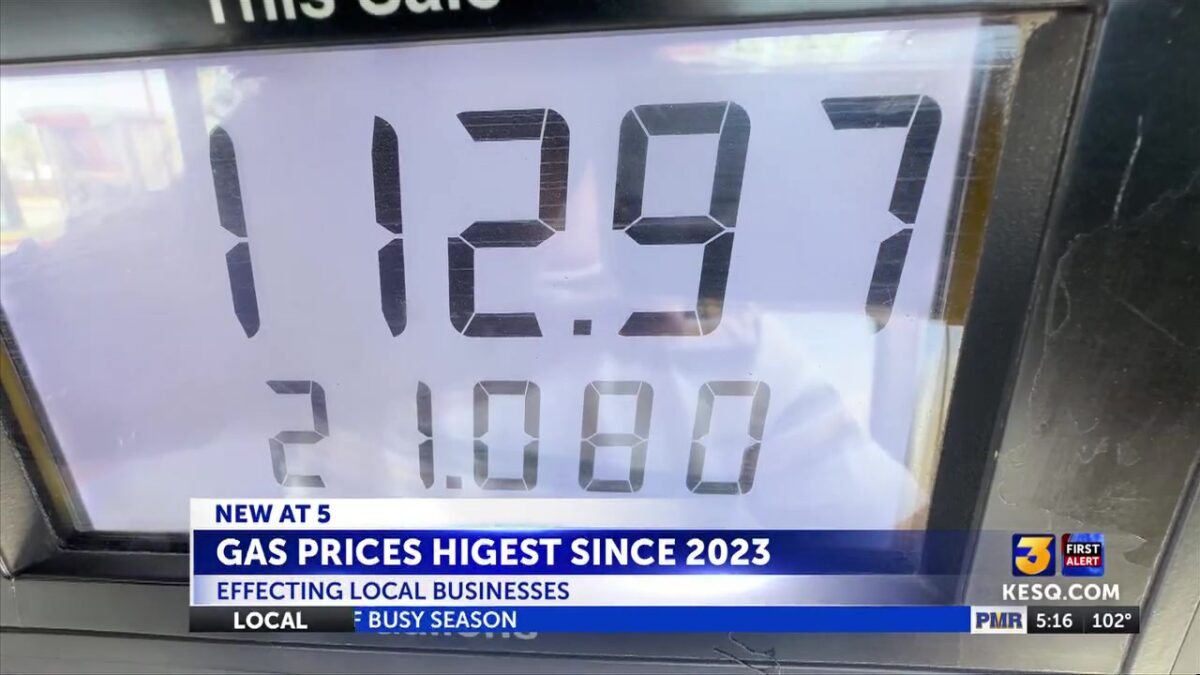
THOUSAND PALMS, Calif. (KESQ)- Fuel prices are climbing across Riverside County, with diesel reaching a new record and regular gas hitting its highest level since 2023.

According to AAA, diesel is now averaging more than $8.32 a gallon in Riverside County. Regular gas is averaging about $6.15 a gallon.

For local businesses that spend much of the workday on the road, those higher prices can add up quickly.

Bill Heitzenrater, owner of Renegade Pest Control, says he drives about 20 to 25 miles and can make 20 to 25 service stops in a normal workday.

“We try and route everything where you’re close together,” Heitzenrater said.

But emergency calls can still send workers across the Coachella Valley. Heitzenrater says his last fill-up cost about $115.

AAA says gas prices would typically be falling this time of year, but prices remain elevated.

According to the California Energy Commission, global crude oil is typically the leading driver of fuel prices. The agency says every $10 increase in crude oil can add about 24 cents per gallon at the pump.

Kandace Redd with the Auto Club of Southern California says higher crude oil prices are continuing to put pressure on drivers.

“Gas tends to follow crude oil prices. And since crude oil is up, then yes, drivers can expect to pay more at the pump,” Redd said.

For businesses like Renegade Pest Control, higher fuel prices can also create a bigger concern: how long companies can absorb the additional costs before customers feel the impact.

Heitzenrater says rising gas, insurance and chemical costs could eventually force the business to pass some of those expenses along to customers.

“We may have to start passing those costs along to our customers, which we don’t want to do,” Heitzenrater said.

AAA says it remains difficult to know when drivers could start seeing relief at the pump.

Click here to follow the original article.

State Sen. Rosilicie Ochoa Bogh speaks with News Channel 3 on school spending, test scores and bringing back the SAT

Garrett Hottle

PALM SPRINGS, Calif. (KESQ) State Sen. Rosilicie Ochoa Bogh spoke with News Channel 3 on Tuesday about where California’s education money is going, why test scores remain low, and her push to bring back the SAT and ACT at the University of California and California State University.

Ochoa Bogh represents the 19th Senate District, which includes parts of the Coachella Valley and the high desert.

She is vice chair of the Senate Education Committee, a member of the Senate Budget Subcommittee on Education and a member of the Senate Rules Committee. She is a former elementary school teacher of English learners and served on the Yucaipa-Calimesa school board.

The interview followed an op-ed she published last week titled “California is spending record billions on education. Where is the money going?”

Where the money is going

News Channel 3 asked the senator what is going wrong in California classrooms.

“The state right now is investing about 48%, when we count all of education, lower and higher ed, 48% of the budget,” she said. “We still have health care, public safety, government functions, infrastructure to fund. So if 48% of the pie is not enough, then what is?”

The state is allocating more than $27,000 per pupil in the 2026-27 budget, Ochoa Bogh said. The state’s enacted budget summary puts total K-12 spending this year at $151.4 billion from state, federal and local sources.

Ochoa Bogh sits on the three-member budget subcommittee that reviews the state’s education spending. Asked for her own answer to where the money is going, she said schools have been asking for more money for low-income students and foster youth even though the state has provided extra funding for those students since 2013.

“We have to evaluate the programs that we currently have in place,” she said, “and if they’re not producing the results, ensure that we’re actually letting go of those programs and bringing in new programs that actually are working as intended.”

She wants parents asking those questions at school site councils and school board meetings.

In 2024, Ochoa Bogh introduced SB 1129, a bill to develop alternative templates for the accountability plans school districts are required to publish. According to the bill’s legislative history, its first hearing was canceled at the request of the author, and the bill did not move forward.

News Channel 3 asked if she plans to reintroduce it.

“It’s the question of accountability doesn’t always equate to legislation,” she said. “It doesn’t have to be legislative necessarily, but it does, I think, benefit us more when we have an informed public where we can then ask the questions.”

She compared school spending to the state’s spending on homelessness, saying an audit she helped request found no accountability measures were required when that money was allocated. The state auditor’s April 2024 report found California allocated about $24 billion to homelessness and housing programs over five years and had not consistently tracked the results.

“We can’t make the same mistake,” Ochoa Bogh said.

Test scores

The state releases new test scores Oct. 15. In the most recent results, from spring 2025, 48.8% of California students met the standard in English and 37.3% met it in math. In Desert Sands Unified, 41% met the standard in English and 27% in math. In Palm Springs Unified, 36% and 22%.

News Channel 3 asked what parents in the valley should be asking their school boards, and what number would tell her the money is working. She did not offer a specific number. Without standardized tests, she said, there is no way to know whether students are getting the services and curriculum they need.

“We need to ask the questions when they’re younger, as they’re growing up, so that we, at the very end, are not graduating students that cannot do basic math or have the ability to read,” Ochoa Bogh said. “If we don’t have those standardized testing, there’s no way to learn. We’re just graduating, navigating students through the process and living in smoke and mirrors.”

The SAT and ACT

In August, Ochoa Bogh and state Sen. Roger Niello sent a letter to UC leaders calling on UC and CSU to reinstate SAT and ACT requirements for all applicants, not only students in science, technology, engineering and math majors. Her office says she plans to introduce legislation on the issue.

News Channel 3 asked whether a test requirement would help a student from Coachella Valley schools get into UC Riverside, or lock them out.

“It allows for that student to be placed in the school that actually they will be successful in,” Ochoa Bogh said. She pointed to California’s 1960 Master Plan for Higher Education, which she said intended for students who were not ready for a university to start at a community college and transfer.

The senator said she has questioned nominees to the UC Board of Regents in the Rules Committee about the SAT, and has pointed them to incoming UC San Diego freshmen testing at a middle school math level. Her office’s August announcement cites a UC San Diego report that found the number of first-year students with math skills below high school level rose nearly thirtyfold over five years.

“These are students who are graduating with a 4.0 average or above, entering the UC system, testing at middle school math,” she said. “How do we explain that? When we don’t have standardized testing, then we have grade inflation that we then have to address.”

“Shame on the system that basically, literally navigates them through a smoke and mirrors system where they graduate thinking they’re at the top of their class, and then realize through these incoming assessments that, wait a minute, we’re not prepared,” she said. “That is unfair.”

Asked how she separates the effect of dropping the tests from the effect of the pandemic, she said the tests are given nationwide.

“We’re comparing ourselves with the rest of the nation, who also went through the pandemic,” Ochoa Bogh said. “So you’re telling me that California is unique in the sense that they are the only ones impacted by the pandemic?”

UC regents voted in 2020 to phase out the tests in admissions. CSU trustees voted in 2022 to permanently drop them. UC’s Academic Senate is now reviewing standardized testing, with a report due Feb. 12, 2027, and a recommendation to the regents by June 2027. Applicants for fall 2027 will not be required to submit scores.

News Channel 3 will report the new test scores for every valley school district when the state releases them Oct. 15.

Click here to follow the original article.

One eastbound lane of I-10 reopens near Desert Center after series of big rig crashes

Julia Castro

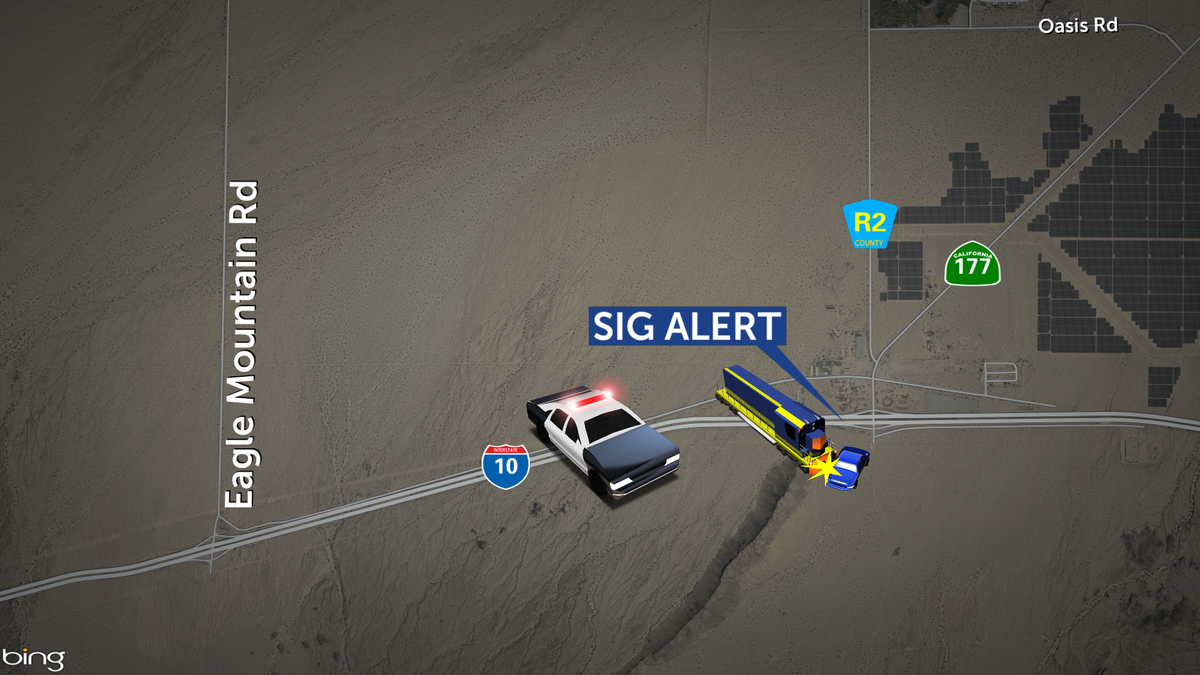
DESERT CENTER, Calif. (KESQ) — One eastbound lane of Interstate 10 reopened Wednesday morning near Desert Center after a series of crashes involving several big rigs.

The collisions prompted a full eastbound closure earlier in the morning, with traffic diverted off the freeway at Highway 177.

Authorities said no major injuries had been reported.

Drivers heading east should still expect delays through the Desert Center area as restrictions remain in place.

Motorists are being advised to avoid the route if possible.

This is a developing story. Stay with KESQ News Channel 3 for updates.

Click here to follow the original article.