Rooted in Philadelphia area, The Berenstain Bears has a “major media project in the works”

By Madeleine Wright

Click here for updates on this story

    Philadelphia (KYW) — Since their debut more than six decades ago, The Berenstain Bears have sold hundreds of millions of copies, been translated into dozens of languages and captivated generations of readers around the world.

The creators of The Berenstain Bears, Stan Berenstain and Jan Berenstain, both grew up in Philadelphia during the Great Depression.

Their upbringing in a city known for its tight-knit neighborhoods and strong sense of community helped shape the wholesome, family-centered stories that define the series.

“They always say Philadelphia is a city of neighborhoods and the neighborhoods are all a bunch of families and people and communities,” Mike Berenstain, their son, said. “I think that influenced how we create the characters in the world, the Bear world, that we created.”

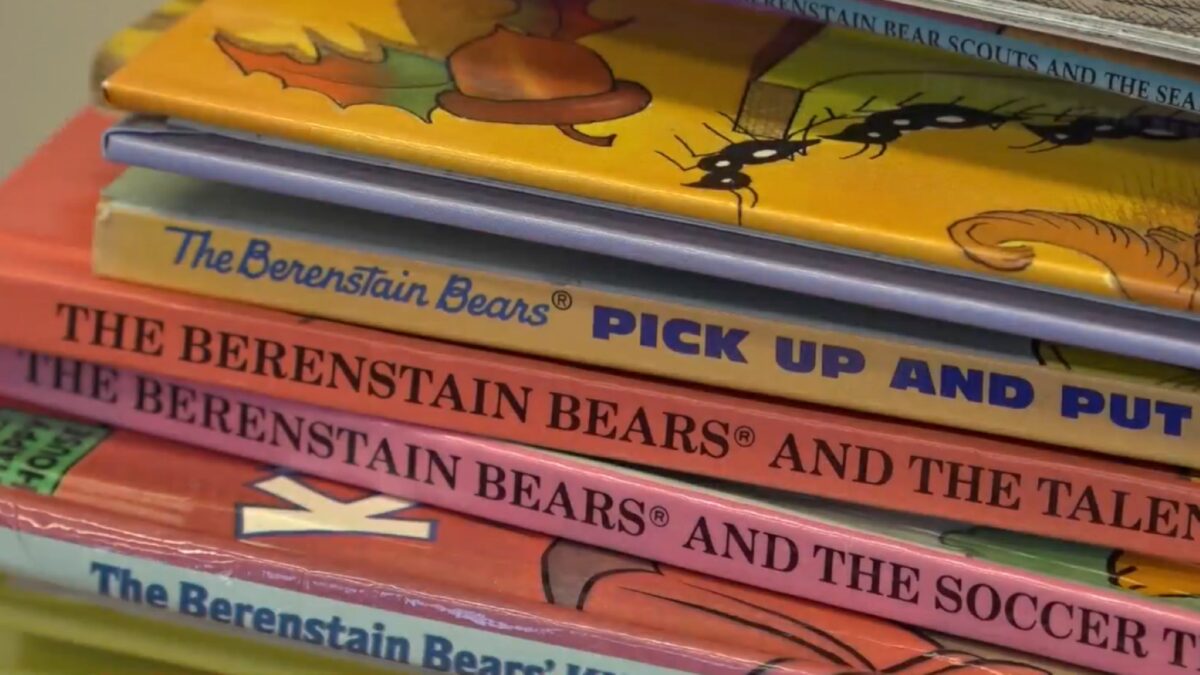
Stan and Jan Berenstain launched the series in 1962 with The Big Honey Hunt. What began as a single title has since grown into more than 400 books and counting, with Mike Berenstain now carrying on the family legacy.

“I’m surprised,” Mike Berenstain said, “that people who know, of course, the Berenstain Bears are totally shocked that their origin is Philadelphia. I’m surprised. Very often people I meet who know, of course, the Berenstain Bears, they’re totally shocked that their origin is Philadelphia.”

Today, Mike Berenstain works from his home studio in Ambler, Montgomery County, where he continues to bring Papa Bear, Mama Bear, Brother Bear, Sister Bear and Honey to life.

That sunny dirt road deep in Bear Country was inspired by the rolling hills and neighborhood life of Solebury Township, Bucks County, where Jan Berenstain had a home studio.

Now a new generation of readers is discovering the Bears.

During a Berenstain Bears story time at Wissahickon Valley Public Library, where more than a dozen children gathered, 2-year-old Gabriel Howell from Ambler already had a favorite.

“The puppy story,” Gabriel said with a smile.

His mother, Victoria Howell, said she and her husband both grew up reading the books and are excited to pass them along.

“The stories of the Berenstain Bears still resonate with children nowadays because they’re lessons that will never go away,” Howell said. “They’re morals that will always stick.”

Mike Berenstain, now 74, said he has no plans to retire. He continues to publish four to six new books each year, keeping the series fresh while staying true to its core values. He believes the series’ success comes from its vivid illustrations, humor and heart.

“It’s the fact that they are very child and family-friendly,” he said. “They’re very helpful both in terms of kids learning to read and also learning values and social life, how to behave.”

He also noted that parents of children with autism often share how the books help their kids better understand social situations and interactions, something he found both surprising and meaningful.

Beyond books, the Berenstain Bears have expanded into television shows, video games and merchandise. Mike Berenstain hinted that something new may soon be on the horizon.

“There is a kind of what you might call a major media project in the works,” he said. “I’m not at liberty to say more about that, but I’m hoping that Bear fans will be pleased with what happens over the next year or so.”

The Bears may live in a treehouse deep in Bear Country, but their roots remain firmly planted in the Philadelphia area.

Please note: This story was provided to CNN Wire by an affiliate and does not contain original CNN reporting. This content carries a strict local market embargo. If you share the same market as the contributor of this article, you may not use it on any platform.

2 LaGuardia air traffic controllers left work early before deadly collision, government source says

By Tim McNicholas, Naveen Dhaliwal, Kris Van Cleave

Click here for updates on this story

    New York (WCBS) — Two air traffic controllers at LaGuardia Airport in New York left work early on the night of a deadly runway collision in March, a government source familiar with the situation told CBS News on Thursday.

The Federal Aviation Administration is in the process of trying to fire those two controllers for leaving their shifts earlier than scheduled because the agency considers it timecard fraud, the source said.

Just before midnight on March 22, an Air Canada Express plane arriving at LaGuardia collided with a fire truck on the runway.

The pilot and copilot of the plane were killed. Two Port Authority Aircraft Rescue and Firefighting officers from the truck, and 39 of the 76 people on board the plane, were taken to local hospitals.

At the time of the crash, two controllers were working in the tower.

The other two who left early would have been additional support staffing, as the National Transportation Safety Board said in March it is common to have just two controllers in the tower.

“It’s also common practice across the national airspace where you would have two controllers in the tower cab during the midnight shift,” NTSB Chair Jennifer Homendy said at the time.

The NTSB said it’s investigating staffing and it has long had concerns about fatigue from controllers working that shift across the country.

“The vast majority of air traffic controllers are great patriots — they show up for work, complete their full shift, and come back and do it all again,” Transportation Secretary Sean Duffy said in a statement Thursday. “But when a small percentage of individuals take advantage of the American taxpayer, unfairly add additional work to their fellow controllers, and impact the airspace — we have no choice but to act. We will not tolerate fraud, and we are taking appropriate action to hold folks accountable and prevent unlawful practices from disrupting the traveling public.”

The air traffic controllers union said it is discussing the situation with FAA leadership.

The FAA would not agree to an interview with CBS News New York, but said it’s committed to holding employees accountable. It also says they’re hiring more controllers to try to fight staffing shortages.

Todd Yeary, a former air traffic controller, told CBS News New York that there are plenty of unanswered questions from the FAA.

“Now, if it is just arbitrary leaving for the sake of leaving because it’s an endorsed practice, we know that’s a whole problem,” he said. “But there are some other factors there. Was the traffic low? Were they on leave? Was that comp time?”

Yeary says there should have been more oversight that night.

“Part of the question is not just for the controllers that they say left early, but also for the supervisors and the managers who were on duty at the time who should have been ultimately covering what was going on with the traffic at that time,” he said.

Please note: This story was provided to CNN Wire by an affiliate and does not contain original CNN reporting. This content carries a strict local market embargo. If you share the same market as the contributor of this article, you may not use it on any platform.

Car registered to former Westchester County police chief involved in multiple reported hit-and-runs

By Tim McNicholas, Walter Smith Randolph

Click here for updates on this story

    New York (WCBS) — A CBS News New York investigation has found that a car registered to the former police chief of Tuckahoe in Westchester County was involved in multiple reported hit-and-runs within minutes.

Now, the Westchester district attorney is investigating how police handled the case.

Yonkers Police say they took a report on Aug. 14 that someone driving an Infiniti sedan struck a car near a CVS on Central Park Avenue then drove off.

Officers say someone else then reported the same Infiniti struck and damaged a parked car half a mile away on Falmouth Road.

Yonkers Police say the Infiniti is registered to former Tuckahoe Police Chief John Costanzo, but a witness said a woman was behind the wheel during the incident on Falmouth. That witness said someone tried to stop her, but she drove off before police arrived, so police took a hit-and-run report.

Minutes after the incident on Falmouth, an Infiniti crashed into a parked Amazon truck in Tuckahoe near Main Street and Columbus Avenue, half a mile from Costanzo’s home, CBS News New York learned. Witnesses say police responded, but the Village of Tuckahoe says no one was arrested.

In a statement, Tuckahoe Mayor Cara Kronen said a vehicle involved in the incident “entered the Village following an earlier incident in Yonkers.”

No injuries have been reported in those crashes, but Amazon did say their truck was scratched and dented.

The village says it referred the case to the Westchester district attorney, and it can’t provide any more details because the DA is now investigating.

The DA’s office will only say their Public Integrity and Law Enforcement Bureau is investigating. That unit typically investigates police misconduct.

No one answered the door when CBS News New York went to Costanzo’s home, and Tuckahoe’s current police chief and mayor would not agree to interviews with CBS News New York.

Costanzo retired from the force in 2023.

Please note: This story was provided to CNN Wire by an affiliate and does not contain original CNN reporting. This content carries a strict local market embargo. If you share the same market as the contributor of this article, you may not use it on any platform.

Grand jury finds DeSantis administration “misappropriated” $10 million in taxpayer money to Hope Florida

By Jim DeFede

Click here for updates on this story

    MIAMI (WFOR) — A state grand jury found the DeSantis administration “misappropriated” taxpayer money when it diverted $10 million from a Medicaid settlement into the Hope Florida Foundation, arguing the transfer was “part of a sophisticated scheme to fund political activities,” according to a copy of the sealed grand jury report obtained by CBS News Miami.

The grand jury report said the money, which was supposed to be used to provide health insurance for poor children, was instead hastily passed through multiple organizations before eventually landing in the bank accounts of two political action committees and the Republican Party of Florida. Those funds were then used in 2024 to defeat Amendment 3, the citizen initiative to legalize marijuana in Florida.

“Despite our finding that the money was misappropriated, we find insufficient evidence to charge anyone criminally,” the report concluded. “Nobody will take responsibility for deciding the $10 million of taxpayer money would go to Hope Florida… or had any memory of who made it.”

“We recognize that this would be an impediment to criminal prosecution,” the report noted. “While we can’t prove who is responsible, we can plainly see that taxpayer money was misused for political purposes and we would like to see changes made to prevent this from happening again.”

The grand jury identified the nexus for much of the activity surrounding the transfer as the state’s current attorney general, James Uthmeier.

“We find that James Uthmeier, as the Governor’s Chief of Staff at the time of settlement, was in a position of authority over those involved in settling …,” the grand jury wrote. “Testimony identified him as having involvement in directing the money after it went to Hope Florida. Testimony also revealed that Mr. Uthmeier’s Keep Florida Clean, a political action committee, was the prime recipient of the majority of the $10 million taxpayer funds.”

The grand jury also concluded that Ashley Moody, who was the attorney general at the time, was aware of the plans to divert the $10 million to Hope Florida and “authorized” her former chief deputy, John Guard, to sign the settlement agreement. The grand jury noted that Guard signed the settlement “without conducting his due diligence to ensure the proper appropriation of taxpayer funds.”

In response to questions from CBS News Miami about his role in the settlement, Guard wrote that “requests for the Department of Legal Affairs to join settlements weren’t uncommon and this settlement was handled in the ordinary course by the Department.”

Guard, whom Gov. Ron DeSantis appointed to the state appeals court in January, said he could not comment further on grand jury proceedings.

“As a sitting judge, it would be inappropriate for me to comment on past or ongoing court proceedings,” he wrote to CBS News Miami. “Even if I weren’t a sitting judge, to the extent that there was a grand jury, Florida law also makes it unlawful to disclose such proceedings.”

Moody, who was appointed to the U.S. Senate in 2025 by DeSantis, has refused repeated requests for comment about Hope Florida. She is up for election in November.

DeSantis has also avoided publicly answering questions about what he knew of the diversion and who in his administration made the decision to send the $10 million to Hope Florida.

On Wednesday, DeSantis was asked about Hope Florida during a news conference and he said, “I wasn’t involved in the settlement agreement, but I’m very happy with how everything was done.”

He continued to call it a “hoax.”

Neither Moody nor DeSantis nor Uthmeier was called before the Tallahassee grand jury to testify.

The grand jury report was filed under seal with the Leon County Clerk’s Office on Jan. 28. The report’s existence has been the subject of intense interest in recent months, with Democratic officials calling for its release and Republican leaders refusing to acknowledge there even was a report.

One source familiar with the investigation said that multiple individuals named in the report, including Uthmeier, have been blocking its release for the last seven months through closed court proceedings. It is not clear where those court proceedings currently stand. Earlier this year, the Florida Center for Government Accountability filed a brief with the circuit court in Tallahassee asking to intervene in the case so it could argue for the report’s release. Its request is still pending.

Uthmeier, who is up for election in November, has refused to directly address the question of whether he was blocking the release of the report. Uthmeier’s deputy chief of staff wrote to CBS News Miami: “Grand jury proceedings are confidential. Unauthorized disclosure of those proceedings is a crime.”

Earlier this year, Uthmeier dismissed the entire affair surrounding Hope Florida as a “big nothingburger.”

“I don’t think anybody cares about this topic any more than the liberal media,” he said in April. “Again, there was a grand jury proceeding. Under Florida law the contents thereof are confidential. That’s not my choice. That is Florida law. What I can tell you is I have not been indicted. I’ve not been a suspect or a target. I have not been involved in any criminal activity. Nobody did anything wrong here.”

Yet while DeSantis and Uthmeier maintain everything with the diversion of $10 million of taxpayer money was perfectly fine, a state grand jury argues it found significant wrongdoing.

The grand jury report describes a coordinated effort involving government officials across multiple state agencies and outside interest groups aligned with the governor. And the report suggests that administration officials took advantage of the chaos surrounding two deadly hurricanes — Hurricanes Helene and Milton — to help obscure their plans to siphon taxpayer money into the political campaign against the marijuana initiative.

In fact, the former chair of the Hope Florida Foundation, Joshua Hay, testified to the grand jury that he agreed to send the $10 million to a pair of political committees without asking many questions because “he assumed the money was needed to assist hurricane victims.”

Hay then told the grand jury: “The road to hell is paved with good intentions.”

History of the settlement In 2021, Florida officials learned the health care giant Centene had been overbilling the state for prescription drugs under the Florida Healthy Kids program. Florida wasn’t the only state affected. At least 20 other states were overbilled nearly a billion dollars.

Florida’s share was calculated to be $67,048,611.

In 2021, Ohio and Mississippi both announced settlements of $88 million and $55 million, respectively. In 2023, Indiana was reimbursed $66.5 million, Massachusetts $14 million, and California received $215 million.

Yet, while other states settled their cases, Florida did nothing, even ignoring Centene’s request to get the case resolved so it could put the overbilling affair behind it.

A draft of the settlement agreement was first sent to Florida officials on July 14, 2021, offering to fully repay the $67 million the state was owed.

It is not known why DeSantis allowed the settlement to languish for three years, but in early September 2024, state officials contacted Centene and said they wanted to immediately resolve the dispute.

Only this time, the state had a new condition.

On Sept. 12, 2024, the state altered the agreement and instead of returning the entire $67 million to state coffers, the DeSantis administration decided only $62 million should be returned to the state and $5 million to the Hope Florida Foundation, a nonprofit set up to help fund first lady Casey DeSantis’ Hope Florida initiative. The idea behind Hope Florida was to move individuals away from government assistance and instead encourage them to receive help from religious-based organizations.

The next day, on Sept. 13, 2024, the state changed the settlement agreement again, this time lowering the amount returned to Florida taxpayers to $57 million and increasing the amount going to Hope Florida to $10 million. No reason was given as to why the amount doubled.

Centene’s lawyers, however, were concerned about any diversion of money, especially since it was going to a charity aligned with the governor’s wife.

Centene demanded the settlement include wording making it clear Centene was being directed by the Florida attorney general to send the $10 million to the Hope Florida Foundation.

Moody, however, did not want to be responsible.

According to the grand jury report, Moody’s chief deputy, John Guard, said he had “reservations” about the deal and that “esoterically” he agreed the $10 million was taxpayer money and “belonged to the state of Florida.”

During his testimony in front of the grand jury, Guard also explained that “Florida Statutes require the legislature to decide how money is spent,” according to the grand jury report.

Guard, according to the report, was also concerned about the political consequences if the Legislature ever found out about the diversion.

“[Guard] did have political concerns about the dedication of $10,000,000 to Hope Florida, which he raised with AG Moody, because he knew the deal would be viewed by the legislature as a constraint on their spending authority,” the grand jury noted.

As a result of Guard’s objections, the settlement was rewritten so that instead of the attorney general directing Centene to send $10 million to the Hope Florida Foundation, it would now state that DeSantis’ Agency for Health Care Administration (AHCA) was directing Centene to send $10 million to Hope Florida.

“His political concerns were resolved by the change to the agreement making the settlement AHCA’s agreement rather than the AG’s settlement agreement,” the grand jury report states, “as the problem would now be AHCA’s problem rather than the AG’s problem.”

In its review of Guard’s testimony, the grand jury noted that “after consulting AG Moody, she authorized Mr. Guard to sign the settlement agreement in its final form.”

Asked by CBS News Miami when he became aware that the $10 million sent to Hope Florida was moved into the political action committees campaigning against the marijuana amendment, Guard wrote: “I first learned that money had been transferred from Hope Florida months after the settlement either from watching a House Healthcare Appropriations committee hearing on the Florida Channel or from a phone call placed by [State] Representative [Alex] Andrade to me well after the election.”

Andrade was the state representative who exposed the diversion of $10 million from the Centene settlement into the Hope Florida Foundation.

In 2025, President Donald Trump nominated Guard to the federal bench, but his appointment was held up by Florida Sen. Rick Scott, who had emerged as a vocal critic of the transfer of $10 million to the Hope Florida Foundation. In December, Scott posted on social media: “Millions in tax dollars for poor kids have no business funding political ads.”

In January 2026, Guard withdrew his appointment to the federal judiciary and DeSantis appointed Guard to be a judge on the state’s Second District Court of Appeal. Guard did not comment for this story.

Conflicting memories The secretary of AHCA at the time of the settlement was Jason Weida. Not only did Weida ultimately sign the agreement, but emails reveal he was one of the key negotiators with Centene over the settlement in September 2024.

“Mr. Weida testified that he does not recall who suggested that Hope Florida should be the recipient of the” $10 million from the settlement. Weida testified that he thought it was OK for Centene to “donate” $10 million to Hope Florida, calling it a bonus, over and above what was owed to taxpayers, a view he said was affirmed when he consulted with the general counsel for AHCA. The general counsel also testified before the grand jury that he thought the diversion was permissible.

The grand jury, however, found otherwise.

“We find that the full Centene settlement was taxpayer reimbursement,” the grand jury wrote. “We reject Agency for Healthcare Administration Secretary Jason Weida’s explanation that $10 million was a `bonus.'”

The grand jury added: “This money was part of the damages Centene owed to Florida taxpayers.”

Weida is currently serving as the governor’s chief of staff. He did not respond to an email seeking his comment about Hope Florida.

Confusion amid the storms On Sept. 26, 2024, Hurricane Helene struck the Florida Panhandle, killing at least 18 people and causing nearly $14 billion in damage. Cassandra Pasley, the chief of staff for the Florida Department of Health, told the grand jury that the next day, on Sept. 27, she was working in the state’s Emergency Operations Center when she “was pulled aside by Katie Strickland, the Governor’s Chief of Staff in charge of Health Agencies” and was asked to sign the settlement agreement.

She said she had never seen the agreement before and wasn’t even aware a settlement was in the works. Nevertheless, she signed it that evening.

“At the time she signed the settlement agreement,” according to the grand jury report, “Ms. Pasley testified that she was not aware that any of the settlement money would end up in a political action committee, nor would she have signed the settlement agreement had she known that fact.”

Also signing the agreement the day after Hurricane Helene made landfall was Florida Insurance Commissioner Michael Yaworsky. He testified he found the provision to send $10 million to the Hope Florida Foundation “atypical,” but was satisfied when he learned the attorney general’s office had signed off on it.

The grand jury also found the repayment schedule outlined in the agreement suspicious, noting the state required Centene to wire transfer the $10 million to the Hope Florida Foundation within seven days, while it also allowed Centene to take more than a year to repay the remaining $57 million to Florida taxpayers.

“The Centene settlement itself seems rushed as it materialized rapidly after years of inactivity,” the grand jury noted. “Then, once reached, it took a mere 7 days to fund. We believe the rush was due to the impending election which was just 45 days away.”

The grand jury also found it questionable that unlike other states that issued press releases about their settlements, “there was no press release by AHCA or the Governor’s Office to boast the recovery of millions in taxpayer funds.”

The grand jury also found “there was no notification to the Legislature of the Centene settlement.”

On Oct. 4, 2024, Centene transferred the $10 million into the Hope Florida Foundation bank account — and no one was more surprised than the chairman of the foundation at the time, Joshua Hay.

He testified before the grand jury that prior to the Centene wire transfer, the largest donation ever made to the foundation was $100,000.

He said he learned about the $10 million when the foundation’s attorney, Jeff Aaron, a close confidant of DeSantis and Uthmeier, let him know the money was coming. Hay, however, testified he soon learned he wouldn’t have the money for very long because he was about to receive two $5 million grant proposals.

The foundation’s board approved the first grant unanimously, and Hay testified he approved the second $5 million grant on his own.

Within 25 days of Hope Florida receiving the $10 million in taxpayer money, it was gone.

Hay told the grand jury it was probably for the best that they didn’t hold on to the $10 million because the Hope Florida Foundation “lacked the infrastructure to effectively and efficiently get the money to those in need.”

The grand jury concluded that it never made sense for the Hope Florida Foundation to receive the money.

“We were told Hope Florida was chosen as the beneficiary of the initial donation because the Centene settlement was compensation for ripping off sick poor children and Hope Florida’s mission and work was aligned with the purpose of serving needy children with health issues,” the grand jury report notes.

“Hope Florida was touted by some witnesses as a high-profile project with a high success rate, but we were unable to get any evidence to substantiate these representations,” the report continues. “On the contrary, other witnesses referred to Hope Florida as just a concept and did not have a clear understanding of what it did, where it existed, or how it operated. So, we fail to see the nexus between Hope Florida and the Centene settlement, and even if there was a nexus, it was rendered moot by the fact that the money only stayed in Hope Florida’s account for a couple of days.”

Following the money On Oct. 9, 2024, Florida was hit with its second major hurricane in less than three weeks. Hurricane Milton killed 12 people after it made landfall near Siesta Key. It left 3 million Floridians without power and caused tens of billions of dollars in damage to the state.

Two days later, on Oct. 11, in the midst of this crisis, Uthmeier, the governor’s chief of staff, was on the phone and texting Amy Ronshausen, executive director of Save Our Society from Drugs, telling her she should apply for a grant from the Hope Florida Foundation, according to the grand jury report.

He told her to contact the attorney for the foundation, Jeff Aaron.

“She does not recall if Mr. Uthmeier suggested an amount but does know that Mr. Aaron advised her to apply for $5 million,” the grand jury report notes.

At approximately the same time, Mark Wilson, executive director of Secure Florida’s Future and the president of Florida’s Chamber of Commerce, testified he was told by the Chamber’s lobbyist that Secure Florida’s Future should apply for a $5 million grant from Hope Florida.

Wilson submitted the proposal on Oct. 13, 2024, outlining how Secure Florida’s Future would use the $5 million to raise awareness about Hope Florida “through webinars, podcasts, in-person statewide summits and meetings, newsletters, surveys” that would help “accelerate the momentum Hope Florida has already created in Florida.”

Less than a week later, Hope Florida approved the grant and sent Secure Florida’s Future $5 million. Within days, nearly all the money — $3.75 million — was then transferred to Uthmeier’s political action committee, Keep Florida Clean.

Ronshausen, from Save Our Society from Drugs, filed her grant application to the Hope Florida Foundation on Oct. 18, 2024, and within hours was informed she was approved. The $5 million was transferred to her account on Oct. 22, according to the grand jury report.

“Within a week, she distributed $4.75 million to Uthmeier’s political committee, Keep Florida Clean,” the grand jury found. “She stated she was not directed by anyone as to how to spend the money.”

The grand jury said that both Mark Wilson and Amy Ronshausen “mischaracterized” the purpose of the funds in their grant applications to the Hope Florida Foundation. The grand jury noted that in both grant applications they stated the money would not be used for political purposes, and yet the money was almost immediately transferred into Uthmeier’s political action committee.

According to a forensic accountant who analyzed bank records for the grand jury, Uthmeier’s PAC received a total of $8.5 million from Secure Florida’s Future and Save Our Society from Drugs. Uthmeier’s PAC then sent $7 million to the Republican Party of Florida and an additional $1.23 million to another PAC he chaired, the Florida Freedom Fund.

Recommendations for change The grand jury argued the public was ill-served throughout this process.

“Those negotiating the Centene settlement on behalf of the State of Florida failed to place any restrictions on the money’s use,” the grand jury states. “Therefore, there was no oversight to ensure proper usage of the taxpayer money.”

The grand jury identified two recommendations that it believes the Florida Legislature should enact immediately.

“The Florida Legislature should enact a law to prevent this situation from occurring,” the report noted. “For example, a law that says any monies received by the state from any source must be deposited into the General Fund, and there should be real consequences for anyone violating this law.”

The grand jury also said the Legislature “should enact clear laws setting requirements how [groups like Hope Florida] can use taxpayer funds, ensuring usage of said funds are tracked and monitored, and providing consequences for violation of these mandates.”

The grand jury ended its report reaffirming its belief the $10 million was taxpayer money that was misappropriated.

“As taxpayer money,” the grand jury found, “it should have been treated as such instead of being allocated for partisan political purposes and without transparency.”

Please note: This story was provided to CNN Wire by an affiliate and does not contain original CNN reporting. This content carries a strict local market embargo. If you share the same market as the contributor of this article, you may not use it on any platform.

Hungry goats help reveal past at historic African American cemetery in College Park

By Nakell Williams

Click here for updates on this story

    ATLANTA (WUPA) — Volunteers with the One Square Mile Project, Inc are making progress with their effort to uncover a hidden historic African American cemetery in College Park.

The cemetery is located behind Mount Calvary Baptist Church on JT Alexander Avenue. Monetary donations from the community enabled the group to have the Red Wagon Goats bring in more than a dozen animals to eat the kudzu that’s covering grave sites there.

“They are going to clear this whole kudzu area and hopefully get these folks out,” said Bre Johnson with Red Wagon Goats.

Workers set up a long fence to cover about an acre and a half where the goats will eat for two weeks. They’ll come back often to check on them.

“When we get down to about 10 to 20% greenery left, we start supplementing with hay so the goats don’t start feeling like they are in a state of scarcity and start thinking that the grass is greener on the other side,” Red Wagon Goats owner Megan Kibby said. “Goats’ mischief can be anything from staging escapes. I think we had one customer who left her basement door ajar, and she woke up and found goats in her basement.”

Craig Eberhart of the One Square Mile Project and other volunteers are urging the community to continue helping in any way that’s possible. Since the organization began uncovering graves by hand several months ago, he said they have discovered headstones dating back to 1925. They include African-American history makers, including the city’s first educators, veterans, morticians, and community leaders.

“There has been immense interest in the community about it. People are coming out, helping us maintain what we are doing. This is probably going to be a million-dollar-plus project, and we are going to need help from every aspect, not only from the community but from the local city government and from the state. We are asking that the airport be involved with it as well.” Eberhart said.

Kibby said the goats helped to restore several historic cemeteries across metro Atlanta.

“We are just really proud to be able to be a part of these efforts of getting these often neglected bodies of land and take care of the people who are here or people whose ancestors are here,” Kibby said.

Volunteers meet at the cemetery on Saturdays to take part in the clean-up. You can contact the One Square Mile Project for information about donations and volunteerism.

Please note: This story was provided to CNN Wire by an affiliate and does not contain original CNN reporting. This content carries a strict local market embargo. If you share the same market as the contributor of this article, you may not use it on any platform.

Bicycle shop in Marblehead, Massachusetts won’t sell e-bikes to kids: “They’re too fast”

By Mike Sullivan

Click here for updates on this story

    BOSTON (WBZ) — A bicycle shop in Marblehead, Massachusetts is refusing to sell e-bikes to anyone under the age of 18, saying they’re just not safe.

Dan Schuman, the president of Marblehead Cycle, is even willing to lose some money to make his point.

“I don’t sell them to kids. I have people all of the time asking me if I’ll sell them a bike for their 14-year-old or 15-year-old that’s motorized, and I won’t,” Schuman said. “The bikes are too heavy, they’re too fast.”

Schuman said some entry level e-bikes can go up to 28 miles an hour.

“The kids don’t know the rules of the road. They don’t know how to handle traffic,” Schuman told CBS News Boston.

According to AAA, e-bikes and scooter crashes rose 33% from 2024 to 2025.

“There’s been deaths and there’s been severe injuries,” Schuman said. “The bikes weigh 70, 80 pounds or more. So to lift that bike back up, being that age and that size, after an injury, is not good.”

Adding to the concerns, Schuman said many kids ride while on their phones and without helmets.

The store’s policy raises the question – when should a child ride an e-bike?

“I’d probably say 12. Get them exercising, ride the bikes, understand the roads,” said Patrick Smith, who just rode one on a distance trip, but added that it only assisted his pedaling. “There are e-bikes that once you stop pedaling it doesn’t do anything, those I would prefer.”

Schuman said some kids are even making their e-bikes go faster, without telling their parents.

“They go into the computer on it and they change the codes and they can go 35 or 45 miles an hour,” he said.

In a statement to his customers on social media, Schuman wrote,” I’m hoping for the day when a company develops an e-bike that can only travel at the speed that a kid would typically ride a regular bicycle (about 5-7 miles per hour). Even then I’d still preach that kids need to be experiencing the joy and satisfaction of moving around under their own power.”

Please note: This story was provided to CNN Wire by an affiliate and does not contain original CNN reporting. This content carries a strict local market embargo. If you share the same market as the contributor of this article, you may not use it on any platform.

Baltimore police officer accused of raping woman after driving her to Harford County

By Adam Thompson

Click here for updates on this story

    Baltimore (WJZ) — A Baltimore City police officer was arrested for allegedly raping a woman he encountered while responding to an unrelated domestic incident in Baltimore before driving her to her home in Harford County.

Daniel Oxendine faces two counts each of first-degree rape, second-degree rape and engaging in a sexual act with a victim or witness of an investigation by a law enforcement officer. He is also charged with burglary with intent to commit rape and misconduct in office.

Harford County deputies said Oxendine was taken into custody Thursday with assistance from the Baltimore Police Department following a nearly three-month investigation. He was transported to the Harford County Detention Center.

The investigation began June 3, when deputies responded to a hospital after a woman reported that she had been sexually assaulted. Investigators later identified Oxendine as a suspect through DNA evidence.

Harford County Sheriff Jeffrey Gahler said the woman needed a ride home after an unrelated domestic incident in Baltimore, and Oxendine’s supervisor authorized him to provide transportation in a patrol car to Edgewood.

Deputies allege that Oxendine entered the woman’s apartment and sexually assaulted her.

“He violated the public trust, in this manner, with someone who already went through a traumatic incident,” Gahler said.

The woman was taken to the hospital for a sexual assault forensic exam, during which investigators collected evidence, including DNA.

Deputies said forensic testing conclusively identified Oxendine as the suspect. Investigators subsequently obtained an arrest warrant.

“This is certainly an example of someone who has violated that public trust,” Gahler said. “It stains the police officers who are out there serving the community across this country every single day.”

The Baltimore Police Department said it is aware of Oxendine’s arrest and that he has been suspended without pay during the investigation.

“His police powers were previously suspended, and he is now suspended without pay,” a Baltimore Police spokesperson said. “While the Harford County Sheriff’s Office conducts its investigation, BPD is fully cooperating with the investigation.”

Please note: This story was provided to CNN Wire by an affiliate and does not contain original CNN reporting. This content carries a strict local market embargo. If you share the same market as the contributor of this article, you may not use it on any platform.

Man with degenerative disease hasn’t left condo since April because of broken elevator

By Suzanne Le Mignot

Click here for updates on this story

    BUFFALO GROVE, Illinois (WBBM) — A Buffalo Grove man with a medical condition that impairs his mobility says he hasn’t left his condo in more than four months because his building’s elevator is broken and hasn’t been fixed.

Hank, who asked CBS News Chicago to only use his first name, said he’s a prisoner in his home and hasn’t been able to leave since April 20. The 80-year-old has primary lateral sclerosis, a progressive neurodegenerative disease similar to ALS, and relies on a walker. The disease also impairs his ability to speak.

“It’s been very depressing,” he said of his predicament.

The condo in Buffalo Grove where Hank lives has only one elevator, and parts of it needed to be replaced. It was supposed to take six to eight weeks for the “modernization” project, but 18 weeks later, Hank has missed two doctor’s appointments. The only way he can leave his third-floor apartment is through a mobility company that costs $300 per visit.

He received a letter from the attorney for his condo’s homeowners association saying his request to be reimbursed for each mobility company visit would be denied.

“I lost all my spring and summer,” he said.

Hank’s wife, Paulette, said the situation has taken a harsh toll on him.

“Just watching him, he’s like a little puppy dog, you know, wanting to go outside,” she said. “So it’s very hard on him.”

It’s been hard on Paulette, too.

“It’s been very challenging. I’ve been dealing with ovarian cancer this past year, actually; surgeries and things. So, getting down the stairs, I take it very slowly, and I need to have a person with me, and we have another walker at the base once I get down there,” she said.

Late Thursday afternoon, one of the companies involved in the condo elevator project told CBS News Chicago the bulk of the work is complete, but the elevator cannot be put into service until the state inspects it.

Hank also filed a complaint with the Illinois Department of Human Rights, which said an ongoing refusal to repair an elevator or provide reasonable accommodations can be considered housing discrimination.

Please note: This story was provided to CNN Wire by an affiliate and does not contain original CNN reporting. This content carries a strict local market embargo. If you share the same market as the contributor of this article, you may not use it on any platform.

100,000 mail-in ballots for Massachusetts primary still not returned. “Do not mail,” Galvin says.

By Mike Toole

Click here for updates on this story

    BOSTON (WBZ) — There’s a primary election in Massachusetts next Tuesday, September 1. If you still have a mail-in ballot, don’t put it in the mail. That’s the advice from the man who’s in charge of the state’s elections.

Secretary of State Bill Galvin said as of Thursday, there are “well over 100,000 ballots out there” that haven’t been sent back yet.

“We strongly recommend, if they are going to vote by mail, do not mail the ballot. It’s too late. We can’t be sure we’re going to receive it. Because this is a primary, all the ballots have to be in the possession of local election officials by 8 o’clock on Tuesday night,” Galvin told reporters at a news conference.

If you still have a ballot to send in for the Massachusetts Primary, Galvin said take it to a drop box.

“All communities have drop boxes. Our official website provides you with the information for that. They can take them to an early voting site, at least through tomorrow. Or, they can get them back to city and town halls,” he said.

“The point is this. Do not mail, because the possibility of them being not received in time exceeds the likelihood that they will be.”

If you prefer to vote in person on Tuesday, the polls open at 7 a.m. in Massachusetts. They will close at 8 p.m.

Voters in both Democratic and Republican primaries will be selecting candidates for the statewide general election on November 3.

Please note: This story was provided to CNN Wire by an affiliate and does not contain original CNN reporting. This content carries a strict local market embargo. If you share the same market as the contributor of this article, you may not use it on any platform.

Gann Fire survivor creates website to aid community in recovery

By Esteban Reynoso

Click here for updates on this story

    CALAVERAS COUNTY, Calif. (KCRA) — The Gann Fire destroyed multiple homes in Angels Camp three weeks ago, leaving residents, including CJ and Julia Poloka, working to recover and rebuild.

“That’s metal roofing, that was the garage underneath,” CJ said, pointing to the remains of their property.

The fire spread rapidly in early August, crossing the ridge and engulfing their home. “The fire in the morning crossed the ridge. It was crazy because the fire spread so fast that Tuesday morning, it looked like a waterfall, and then it’s at our property,” CJ and Julia said.

While they managed to rescue most of their animals, they are still hoping the rest will return.

“We rescued seven out of our eight goats. Her name is Sky. Our Great Pyrenees, he ran off, and our barn cat, Luna,” they said.

The couple, like many of their neighbors, did not have fire insurance, making the road to recovery even more challenging. Despite this, they are leaning on their community for support.

“The question we keep getting is, how can I help or what can I do to help?” CJ said.

To address this, CJ created a website, GannFireRecovery.org, to connect survivors with those who want to lend a hand.

“What better way to try to connect what somebody might need, with the people who might have it and able to give it. With a tight-knit community like this, people are willing to help out,” CJ said.

The website offers resources for survivors to get help, updates on damage assessments and recovery efforts, and opportunities for volunteers to sign up to assist.

“It’s going to be hard to break us now,” CJ said. “We’re a very tight-knit group now. I love my neighbors, I love living in Angels Camp. The support has been great, from people we don’t even know.”

The Polokas have also received help from a neighbor in Valley Springs, who donated a trailer to them.

“He’s actually giving us a trailer. Doesn’t even want us to give it back,” CJ said. “That’s what I mean about the community and helping out. To them it’s like, I don’t even need this, but to somebody else, we can sleep there, and have somewhere to wash our hands.”

The couple’s resilience and community spirit are helping them and others navigate the long road to recovery.

Please note: This story was provided to CNN Wire by an affiliate and does not contain original CNN reporting. This content carries a strict local market embargo. If you share the same market as the contributor of this article, you may not use it on any platform.