Former Detroit assistant principal pleads no contest to sexually assaulting child

By Joseph Buczek

Click here for updates on this story

    DETROIT, Michigan (WWJ) — A Roseville, Michigan, man has pleaded no contest to first-degree criminal sexual conduct in the alleged assault of a minor, prosecutors said.

Jerome Younger, 55, entered the plea during a pretrial conference in the Macomb County Circuit Court on Monday and was taken into custody.

The alleged assault occurred on Oct. 8, 2025. Prosecutors say Younger served as the assistant principal at the Edward “Duke” Ellington Conservatory of Music and Art in Detroit at the time.

As part of his plea, Younger must register as a Tier III sex offender, as well as undergo a lifetime of electronic monitoring. He is also subject to Wyatt’s law registration and HIV testing and cannot have contact with the victim, prosecutors said.

“It takes tremendous courage for a young victim to come forward and speak about what they experienced. This victim deserves our gratitude and support for having the strength to tell their story. My office will continue to stand up for victims and ensure their voices are heard,” Macomb County Prosecutor Peter Lucido said in a statement.

Younger is scheduled to be sentenced on Sept. 24.

Please note: This story was provided to CNN Wire by an affiliate and does not contain original CNN reporting. This content carries a strict local market embargo. If you share the same market as the contributor of this article, you may not use it on any platform.

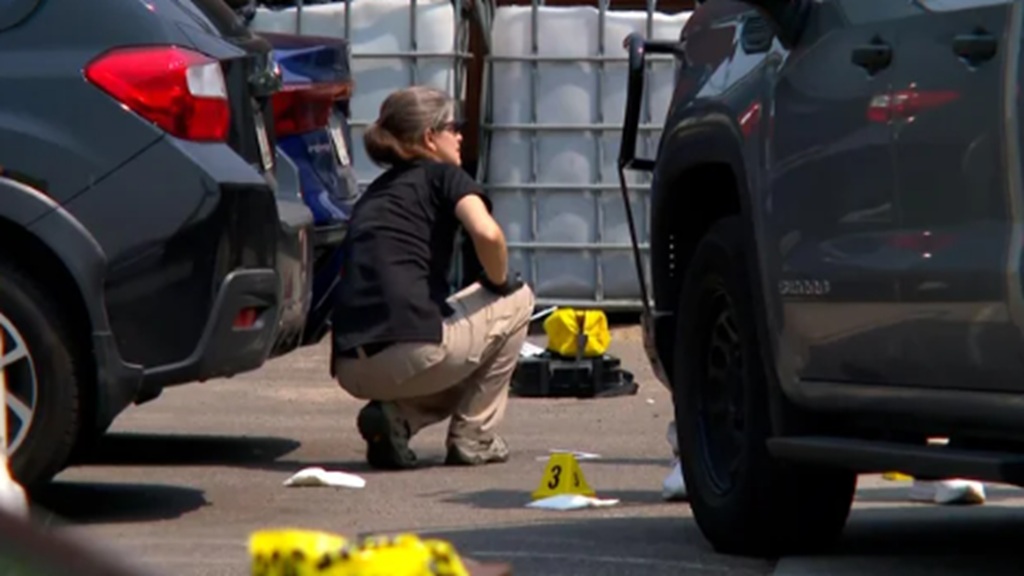
Minnetonka officer’s unoccupied squad hits, injures burglary suspect near George Floyd Square in Minneapolis, police say

By Stephen Swanson, Tony Peterson

Click here for updates on this story

    MINNEAPOLIS, Minnesota (WCCO) — The Minnetonka Police Department says an officer’s unoccupied vehicle hit and injured a burglary suspect Monday morning near George Floyd Square in south Minneapolis.

Police say it happened around 9:20 a.m. when the officer, a member of the Hennepin County Auto Theft Task Force, “engaged in a foot pursuit of a burglary suspect.”

After making the arrest, the “officer’s vehicle struck the suspect, and he sustained non-life-threatening injuries,” according to police.

The suspect was taken to Regions Hospital in St. Paul, and police say the Minnesota Bureau of Criminal Apprehension is now leading the investigation.

WCCO spoke at the scene with neighbor Jonathan Williamson, who says his friends witnessed an unmarked police vehicle drive over the suspect in the parking lot of the Chicago Avenue Fire Arts Center.

He says a similar crash involving law enforcement and pedestrians occurred on the block earlier this summer.

Please note: This story was provided to CNN Wire by an affiliate and does not contain original CNN reporting. This content carries a strict local market embargo. If you share the same market as the contributor of this article, you may not use it on any platform.
Baltimore officer says “no repercussions” for ICE after parents’ arrests at school: “They do what they want”

By Mike Hellgren

Click here for updates on this story

    BALTIMORE, Maryland (WJZ) — Baltimore Police Commissioner Richard Worley praised his officers’ response to a call for service after Immigration and Customs Enforcement (ICE) officers arrested two parents outside their children’s Southeast Baltimore school in June.

The parents, Adriana Gavilan Sanchez and her partner, Jesus Acevedo Sanchez, have since been released. A Baltimore-based federal judge also reprimanded ICE for failing to follow due process.

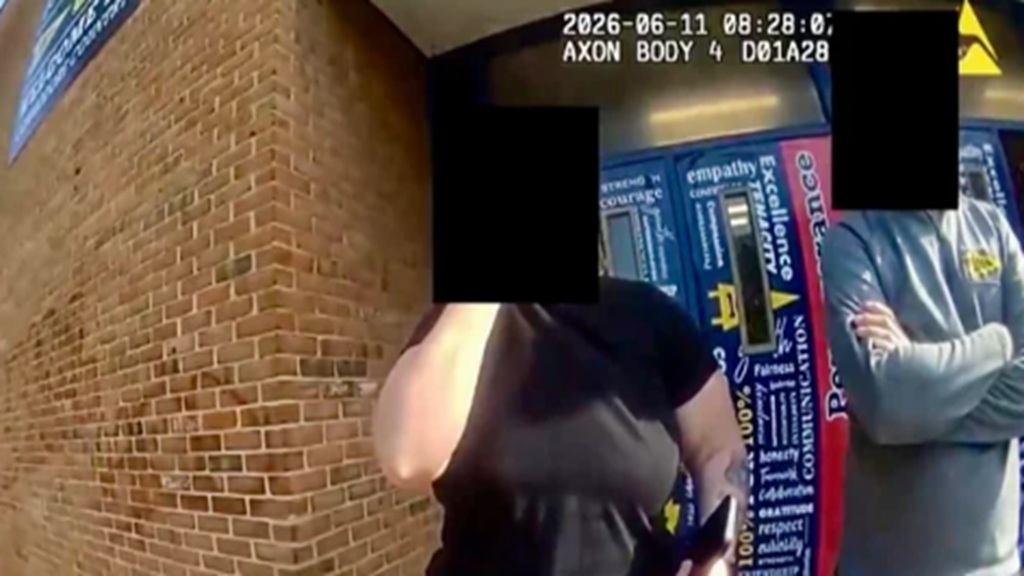
What the body camera video shows Baltimore police officers listened and appeared sympathetic but told a school employee there was not much they could do in response to the June 11 arrests outside Commodore John Rodgers Elementary Middle School.

The ICE activity near the school struck fear among many in the community, who believed the campus was a safe haven.

“They dragged him out of the vehicle, abused him in front of his children and in front of all the teachers here and children here on the property, which we have been informed they cannot do that,” said the school employee who called 911 in response to the ICE arrests.

On a body-worn camera, a Baltimore officer explains to his supervisor what is happening, and the school employee’s belief that ICE should not be on their campus.

“Unfortunately, the political era we are in now, they do what they want, and there are no repercussions,” the supervisor said.

The officer explains why there is little action Baltimore police can take.

“Unfortunately, we can’t get involved in that one,” he told school employees. “Only thing you guys can do is report up and have a school police supervisor contact ICE, but it’s not going to do any good to be honest with you.”

Police explained to the school employees, “How they [ICE] operate and how we operate are two different things. Things they may be able to get—I’m not even going to say get away with—but the things they may be able to do because of Trump just letting them loose, we can’t do. You get what I’m saying?”

On Monday, CBS News Baltimore asked the police commissioner what he thought of the response.

“We got a call for service, so we have to investigate the call for service,” BPD Commissioner Richard Worley said. “They were asking the proper questions to find out if there was anything that we needed to do in reference to the call. They were doing exactly what we’re supposed to do when we get a call for service. They were investigating this to the best of their ability.”

Worley also told CBS News Baltimore, “If ICE makes an arrest, they’re a federal law-enforcement agency. They have the right to make an arrest, and then, we do our part and investigate if there’s something to investigate.”

What happened in the initial encounter The couple was driving their SUV with their children inside just after 7 a.m. June 11 when they noticed someone following them as they pulled out of a Dunkin’ Donuts, according to their attorneys.

The unmarked vehicle with ICE officers inside then tried to pull the vehicle over at Dundalk Avenue and O’Donnell Street.

They cut off his vehicle and slammed on their brakes; then, men wearing all black got out yelling with guns drawn and one broke his driver’s side window, Acevedo Sanchez’s attorney Rachael Savage told Judge Julie R. Rubin last month.

“He was terrified it was a random act of violence,” Savage said.

Her client then drove to his daughter’s school “seeking protection.”

Savage said her client was not questioned until he was placed in the ICE holding facility in downtown Baltimore.

She said at the time of his detention, there were no removal proceedings against him.

“They had no probable cause he was in the U.S. illegally. They had no probable cause to stop him,” Savage said.

Her co-counsel Rachel Girod told the judge, “He thought he was fleeing a carjacker who was coming for him and his elementary school age daughters.”

She said Acevedo Sanchez went to their school because he knew there would be police officers present.

“He was trying to get his daughters to safety,” Girod said.

In an interview with WJZ Investigator Mike Hellgren, Girod said, “Wouldn’t anybody [think they were being carjacked]? A man jumps out wearing all black head to toe, breaks your window, and points a gun at you and your little girls in the back seat. You’re going to do whatever you can to protect your family and that’s what he did, and the judge saw it for what it was.”

Government responds Assistant U.S. Attorney Beatrice Thomas told Judge Rubin in court last month the stop was “justified.”

She said it was part of a “targeted enforcement operation” and ICE was trying to determine if Acevedo Sanchez was in the country illegally.

Thomas said ICE ran checks on Acevedo Sanchez that turned up nothing and wanted to question him. She said that is why ICE ordered Acevedo Sanchez to get out of the car.

“He did not comply. He decided to drive over a median, knocking over our officer,” Thomas told the court.

Thomas also claimed the ICE officers “were in fact in uniforms” and insisted they “did have the authority to arrest this person.”

She did not provide specific information when the judge asked what initially led ICE to believe Acevedo Sanchez was in the country illegally.

In her ruling, Judge Rubin noted Acevedo Sanchez entered the United States illegally in 2007 from Mexico. She said he had no criminal record.

His daughters are U.S. citizens.

The Department of Homeland Security issued the following statement to WJZ after the release of the BPD body camera video:

“As our brave law enforcement arrests and removes dangerous criminal illegal aliens, including murderers, rapists, and gang members from our communities, America can be proud of the professionalism our officers bring to the job day-in and day-out. Since Day One, DHS law enforcement has been delivering on President Trump’s promise to the American people to arrest and deport criminal illegal aliens including murderers, rapists, pedophiles, gang members, and terrorists. Nearly 70% of ICE arrests are of illegal aliens charged or convicted of a crime in the U.S. More than 3 million illegal aliens are out of the country. We will continue to deliver on the President’s promise to make America safe again.”

Judge criticizes ICE Judge Rubin found the ICE officers initially “did not wear any item that identified themselves” and she believed Acevedo Sanchez account that he thought he was a victim of a carjacking, including that he thought a bullet had pierced his window when the ICE officer broke it with his weapon.

“Out of fear they were going to kill him and his family, he jumped the median to get away when the officer was knocked to the ground,” she read from her ruling in court.

Judge Rubin said the lack of a warrant gave ICE more limited authority, and she was critical of the officers for not immediately identifying themselves and providing Acevedo Sanchez a reason for the arrest.

She said the arrest was a “violation of the framework in place to afford due process.”

Judge Rubin told the courtroom, “His arrest and detention are not justified.”

She also said the lack of records when police searched Acevedo Sanchez’s name in computer databases was no reason to pull him over.

“It is unclear how a negative hit leads them to believe a person is in the U.S. unlawfully,” Judge Rubin said.

She noted a search of her own name would not lead to a “hit” in the system and said there would be no reason for ICE to stop her vehicle.

Girod told WJZ she was “grateful” for the judge’s tough language against the immigration enforcement efforts in this case.

“I think we especially need to consider that language in light of the fact that she said that was her being restrained,” she said.

Please note: This story was provided to CNN Wire by an affiliate and does not contain original CNN reporting. This content carries a strict local market embargo. If you share the same market as the contributor of this article, you may not use it on any platform.

Baltimore police officer accused of faking traffic stops to avoid responding to other calls

By Adam Thompson, Tara Lynch, Bryan Lynn

Click here for updates on this story

    BALTIMORE, Maryland (WJZ) — Baltimore City police officer Dequwan Houchins is facing an indictment for allegedly logging fake traffic stops, according to Baltimore State’s Attorney Ivan Bates.

Houchins is accused of four counts of false entry in a public record and five counts of misconduct in office. Bates said that if found guilty of all charges, Houchins could face a penalty of 12 years in jail and a $4,000 fine for each of the false entry charges. The misconduct charges do not have a maximum penalty.

Bates announced the charges at a press conference Monday morning.

The allegations came to light in December 2025 during “a routine audit” carried out by the Baltimore Police Department. The audit “discovered that for several months, officer Houchins had been making numerous false reports of traffic stops,” as well as fake entries to an electronic reporting system, Bates said.

During the period Houchins was investigated, it was also discovered that he had not filed any bodycam footage, as is required by police department rules. Investigators suspected the officer had been using the false reports to claim that he was unavailable to respond to any service calls. This left other officers to respond to calls that would have been assigned to Houchins.

“This was just a lazy cop who didn’t want to do anything and wanted to collect a paycheck,” Baltimore Police Commissioner Richard Worley said.

“Troubling disregard” for responsibility “Every Baltimore Police officer takes an oath to serve and protect our city, and with that oath comes a responsibility not only to the public, but to the fellow officers who rely on them every day,” Bates said. “The allegations in this indictment reflect a troubling disregard for that responsibility.”

In a statement, Baltimore Mayor Brandon Scott called the actions of the indicted officer “shameful,” and he thanked police ethics investigators “for taking action.”

During some of the times officer Houchins allegedly entered false traffic stops, investigators said they saw him sitting in his patrol car, and attending to “other personal matters”, which include ordering a smoothie, according to court records. By doing so, he “placed a burden on his brothers and sisters in uniform and potentially jeopardized their safety.”

The department began investigating Houchins after receiving an anonymous, internal complaint alleging Houchins made false traffic reports during a four month period. At the same time, the department launched a random audit and found some inconsistencies in his traffic stop records.

“This is bigger than one officer trying to make his numbers look good,” Worley added. “Even the numbers that he falsified, he wasn’t a ball of fire, so he wasn’t really out there doing a whole lot of work.”

Undercover detectives followed Houchins, who worked in the Northeast District for five years, during four patrol shifts. They found that he recorded nine legitimate stops and eight false reports.

Worley called this egregious and said the department regularly uses technology to make sure officers are doing daily tasks.

“It’s on a lower level than this. It’s making sure officers do the reports. If they have delinquent reports, it’s holding our officers accountable to doing the job that they get paid to do. 99% of them go out there every single day and bust their butts for the city of Baltimore,” Worley added.

The police department says this is a warning to the entire department that any misconduct will be seriously dealt with.

“The bad thing is he was probably sitting doing something else when another officer needed help, and somebody else had to help him because he was too lazy to do it,” Worley added. “Goodbye, good riddance, and if anybody else does it, we’ll do the same thing to them.”

Houchins’ police powers are suspended. He is being paid and is limited to administrative duty.

Several other Baltimore officers were indicted in 2026 This is not the first time a Baltimore police officer has been indicted on criminal charges this year.

In March, four Baltimore City police officers were indicted on charges including assault, misconduct in office and filing false reports.

According to the Baltimore City State’s Attorney’s Office, Officer Kevin Dugan was indicted on five counts of misconduct in office. Officer Kevin Hilton was indicted on charges of second-degree assault and misconduct in office.

Officer Mordechai Mandelbaum was indicted on charges of false report, false statement and two counts of misconduct in office. Officer Menachem Rosenbloom was indicted on charges of second-degree assault, false report, false statement and four counts of misconduct in office.

Also in March, three Baltimore police officers were indicted on charges including theft, forgery and misconduct in office, according to the Baltimore City State’s Attorney’s Office.

Lt. Welai Grant was indicted on one count of theft between $1,500 and $25,000 and two counts of misconduct in office. She is accused of failing to report for her overnight shifts while logging the hours on her timesheet and receiving pay for eight shifts.

Sgt. Mark Rutkowski was indicted on one count of theft between $1,500 and $25,000 and three counts of misconduct in office. He is accused of inflating his work hours by clocking in before leaving his home and not clocking out until he returned. The indictment also alleges that Rutkowski logged into another employee’s computer to cancel his own leave, triggering overtime and “penalty pay” under the police collective bargaining agreement.

Officer Harrison Brandon was indicted on one count of forgery, two counts of identity fraud, one count of theft between $100 and $1,500 and two counts of misconduct in office. He is accused of submitting fraudulent doctor’s notes to obtain sick leave pay on five occasions.

Please note: This story was provided to CNN Wire by an affiliate and does not contain original CNN reporting. This content carries a strict local market embargo. If you share the same market as the contributor of this article, you may not use it on any platform.
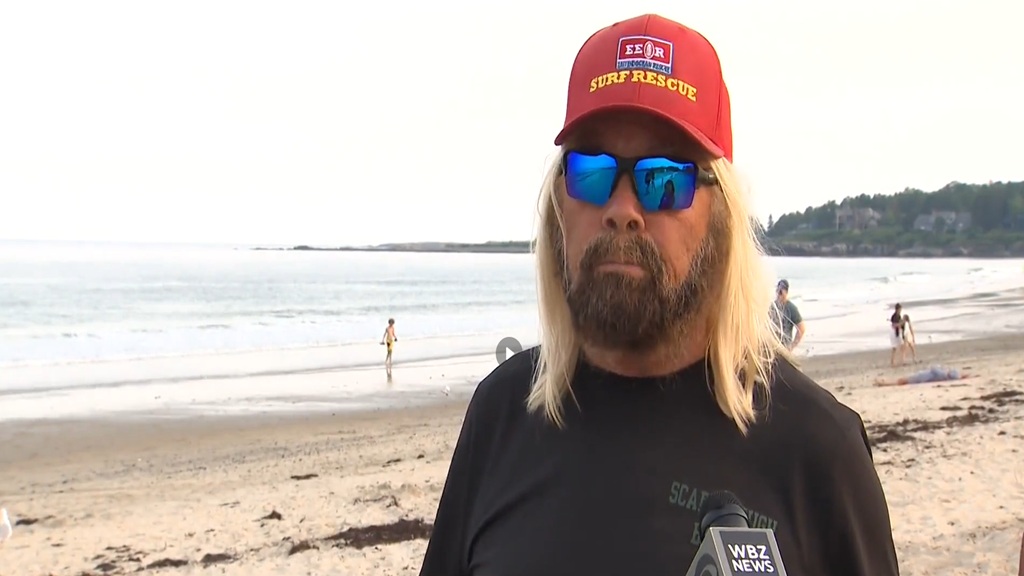
Shark drags 71-year-old lifeguard underwater at Scarborough Beach in Maine: “I knew it was a great white”

By Riley Rourke, Tammy Mutasa

Click here for updates on this story

    SCARBOROUGH, Maine (WBZ) — A 71-year-old lifeguard said he was dragged underwater by a great white shark last weekend at a beach in Scarborough, Maine.

It happened just days after more than half a dozen of the sharks were caught on video near popular beaches in the area over a 48-hour period.

The lifeguard, Greg Wilfert, was out swimming on patrol with other lifeguards at Scarborough Beach State Park around 1 p.m. Saturday when he said a shark grabbed his rescue torpedo.

“I thought I got caught in a boat propeller and it pulled me under, and I realized when I was going under there was no boat,” Wilfert told CBS News Boston. “And I knew what it was, I knew it was a great white.”

“It was frightening” He said the shark dragged him about six feet underwater.

“The amount of force that pulled me under, I’ve never felt anything like that, never,” Wilfert said.

The lifeguard pulled off the strap to his rescue torpedo to break free.

“I immediately slipped out of the strap on my can and swum to the surface as fast as I could and then I just beelined it back to the beach,” Wilfert said.

A witness saw the rescue torpedo erupt around 6 to 8 feet out of the water as Wilfert swam to shore, according to Scarborough Police.

“It was frightening; I am not going to deny that,” Wilfert said.

Wilfert was not hurt and he returned to work Sunday. Scarborough Beach was shut down for about an hour after the incident but has since reopened.

“I was just screaming at people to get out of the water, because I didn’t know where that thing was,” Wilfert said.

A drone took to the sky and jet skis scoured the waves searching for the shark. Wilfert explained that they fly the drones every half hour, and they will send the jet ski over to the sharks.

“The sharks don’t like the jet ski,” Wilfert said.

Biologists monitoring the area also believe that the number of sharks lingering there had grown to more than a dozen. The white sharks appear to be juveniles ranging in size from 6 to 12 feet.

No other shark interactions have been reported in the area, but Scarborough Police said that the encounter is “very consistent with other activity we have seen.” The sharks have been spotted near the sandbar and shore at both Scarborough Beach and Higgins Beach.

Sharks in New England New England Aquarium adjunct scientist John Chisholm explained that warmer waters are making the northeast more hospitable to some sharks. He said it isn’t unusual to see sharks in the area at this time of year, but the number of great white sharks is “surprising.”

“That’s more like numbers we see down when we’re tagging off of the Cape,” said Chisholm.

Experts recommend that anyone entering the ocean be aware that it’s a wild environment. You should avoid splashing, seals and schools of fish. They also said you shouldn’t swim alone and make sure to listen to the lifeguards.

“Stay close to shore. You don’t need to go out into the deep water; you’re asking for trouble,” Wilfert said.

The rising number of sharks is something that beachgoers are keeping in mind when they are heading to the coast.

“I don’t want to get eaten, but no problem. Sharks are sharks; they’ll stay out there, and I’ll stay here, no worries,” said Mark Coleman.

Biologists and officials will continue to monitor the area. Scarborough Beach State Park will remain on a red and yellow alert until the sharks are gone.

“The safety of residents and visitors remains our highest priority,” Scarborough Police said.

Please note: This story was provided to CNN Wire by an affiliate and does not contain original CNN reporting. This content carries a strict local market embargo. If you share the same market as the contributor of this article, you may not use it on any platform.

Why Gillette Stadium turf had to be replaced days before Patriots preseason opener

By Aaron Parseghian

Click here for updates on this story

    FOXBOROUGH, Massachusetts (WBZ) — As the New England Patriots prepare for their first preseason game later this week, crews at Gillette Stadium are once again replacing the playing surface.

WBZ SkyEye video captured rolls of turf inside the stadium’s tunnels Monday as crews worked to replace the field for the second time since the World Cup. The latest artificial turf was removed after it failed to pass an independent laboratory test required by the NFL.

ESPN Patriots reporter Mike Reiss tells WBZ the Patriots installed an artificial turf field to replace the natural grass installed for the World Cup, and initial testing by both the NFL and Major League Soccer showed positive results.

“They were told this is good to go, but they also need to clear an independent laboratory test which is sort of a co-op with the NFL and the NFL Players Association, and that was where the field was deemed non-compliant,” Reiss said.

The Patriots have not released an official statement about the turf issue, but the team tells WBZ on background artificial turf fields typically consist of three layers: a base, usually made of concrete, asphalt or stone dust; a pad or e-layer separating the turf from the ground; and then the artificial grass itself.

On the bottom of Gillette Stadium, the base is stone dust, a more forgiving surface. A vendor told the team the pad on top of stone could make the field “too springy” to play on. So, the decision was made to not include the added layer.

“The Patriots felt like their choice of field and that stone dust was going to pass. But because the independent laboratory test did it over the e-layer, it was an inconsistent duplication, I suppose, of what they were testing,” Reiss explained.

With the second turf replacement nearly complete, Reiss said the Patriots are confident the new field will be ready and approved before Thursday night’s preseason opener against the Indianapolis Colts.

“I believe the reason they feel it’s going to pass is that the field they’re installing is the latest version of what they had last year, which passed,” Reiss added.

The latest replacement also raises the question of why Gillette Stadium does not simply retain the natural grass used during the World Cup, favored by FIFA and other advocates.

Reiss said longtime Patriots fans may remember what happened when the stadium used natural grass nearly two decades ago.

“Longtime Patriots fans would remember 2006. They had the natural grass. It was hard to upkeep. And the field became a mud pit in a late-season game against the Jets. The hated Jets, the Patriots lose the game,” Reiss said. “And Bill Belichick, who was the head coach at the time, said, ‘never again,’ as I understand it. And that’s when they went to the artificial surface that’s been there ever since. And I think it’s just with the event load that they have, it’s hard to maintain a natural grass field.”

Please note: This story was provided to CNN Wire by an affiliate and does not contain original CNN reporting. This content carries a strict local market embargo. If you share the same market as the contributor of this article, you may not use it on any platform.

Why the Pittsburgh Zoo’s new lion cub was named after a potato

By Ross Guidotti

Click here for updates on this story

    PITTSBURGH, Pennsylvania (KDKA) — Four months after she was born, the Pittsburgh Zoo and Aquarium’s lion cub made her public debut with her new name on Monday.

The cub was named Kiazi, which means potato in Swahili.

“When she was first born and she was just little and just laying there, doing nothing but sleeping and nursing, she looked like a baked potato,” said lion handler Karen Vacco.

“And the fact that her father is a first-time dad, he came from Idaho. Idaho potato,” Vacco added.

The zoo had more than 1,100 names to choose from, with the contest to name the cub raising more than $5,700. She was on display Monday, much to the delight of visitors.

“I like it because it plays with its mamma,” a young visitor said.

Kiazi was born on April 5 to first-time parents Hondo and Scarlett. African lions are considered vulnerable, and their numbers have declined more than 50% over the last 25 years.

Officials say Kiazi is as healthy as can be and will spend a few more years at the zoo before she heads out to start her own pride at another zoo. But for now, Vacco says, “She’s our baby, and we’re going to keep her.”

Please note: This story was provided to CNN Wire by an affiliate and does not contain original CNN reporting. This content carries a strict local market embargo. If you share the same market as the contributor of this article, you may not use it on any platform.

Deadly U.S. Steel Clairton Coke Works explosion “should never have happened,” report says

By Ricky Sayer

Click here for updates on this story

    CLAIRTON, Pennsylvania (KDKA) — The U.S. Chemical Safety Board has released its final report into the deadly explosion at U.S. Steel’s Clairton Coke Plant, finding it was the result of multiple preventable safety issues.

The report, released a day shy of one year since the explosion, faults the company, saying the explosion that killed Timothy Quinn and Steven Menefee and injured 11 others “should never have happened.”

It cites the outcome of the deadly explosion being the result of the absence of a formalized procedure, the proximity of buildings employees work out of to where dangerous processes take place, and what the report refers to as an ineffective process safety management system.

“This incident was the result of workers routinely performing a task incorrectly over a period of years until it ultimately led to a catastrophic explosion,” CSB Board Member Sylvia Johnson said. “Companies must outline procedures for any task that could potentially cause harm to workers and make sure that workers are fully trained on those procedures.”

Drew Sahli has been in charge of the investigation that produced Monday’s report. It faults U.S. Steel for not having a formal procedure for a safe or proper way to complete the specific valve-cleaning process that caused the explosion.

Workers from U.S. Steel and its contractor MPW Industrial Services were cleaning a 70-year-old valve when the valve broke, leading to coke oven gas igniting and exploding. As KDKA was the first to report in the weeks following the explosion, workers had used water and significantly overpressurized the valve, leading to its failure.

“There was no procedure describing the correct or proper or safe way to do that operation, and unfortunately, the operation was done in such a way that directly caused the valve to fail,” Sahli said.

In the days and weeks before the explosion, investigators say it’s what wasn’t thought of that helped result in the explosion.

“Nobody ever sat around and said, ‘Hey, is it a good idea to be doing this? This valve is rated for 50 pounds of pressure. Is it a good idea to hook up a [water] pump truck capable of producing far more than 50 pounds?'” said Drew Sahli, the investigator in charge of putting together the report for the Chemical Safety Board.

The CSB report says workers had been cleaning the valves incorrectly for years.

When asked why it had not failed before the explosion, Sahli said he doesn’t have a solid answer, but that they do know for the valve to fail, it had to have been closed or nearly closed. That would prevent the water that was being used to clean the valve from getting out. The board concluded that a formal procedure for using water to clean valves wasn’t drawn up despite U.S. Steel management being aware of and endorsing the practice.

“The second safety issue is the longest one in the report, and that one talks about what’s called facility siting,” Sahli said.

In short, it meant U.S. Steel didn’t put enough distance between its coke batteries and buildings where people work out of. The two men who died were in or near control rooms located above the coke oven piping, and a break room was above it too.

“When buildings are occupied by personnel, they must be adequately designed or located to protect the personnel or equipment from fires, explosions, or toxic releases,” Sahli said. “Had these buildings been located in a different area of the facility, away from coke batteries, this incident could have been far less severe.”

He explained that U.S. Steel could have taken action to identify and fix the issue.

“The history of this issue at Clairton is that the companies had multiple opportunities in the past to think about this topic, and unfortunately, the company has chosen not to do that,” he said.

U.S. Steel didn’t act because it believed it wasn’t required to do so, Sahli said. Whether the reason is valid has been disputed.

It connects to the third safety issue the report says resulted in the explosion — what they call process safety management systems.

“Maybe you weren’t required to do it by regulation, but you should have done it anyway, because now you have two employees who were fatally injured during this incident, and had you done all of these activities voluntarily, they might still be with us,” Sahli said.

The Chemical Safety Board made multiple recommendations.

They include evaluating those distances between buildings and hazardous processes, developing a written procedure for washing valves with pressurized water, and developing a comprehensive process safety management system.

In a statement to KDKA, U.S. Steel said, “We appreciate the work of the Chemical Safety Board contained in its Final Report and will thoroughly review its recommendations.”

They also outlined several safety protocols they say they have already strengthened, including establishing standardized best practices for valve cleaning, improving their management of change program and having workers complete comprehensive training related to those changes.

As for Tuesday’s remembrance of the explosion, along with lowering flags and a moment of silence, U.S. Steel says workers will gather for safety discussions, the company saying the best way to honor their fallen colleagues is to make sure everyone returns home in the future.

A company spokesperson said, “As we honor their memory, and those of others we have lost, we also reflect on the responsibility we all share to protect one another and ensure safety remains at the center of everything we do.”

The spokesperson said they will remember their colleagues and keep their families and loved ones in their thoughts.

Please note: This story was provided to CNN Wire by an affiliate and does not contain original CNN reporting. This content carries a strict local market embargo. If you share the same market as the contributor of this article, you may not use it on any platform.

Pittsburgh-area family warns pet owners after beloved dog dies from rare fungal infection

By Christopher DeRose

Click here for updates on this story

    PITTSBURGH, Pennsylvania (KDKA) — A local family is warning other dog owners about a potentially deadly fungal infection that took the life of their beloved German shepherd in just days.

Beansie was a 5-year-old German shepherd who suddenly died last month after a short but aggressive battle with blastomycosis — a fungal disease found in soil and decaying organic matter, often around fresh water.

“Towards the end of June, he developed a small open wound on his back, and we thought it was just like a typical hot spot. After two weeks, it was not healing and getting much, much bigger,” said Mylyssa Wilson, owner of Petite Feet Pet Care.

Wilson was Beansie’s pet nanny and dog walker for years. She says once those first symptoms appeared, his condition deteriorated quickly.

“He started to develop signs of difficulty breathing, which happened fast,” said Wilson. “It was on a Monday that he started to show those signs; by Saturday we had him down at the emergency vet and by Sunday he had passed away because the fungus had completely taken over his lungs.”

Wilson says blastomycosis can be difficult to detect.

She believes Beansie may have been exposed to one of the local parks where they regularly walked. Other symptoms can include coughing, weight loss, loss of appetite, and fever.

Wilson says the veterinarians she has spoken with have told her blastomycosis has been considered exceedingly rare in Pennsylvania, with cases more commonly associated with other parts of the country.

But Beansie never left the area. Neither did his sister, Vala. And shortly after Beansie died, Vala was tested. She came back positive for blastomycosis and is now being treated and is doing well.

“It is heartbreaking,” said Wilson. “We don’t want anybody else to go through this and suffer needlessly; you know when treatment can be started soon enough to save another pet, that’s what we want.”

Please note: This story was provided to CNN Wire by an affiliate and does not contain original CNN reporting. This content carries a strict local market embargo. If you share the same market as the contributor of this article, you may not use it on any platform.

Douglasville man convicted of laundering $2.7 million stolen in romance, online scams

By Zachary Bynum

Click here for updates on this story

    DOUGLASVILLE, Georgia (WUPA) — A Douglasville man has been convicted of laundering more than $2.7 million stolen from victims of romance scams and other online fraud schemes, including older adults who lost retirement savings, federal prosecutors said.

A jury on Thursday convicted 41-year-old Babajide Adesayo on all charges following an eight-day federal trial, according to the U.S. Attorney’s Office for the Northern District of Georgia. The charges include two counts of conspiracy to commit money laundering and 16 counts of transactional money laundering.

Federal prosecutors said Adesayo helped move money through a transnational network that sent victims’ funds overseas, primarily to China, Hong Kong and Nigeria. U.S. Attorney Theodore Hertzberg described Adesayo as a key financial player in a network that targeted elderly victims and moved their savings beyond the reach of U.S. authorities.

How prosecutors say the scheme worked According to information presented in court, fraudsters began communicating online with unsuspecting victims between April 2020 and September 2021, posing as friends, business associates or romantic partners.

After building relationships with the victims, prosecutors said the scammers asked them for money using false stories, including claims that they needed business equipment, had been imprisoned or were suffering from injuries or illnesses.

Victims were then directed to send hundreds of thousands of dollars, in some cases including retirement savings, to business accounts belonging to Adesayo’s co-defendant, Nigerian national Efemena Igbe.

Prosecutors said Igbe transferred much of that money to Adesayo and disguised the transactions as payments for vehicles from Adesayo’s automotive business. Adesayo then sent much of the money to accounts in China, Hong Kong, Nigeria and other countries. Over roughly 17 months, prosecutors said he received and moved more than $2.7 million in victim funds.

Prosecutors say the money laundering continued after his arrest Adesayo was arrested in June 2024 and initially released on bond, but prosecutors said the money laundering continued while his case was pending.

Additional victims sent money either directly to Adesayo’s business accounts or through other accounts that later transferred the funds to him, according to prosecutors. Authorities said Adesayo quickly withdrew or transferred that money after receiving it.

A federal magistrate judge later revoked his bond after authorities discovered the additional conduct. Adesayo has remained in federal custody since March 2, 2026.

The FBI and Homeland Security Investigations investigated the case, with assistance from the U.S. Secret Service and law enforcement agencies in New Hampshire, Mississippi and New York.

Adesayo is scheduled to be sentenced Nov. 20 before U.S. District Judge Mark H. Cohen. He faces up to 20 years in prison on each conspiracy count, up to 10 years on each transactional money laundering count and an additional consecutive sentence of up to 10 years for offenses committed while on release.

Please note: This story was provided to CNN Wire by an affiliate and does not contain original CNN reporting. This content carries a strict local market embargo. If you share the same market as the contributor of this article, you may not use it on any platform.