High 5: Massachusetts high school students work with NASA to help plants grow in space

By Antoinette Antonio
Click here for updates on this story
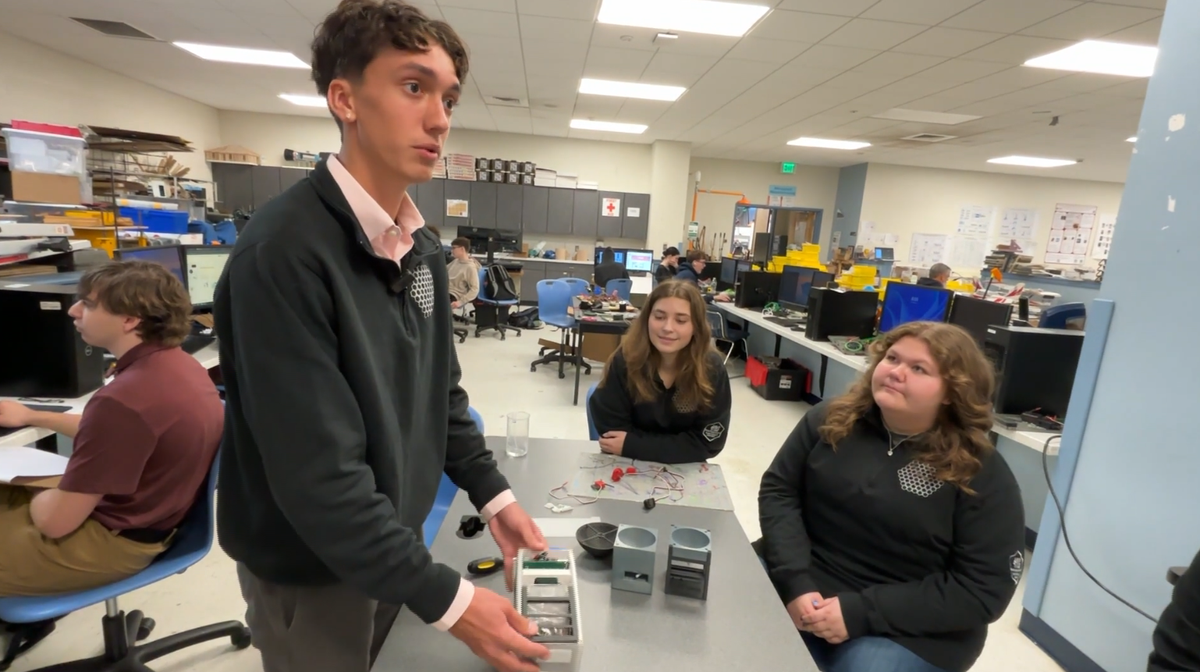
FRANKLIN, Massachusetts (WCVB) — Five seniors at Tri-County Regional Vocational Technical High School in Franklin are taking their engineering skills beyond the classroom and into the world of space research.
The students were tasked with solving a challenge astronauts face when trying to grow plants in space.
“They wanted to be able to grow plants without the plant’s roots drowning,” team member Nate Hatami said. “So they tasked us with designing a way for the plants to not drown.”
The team — Aidan Forrester, Nate Hatami, Sabrina Gaul, Madison Gouck and Lucas Bianco — participated in NASA HUNCH, which stands for High Schools United with NASA to Create Hardware.
Through the program, students work on projects designed to address real challenges related to space exploration.
“Because there’s no gravity, water doesn’t flow like it would on Earth. Instead, it balls up in little spheres and just floats around,” team member Sabrina Gaul explained. “So we needed to figure out how to make water pour and flow so we can water plants effectively.”
The Tri-County students designed a system of channels that uses capillary action to guide water through their device, which they named Hexaflow.
The inspiration came from an unexpected source: the thorny devil lizard.
Hatami said he got the idea while watching the educational animated series Wild Kratts with his younger brother.
“It takes in water from its environment through hexagonal patterns on its scales and delivers it through its mouth using capillary action,” Hatami said, describing how the lizard inspired the team’s design.
The students incorporated that concept into Hexaflow, applying what they learned about the lizard’s ability to move water to their own engineering challenge.
After submitting their design to NASA, the team advanced to a final design review in Houston in May 2026.
The next step was testing their prototype at NASA’s Glenn Research Center in Ohio.
The experiment was dropped from an eight-story tower in approximately 2.2 seconds, simulating microgravity.
During the test, the students observed how water moved through their device.“It did really well, better than we actually expected, which is really good,” team member Madison Gouck said. “And we got to see the water movement in action.”
Capturing that brief moment was critical.
The team used a camera to record the experiment so they could review what happened during the drop.
“So this camera was very important that we could retrieve the footage after because that is our proof,” team member Aidan Forrester said.
The students’ work is continuing beyond the experiment.
The team is developing a research paper and has been invited to present its work at a gravitational and space research conference in the Washington, D.C., area in December 2026.
Please note: This story was provided to CNN Wire by an affiliate and does not contain original CNN reporting. This content carries a strict local market embargo. If you share the same market as the contributor of this article, you may not use it on any platform.