MoDOT identifies stretches of rural interstates for increased speed limits

JEFFERSON CITY, Mo. (KMIZ)
The Missouri Department of Transportation said Wednesday that speed limits will increase to 75 miles per hour on eight stretches of rural interstate around the state.
In a news release, the department stated it took various factors into consideration when deciding where to change speed limits:
Current traffic numbers. Truck traffic. Speed data. Crash history. Terrain of the road and road design. Existing speed limits. Ongoing construction.The areas chosen for an increase to 75 mph are:
I-29: Exit 56 in Andrew County to 2.5 miles south of the Iowa border. I-35: Northern Cameron city limit to four miles south of the Iowa border. I-49: Arkansas border to Exit 24. I-49: Exit 56 to south of Exit 101 in Nevada. I-55: Arkansas border to mile marker 16.6, south of I-155 interchange. I-55: Mile marker 19.8 north of Highway 84 to mile marker 64.9 at the Route AA bridge. I-55: Mile marker 70.5 north of Route HH to mile marker 86.6 south of Route PP. I-55: Mile marker 106.4 north of Exit 105 to mile marker 164.9 at Jefferson County line.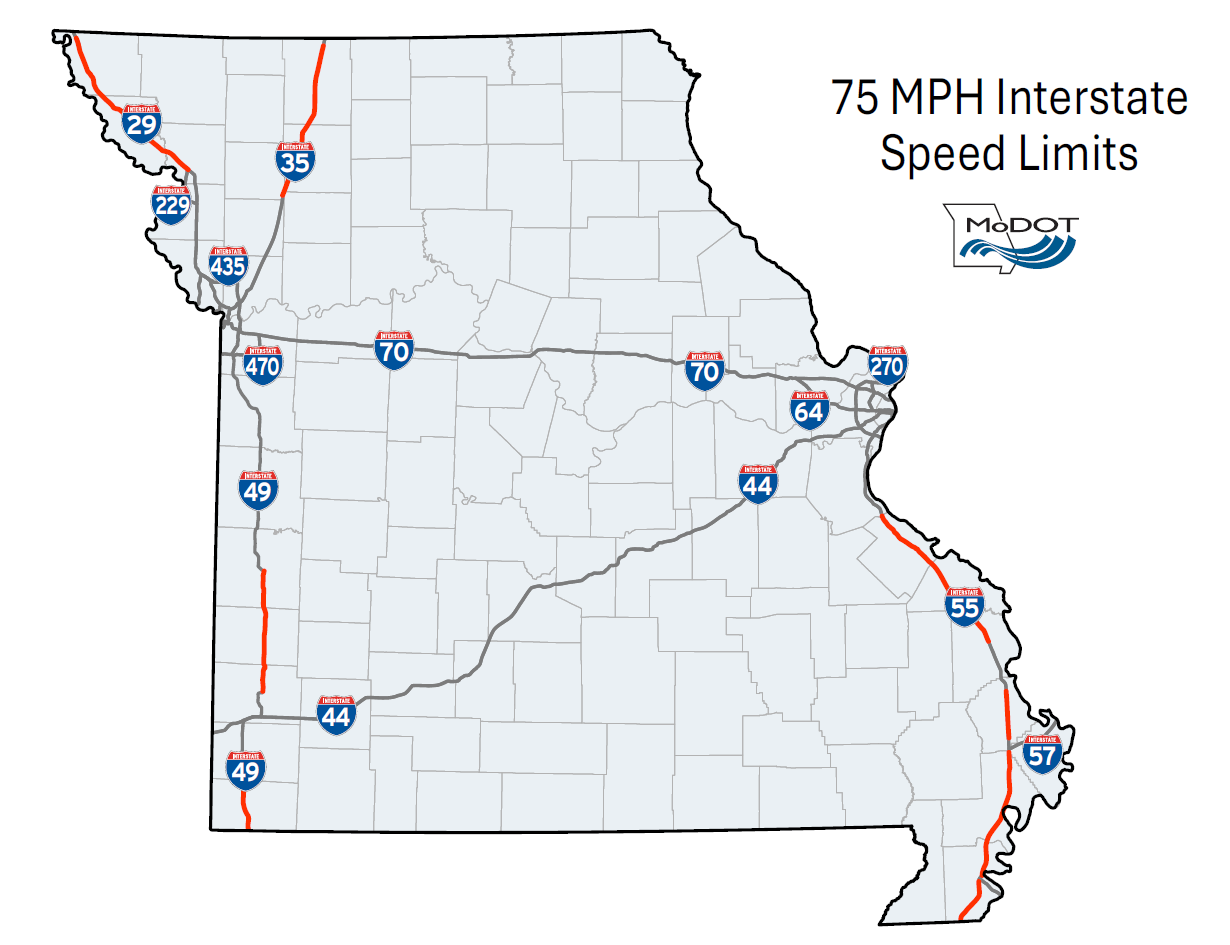
A map was provided in the release, visually highlighting the interstate road segments where speed limits will increase.
MoDOT director Ed Hassinger said that the decision for which roads will be impacted by the increase came down to the publics convenience and safety.
“There’s a desire, I think, from the public to be more convenient, to be able to get places more efficiently,” Hassinger said. Our concern is safety of the traveling public…we’re trying to balance those two things to get the best outcome.”
Once the speed limit increases are set, MoDOT crews will continue to monitor those specific stretches to make sure there are positive results.
“If we see negative results, then we will dial it back to a lower speed limit, so that’s kind of the plan that we’re under right now,” Hassinger said.
Gov. Mike Kehoe signed the bill allowing increased speed limits into law in July. The bill was sponsored by Sen. Jamie Burger (R-Benton) and carried in the House by Rep. John Voss (R-Cape Girardeau).
For AAA, who opposed the initial bill signed, there is growing concerns about the safety aspect of increasing the speed limits.
“This piece of legislation is moving Missouri in the wrong direction when it comes to roadway safety,” AAA spokesman Nick Chabarria said. “We know that increased speed limits on interstates have resulted in increased fatalities in neighboring states that have enacted similar legislation.”
Chabarria said, based on AAA’s data, neighboring states like Arkansas saw an increase in fatalities of about 27% after increasing their speed limits on rural roads. And in Kansas fatalities increased by 22% he said.
For AAA, Chabarria said they share the same safety concerns expressed in MoDOT’s press release, as well as the goal of active roadways that make driving more efficient. However, he said that the stretches of interstate that are going to see an increase will not make traveling faster by a lot, and the safety aspect is now being jeperdized.
“When you calculate that out, even on that longest stretch, that saves a driver about 3 minutes, and that’s 3 minutes,” Chabarria said. “I don’t think the speed limit increase is necessarily worth it, and I don’t know that the argument that it gets people there faster will hold up when you actually look at the numbers.”
Mid-Missouri was not part of the speed limit increases, and Hassinger said that was partially due to the current construction happening.
“We’re having enough problems getting people to drive, the works zone speed limits, so we made a decision that we’re not going to even look at I-70 until the construction is done,” Hassinger said. “That will be several years from now.”
Hassinger said there is a chance for Mid-Missouri to get speed limit increases, but the analysis for those roads will not happen until after 2030, when most of the construction has been completed.
For urban highways, they require more safety analysis from MoDOT. Hassinger said that when they were looking at the rural interstates, those stretches had less traffic volume, low truck counts, and the roads were mostly flat and straight, making it easier to determine that increasing the speed was safe.
MoDOT will be working this fall to update speed limit signs on those stretches; no timeline of completion was provided.
It is recommended that drivers continue to follow the posted speed limit signs as the updated speeds roll out.
Both Hassinger and Chabarria are urging drivers to understand that speed limits means that is the maximum speed a driver can safely travel in those areas.
“The speed limit going up means it’s a speed limit, and so none of our roads are designed to drive 80 miles an hour on, so 75 is kind of the limit if people want to be safe on the road,” Hassinger said.
“This should be the fastest you’re going on that stretch of road,” Chabarria said. “Even though we’re seeing the speed limit increase on these stretches of roads, you know, drive what you’re comfortable with and certainly drive for conditions we know that speeding is a factor in about a third of all fatal crashes nationwide.”
Click here to follow the original article.