U.S. Supreme Court ruling mandates use of 2022 congressional election map

COLUMBIA, Mo. (KMIZ)
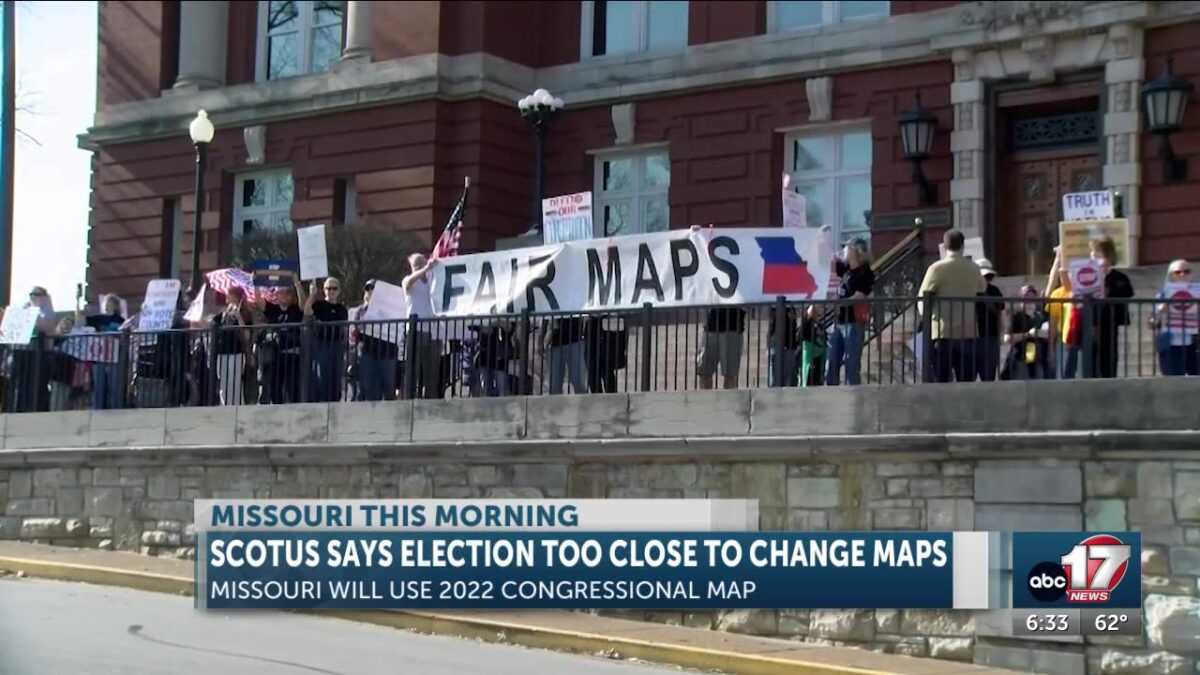
The U.S. Supreme Court granted a stay on injections granted by the U.S. District Court for the Eastern District of Missouri on Friday, ensuring the 2022 congressional map will be used for the November 2026 election.
The order from the Justice Brett Kavanaugh will remain in effect “pending any further order of [the] court lifting such stays.” The court further ordered the District Court and Court of Appeals “should not enjoin or otherwise prohibit the use of the 2022 map in the 2026 congressional election in Missouri.”
It further said the courts should not order or require Missouri to use the 2025 map in the election.
This comes after Missouri held its August primary under the 2025 congressional map, despite the map not being approved by voters.
In its ruling, SCOTUS uses Purcell–a legal principle that federal courts shouldn’t alter state election rules close to an election–to justify its decision. This argument was also used in lower-court arguments by interested parties, and it was used in federal court decisions to justify using the 2025 map.
“At this late date, ordering a reversion to the 2025 map in the midst of an ongoing election would usher electoral chaos,” the Supreme Court wrote in its decision.
When the referendum to put the 2025 map on the November ballot was before the Missouri Supreme Court in early September, three top Republican groups jumped in on the state’s side. The groups, including the Republican National Committee, used the Purcell principle to argue that a change to the maps between elections would cause voter confusion. A similar argument was presented to SCOTUS when this case was heard on appeal, which was denied.
A federal court also used the Purcell principle in its decision to justify using the 2025 map. However, SCOTUS said in its decision that it was the wrong application.
“At this late date, ordering reversion to the 2025 map in the midst of an ongoing election would usher in electoral chaos. Purcell protects against such disorder. The Eighth Circuit panel dealt with Purcell by casting blame on the Missouri Supreme Court for its September 3 decision prohibiting use of the 2025 map,” the Supreme Court wrote in its decision.
This is the sixth decision on which map Missouri will use for November, with the Supreme Court issuing three of those.
In its order, the U.S. Supreme Court said Secretary of State Denny Hoskins was aware of the “significant risks” of holding the primary under the new map, but “nonetheless chose to proceed.”
The Missouri Supreme Court warned Hoskins in May that if the referendum on the 2025 congressional map was sufficient, then it would freeze Missouri’s congressional districts under the 2022 map until voters could decide. That referendum was determined to be sufficient by a Missouri Supreme Court ruling, and it will be on the November ballot as Proposition A.
In a press release, Hoskins said the Supreme Court’s ruling was disappointing, calling it a blow to representative democracy, but said he appreciates having clarity on how the November election will proceed.
He said his office will comply with the ruling and expressed confidence in local election authorities to administer a seamless general election.
Hoskin also defended his efforts to uphold what he described as the principles of the U.S. Constitution, saying he “left nothing on the field” and will continue fighting for Missourians and what he called the American way of life.
Gov. Mike Kehoe shared his disappointment over the decision on social media.
State Sen. Rick Brattin said Friday’s decision is a “travesty for Missouri voters”.
He does add that he is grateful the Eighth Circuit addressed the case, arguing that voters should not select their nominees under one congressional map and then vote in different districts during the general election.
Brattin said the decision reflects what he believes the Constitution and common sense require.
U.S. Representative Emanuel Cleaver had a different reaction to Friday’s ruling.
Cleaver called the decision an act of democracy and recognized the people who protested the congressional map, including those who demonstrated during the cold winter months.
“If there’s ever been a time when we could honestly declare power to the people, it is right now; people, not politicians, did this,” Cleaver said.
The legal battle over the map began last summer, when Republican Gov. Mike Kehoe signed the “Missouri First” congressional map into law.
Cleaver also criticized state officials, saying they spent more than a year and public resources trying to silence Missouri voters and gain a congressional seat.
Gillian Wilcox, director of litigation and policy for the ACLU of Missouri, called the decision the latest example of what she described as “unnecessary but intentional chaos” for Missouri voters.
“Politicians and elected officials have unleashed unnecessary but intentional chaos on Missouri voters, not for the benefit of their constituents but for themselves and the state actors in D.C. who designed and demanded these maps solely for partisan power grab,” Wilcox said in a press release. “Voting has already begun and today’s decision closes the door on the politicians’ shenanigans.”
Boone County Clerk Brianna Lennon said the decision is “very relieving,” because the county will not have to reprint ballots or reprogram voting machines.
Lennon said the county has updated its website and social media pages to notify voters no changes will be made to their ballots.
“Please feel free to come in and absentee vote, especially during that two-week period of time before the election. But it is incredibly relieving to know that we don’t need to redo the work that we’ve already done,” Lennon said.
The ruling is the latest in a series of legal maneuvers between Missouri Republicans, who redrew the state’s congressional district boundaries in 2025 to turn Kansas City from a Democratic seat to a Republican one, and People Not Politicians, who opposed the redistricting.
Missouri used the 2025 map in the August primaries, but since then, questions have persisted about what using the older 2022 map in November would mean for voters.
In his ruling, Kavanaugh noted that “ballots using the 2022 map have been printed and mailed. Absentee voting has already begun, as has military and overseas voting.”
“At this late date, ordering reversion to the 2025 map in the midst of an ongoing election would usher in electoral chaos,” Kavanaugh said in his order.
SCOTUS Map Order 9-25-2026Download Click here to follow the original article.