New aerial survey finds drought remains key stressor for Oregon forests

SALEM, Ore. (KTVZ) — A new report on the health of Oregon’s forests shows tree death and damage decreased in 2025, but drought continues to put stress on trees across the state.
The Oregon Department of Forestry and the USDA Forest Service recently released the results of their annual aerial forest health survey. The survey found 181,500 acres of Oregon forestland showed signs of tree death or damage in 2025.
That figure was well below the 10-year average and less than half the peak recorded in 2022.
In 2025, about 0.7% of Oregon’s roughly 30 million forested acres showed signs of death or damage, compared with 0.8% in 2024 and 1.8% in 2022.
Drought remains a major concernThe report found drought remains a significant stressor for Oregon’s forests, particularly because it can make trees more vulnerable to insects and disease.
ODF Forest Entomologist Christine Buhl said drought is often accompanied by rising temperatures, creating additional stress for trees.
“Together these are often the underlying cause of tree deaths in our state,” Buhl said. “Drought reduces tree growth and lowers their defenses against insect pests and some diseases, which healthy trees may otherwise resist or tolerate.”
The report found 78% of the damage detected during the 2025 aerial survey was linked to the combination of drought and opportunistic beetles attacking stressed Douglas-fir, true fir and pine species.
Eastern Oregon sees highest levels of damageEastern Oregon had the highest percentage of forest death and damage in the state.
Union County had the highest percentage, with 2.4% of its forested acres showing signs of death or damage. Umatilla County followed at 1.24%, while Harney County recorded 1.12%.
Coastal counties and areas bordering the Coast Range had the lowest percentages of forest death and damage.
The report also tracks other causes of tree injury and death, including disease, storms and wildfires.
Tree diseases remain a concernResearchers found levels of many common tree diseases remained relatively unchanged in 2025, although they noted some diseases can be difficult to detect from the air.
One exception is sudden oak death, a disease caused by the water mold Phytophthora ramorum. The disease was first discovered near the California border in 2001 and continues to spread north and northwest through Curry County.
Sudden oak death can infect dozens of shrub and tree species and kills Oregon’s native tanoak trees.
Oregon is working with federal land managers to slow the disease’s spread by identifying newly infected areas and cutting and burning infected vegetation. Private forestland is also being treated.
Swiss needle cast also remains a concern for Douglas-fir trees, particularly in the Coast Range where late-spring atmospheric moisture is high.
ODF Forest Pathologist Gabriela Ritokova said the fungal disease causes trees to lose needles prematurely, resulting in sparse crowns and slower growth.
According to the report, Swiss needle cast can reduce volume growth by 20% to 50%.
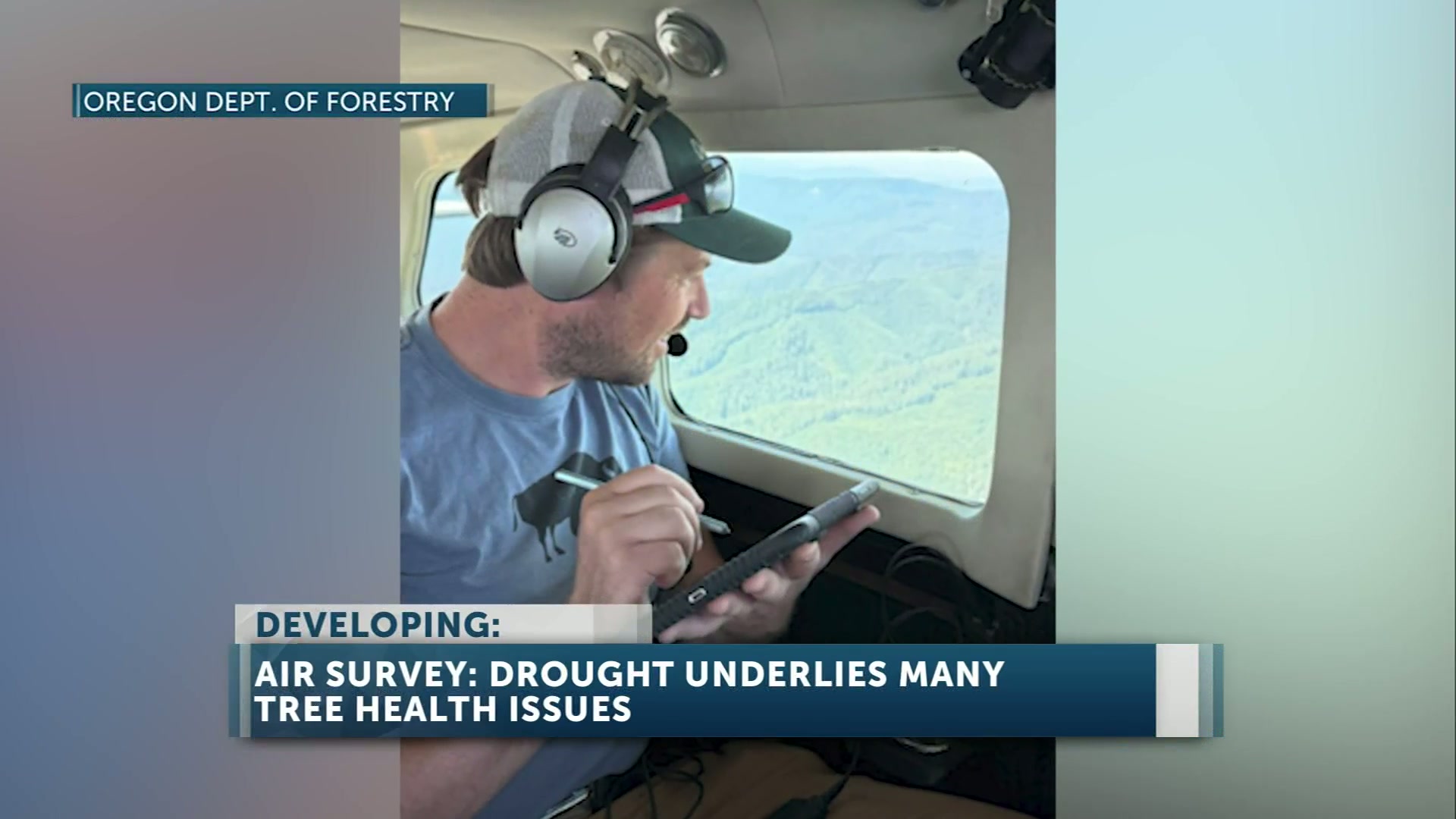
Survey has tracked Oregon forests for decadesThe annual aerial survey is conducted by trained observers who fly over forested areas throughout the Pacific Northwest in fixed-wing aircraft.
Observers typically fly between 1,500 and 2,500 feet above the ground, following a systematic grid spaced four miles apart. Flights generally travel between 90 and 140 miles per hour.
The survey is the longest continuous forest health survey of its kind in the United States. It began in 1947 and has been conducted every year except 2020, when the survey was canceled because of the COVID-19 pandemic.
ODF says information gathered on the ground by Oregon State University Forestry Extension staff, natural resource agencies, universities, landowners and members of the public also helps provide a more complete picture of forest health.
The full 2025 Oregon Forest Health report is available through the Oregon Department of Forestry. Data from annual aerial surveys is also available through the USDA Forest Service.
Click here to follow the original article.