Against All Odds: What Remains — The challenges facing our local Tribes

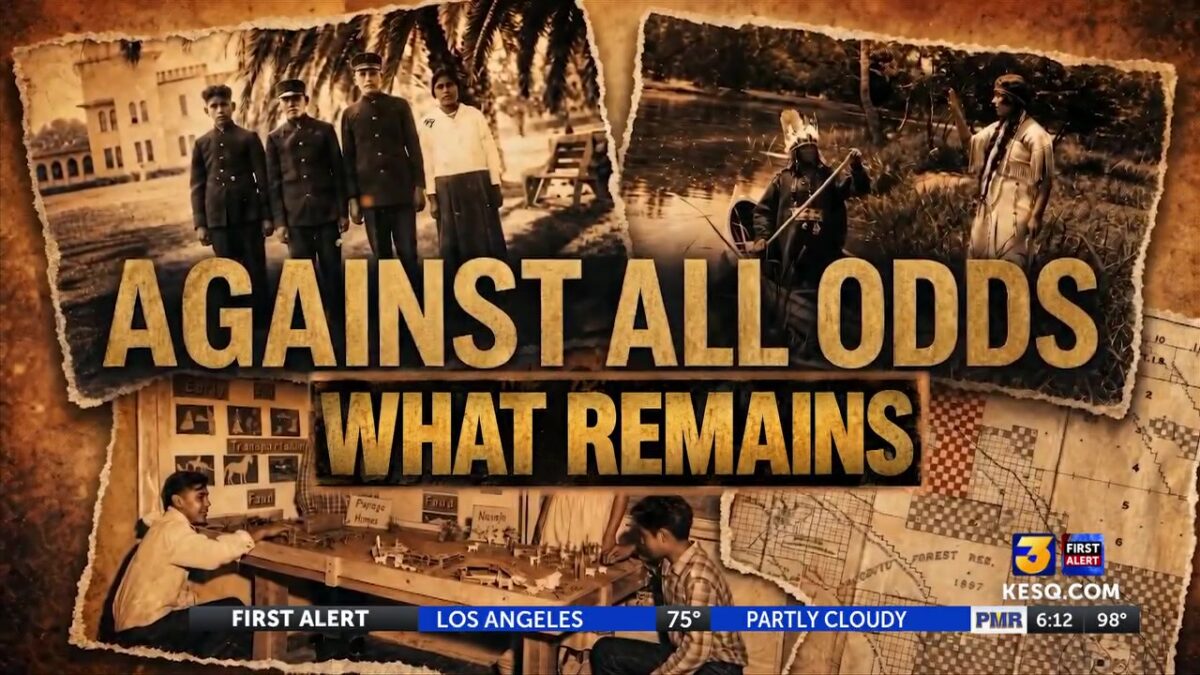
PALM SPRINGS, CA (KESQ) – In Part 1 of Against All Odds, we looked at the role that tribal casinos have played in the Coachella Valley and how they have become a major part of the region’s economy and identity. But the pain behind the prosperity remains, with the bands now grappling to honor the culture and language.
Ravaged by disease in the 1800s, the Augustine Band of Cahuilla Indians in Coachella were federally recognized as the smallest tribe in the entire United States at just one woman in 1972 — Roberta Augustine. The numbers grew when she had children. But it was to be short-lived, because Roberta died, and all of her children died soon after.
Except for one — her daughter Mary Ann Martin.
And so, it was again, the weight of an Indian nation, solely on one woman’s slim shoulders.
“My mom’s biggest struggle was being alone. She didn’t have elders to rely on. She didn’t have people to guide her,” said Amanda Augustine, the Chairwoman of the Augustine Band of Cahuilla Indians.
Amanda, as a child, watched her mother grapple with that isolation.
“She missed her family. She struggled with having to learn everything by herself and understand everybody is not your friend,” said Augustine. “”The tribes are here. They’ve been here. They’re not going anywhere. We can’t go anywhere.”
Now, in 2026, they have boosted their numbers to 20, to become the second smallest tribe in the U.S.
Augustine is one of 9 bands of the Cahuilla tribe who have been here in the Southern California desert area — for decades — centuries — ruling the Coachella Valley long before white settlers — before Spanish conquistadors — before all else —
The Cahuilla are grouped into nine different bands; there are the Mountain Cahuilla, with the Ramon, Cahuilla, Santa Rosa and Los Coyotes bands and the Pass Cahuilla which encompasses the Morongo Band and the Agua Caliente as well as the Desert Cahuilla, which includes the Torres Martinez, the Cabazon Band of Cahuilla Indians, and the Augustine Band of Cahuilla Indians, whom Coachella Valley residents are most familiar with.
These bands spoke different dialects, but shared the same cultural traditions.
“Cahuilla clans spread out all over Southern California, and those independent clans would join together for different ceremonies and social gatherings, and Cabazon, both Cabazon the Elder and Cabazon the Younger, in this photo, they negotiated lands,” said Arkamez Blankenship, the Director of Cultural Affairs for the Cabazon Band of Cahuilla Indians.
For the past century, language and culture have been in danger of becoming lost to history entirely.
In the 1800s, kids were ordered to attend Indian assimilation boarding schools, like the Sherman Institute in nearby Riverside, where cultural eradication was the goal. The guiding philosophy by the founder of these schools, Richard Pratt, was “Kill the Indian in him and save the man.”
Native Americans today are still suffering the effects after being forced on to reservations about a century ago, facing the highest poverty rate at 19.3% of all racial groups, according to 2024 U.S. Census data. Reservations across the nation are often on isolated land that can be difficult to develop with few employment opportunities.
The wealth gap based on land location is apparent here in the Coachella Valley.
“One thing that I do want to say is that we’re Augustine, not Agua. I always get that,” said Augustine.
Most recently, young Indigenous people have lost interest. For some, it’s been an uneasy lifelong identity struggle, with elders sometimes refusing to teach the next generation. When asked about the resistance, Michael Mirelez, a lineal descendant of the Torres Martinez Desert Cahuilla, pinpointed one particular reason:
“Shame,” said Mirelez. “They were ashamed because they couldn’t answer once I got to a certain point of asking more in-depth questions. They were ashamed because they couldn’t answer, and it made them feel bad. They didn’t realize what they had was for us. We considered it gold. We do consider it gold. For them, they think ‘it’s not enough, it’s not enough,’ and so shame takes over, and then they get angry, and all it was a reminder of what they don’t know.”
The director of cultural affairs for the Cabazon Band is one of a handful of people in the world right now who can still speak Cahuilla.
“It’s a lot of loss, and over the years, you lose more and more, and eventually there aren’t a lot of people left to speak to or use the language,” said Blankenship.
But, in recent years: some hope. Blankenship says that young people here have begun expressing an interest in learning the Cahuilla language again.
As bands grapple with preserving tradition while managing modern living, misconceptions by outsiders are still rampant.
“And still to this day, people still think that we live in tipis and we all wear feathers, and that that one image encapsulates us all, and it’s not,” said Mirelez.
“I’ve been asked the questions: Where’s your long hair? How do you get your food? Do you live in a tent?” said Doug Welmas, the Chairman of Cabazon Band of Cahuilla Indians. “Certain things like that. I go to the store just like. I live in a house. I got to tell them they’re kind of shocked or surprised.”
“I think that most people think because there are so many casinos out here that we’re just bathing in money, we’re like Scrooge McDuck, just swimming in a vault of money, that is not true,” said Augustine.
These desert bands, who all own casinos, contribute robustly to the Coachella Valley with back-to-school drives, Thanksgiving meals and more.
“We also do a lot of donating, Martha’s Village, Coachella Valley Rescue Mission, Ophelia Project. We do a lot of donating around this valley, and so it’s not that we’re just enriching ourselves, but we’re enriching the families around us,” said Augustine.
“We try and help out as much as we can. We’ve helped with the Ronald McDonald House, the Hanson House, which is local, Martha’s Village and Kitchen,” said Welmas.
Still, in the face of so much loss of culture and history and language, there is resilience.
Amanda has been carrying out her mother’s dream. No longer the last of the Augustine — Amanda has led the expansion of the Augustine Casino in Coachella, opened Temalpakh Farms, and built a solar panel field.
“She just saw a vision, and she went for it. I know a lot of tribes do the resorts and big casinos,” said Augustine. “She wanted to do something else that would help strengthen our sovereignty, standing alone, not needing any other entity.”
A note from News Channel 3: the valley’s largest tribe, the Agua Caliente, is missing from this story.
They agreed to an interview in September, but canceled. They have rescheduled for mid-October.
To see more on the impact of the tribes on Coachella Valley’s history and economy — watch part 1 of anchor Angela Chen’s series “Against All Odds” — now online at kesq.com.
Click here to follow the original article.