Visitors help track monarch migration at Trempealeau National Wildlife Refuge

By Crystal Flintrop
Click here for updates on this story
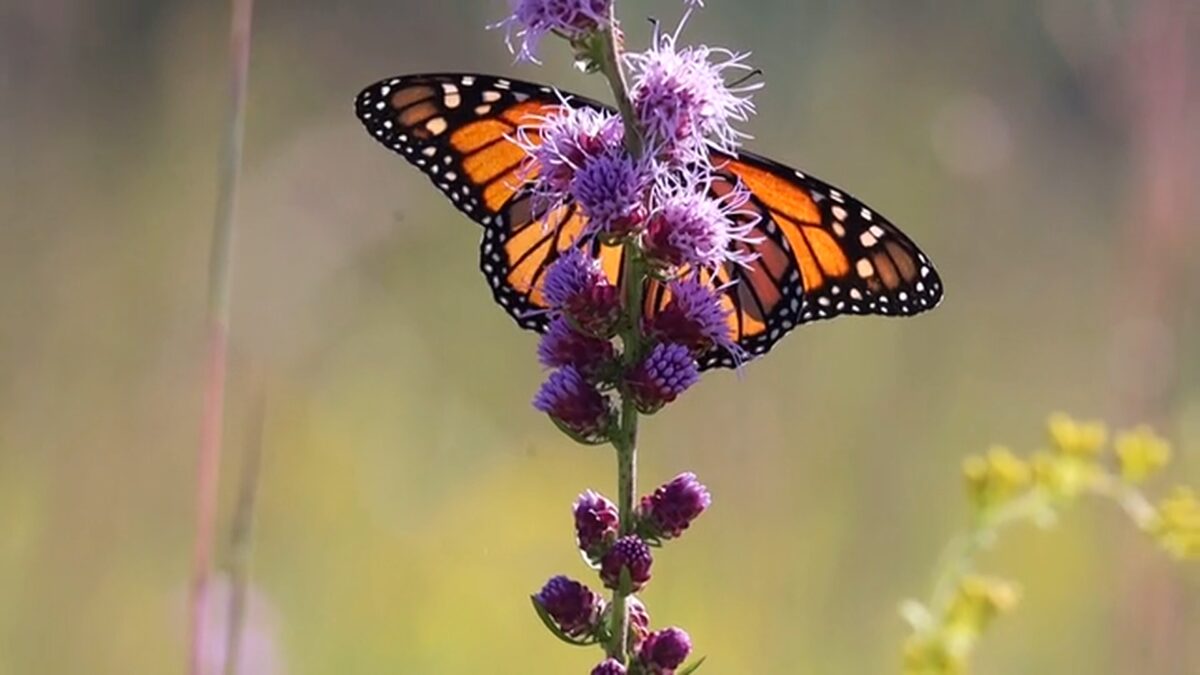
TREMPEALEAU, Wisconsin (WXOW) — Monarch butterflies are making their way south for the winter, and visitors at Trempealeau National Wildlife Refuge are getting a hands-on role in helping researchers track that migration.
The refuge is hosting its third year of the Monarch Journey Program, which allows visitors to catch monarch butterflies in the field before bringing them back to refuge staff to be measured, tagged and released.
“We are experiencing the monarch migration. The monarch is the only known butterfly that makes a round-trip or migration round-trip, for example, like the ducks,” Trempealeau National Wildlife Refuge Visitor Services Ranger Dana Schelling said. “They will travel all the way south to Mexico to be there and spend the winter.”
According to the U.S. Forest Service, some monarchs travel as far as 3,000 miles during that journey. Eastern North American monarchs spend the winter in the Sierra Madre Mountains of Mexico.
Before participants head into a field at the refuge, staff give them an informal lesson on the butterflies and the tagging process.
That includes how to distinguish between male and female monarchs, where to look for them and how to safely catch them.
“If the butterfly is perching on a flower, they need to sneak from the back and place their net on top of the butterfly,” Schelling said. “Then, as they are placing that net on top of the butterfly, that is on a flower, they need to slowly remove it from the butterfly, from the plant and then eventually put it inside a cage.”
For Galesville resident Lance Remus, the tagging program was an unexpected addition to a day at the refuge with his children.
“They have off school today, so I brought them out just to see the birds and the refuge stuff, and take a little walk on the trail,” Remus said. “And when we did, we met the rangers and they told us that they had the monarch catching program today. So the kids wanted to do it and it was fun for them.”
Remus said it took a little practice to figure out the best way to catch the butterflies.
“It took a little bit,” Remus said. “You had to figure out the technique of how to catch them and not have them fly away. But, it wasn’t too hard. You just have to handle very delicately, obviously.”
Participants can catch as many monarchs as they would like before bringing the butterflies back to the refuge contact station for tagging.
There, refuge staff carefully remove each butterfly from its cage and handle it by the wings before placing a small tag on the rear wing.
“They are actually very strong little creatures,” Schelling said. “And we try to be delicate and handle them with our hands without harming them.”
Rangers also measure each monarch’s wings before releasing it.
“It’s going to help us also to know the difference in size, because we actually, when we tag them, we measure their wings,” Schelling said. “It’s also going to let us know the difference in the generations because they go through metamorphosis. And every time we go through that process, we know that it’s a different generation.”
The tags can also help researchers track migration routes, longevity and survival rates if the butterflies are later recovered.
The U.S. Fish and Wildlife Service says monarchs making the fall trip are part of what is often called the “super generation.”
Unlike earlier summer generations that complete their life cycle in about four weeks, the fall generation can live for up to eight months and delays reproduction until spring.
The agency says decreasing daylight and temperatures, along with changes in milkweed and nectar sources, help trigger the fall migration.
Monarchs use air currents and thermals to travel long distances, while researchers continue to study the combination of directional cues they use along the way.
The refuge has seen strong participation in this year’s Monarch Journey Program.
“We have had an outstanding response from the community,” Schelling said. “We have had over 150 visitors and we also have tagged more than 200 butterflies, maybe 250.”
At least 50 more monarchs were tagged during Friday’s program.
Schelling said the program is also meant to connect people with the refuge and give them a role in the research.
“It’s a way to get people outdoors and experience the refuge and help us too with this effort of citizen science,” Schelling said.
The remaining scheduled sessions are Thursday, Sept. 3, Friday, Sept. 4, and Saturday, Sept. 5, from 9 a.m. to noon at Trempealeau National Wildlife Refuge.
Nets, butterfly identification guides and butterfly cages are provided. Groups of more than six people are asked to call ahead so accommodations can be made.
The Monarch Journey Program is weather permitting and will continue while tagging supplies remain available.
Please note: This story was provided to CNN Wire by an affiliate and does not contain original CNN reporting. This content carries a strict local market embargo. If you share the same market as the contributor of this article, you may not use it on any platform.