July marked the hottest month on record for the lower 48. How did Palm Springs compare?

PALM SPRINGS, Calif. (KESQ) – The summer heat is on, and it’s not just in the desert. Across the nation, this summer has broken records.
According to the National Oceanic and Atmospheric Administration, or NOAA, July marked the warmest month for the contiguous United States since records began in 1895. Temperatures averaged 76.9°F nationwide.
NOAA wrote that figure lies 3.3°F warmer than the 20th-century average. It also marked the warmest July (and warmest month overall) by 0.1-0.2°F, beating out July 1936 and July 2012.
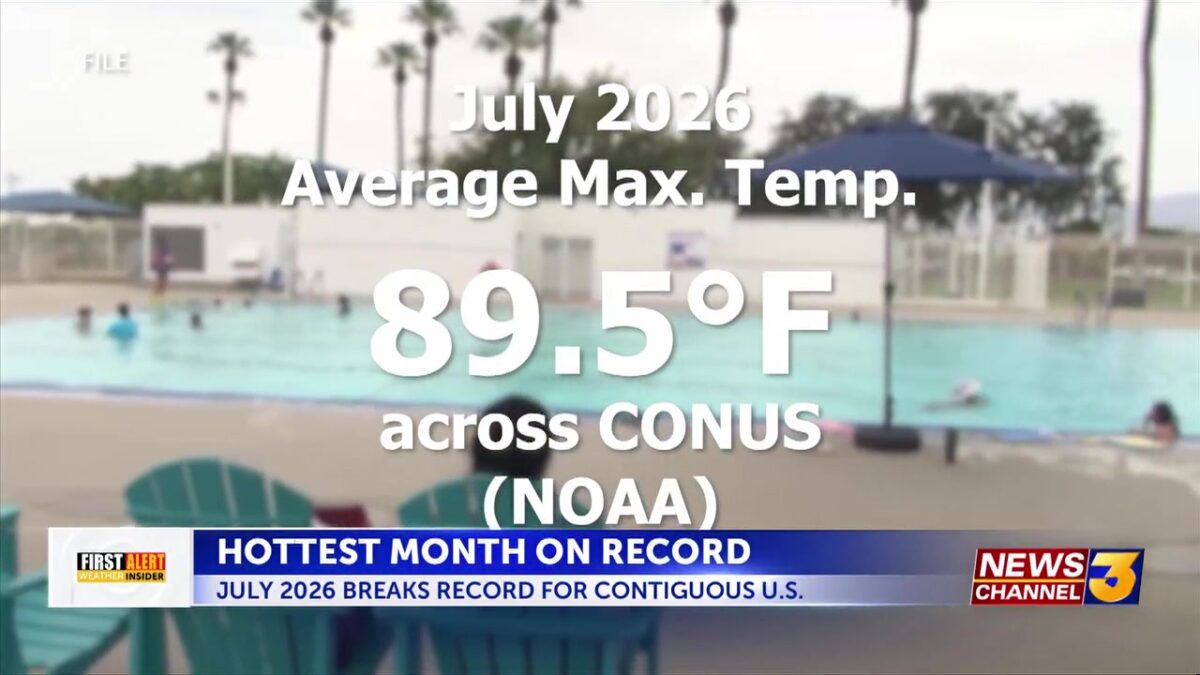
Nationwide, daily maximum temperatures rose to 89.5°F, which was nearly three degrees above average. It ranked as the sixth-hottest month.
Overnight minimum temperatures hit 64.2°F and broke records by a larger margin: 0.7°F.
While the national average skyrocketed this July, the numbers in the desert showed a different story. The average high temperature in Palm Springs was 109.5°F this July. The average usually sits at 108.6°F. Still, this is shy of years past, like 2024, when Palm Springs had an average daily high temperature of 114.9°F.
“It’s, like, becoming unsustainable to an extent,” said Ashley Madera, a Cathedral City resident headed to the gym in Palm Springs. “I’d say, like, to the point where it’s just not as enjoyable going outside sometimes.”
Though still above average, Palm Springs didn’t break any records last month. Extra monsoonal moisture helped limit the air temperature for our region.
 Average temperature, highs, and lows between Palm Springs and the contiguous U.S. in July 2026, according to data from NOAA.
For Palm Springs Unified School District, it led to some uncomfortable conditions for the first week of school, with humidity that made things feel worse than years past.
With heat and humidity being two of the main factors allowing students to be outside and participate in sports, we’re checking in with the district on its Perry Weather Monitoring Systems, one year after they were installed.
We asked district leaders what changed between now and then. They said it was making a positive impact.
“The Perry Weather System has all of our policies and protocols built into it. So when the wet bulb temperature or the the wind or the air quality begins to deteriorate, the sites can get an alert directly to their phone,” said Laura Dyson, the Director of Health Services for Palm Springs Unified. “So it really gives [faculty] that up-to-date, to-the-minute information on how to react and what to do.”
The data is localized to specific sites throughout the district’s 500 square miles of coverage. That allows school administrators to make decisions based on the site closest to them, rather than a single, broad decision that may be inaccurate from one end of the valley to the other.
District leaders added giving the students and their families access to the data helps create more transparency.
“Everything is just out there in the open. If you want to know what you know, what your child is going to be doing outside during the day. This is all available on the district website and that feedback’s been really good,” said Dyson.
To check real-time weather data from Palm Springs Unified, click here.
Desert Sands Unified School District also uses the Perry Weather System. Its real-time data is available here.
We’re breaking down the technology and the numbers behind the country’s hottest month on record. Stay with us for our full report tonight on News Channel 3.
Click here to follow the original article.