CDOT explains challenges of repairing highway bumps & dips

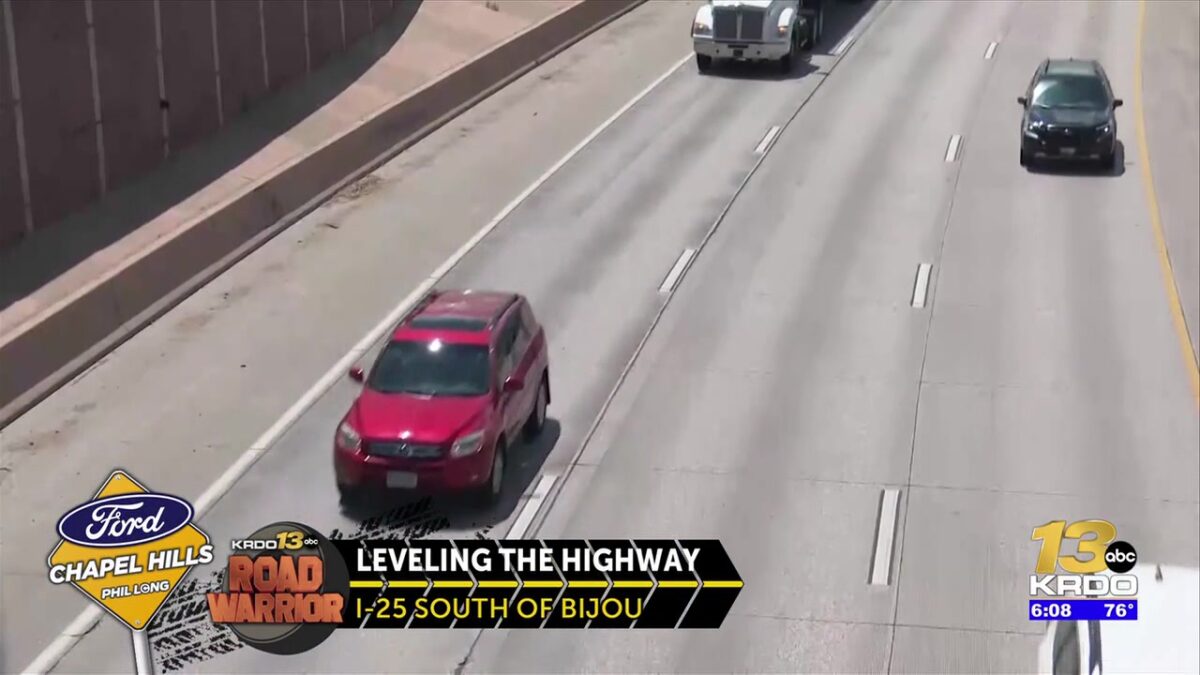
COLORADO SPRINGS, Colo. (KRDO) — The Road Warrior showed us how the Colorado Department of Transportation (CDOT) repaired a pesky bump last week on southbound Interstate 25, under the pedestrian bridge near downtown.

But dips — areas of low pavement — are a concern, as well.
A series of dips had long existed in both directions of I-25 between Bijou Street and the Colorado Avenue bridge; those dips, combined with a bend in the highway, made drivers feel as if they were driving on waves.

CDOT recently explained its repair strategy during three overnight work sessions to correct the problem.
“It’s really unknown what caused those dips to develop,” said Eric Meyers, a CDOT maintenance supervisor. “But the result was sunken concrete panels.

He said that the dips in the lanes and shoulders created more than a maintenance issue and required an engineering solution — with a process known as foam jacking.
“We hired a contractor and provided traffic control for them,” Meyers said.

In foam jacking, small holes are drilled into the panels, and a polyurethane foam is injected; the foam cures in less than 30 minutes and can bear the weight of traffic almost immediately.
Foam jacking offers advantages over traditional mud jacking in that the drilling holes are smaller and the foam is waterproof and erosion-resistant.

Meyers said that another engineering solution will eventually be needed on the bump mentioned above, as a CDOT crew made temporary repairs there.
“They saw-cut that area,” he said. “They jackhammered all that concrete out, removed all the concrete, and then, through lifts, put hot mix asphalt back in it, to the current pavement level.”

Myers said that any kind of concrete work on a busy highway such as I-25 is a major challenge.
“When you talk about concrete pavement, it’s on an interstate corridor; it’s extremely thick,” he explained. “And it takes a long time when you have to remove that and then put a product back in there to get it back up to where traffic can flow on it within the constraints of the closure.”
Myers said that the best solution for potholes and bumps on concrete pavement is to remove the damaged panels and replace them.
Click here to follow the original article.