DIY air purifiers offer affordable relief amid Central Oregon smoke from ongoing wildfires

(Update: adding EPA instructions)
BEND, Ore. (KTVZ) — As wildfire smoke continues to affect Central Oregon, many commercial air purifiers have sold out at stores around the region. But the Environmental Protection Agency says a do-it-yourself box-fan air cleaner can offer a more affordable, attainable way to reduce smoke particles indoors.
The Oregon Department of Environmental Quality has extended an air quality advisory for Crook, Deschutes, and Jefferson counties through at least Friday afternoon due to smoke from multiple wildfires. Conditions can change quickly depending on fire activity and wind direction.
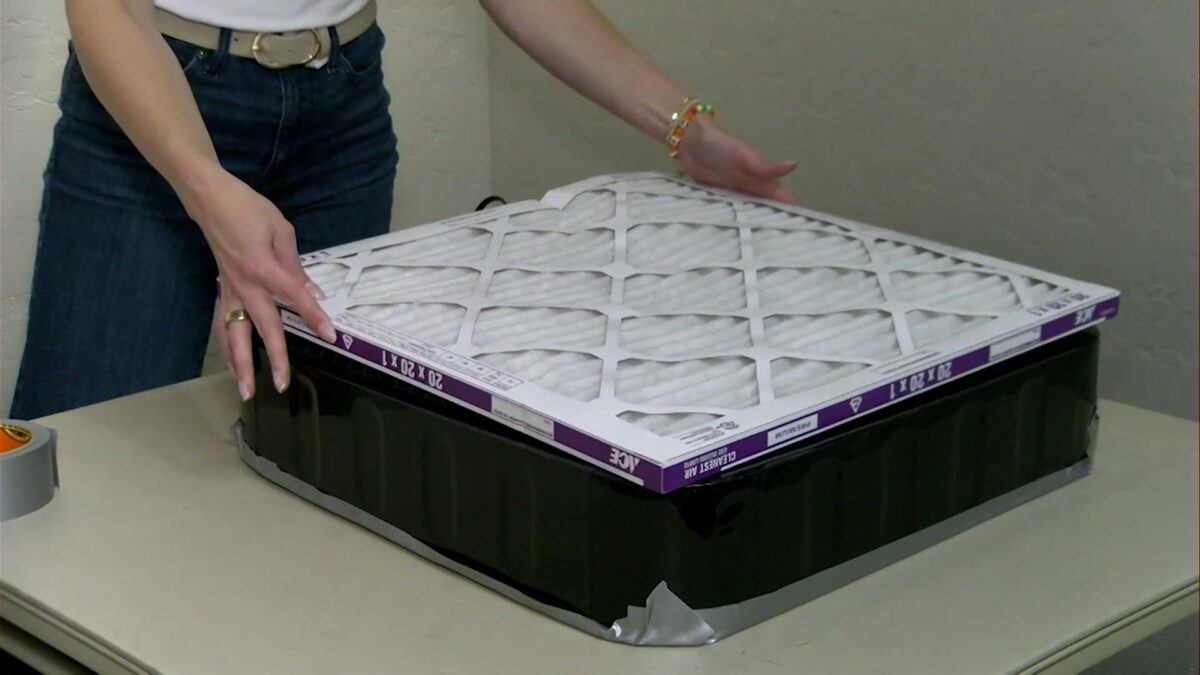
To build a basic air cleaner, the EPA recommends using a 20-by-20-inch box fan made in 2012 or later, a matching MERV 13 air filter, cardboard, and duct tape. The fan should also have a UL or ETL safety marking.
MERV stands for Minimum Efficiency Reporting Value and measures how effectively a filter captures airborne particles. The EPA recommends a MERV 13 filter because it can capture the very small particles found in wildfire smoke. A one-inch-thick filter can work, although the agency found that thicker filters are more effective.
The filter should be attached to the back of the fan, with the airflow arrow pointing toward the fan. A cardboard shroud with an opening roughly the size of the fan blades can then be taped to the front.
EPA laboratory testing found that adding the cardboard shroud increased the cleaner’s clean-air delivery rate by 40%.
The EPA recommends keeping both sides of the cleaner free of obstructions and plugging the fan directly into an outlet instead of using an extension cord. During smoky conditions, check the filter daily and replace it when it turns dark gray or brown or begins to smell like smoke.
One unit may help create a cleaner-air room where household members spend most of their time. However, a DIY cleaner does not eliminate every wildfire hazard and is not a substitute for following evacuation orders.
More construction and safety information is available through the EPA’s DIY air-cleaner guide.
Click here to follow the original article.