Federal government files motion to take land at Mount Cristo Rey for border security

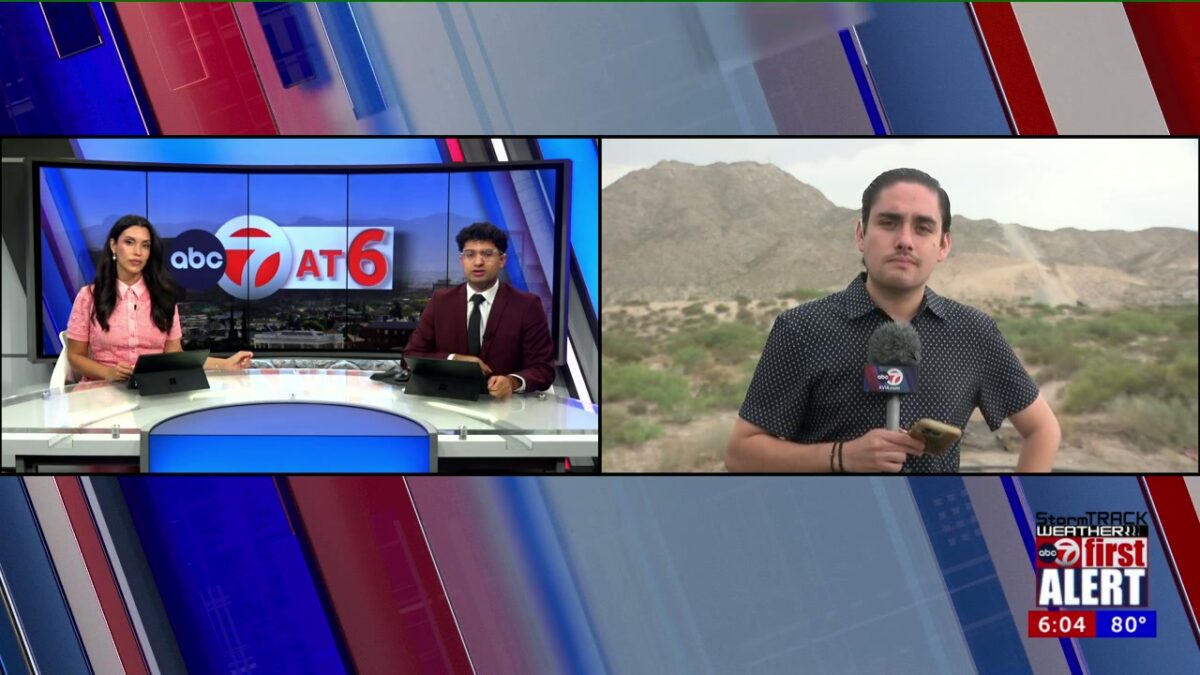
UPDATE (3:54 p.m.):
The U.S. government filed a motion for judgment on the pleadings to finalize the condemnation of 14.259 acres of land in Doña Ana County, New Mexico. Owned by the Catholic Diocese of Las Cruces, the property is intended to help Customs and Border Protection secure the U.S.-Mexico border.
Although the Diocese raised religious and monetary objections, the government maintains they are legally insufficient to halt the seizure.
Federal law generally recognizes only one valid objection to a condemnation proceeding: that the United States’ land acquisition was not for a congressionally authorized public use.
The United States requested that the Court enter judgment on the pleadings as to the lawfulness of this condemnation. — United States of America
SUNLAND PARK, New Mexico (KVIA) — Congresswoman Veronica Escobar (TX-16) introduced the Mount Cristo Rey Protection Act, legislation designed to prohibit the federal government from using eminent domain at Mount Cristo Rey. This action follows the Trump administration’s announcement of its intent to seize land at the sacred site for border wall construction.
The Trump administration announced plans to seize approximately 14 acres of land near the base of Mount Cristo Rey to extend the southern border wall. Mount Cristo Rey is a significant religious and cultural landmark owned by the Roman Catholic Diocese of Las Cruces, serving the El Paso and Southern New Mexico area since 1939. The site welcomes more than 40,000 pilgrims and visitors annually for Good Friday and other religious observances.
Congresswoman Escobar emphasized the site’s importance:
“Mount Cristo Rey is a religious and cultural landmark that has been central to our community for generations,” said Congresswoman Escobar. “Rather than working with border communities to advance effective border security, the Trump Administration continues to disregard the people, history, and culture that make our region special. I will continue to fight for its preservation.”
El Paso Bishop Mark J. Seitz highlighted the unique position of Mount Cristo Rey:
“For almost 100 years Mount Cristo Rey has been an iconic sacred site in our borderland region,” said El Paso Bishop Mark J. Seitz. “The mountain, with its 29-foot statue of Christ, is visible for many miles and stands at the border of two countries and three states. It has become for people in our region a holy site marking the unity of humanity and of faith that transcends borders. For the federal government to forcefully take this holy ground to build a tall barrier topped with razor wire would represent an overreach on the part of the government and create a sign that speaks, not of mutual respect and love, but of separation and rejection. As the Bishop of El Paso I support this Bill which would call the federal government to set aside a heavy-handed abuse of power against this sacred place. I am confident that through negotiation with the rightful owners of the property, the Church of Las Cruces, solutions can be found to provide for the deterrence of unauthorized entry into this country while at the same time preserving the integrity of Mount Cristo Rey.”
Las Cruces Bishop Peter Baldacchino also spoke about the site’s historical significance:
“For generations, the faithful from the cities, farms and villages of the borderland have climbed Mount Cristo Rey and united as a single community for prayer and celebration at the feet of Christ the King,” said Las Cruces Bishop Peter Baldacchino. “In a world fractured by political, racial and economic divisions, Mount Cristo Rey stands out as both a powerful symbol of hope and peace and a literal pathway to unity. We are grateful for the actions of Rep. Escobar and other legislators in helping to preserve this important site for generations to come.”
The Mount Cristo Rey Protection Act aims to officially recognize Mount Cristo Rey as a holy site. It further seeks to prohibit the use of federal funds to litigate against the Roman Catholic Diocese of Las Cruces in its lawsuit challenging the federal government’s attempted land seizure.
Additionally, the act would prohibit the use of federal funds to construct, install, operate or maintain border barrier infrastructure on or near Mount Cristo Rey.
This legislation builds on Congresswoman Escobar’s previous efforts to protect the site. During consideration of the Fiscal Year 2027 Homeland Security Appropriations bill by the House Appropriations Committee, Rep. Escobar offered an amendment to prohibit the use of federal funds for border wall construction at Mount Cristo Rey. This amendment was rejected by House Republicans.
The Mount Cristo Rey Protection Act is now in the legislative process, aiming to provide protections for the sacred site.
ABC-7 reached out to the Department of Homeland Security and Customs and Border Protection for comment.
A CBP spokesperson sent us the following written statement:
“CBP’s priority is to implement President Trump’s Executive Order 14165, “Securing our Borders” and Proclamation 10142, “Declaring a National Emergency at the Southern Border of the United States.” Congress mandated that DHS achieve and maintain operational control of the border and directed the Secretary to construct barriers and roads and authorized the Secretary of Homeland Security to waive all legal requirements determined necessary to ensure the expeditious construction of barriers and roads.”
“CBP is utilizing the $46.5 billion from the One Big Beautiful Bill Act to construct a Smart Wall, which includes a steel bollard wall, along with roads, detection technology, cameras, lighting and in some cases waterborne barrier or a secondary wall – creating a double layer barrier. These elements are integrated into the awarded border barrier contracts.”
“The locations of Smart Wall and technology are determined by the U.S. Border Patrol’s requirements, which vary according to operational conditions and geographic terrain at each location. CBP is committed to ongoing coordination with local landowners, stakeholders, and governments throughout planning and construction activities.”
“Smart wall construction in this area is located within 250 feet of the international boundary, well south of the Mount Cristo Rey cross and access road. The cross is located a quarter mile or 1,300 to 1,400 feet north of the border. Access to the shrine will not be affected, as all attendees enter from the U.S. side. Smart Wall construction will enhance safety for those using the grounds.”
A DHS spokesperson also sent us this written statement:
“Anyone who spent thirty seconds examining a map of Mount Cristo Rey and the southern border would realize how ludicrous these claims are.
Smart wall construction in this area is located within 250 feet of the southern border, well south of the Mount Cristo Rey cross and access road. The cross is located approximately A QUARTER MILE, 1,300 to 1,400 feet, north of the border ON TOP OF THE MOUNTAIN. Access to the shrine will not be affected, as all attendees enter from the U.S. side. The only individuals who could POSSIBLY be impacted by the border wall are illegal aliens attempting to illegally enter our country.”
Click here to follow the original article.