Louisville community leaders address police response to mental health crises

By Alexis Mathews
Click here for updates on this story
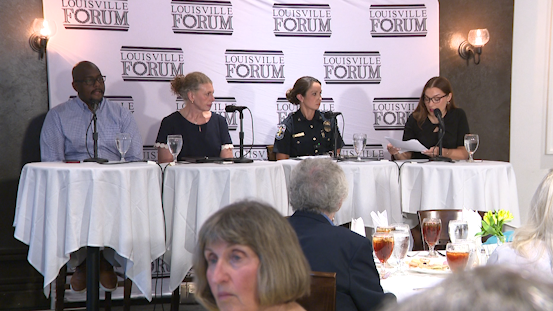
LOUISVILLE, Ky. (WLKY) — The police shootings of Katelyn Hall and Martin Nitzken prompted a community conversation Wednesday about how law enforcement handles individuals in mental health crises.
“We are a couple of months removed from two of our neighbors who are no longer here, whose families called because they were in crisis, and we sent officers because we decided that that was the best response possible, and it’s simply not the case,” said Lyndon Pryor, president of the Louisville Urban League.
Panelists at the event, representing civil rights, health care, and public safety, discussed the complexities of the issue.
“Policing alone is not our community’s mental health system, nor should it be, nor do we want it to be, and it’s our responsibility as police officers to stabilize an incident, to stabilize a situation, protect everybody involved, and get people the help that they need,” said LMPD Deputy Chief Emily McKinley.
A revamp of Louisville’s crisis call diversion program was suggested as a way to improve responses.
The current method allows only officers to respond if there is a weapon or threat of violence. Proposed changes included sending trained intervention counselors to crisis situations alongside police.
“Keep them safe from themselves, as well as to keep other people around safe from harm, there are a lot of ways to do that in these situations that don’t involve people with guns,” Pryor said.
This discussion marked one of the first times Seven Counties Services, which facilitates the metro’s deflection program, publicly weighed in on the co-response approach. Louisville’s mayor has also expressed support for this solution.
“We’ve recently been trying to rally a deflection team about a block away, so if they get there and they determine this is safe to bring another civilian into the setting, we’ll bring them in much sooner in the process,” said Elizabeth McKune, COO of Seven Counites Services.
Other recommended approaches to addressing behavioral health emergencies discussed at the forum included policy changes, a call for more mental health care professionals, increased funding, and continued community partnerships.
“You have people, not just in the police department, who are willing to say, ‘hey this didn’t work and we need to do better,'” said McKinley. “That push for constant improvement is something that gives me hope.”
Please note: This story was provided to CNN Wire by an affiliate and does not contain original CNN reporting. This content carries a strict local market embargo. If you share the same market as the contributor of this article, you may not use it on any platform.