Poet Katharine Lee Bates’ travels west to Pikes Peak inspired “America the Beautiful”

Heather Skold
COLORADO SPRINGS, Colo. (KRDO) — The song, “America the Beautiful,” is woven into the fabric of our very patriotism in the United States: its imagery, its faith, its call for oneness.
Written in 1893 by the poet and English professor Katharine Lee Bates, it expresses gratitude while also being aspirational.
Katharine Lee Bates, Courtesy of Regional History & Genealogy, Pikes Peak Library District, 102-354
Bates was born shortly before the Civil War started, and thus, many of her writings focused on social reform.
A professor at Wellesley College in Massachusetts, Bates decided to venture west to teach for the summer at Colorado College.
“This was a business trip, where she spent several weeks in Colorado Springs,” said Matt Mayberry, Director of the Colorado Springs Pioneers Museum, outside which Bates’ iron statue sits, facing Pikes Peak. “She thinks as a poet, and she processes her reality as a poet. Her travels west inspired her and became part of the poem.”
Bates had never been west of Philadelphia at that point in her life, but her travels by train created inspiration: patriotism on display at the World’s Fair in Chicago, the prairies of Kansas, and the “sublimity of the Rockies.”
“It was with this quickened and deepened sense of America that we went on, my New England eyes delighting in the wind-waved gold of the vast wheat fields,” she wrote, in an article published in a 1928 edition of the Gazette and Telegraph.
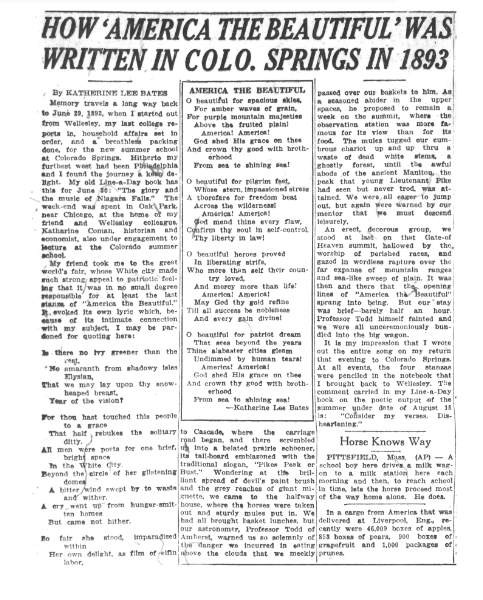 Colorado Springs Gazette and Telegraph, Dec. 30, 1928
She and her colleagues were shown Manitou Springs, Cascade, and Garden of the Gods — “all so marvelous that our stock of exclamations ran out.”
One day, she and her teacher friends ventured up Pikes Peak, via “prairie schooner,” pulled by horses that were traded out with mules halfway.
Once at the top, they were advised against jumping out of the wagon, but instead “descend leisurely” due to the altitude, a warning that befell their guide, who himself fainted at the summit and curtailed their visit to 30 minutes.
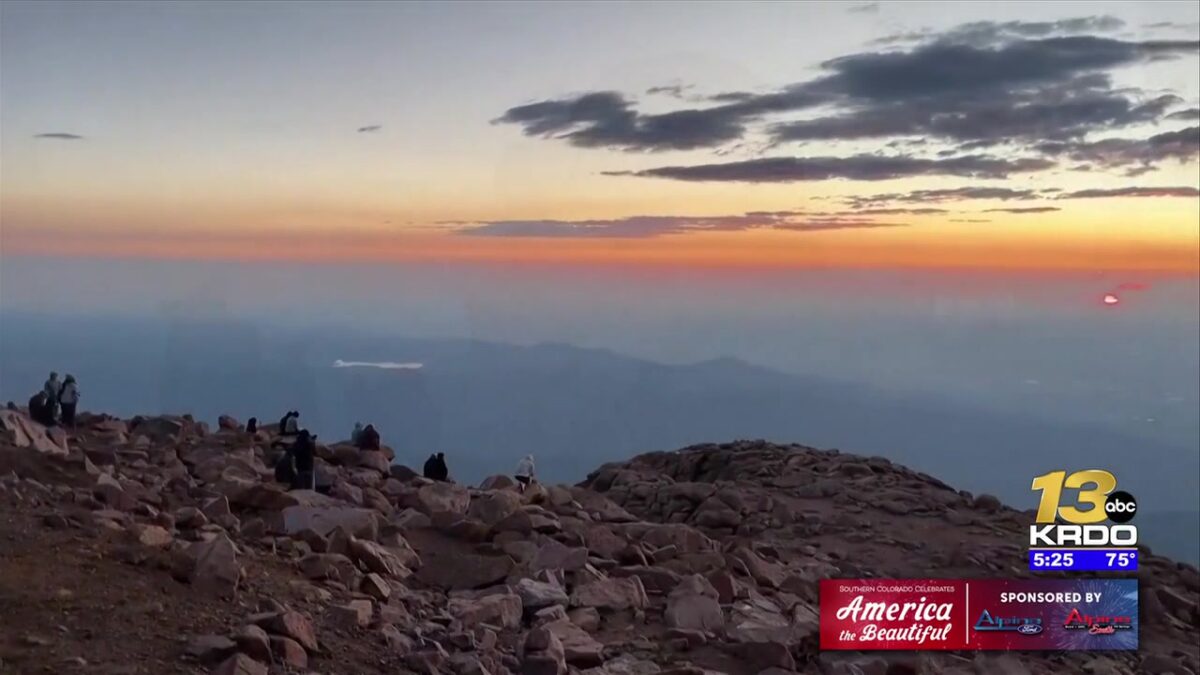
The brief view at 14,115 feet was enough to bring a sense of awe to Bates, who wrote of its “purple mountain majesties above the fruited plain.”
That night, upon returning to the Antlers Hotel, Bates wrote the first lines of her poem. She made several revisions to her poem before its final version as we know it today.
 Antlers Hotel, Courtesy of Regional History & Genealogy, Pikes Peak Library District, 102-354
“It is not stuck in time, and can be meaningful to us today,” said Mayberry.
Her words were set to the hymn, Materna, which was composed Samuel Ward.
Here is a 1923 recording of “America the Beautiful.” Public Domain.
