Columbia Police Department educates public ahead of July 1 start of median restrictions

Erika McGuire
COLUMBIA, Mo. (KMIZ)
Public education efforts are underway by the Columbia Police Department as the city’s new median ordinance is set to take effect July 1.
CPD Lt. Clint Sinclair, who is overseeing the implementation, said education efforts began the first week of April, providing a three-month window before the law takes effect.
“I think we’re somewhere between 60 and 70 officers on patrol,” Sinclair said. “We pushed our directive saying, ‘Hey, if you’re on patrol and you see conduct that will violate the ordinance when it goes into effect, go ahead and stop and have a conversation with them,’ and then we also have some of our specialty assignments that work with community partners,”
Officers have been provided with a flyer they can distribute, and resource providers are also using the materials as part of the public education effort.
 A flyer used to educate the public on the city’s new median ordinance created by the City of Columbia.
The city has also created a webpage outlining the ordinance’s criteria and identifying the areas where it applies, along with sharing videos on CPD’s social media pages.
“We’ve been working on reducing pedestrian fatalities for a long time, and this is another step in that direction,” Sinclair said.
When enforcement begins on July 1, Sinclair said officers will focus on warnings and education before issuing citations for repeat violations.
“We’re always looking for voluntary compliance first, and I would anticipate, as with most things, we try to get people warnings, and it’s the repeated behavior, the repeated conduct that then we’re looking at maybe a citation,” Sinclair said. “Part of the early campaign now is to maybe give those warnings now and give time for people to prepare for the ordinance to come into effect,”
Sinclair said the ordinance is not based on what a person is doing while standing on a median, but rather on their location. City leaders have been adamant about that aspect of the law so that it withstands First Amendment scrutiny.
“It doesn’t talk about panhandling or protesting or demonstrating. It’s just strictly where you are in the roadway, and it doesn’t matter what you’re doing in a median,” Sinclair said. “If you’re asking for money, if you’re protesting something, if you’re fundraising, none of that matters.”
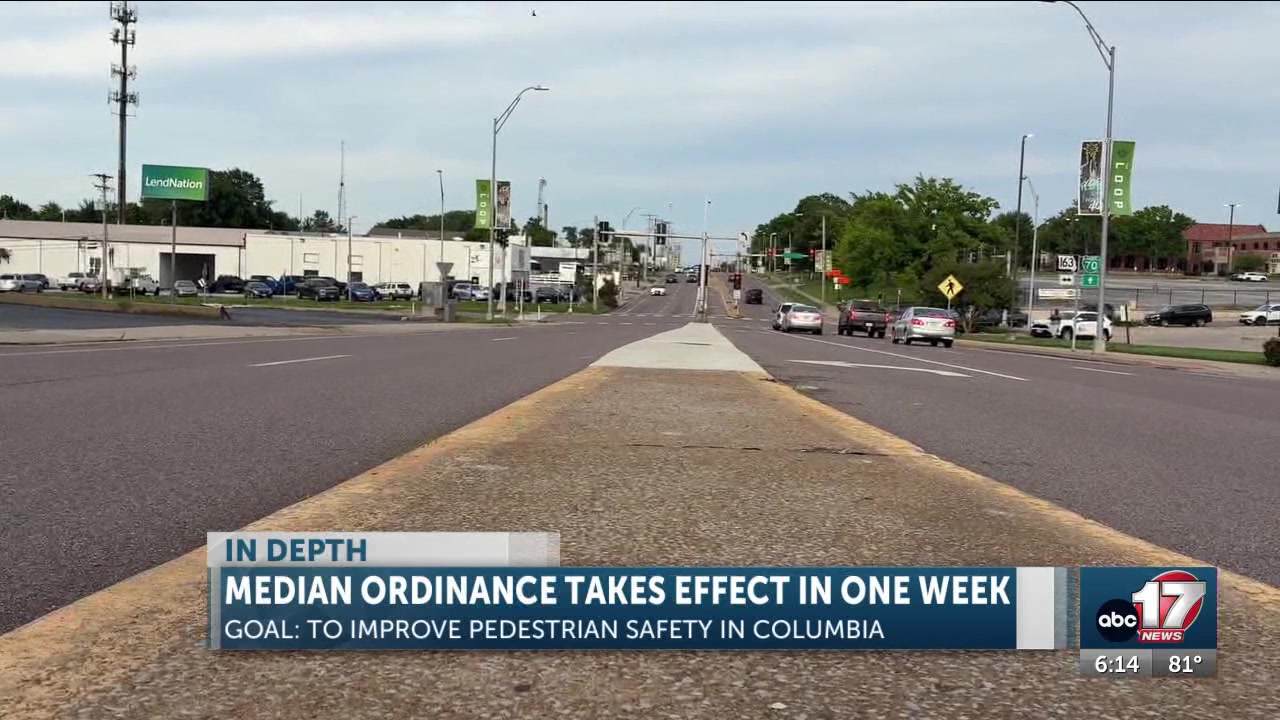
According to the city’s website, remaining on a narrow median after two light cycles will be considered a violation. Officers will address violators and ask for voluntary compliance before writing a ticket.
Sinclair said officers will not put handcuffs on people or take them into custody just for violating the ordinance.
High-priority areas
The 47 identified crash areas where data shows the highest risk of pedestrian-vehicle crashes are where officers will prioritize enforcement, according to the city.
Some of those areas include:
College Avenue and University Avenue
College Avenue and Rollins Avenue
Stadium Boulevard and Monk Drive/Champions Drive
Business Loop 70 and Providence Road.
“We anticipate this being a complaint-driven or work-driven ordinance, meaning that people will be calling in non-emergency or reporting violations,” Sinclair said.
Those who violate the ordinance can face a fine up to $500, but Sinclair says no one would face jail time for a violation.
ABC 17 News rode along in Sinclair’s patrol vehicle to observe the city’s education efforts. During the ride-along, Sinclair contacted two people on medians that would be off-limits under the ordinance. Both said they were already aware of the ordinance and its requirements.
Zachary Gramke, who said he relies on medians to get by day-to-day, said he learned about the ordinance through word of mouth. While standing on a median on College Avenue, which would be in violation of the ordinance, he questioned the policy, saying it limits access to public space.
“It’s a public space, it would be against my rights to remove me unless I’m breaking the law,” Gramke said. “It definitely puts me in touch with people I wouldn’t be able to get in touch with anyway,”
Gramke said he makes anywhere from nothing to $40 a day on medians and will need to find a new location once the ordinance takes effect.
“I may find a different place, but I guess it comes down to how hungry I am. I have 95 cents in my pocket, and my next meal is not promised. I guess I would do whatever I have to do to eat,” Gramke said.
Gramke believes the city should be focused on bigger issues rather than a median ordinance.
‘I think we’ll have to keep them busy with something else. We should be worried about bigger things like downtown shootings and things like that,” Gramke added.
The Columbia City Council passed the ordinance Feb. 2 on a 5-2 vote. Ward 1 Councilwoman Valerie Carroll and Ward 2 Councilwoman Vera Elwood voted against the measure, while Mayor Barbara Buffaloe was among those who voted in favor.
The ordinance regulates road crossing and traffic islands for both motorists and pedestrians at intersections with speed limits of 35 mph or higher, average daily traffic volumes of at least 15,000 vehicles, or medians narrower than 6 feet.
 A City of Columbia map pinpoints medians greater than 6 feet wide and marks roads with higher speeds and traffic volumes.
Several intersections in the city are affected, with the five busiest intersections being:
Providence Road and Stadium Boulevard
Providence Road and Broadway
Broadway and Stadium Boulevard
Broadway and College Avenue
Broadway and Old Highway 63
Drivers can no longer hand items to pedestrians from their vehicles. The ordinance also prohibits drivers from stopping in travel lanes in a way that creates a traffic hazard or allowing occupants to exit a vehicle in a travel lane or major corridor intersection, except during an emergency.
Motivated by safety
The city first proposed the ordinance after hiring George L. Crawford & Associates to conduct a street and intersection safety study.
According to the study, between 2019 and 2023, Boone County experienced 3.1% of the state’s pedestrian fatal crashes. During the same period, 20.4% of deadly crashes in the county involved pedestrians, which is above both the national average of 18.7% and the state average of 11.9%.
In Columbia, between 2019 and 2023, the study found the city experienced 2.6% of all pedestrian deaths within Missouri, representing 76% of Boone County pedestrian deaths. It also found that 32% of deadly crashes in Columbia were pedestrian-related, well above both state and national rates.
Local Motion, a Columbia-based group that advocates for transportation equity, said it was initially against the ordinance and was not in favor of its naming.
The group said it is encouraged by the city’s focus on pedestrian safety but believes the ordinance does not address some of the community’s biggest transportation needs, and there were better approaches to improving pedestrian safety rather than regulating pedestrian behavior.
“In our opinion, the ordinance didn’t include some of the things that we felt like were the biggest priorities for improving that like, Complete Streets policy update, which is happening now,” Local Motion CEO Mike Burden said. “Improving and investing more in sidewalks and sidewalk infrastructure, having leading pedestrian intervals that really prioritize pedestrians getting through intersections, having larger refugee island so that folks who need more time crossing a major intersection have an adequate space.”