Rattlesnake Aversion Training for dogs returns to Central Oregon for another successful season

Claire Elmer
BEND, Ore. (KTVZ) — Dogs and their owners gathered on the outskirts of Bend this week for an annual training aimed at helping dogs avoid rattlesnakes before they encounter one in real life.
For 15 years, Bend Veterinary Clinic has helped bring Natural Solutions Wildlife Enterprises to Central Oregon for rattlesnake aversion training, giving dogs a controlled introduction to live rattlesnakes in a safe environment.
Dr. Byron Maas, a veterinarian with Bend Veterinary Clinic, said the training is especially important as more people and dogs spend time outdoors in areas where rattlesnakes are present.
“We’re seeing people go to the Ochocos, where we’re definitely seeing a lot more rattlesnakes, down in Smith Rock and the Deschutes River Basin,” Dr. Maas said. “And now we’re starting to see, because of the weather, the snakes are actually moving up the river beds, up the Deschutes River, and actually getting into places like Tumalo and higher elevations.”
The goal of the training is to teach dogs to recognize the sight, smell, and sound of a rattlesnake — and stay away.
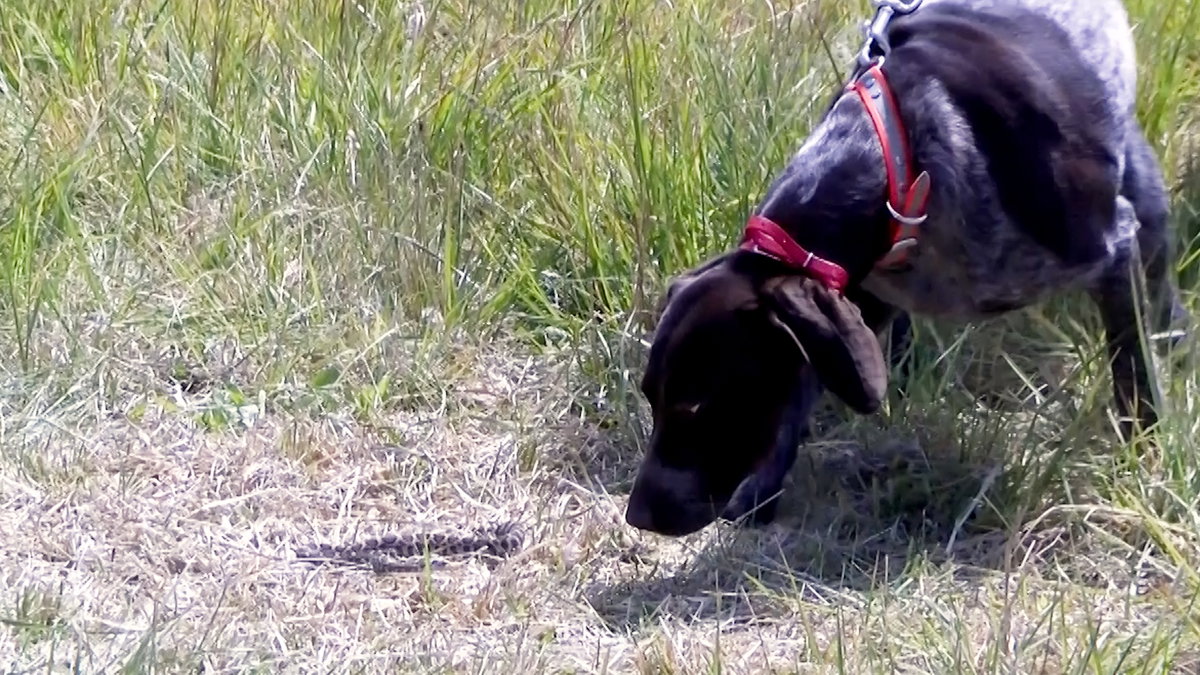
During the training, dogs are taken with their owners and a trainer into a field where there are live, muzzled rattlesnakes.
Erick Briggs, owner of Natural Solutions Wildlife Enterprises, said the training gives dogs the chance to learn about rattlesnakes in a controlled setting.
“What we’re doing today is giving dogs opportunities in a safe environment to learn what rattlesnakes are, the different sensory aspects of smell, the sound, visual — obviously both big and small, pairing that with a slightly uncomfortable feeling so that they believe that the snakes were mean to them, bit them,” Briggs said.
Briggs said the snakes are humanely muzzled so they cannot bite the dogs, and the process does not harm the snakes. Trainers use a remote collar at a low level to create an association for the dog: snake equals danger.
The dogs are then exposed to different aspects of a rattlesnake encounter, including odor, the sound of a rattle, and different-sized snakes. Briggs said that helps prepare dogs to recognize a rattlesnake even if it is hidden in a rock pile, tall grass, or other brush.
“We want them to understand that that noise will always be dangerous,” Briggs said. “It basically creates that reflex that we all developed over our childhood — not to touch those hot items or not to grab that cactus.”
Briggs said most dogs catch on quickly, and by the end of the training, many choose to avoid the snake and return to their owners rather than investigate.
The training is not only for working dogs. Briggs said most of the dogs that go through the program are family pets that hike, camp, or live in areas where rattlesnakes may be present. The company also trains search-and-rescue dogs and other working animals.
Hank Minor and his wife traveled hours from Princeton, Oregon, with their two dogs: Rory, a 4-year-old German Shorthair Pointer, and Lulu, a 10-year-old Golden Retriever.
“This is actually my second time with one of our dogs, and the first time with the other dog,” Minor said.
Minor said Rory, who works with him in the field, was back for a refresher. Lulu, he said, was a little more eager to make a new friend.
“Rory was a repeat and needed a refresher. Caught on pretty quickly, but needed a refresher,” Minor said. “And the first-time golden retriever wanted to make friends with a snake and learned a valuable lesson — that’s not a good thing to do.”
The Minors live in Eastern Oregon, where rattlesnakes, like on the High Desert, are a reality. He is also a master falconer, and Rory goes into the field with him.
“These dogs, Rory the German Pointer, goes out in the field with me and needs to understand the difference between a rabbit and a snake,” Minor said. “It’s a functional thing for her.”
For dog owners in snake country, Minor said the training is part of being responsible.
“If you’re going to have a dog and if you’re going to be out in the field, it’s good to know what you’re getting into,” Minor said. “There are professional services like this one that are incredibly valuable to dog owners.”
Dr. Maas said Bend Veterinary Clinic has treated dogs bitten by rattlesnakes. He said bites commonly happen when dogs sniff too close and are bitten on the neck, or when they step too close and are bitten on the foot or leg.
Bites to the neck can be more serious because of the location, Dr. Maas said. Regardless of where a dog is bitten, he said owners should seek veterinary care right away.
“If you’re down in the Deschutes River Canyon, you’ve got two or three hours sometimes to be able to get to a veterinarian,” Dr. Maas said. “So avoiding the snakes is really important.”
Dr. Maas said some dogs that have gone through the aversion training have later encountered snakes and backed away, alerting their owners in the process.
“We’ve had several clients that have actually gone through the rattlesnake aversion training, and they’ve seen snakes and the dogs are aware of them,” Dr. Maas said. “They let the owners know and they back up. So the owners are protected, the dogs are protected.”
The training is offered locally once a year in partnership with Bend Veterinary Clinic. Dogs do not have to be patients at the clinic to sign up.
“We’ve actually had people come over from Portland, Tigard, Hillsboro,” Dr. Maas said. “They don’t have to be a patient at our clinic at all.”
Because the training is only offered once a year in Central Oregon — and is the only training of its kind throughout the state — Dr. Maas said the clinic keeps a waiting list and begins contacting interested dog owners when the next date is scheduled.
Briggs said annual training is not required, but refreshers can help dogs retain the information.
“For best results to maintain that information in the dog’s mind, to maintain that memory, two to three years in a row really does help,” Briggs said.
More information about Natural Solutions Wildlife Enterprises and future rattlesnake aversion training locations can be found here on the organization’s website.