FAMU doctoral student builds seawater battery that could revolutionize underwater exploration

By Justin White
Click here for updates on this story
COLLEGE TOWN, Florida (WTXL) — A FAMU doctoral student is developing a seawater-powered battery that could transform how military submarines operate underwater and underwater expeditions.
A Florida A&M University doctoral student is developing a battery powered by seawater that could dramatically extend the range and stealth of unmanned underwater military vehicles.
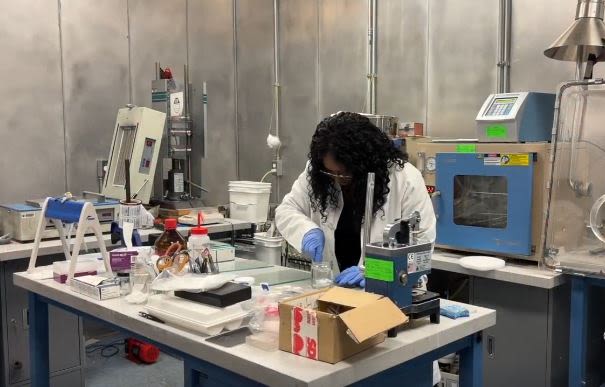
Destiny Law, an electrical engineering Ph.D. candidate at the FAMU-FSU College of Engineering, is building a lithium seawater flow battery designed for unmanned submarines and underwater vehicles.
Law said the technology could solve a critical vulnerability for military operations.
“For submarines, right now they have to come back to the surface to recharge, and they can sometimes have to stay for hours, sometimes even days to recharge, and that’s like very dangerous for our soldiers. So with our battery, they won’t. If they do have to come back up to recharge, it’s only for like a few, maybe max 30 minutes,” Law said.
By incorporating seawater into the battery’s chemistry, Law said the system could deliver more than 10 times the energy of traditional lithium-ion batteries.
Her research is the first of a renewed partnership between Florida A&M University and The Boeing Company.
Petru Andrei, an electrical and computer engineering professor, said Law’s dedication drove the project forward.
“Working with Destiny actually made this quite exciting, because Destiny was so dedicated to the project she loved it from the very beginning and not only that you could see her coming on the weekends to do work for, shows she was really excited…it’s been great actually to have Destiny work with this one and we hope that she will actually continue this project for the next 3 or 4 years again, in fact we have already are looking for other students to continue her work,” Andrei said.
The path to that breakthrough was not without setbacks. Law said the challenges she faced made the success even more meaningful.
“Finally being able to get that success, after all those fails was like the best part of like my research because coming in I had very limited battery knowledge didn’t really have like battery knowledge behind me so I was like it’s a whole new world for me and that was like the most exciting part like to open up a new space that I’ve never been in as an electrical engineer,” Law said.
After graduating this spring, Law will head to Boeing full-time, where she will continue her work on the technology.
This story was reported on-air by a journalist and has been converted to this platform with the assistance of AI. WTXL verifies all reporting on all platforms for fairness and accuracy.
Please note: This story was provided to CNN Wire by an affiliate and does not contain original CNN reporting. This content carries a strict local market embargo. If you share the same market as the contributor of this article, you may not use it on any platform.