Former U.S. Army bomb technician shares confidence in Iowa detonation plans

COLUMBIA, Mo. (KMIZ)
Evacuation orders are in place ahead of the United States Army’s plans to detonate nearly five tons of lead azide at a Middletown, Iowa, Army ammunition plant on Wednesday morning.
The blast is set for 9 a.m. with a 6-mile evacuation zone. The zone is defined by the Army as a 5-mile cone extending southwest of the ammunition plant. Out of caution, the Army has also extended it one mile beyond the dispersion path.
Transportation to take affected residents to short-term hotel lodging will be provided as well as food, water, and other supplies. Lodging will be provided by FEMA through Friday. Evacuated individuals will be given an “all-clear” by phone and then allowed to return home.
Officials are monitoring a 100-mile radius around the blast. Concerns over affects to the environment and public health have grown in recent days across the three states identified in the blast radius including: Iowa, Illinois and Missouri.
Missouri Gov. Mike Kehoe and leaders of other state emergency agencies looked to reassure residents during a Monday press conference. Kehoe said the predicted risk to Missourians is low.
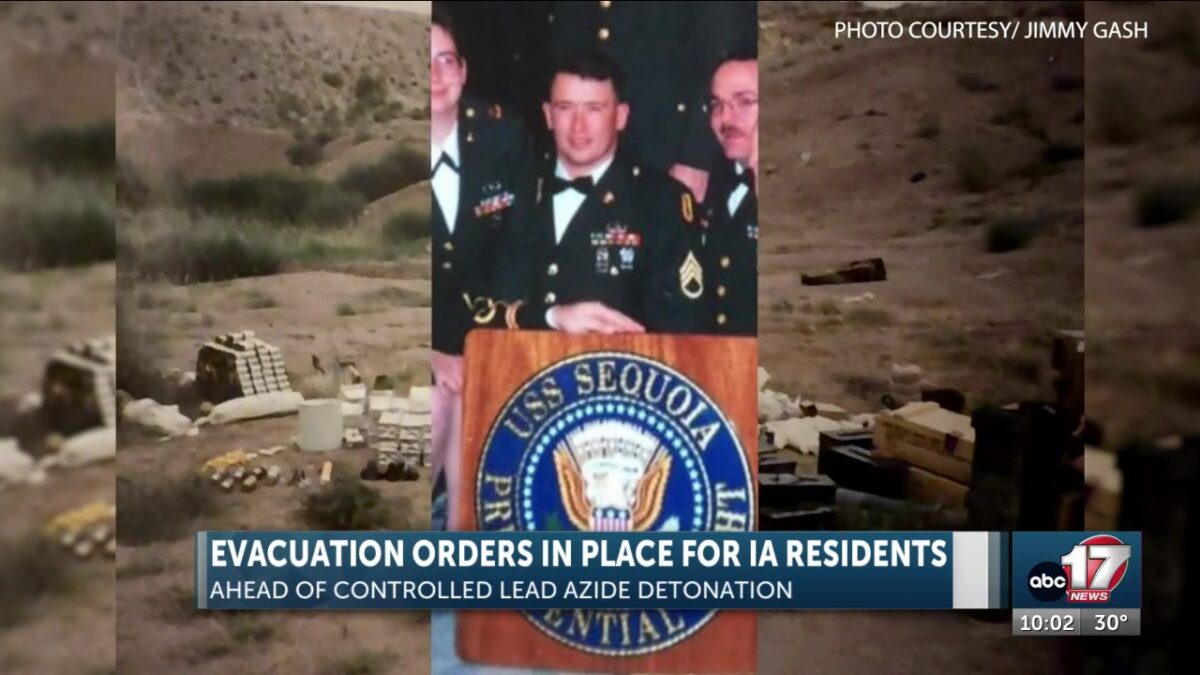
Boone County resident and former U.S. Army Explosive Ordnance Disposal Team Leader SSG. Jimmy Gash expressed his confidence in the execution and preparation plans in place. Gash retired in the summer of 2005 after serving more than 20 years.
“They actually have gel blocks, they have all kinds of different things trying to catch whatever particles they can of this,” Gash said.
The army will detonate the lead azide in ground-covered magazines. The magazines are described as “a reinforced structure made of concrete purpose-built to hold ammunition or explosives.” Plans also include soaking the soil above and around the magazines before and during the controlled detonation. The Army said in a statement the measures will reduce the amount of lead that travels from the detonation site.
Gash said the Iowa blast is just one of many controlled detonations apart of the military’s usual demilitarization efforts.
“Everything has a shelf life, you know, and so it required us to get rid of it,” Gash said.
Gash recalled a similar plan of action during a detonation he helped execute in Loudoun County, Virginia in August 2003. Gash said the Loudoun County Sheriff’s Department found a warehouse full of fighter jet propulsion canisters. The canisters had crystalized due to the lead azide inside of them.
“We ended up having to use an oily substance to soak these items in order to transport them to a disposal site,” Gash said. “I had them dig a hole, a detonation hole, and we put all these items in the bottom of this hole. [We] covered them with explosives, covered the hole up, we tamp the shot and detonated the items in place.”
For the Iowa detonation, agencies will utilize extensive drone surveillance of lead levels, placement of physical barriers full of sand approximately two stories high, a “water wall” and gel blocks to contain particle dispersion. Foam barriers will also be used to absorb thermal energy and reduce airborne particle dispersal.
The release from the Army says the decades-old lead azide was found partially crystalized during an inspection on March 11. Gash said improper storage or too much moisture can create conditions for crystallization to occur.
“There’s a couple different stages of crystallization,” Gash said. “Small crystals on the exterior of the cart, the canister or the box, whatever it’s in. Then there’s a severe case where it starts to crystallize and it almost looks like icicles. Well, that becomes highly sensitive to heat shock and friction.”
However, Gash said dry lead azide isn’t a good thing either. Based on his previous experience, Gash said EOD techs will check to make sure all of the lead azide is taken care of after the blast. If it isn’t, he said that result may warrant a second blast.
Following the detonation, Gash said the clean up is in the hands of the EPA. With the explosion happening below ground, he expects more impacts to the surrounding soil versus the air.
“They’ve probably already figured out how much soil they’re going to have to remove, or how much they’re going to have to clean up, or the detection process as far as going through and seeing what’s left,” Gash said.
Missouri has 10 public primary drinking water systems from surface water and 13 water intakes in the monitored blast radius. The Department of Natural Resources said Monday that EPA officials collected samples from all locations ahead of the planned detonation to monitor possible changes.
Gash described the training process to become an EOD tech as difficult, saying that very few make it through to the end.
“It has about an 85% failure rate, so it’s a very intense program. Very few people make it through it,” Gash said.
The release from the Army recommends closing all windows and doors, setting heating to recirculate, turning off fans that pull in outside air, keeping small children and pets inside, and covering feed and water for livestock and crops for residents in the blast radius.
Click here to follow the original article.