Las Cruces LIGHT team connects residents with mental health care

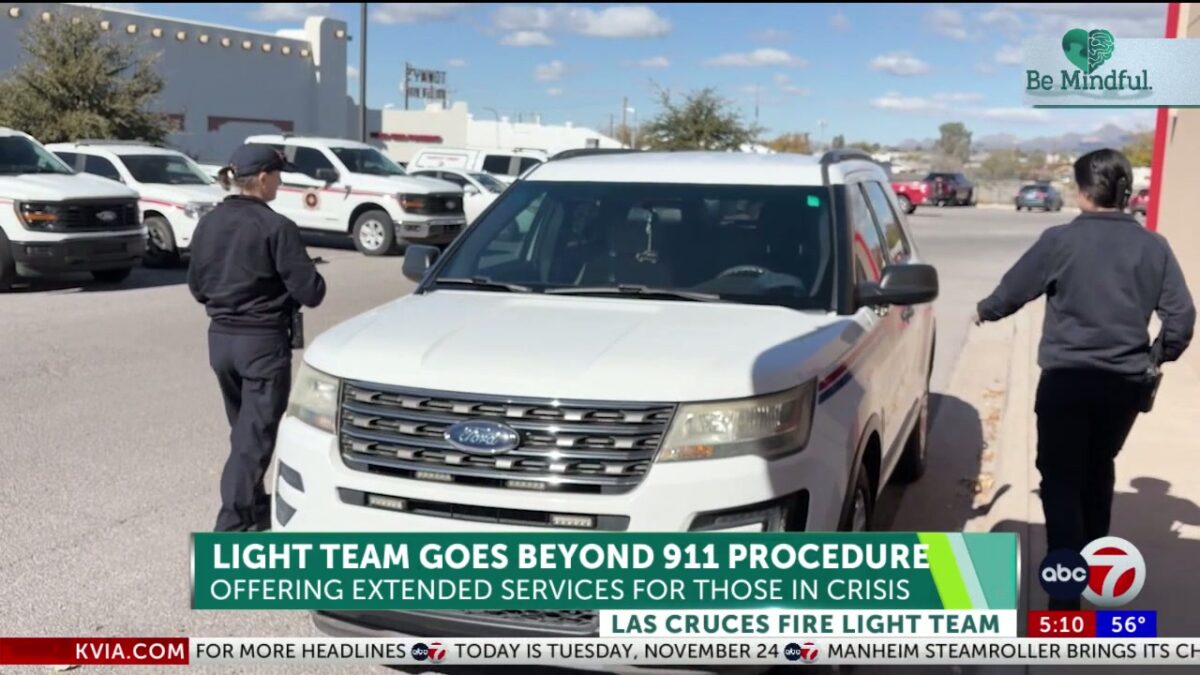
LAS CRUCES, N.M. (KVIA) — A new review from the Las Cruces Fire Department revealed that pairing firefighter-paramedics with mental health professionals significantly reduces emergency room visits and helps keep more residents connected to care. The internal review examined 625 behavioral health crisis calls between Jan. 1 and Sept. 30, 2026. Of those calls, 172 were handled by the department’s LIGHT program, Lessening the Incidence of Grief, Harm and Trauma—while traditional emergency medical services (EMS) units handled the remaining 453.
When firefighters are dispatched to a call, social workers and mental health professionals with LIGHT can also be called out when needed, offering a team approach from the initial call to the response plan.
“I definitely think not having a badge or a firearm on my belt, I only use a radio. That’s definitely de-escalating,” said Jonette Coquat, Licensed Social Worker with the LIGHT team.
Avoiding Re-Traumatization and Care at HomeAccording to the review, emergency department visits occurred in just 22.7% of LIGHT cases, compared with 69.7% of calls handled by traditional EMS units. LIGHT teams helped 65 residents nearly 38% of their cases, safely remain at the scene with a care or safety plan, while traditional EMS records showed no cases in that category.
Coquat said emergency rooms aren’t inherently bad, but they can be overwhelming for someone already in distress.
“I don’t think E.R. visits are bad, but sometimes they can be re-traumatizing,” Coquat said. “Going and sitting in a busy triage room, seeing other people that are sick, seeing other people running around—just the beeping alone can be triggering for people.”
Instead of defaulting to a hospital transport, LIGHT teams work to stabilize people on site—often right at home using tools like breathing exercises, taking a shower, reminding residents to take medication, or connecting them with someone they trust.
“Sometimes definitive care is a safe person,” said Allison Stoner. “If they would feel safer at grandma’s house today, our team can then engage with that person to say, ‘Okay, can we call grandma?’”
Coquat added that the goal is building support where people already feel comfortable.
“What we’re trying to do is create an in-home, in-place safety network for the people to feel comfortable and safe at home,” Coquat said. “Just going to an emergency room sometimes can be [hard] for people, especially riding in an ambulance or having police involvement.”
Beyond immediate de-escalation, team members say they focus on reminding residents of their options and coping skills before a situation escalates further.
“And one of the things that we try to do is provide them with many resources to let them know that there’s a lot of options before getting to a point where they’re completely in crisis,” Coquat said. “And so being able to remind them and to bring those coping skills or those resources back to their memory sometimes can be all that… is needed for them to remember that they aren’t alone and that there is hope.”
Coquat also shared how the team supports families after a loss, recalling a recent call where paramedics tried to save someone who didn’t make it.
“The LIGHT team was able to come in and provide emotional support to that family. Not only did we just sit and talk with the family, but we were able to answer questions about the next steps,” Coquat said. “We were able to offer support services for them moving forward, and we were able to offer whether they wanted a chaplain or a pastor or somebody to come. We offered to call for them to have family members and support, and so we were able to just be with that family in a moment of grief. It wasn’t our job to make it better or to tell them everything was going to be okay.”
She added that sitting with people through difficult moments brings a human element that makes the work meaningful despite its challenges.
“Our job was to have that human element and let them know this is a hard thing, that they’re not alone in their moment of crisis,” Coquat said. “And that was really beautiful. It’s a hard thing to do sometimes helping people in those troubled situations, but it brings that human element that I just don’t believe would be possible without a program like LIGHT.”
How LIGHT OperatesDispatched through the 911 system, LIGHT responds to behavioral health crises, suicide attempts, reports of suicidal thoughts, overdoses, and calls involving a death.
The department noted that because the nine-month review compared actual emergency calls rather than randomly assigned cases, factors like unit availability, dispatch practices, and call circumstances may have influenced the results, and the review did not track long-term outcomes. LCFD plans to use the findings to guide future training, improvements, and planning.
According to LIGHT, the team is currently in the process of getting its own dedicated location and operates out of Las Cruces Fire Station #1 from 8 a.m. to 7 p.m.
Click here to follow the original article.