CVAG homelessness program falls short of housing goals as officials consider changes

PALM DESERT, Calif. (KESQ) – A regional program designed to help some of the Coachella Valley’s most vulnerable residents move off the streets and into permanent housing is falling short of its annual goals, even as local leaders approve additional funding and changes aimed at improving outcomes.
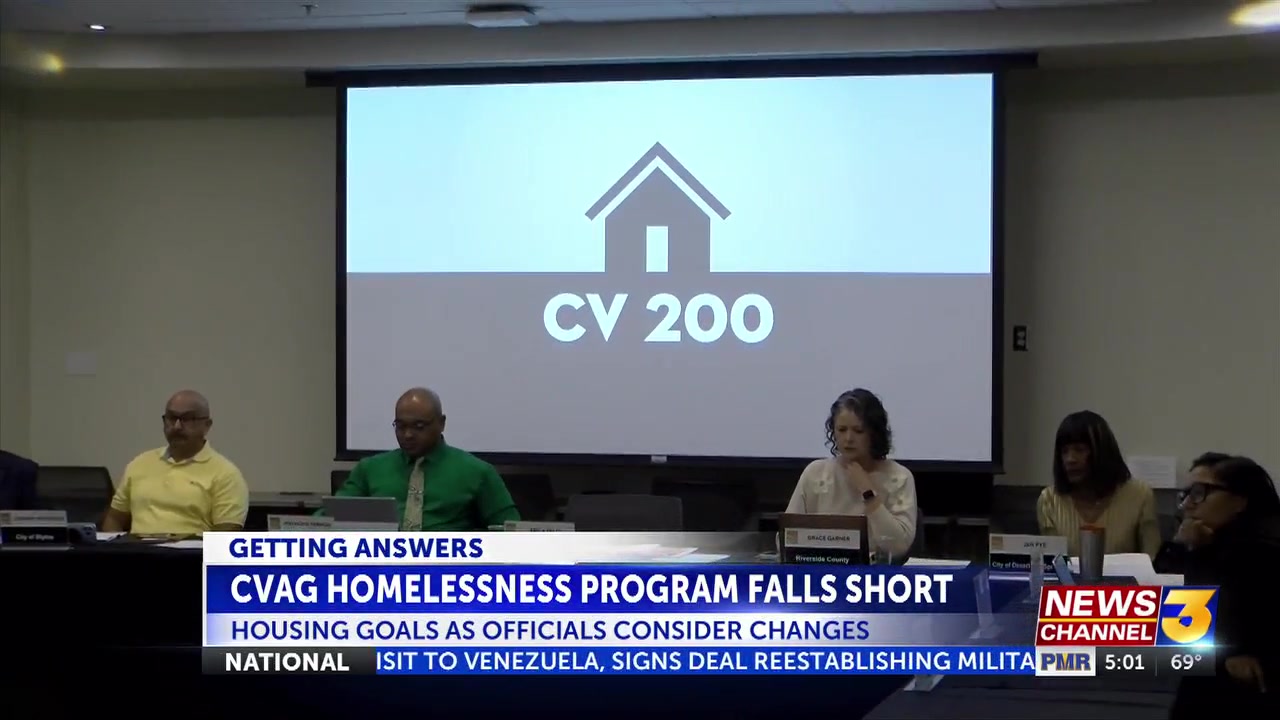
The Coachella Valley Association of Governments (CVAG) Homelessness Committee met Wednesday morning in Palm Desert, where members reviewed the latest results from the CV Housing First program and approved nearly $420,000 in state funding to support homelessness services.
The funding comes as CVAG acknowledges that permanent housing placements have slowed significantly in recent months, with staff pointing to a shortage of affordable housing, limited housing vouchers and challenges keeping some participants engaged in services.
Housing placements fall short of annual goalCV Housing First works with chronically homeless individuals throughout the Coachella Valley, providing street outreach, temporary crisis-stabilization housing and assistance with finding permanent homes.
One of its primary initiatives, known as CV 200, focuses on a targeted group of individuals identified in coordination with local law enforcement, code enforcement and municipal partners.
According to CVAG’s latest quarterly report, the program established a goal of permanently housing 65 people in 2026.
However, through September, just 29 participants had reached that milestone.
The report shows permanent housing placements declined sharply after the beginning of the year:
First quarter: 18 people permanently housed Second quarter: 4 people permanently housed Third quarter: 7 people permanently housedThe report also shows 53 program participants were recorded returning to the streets after receiving temporary housing assistance.
Those returns do not necessarily mean participants lost permanent homes. Rather, they reflect individuals who returned to homelessness after participating in temporary assistance programs.
CVAG staff acknowledged the program had fallen short of expectations for two consecutive quarters.
Indio Mayor Pro Tem Waymond Fermon, who chairs the CVAG Homelessness Committee, said the numbers warrant a closer look.
“This round of our CV 200 numbers are low and we want to look and see why the numbers are low,” Fermon told News Channel 3. “We want to see where folks may be falling through the cracks.”
Fermon said the committee will continue monitoring the program’s performance and identifying barriers preventing participants from successfully transitioning into permanent housing.
Officials point to shortage of permanent housingDuring Wednesday’s meeting, CVAG staff explained that finding available housing has become increasingly difficult, particularly for participants who require permanent supportive housing or rental assistance.
Staff said the region previously benefited from new affordable housing developments and referrals through Riverside County that helped move participants into permanent homes.
However, those opportunities have become more limited.
CVAG officials said there are currently fewer available housing vouchers and no comparable new supportive housing developments immediately opening in the valley to provide placements for participants.
Without permanent housing readily available, some participants are reluctant to enter temporary programs, particularly when they are uncertain whether a long-term housing option will become available.
Staff also described efforts to connect individuals with mental health treatment, rehabilitation services and income assistance while working toward eventual permanent housing.
Officials emphasized that progress does not always happen quickly, particularly for individuals who have experienced chronic homelessness for several years.
Some participants require repeated outreach and assistance before they are ready to accept services.
During the meeting, staff described an individual who had been on the program’s list for years before eventually accepting treatment and transitioning into rapid rehousing.
Affordable housing remains a regional challengeLift to Rise Executive Director Ian Gabriel also addressed the committee Wednesday, presenting the organization’s affordable housing action plan for the next two years.
Gabriel emphasized that the shortage of affordable housing affects not only those currently experiencing homelessness, but also working families at risk of losing their homes.
“We know that homelessness is a very complex issue, but it is fundamentally a housing issue,” Gabriel said during the meeting.
Gabriel cited data indicating approximately 56,000 renter households across Riverside County lack access to affordable housing.
He also referenced California Housing Partnership data showing that a worker would need to earn approximately $39 an hour to afford the county’s average rent without spending more than the benchmark share of income on housing.
Those figures represent Riverside County as a whole, not just the Coachella Valley.
Lift to Rise has been working with local governments, developers and community organizations to increase the region’s affordable housing supply.
Gabriel said the organization continues advocating for additional funding, infrastructure improvements and policy changes that could make affordable housing developments easier to build.
He also noted that some projects face lengthy development timelines and challenges securing sufficient utility capacity, even after funding is arranged.
Nearly $420,000 in state funding approvedDespite the program’s challenges, the CVAG Homelessness Committee voted Wednesday to authorize the acceptance of approximately $419,450 in state Homeless Housing, Assistance and Prevention (HHAP) funding.
The funding, administered through Riverside County, will support two components of CV Housing First:
$185,000 for street outreach, supporting efforts to connect people experiencing homelessness with available services. $234,450 for interim housing, helping fund temporary crisis-stabilization units where participants can receive assistance while working toward more stable housing.CVAG Management Analyst Candice Graff explained during the meeting that the additional grant funding will help cover program expenses over the coming fiscal years and reduce the need to draw from reserves.
The funding is intended for outreach and interim housing operations, rather than the direct construction of new permanent housing.
News Channel 3 asked Fermon how officials plan to ensure public dollars translate into measurable results as the program continues falling short of its permanent housing goals.
“These dollars are very important, and it’s important to the community to understand that we are stewards of their tax dollars,” Fermon said.
He also acknowledged that funding for homelessness services remains limited and emphasized the need for regional cooperation.
Fermon said the committee will continue closely examining program performance and working with outreach teams, service providers and local governments to identify more sustainable solutions.
Expanded landlord incentives approvedThe committee also approved expanding its existing landlord incentive program to include month-to-month and shorter-term rental arrangements.
The program offers financial incentives to landlords willing to rent rooms or housing units to eligible CV Housing First participants.
Officials hope the expanded eligibility will make more housing options available, particularly for participants who cannot qualify for traditional subsidized housing.
However, the proposal also prompted questions about oversight.
During Wednesday’s discussion, a committee member raised concerns about whether landlords could repeatedly collect incentive payments if tenants frequently moved in and out of the same unit.
The member cautioned that the expanded structure could potentially create opportunities for misuse if not carefully monitored.
CVAG staff responded that they maintain contact with participants after housing placements and work with landlords and tenants to resolve problems that could threaten housing stability.
A committee member also suggested tracking repeated incentive payments and reviewing the program’s performance after implementation.
The expanded incentive program was approved.
Coachella rejoins regional homelessness program for 2027Looking ahead, the committee also approved resetting its CV 200 targeted client list for 2027.
CVAG officials explained that the list is reviewed annually in coordination with local law enforcement, code enforcement teams and city staff who work directly with individuals experiencing chronic homelessness.
The updated program will include the City of Coachella, which is rejoining the regional effort next year.
According to CVAG staff, Coachella’s previous agreement expired and the city temporarily stopped participating in the program during 2026.
The Coachella City Council recently voted unanimously to return for 2027.
The updated CV 200 list will reserve 31 positions for individuals identified through Coachella’s participation.
CVAG officials said the changes are part of their continuing efforts to improve coordination and reach individuals who need assistance.
What’s next?While CV Housing First has helped hundreds of individuals move into permanent housing since CVAG began operating the program directly in 2021, the latest numbers highlight the challenges of maintaining that progress.
Through September, the program had reached fewer than half of its 2026 permanent housing placements goal.
Officials say expanding housing availability, maintaining consistent outreach and strengthening partnerships with landlords and service providers will be critical to improving outcomes.
Fermon said homelessness remains a complex regional issue involving housing affordability, behavioral health needs and access to services.
He emphasized that the committee plans to continue evaluating the program’s performance and identifying areas needing improvement.
The CVAG Homelessness Committee’s next scheduled meeting is January 20, 2027.
For now, the central question remains whether the newly approved resources and program changes will help more Coachella Valley residents move beyond temporary assistance and into permanent homes.
News Channel 3 will continue following the program’s progress and the region’s efforts to address homelessness.
Click here to follow the original article.