ODOT workgroup weighs three funding options ahead of Dec. 15 deadline

BEND, Ore. (KTVZ) — A state workgroup appointed by Gov. Tina Kotek is preparing to present new funding proposals for the Oregon Department of Transportation ahead of a Dec. 15 deadline. The proposals follow voters’ overwhelming rejection of a legislative transportation funding package earlier this year.
The funding effort comes after Oregon voters rejected increases to the state gas tax and vehicle registration fees by an 83% to 17% margin in May, a difference of nearly 800,000 votes. That ballot defeat left ODOT without stable long-term funding following years of revenue shortfalls.
In 2017, the Oregon Legislature passed House Bill 2017 to raise revenue for modern transportation infrastructure, but state revenue models revealed in 2023 that collections were significantly below expectations. Lawmakers passed a party-line bill in 2025 to increase vehicle fees and the gas tax, prompting the referendum that voters rejected.
Declining revenue stems in part from changing vehicle trends across the state. Kacey Davey, a public information officer for ODOT, explained how shifting driver habits affect the agency’s budget.
“Vehicles are becoming more fuel efficient,” Davey said. “And while that’s great, it means that people are spending less money on gas tax because a lot of the state highway fund comes from gas tax revenues. Our vehicle registration rates are also down at DMV, and DMV fees are another way that ODOT gets funding.”
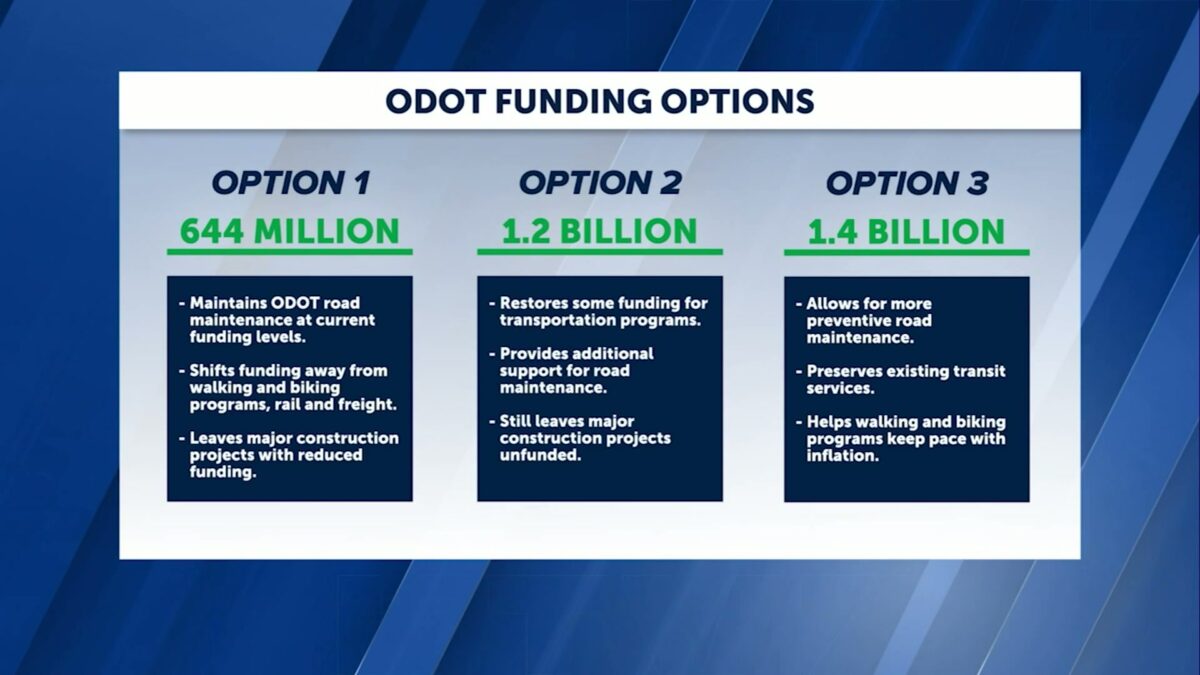
To address the shortfall, the governor’s workgroup is weighing three distinct financial packages, according to the Oregon Capital Chronicle. The lowest proposal of $644 million annually would maintain basic road operations while shifting funds away from rail, freight, walking, biking and major construction. A middle option of roughly $1.2 billion each year would restore some of that funding but leave major construction projects unfunded. The highest option, totaling about $1.4 billion annually, would increase preventive road maintenance, protect existing transit service and help walking and biking funding keep pace with inflation.
Any proposal selected by the workgroup and the governor must secure approval from the state Legislature, where lawmakers from rural districts have criticized ODOT spending decisions. State Rep. Vikkie Breese-Iverson, a Republican representing Prineville, argued that rural regions bear an unfair burden during budget cuts.
“Can I just point out that every winter that we come into the Odot budget, we see Odot start to squeeze rural Oregon?” Breese-Iverson said. “It is absolutely unfair and uncalled for. They pick on us because we have a vast majority of roads in our in our in rural Oregon, around eastern Oregon and southern Oregon. And they’re hit hard with winter weather. They choose to put their priorities before the safety of Oregonians.”
The workgroup faces a deadline of Dec. 15 to present its plan. Transportation funding will be one of the primary issues lawmakers tackle when the Oregon Legislature convenes for its long session in a few weeks.
Click here to follow the original article.