Critics see age-verification laws like Missouri’s as not secure, unconstitutional

COLUMBIA, Mo. (KMIZ)
It’s been nearly a year since major adult entertainment websites Pornhub, YouPorn and RedTube stopped serving Missouri users, pulling access in response to the state’s new age verification requirements.
The rule was spearheaded by Attorney General Catherine Hanaway in 2025, taking effect in December of that year. It was followed by HB 1839, passed in the following 2026 legislative session, which took effect in August.
Missouri is one of more than 25 states requiring age verification regulations for adult websites. The laws typically apply to websites with at least 1/3 of their total content considered sexually explicit and often require users to submit a government ID and facial scan. Accounts with a verified user and subscription payment are also sometimes required.
In response to the new requirements, Pornhub and other major adult websites banned new Missouri users from accessing content or creating accounts, while allowing existing account holders to keep theirs.
Non-adult platforms like TikTok, Discord and Roblox have similarly introduced age-estimation measures for younger users.
Supporters see age verification as another layer of protection, while critics question its effectiveness and constitutionality, with legal challenges emerging in states like Utah, Alabama and Texas.
While promoting the regulations in 2025, Hanaway highlighted the need to shield underage users.
“Much of this material is violent, degrading, and explicitly misogynistic. It can warp young minds, fuel sexual exploitation, undermine healthy relationships, and contribute to human trafficking. Studies also show that pornography can have neurological effects comparable to addictive substances, leaving adolescents especially vulnerable to long-term harm,” Hanaway said in a statement.
Attempts to interview Hanaway and HB 1839’s bill sponsors, Rep. Sherri Gallick (R-Belton) and Sen. Mike Henderson (R-Desloge), were not successful.
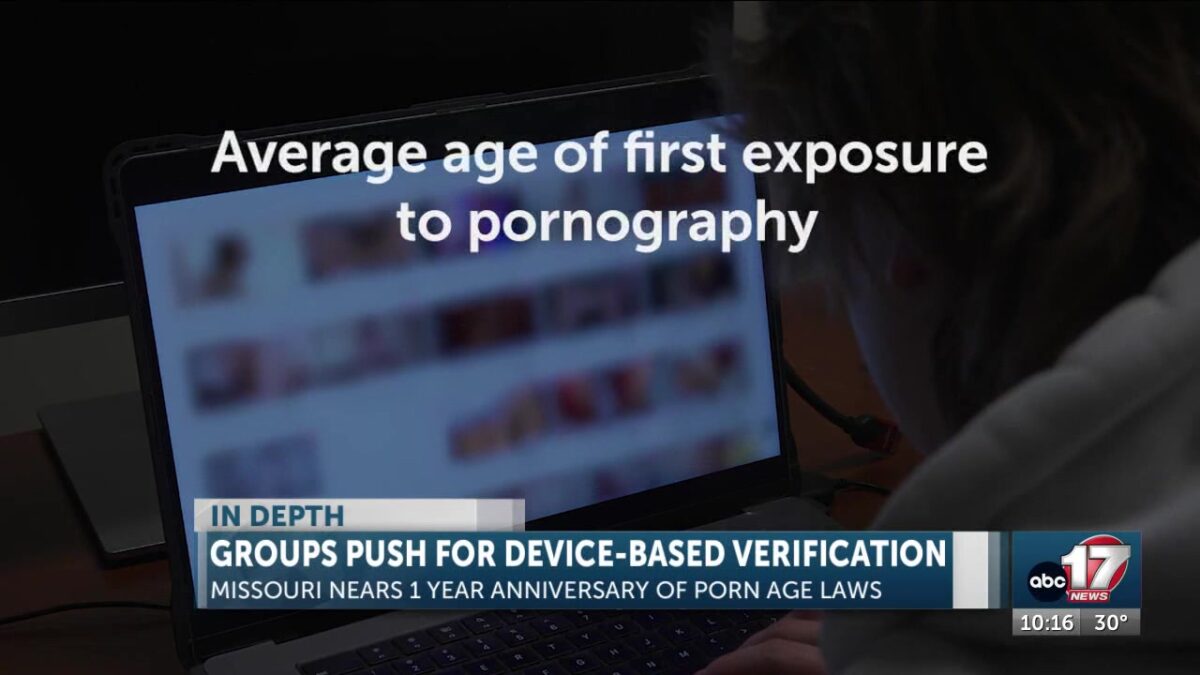
According to a 2022 Benenson Strategy Group study of nearly 1,400 U.S. teens, 58% viewed porn accidentally, with 12 being the average age when children first consume pornography.
“It’s hurting kids’ developing brains; it’s crafting the way they view themselves, and they view others,” said Caleb Pascoe, government affairs manager with conservative group the American Principles Project. “It’s not too much to ask for sites that are distributing pornography to take the interest of the user into account.”
The American Principles Project has played a leading role in the national age verification debate, advising lawmakers across the country, with the group testifying for HB 1839 in the general session.
“I think that these industries require children’s participation in order to keep their business model afloat, so they’re going to resist this,” Pascoe said.
Internet safety education non-profit Digital4Good compares the regulations to being carded for adult products like alcohol and cannabis.
“Everyone has to get ID’d no matter your age, that you are over 21,” Digital4Good Director Kim Karr said. “I just think that we need to do something because children are seeing things that are not appropriate on that end.”
Experts, however, warn that age verification may not have made much difference.
While major adult film companies removed access from the state, dozens of adult “tube sites” remain, along with adult content being posted on platforms like X and Reddit. Tube sites often have a self-reported age-confirmation page that asks the user to input their age or confirm they are over 18.
Industry experts additionally warn that “tube sites” are not regulated for creators.
According to Reuters, social media platform X reported that 13% of its content was adult content. While age verification is required for adult content on the website, users have reported inaccurate readings that incorrectly identified users as both older and younger than they actually were.
“People just hit the back button. I just can’t express how many sites are not complying with these laws,” Free Speech Coalition spokesperson Mike Stabile said. “Those are pirate sites; often those are sites that are not taking down revenge porn or child abuse content. Those are sites that are not complying with any U.S. law.”
The Free Speech Coalition has been a leading group against “anti-porn” laws like HB 1839.
Stabile said the adult film industry does not want minors using its content. All eight adult industry members interviewed by ABC 17 News expressed similar concerns, emphasizing that they do not want minors accessing their content but question the effectiveness of age verification.
“These laws do not protect children or stop them from watching content,” adult industry advocate Sasha Bee said. “The reason that we have to show an ID to go into a bar is that it’s effective. If this law was effective, I would be 100% behind it as someone that believes that minors should not access content that is harmful to them.”
The American Principles Project maintains that age verification laws are effective, while acknowledging there is room for improvement in how they are implemented.
“We have to use these age verification tools as a first step. If they do go far enough, fantastic,” Pascoe said. “If we get this baseline down, then we can say, ‘all right, where are these other problems happening?'”
A content creator’s perspectiveMissouri-based Emily Hess has been an adult content creator for a little over four years and is a cast member on the recently launched TLC show “Double Lives of Suburban Wives” that features couples in the industry.
Hess is also a mother of four and understands the push for regulation.
“I think it’s really difficult to know what all of our children are doing at every moment. I think we all just do the best that we can, so for that reason, I do think the age verification is important to have, just not maybe so strongly,” Hess said.
VPNs, or virtual private networks, can also allow users to mask their location and bypass state age verification requirements. Many VPN services are readily available through a paid subscription and don’t require users to verify their age to sign up.
Digital4Good acknowledges the loopholes in age verification laws but overall approves of the measures as a way to help protect children who may encounter explicit content online, even unintentionally.
A 2026 New York University study compared website traffic across states with varying age verification laws. Researchers found that in states with age regulations, traffic for Pornhub decreased by 51% while the non-compliant tube site Xvideos saw an over 48% increase in traffic.
“Yeah, sure, you’ve made it more difficult to see the larger corporations’ material content, but the inadvertent consequence is now are these people that are just the Wild West out here,” said Giovanni Valentino, chairman and chief marketing officer of adult entertainment marketing firm The Industry PR.
Valentino has been working in the adult film industry for 15 years.
VPN services also saw traffic increase by nearly 24% in the study.
“The traffic is still there, the demand is still there, it just shifts somewhere else,” said Keli Jackson, an assistant professor of communication at St. Louis University. “It is super common for people to circumvent these kinds of laws by using a VPN, and you really can’t prevent a teenager who is determined to do so from being able to use that as a workaround.”
The United Kingdom established similar age verification rules for adult websites through the 2023 Online Safety Act. Unlike state-by-state regulation, adult website compliance is reviewed at the national level by the UK Office of Communications.
A 2025 study from the Office of Communications found results similar to NYU’s, with VPN usage nearly doubling from 650,000 users to 1.4 million users after the act took effect. However, they found that traffic for both Pornhub and Xvideos decreased by 31% and 24%, respectively. OnlyFans, which initially required a valid credit card from users, saw around a 10% decrease after the additional security measures.
Pornhub’s parent company, Aylo, initially followed UK regulations until it also blocked access to non-member users in February 2026.
Globally, the company has been a strong supporter of alternative age-verification measures. Aylo says in a statement on its website that any system to verify age should be applied across the board, including to less-safe websites.
Worried about dataStabile said possible data hacks also discourage people from using current age-verification tools.
“When you’re going to a site that has adult content, most people are unwilling to do that [provide personal information]. There are real concerns about what would happen if that information was leaked,” Stabile said. “If you were publicly exposed to going to a site with adult content, whether or not you could lose your job, whether or not you would be publicly shamed.”
Digital4Good also raised concerns about the security of personal information collected through age verification technology, noting that some of the technology is still relatively new.
“Our main concern with the law is information being sold to a third party, third-party users and whatnot, but overall, I think it’s a very beneficial law,” Digital4Good spokesperson Ivette Padilla said.
The American Principles Project argues that age verification laws provide added privacy protections by legally limiting how websites can handle users’ personal information.
According to HB 1839’s bill text, “A third party that performs the age verification under this section shall not retain any identifying information of the individual.”
“They’re [websites] able to do whatever they want with users’ information. The laws mandate that you actually cannot hold on the user’s information once you gather it to verify age, and that applies broadly,” Pascoe said.
Just last year, instant messaging platform Discord experienced a data breach, with hackers gaining access to over 70,000 photos of Discord users who scanned their faces through the website’s age verification program.
“Users are right to be concerned about what happens to their data if they are turning over IDs to platforms,” Jackson said. “That kind of data often lives with a provider that you have never heard of, and you don’t know that much about, and so you are vulnerable.”
The American Principles Project argues this is the company’s fault for its lack of security.
“To pretend as if these multibillion-dollar companies cannot have the appropriate software to be able to ensure users’ privacy, I think is missing the point of the way that software works and development works,” Pascoe said.
Effects on the industryStabile said he’s seen a decrease in sales for OnlyFans creators in the Free Speech Coalition.
“This was an economy with 2 million people who were earning money through this, individual creators who suddenly are hitting a 30% cut in revenue, if not more, because of these laws,” Stabile said.
Several creators ABC 17 News spoke with said they saw similar effects on their sales.
Adult performer and mother Nyxian Nox has been in the industry for six years and also works as the director of model relations for The Industry PR. She reports around a 10% decrease in sales.
ABC 17 News agreed to use Nox’s stage name to protect her privacy.
“It puts them [clients] off really hard,” Nox said. “Instead of them spending that $10 to subscribe and buy other things, they go, ‘I’ll pass.’ And that might have been my best customer I never had.”
Nox said tube websites often lead to unfair competition with ethical porn creators.
“Instead of it being a regulated product, it’s out there free to whoever wants it,” Nox said, “trying to make it better, you end up making it worse.”
“It becomes a race to the bottom of the price,” Valentino said.
Adult performer Em Ambisious has been in the industry for nearly 10 years and is a camera operator and company executive for The Industry PR. Ambisious reports seeing an increase in sales due to the tighter regulations.
ABC 17 News also agreed to use Ambisious’ stage name to protect her privacy.
“People were taking my stuff and re-uploading it somewhere else,” Ambisious said. “Adults were actually watching it instead of trying to rip it off, so I think that’s a really positive thing.”
Valentino said traditional adult film production companies have been hit particularly hard by declining traffic on major adult websites, which provide an additional source of views and revenue for producers through affiliate partnerships.
“Why go to the trouble of uploading a huge … file with all the tags and the content and the metadata and videos for affiliate programs where maybe next week Georgia decides it’s going to run some brand new legislation which is going to kill whatever site that I’m using that has that affiliate group?” Valentino said.
Other verification and protection methodsInstead of website-based verifications, opponents are pushing lawmakers for device-based verification.
Apple, Google and Android use the software, allowing users to submit photos, credit card information and government-issued IDs to their device. Devices can also be locked by parental controls.
“Device-based solutions address the problem at its source, protecting minors across the entire internet rather than on a handful of compliant sites,” a statement displayed on an Aylo website’s homepage reads.
Stabile said social media platforms like X and search engines can also adjust their algorithms and search results to limit what certain age groups can see.
“We do have tools on the devices already that can limit this,” Stabile said. “It’s also going to block, I think this is most important, the people who are not meaning to see adult content. We know that a lot of minors who encounter adult content aren’t looking for it.”
Jackson said device-based verification has potential but still faces similar security concerns.
“If you look at using your face ID and your iPhone or using your fingerprint or something like that that could be a token entrance into any kind of platform might be the ideal way to do it,” Jackson said. “That is unmanageable, given the fact that it’s a completely disconnected world of providers, platforms and management ideas, that becomes a real tech challenge to be able to implement, but that would be the solution.”
Digital4Good and the American Principles Project also support device-based verification as an additional security option but have doubts about its effectiveness, especially when used on a shared family device.
“How easy is it if a 15-year-old is actually friends with the 18-year-old and the 18-year-old has access to all this?” Padilla said.
Pascoe argues that device-based laws also put the blame on parents
“American parents don’t have the resources, and they don’t actually have the technical expertise to be able to head off all these things at the pass,” Pascoe said. “The government represents the people and the interests of the people, and it’s supposed to fight to protect their well-being; we think that this is something that rises to that level.”
Others stressed that protecting children online requires group cooperation.
“It’s everyone’s responsibility,” Karr said. “The big tech companies and usually the parents. It also needs to be these companies who have this adult content. It’s even the user itself.”
Creators say they can’t bear the full burden.
“Parents really need to be on top of their game because we can only do so much as creators, actors, business people, etc., before it becomes ridiculous,” Ambisious said.
First Amendment concernsThe effort to keep minors away from adult content has also sparked debate over the limits of free speech.
The Free Speech Coalition took Texas Attorney General Ken Paxton to the Supreme Court in 2025 over a 2023 age verification law, arguing that adults have a constitutional right to access sexually explicit material and shouldn’t have to face additional barriers to view legal content.
“Part of this argument really draws a distinction between being 18 and over and 18 and under,” Jackson said. “Once you cross that age threshold, you are completely free to access, or should be.”
The Supreme Court ruled 6-3 in Paxton’s favor.
The justices acknowledged that age verification requirements place a burden on adults’ First Amendment rights, but found that burden was justified by the state’s interest in protecting children.
“I think that they were overly rosy in their estimation of how complicated this is. I think they were overly rosy in their estimation of what the privacy concerns are,” Stabile said.
Pascoe argues that obscenity like porn does not fit under the First Amendment.
“Any of the writing of the founders who wrote the First Amendment, any of the arguments, look at the state laws that were on the books, they were much more harsh, particularly about protecting the innocence of children against these kind of obscenity,” Pascoe said.
In their dissenting opinion, Justices Elena Kagan, Sonia Sotomayor and Ketanji Brown Jackson agreed that children have no right to view porn but argued Texas’ law may have gone too far.
Kagan also warned that the stigma surrounding pornography could discourage adults from verifying their age, effectively keeping them from exercising their First Amendment right to access legal content.
“It’s a sort of form of self-censorship so the state government can say, ‘Hey, we didn’t say you couldn’t access the pornography, we just said you had to show your ID,'” Washington University law professor Greg Magarian said. “If a reasonable analysis would say, ‘yeah, that’s stuff that people are going to be afraid to do, that’s stuff that’s going to intimidate or discourage people,’ then that’s a First Amendment violation.”
Additional concerns have been brought up about where the line is drawn under “obscenity.”
Under Chapter 573 of the Missouri Constitution, for material to be “pornographic for minors,” it must meet three requirements: cater sexual content to minors or, “cater or appeal to a prurient interest of minors,” clearly show nudity or sexual acts and lack “serious literary, artistic, political, or scientific value for minors.”
But determining what qualifies as inappropriate content for minors has not been straightforward.
In September, the Missouri Association of Librarians asked the Missouri Supreme Court to rule on a law that would criminally punish school staff for distributing “explicit sexual material” to a student, leading to librarians in the state pulling books from shelves out of fear of punishment.
Secretary of State Denny Hoskins threatened to pull funding from Columbia’s Daniel Boone Regional Library, which hosted an LGBTQ+ “Rainbow Story Time” event, calling the books read there “grooming” material.
In 2023, then-Missouri Attorney General Andrew Bailey sent a warning letter to Target over LGBTQ+ Pride merchandise, calling it “potentially harmful to minors.”
“The Missouri State government is using this pornography restriction as a broader umbrella to encompass and restrict some of these other things, and that’s, from a First Amendment standpoint, way out of line,” Magarian said. “We may disagree about that politically, but there’s no question about it legally.”
Pascoe argues the law’s focus on clearly pornographic websites makes it unlikely to affect other forms of content.
“We know that when we see it, the government knows that when they see it, the people working in local and federal government know that when they see it, and so these standards are being put in place,” Pascoe said. “It’s literally in the name of some of these companies.”
Shared responsibilityPascoe said there is growing agreement among lawmakers, adult performers, parents and child protection groups that something needs to be done to protect children online.
“There are individuals within the industry who I think recognize the danger that this poses to children specifically, and this poses to children’s innocence,” Pascoe said. “As far as the movement goes, I think there is broad coalition agreement.”
Stabile described discussions between the Free Speech Coalition and lawmakers as an “uphill battle,” saying part of the challenge is educating legislators who may not fully understand how the internet works or how these laws could affect users. He said those conversations have improved over the years.
“We’ve know the technology better than the legislators, and we know how people are getting around it,” Stabille said. “Sometimes it’s uncomfortable to deal with the adult industry, for legislators. I think people are starting to realize, we’ve got the information and we don’t want minors on our sites.”
Valentino said the adult industry has a stake in the discussion, even if it’s not always an easy one to have.
“There’s a certain irony; there are years where our industry makes more money than Hollywood does, and we clear more money than they do by far,” Valentino said. “If we’re talking about citizens making laws together, it’s our job to have a discussion.”
Click here to follow the original article.