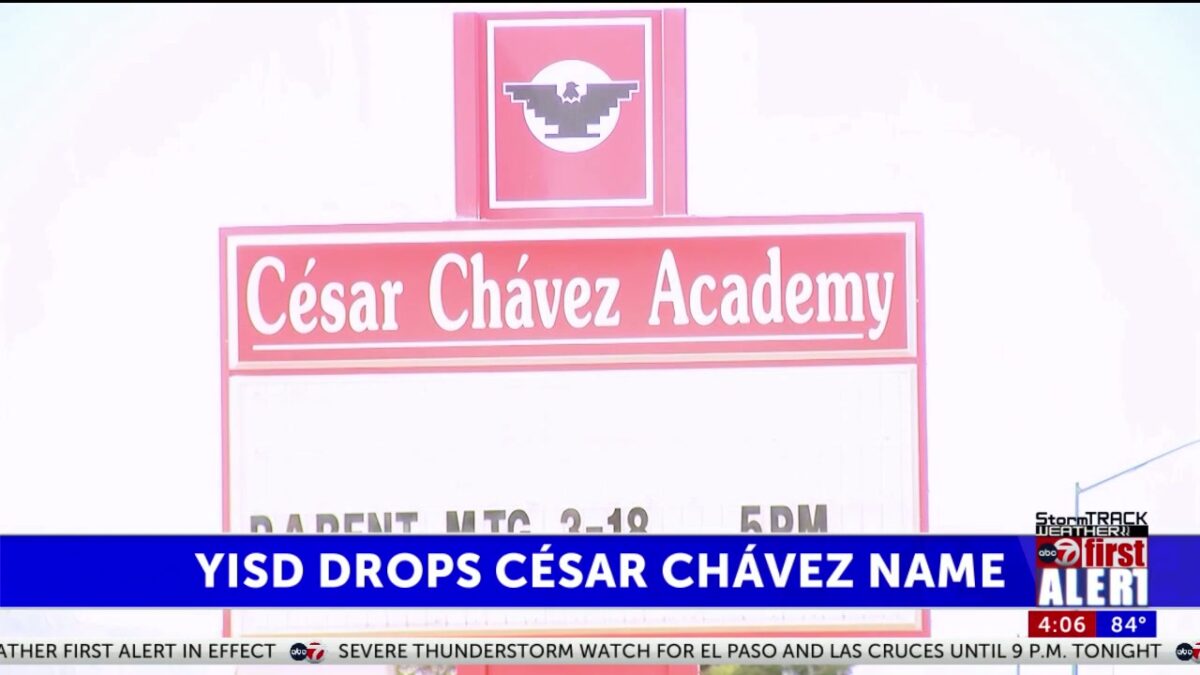
Ysleta ISD votes to rename Cesar Chavez Academy

Gabrielle Lopez

EL PASO, Texas (KVIA) — Cesar Chavez Academy of the Ysleta Independent School District will be renamed “The Academy.” Wednesday, YISD board members voted 6-1 for the name change.

Board member Shane Haggerty was the only member to vote against the change.

“I understand why we are changing the name of our school, but renaming the campus to The Academy doesn’t honor anyone. My opinion, it erases the community. Our district serves numerous families who have deep Mexican-American roots, and there is no shortage of people with that same heritage that are worth putting on our building,” Haggerty said.

Haggerty mentioned three people whose names could be added to the school: Silvia Mendez, Pat Mora and Lauro Cavazos.

Haggerty said Mendez was a student at the center of Mendez v. Westminster (1947), which was the case that ruled forced segregation of Mexican American students into separate schools as unconstitutional.

Mora is an El Paso-born poet. Haggerty mentioned she started the Dia de los Libros program and received numerous honorary doctorates.

Lastly, Cavazos was president of Texas Tech, the first Hispanic cabinet member who was also the Secretary of Education.

The talk of renaming the school comes after recent sexual abuse allegations about labor rights activist Cesar Chavez came out in March.

Initially, YISD said it couldn’t rename an existing facility unless its “educational function or support activity is changed and/or redirected,” per its policy. In April, the board voted 5-1 to change its renaming policy. Haggerty opposed the vote, while Board Secretary Connie Woodruff was absent.

In Wednesday’s meeting, Board President Carlos Bustillos said he met with his community who are on board for renaming the school “The Academy.”

In April, Las Cruces Public Schools voted to rename one of its elementary schools after Chavez. It has since been renamed Desert Bloom Elementary School.

Click here to follow the original article.

Missouri leaders tout state’s data center consumer protections

Haley Swaino

COLUMBIA, Mo. (KMIZ)

Over the last two years, federal and state regulators have worked to establish what they believe are effective safeguards to protect average ratepayers from data center power costs.

Amid a surge in large-scale data center projects across the Show-Me State, Missouri Senate Bill 4 helped lay the groundwork for consumer protections.

“Large load customers and data centers have always kind of been operating in Missouri for several decades,” said Rich Germinder, senior policy adviser with the Missouri Public Service Commission. “But the scale of the load growth that we’re seeing really dictated, ‘We need to have a different approach.’”

Signed into law by Gov. Mike Kehoe in April 2025, SB 4 requires large-load customers to pay their full share of grid and power costs. A specific provision also changed the way the Public Service Commission deals with electric rates and the adoption of electric facilities.

The provision requires utility companies to establish large-load tariffs. By December 2025, the Public Service Commission had approved contracts for both Ameren Missouri and Evergy.

“This large-load tariff enabled us to, before we connect these customers, they have to sign these contracts,” Ameren Missouri Economic Development Manager James O’Mara said. “Because we understand the costs that could be required to serve them. They have to pay that cost.”

Source: Charles River Associates

const chart = echarts.init(document.getElementById(‘retail-rates’));

chart.setOption({ title: { text: ‘Change in Average US Retail Rates’, subtext: ‘Average residential rate and year-over-year increase | twelve months ending October’ }, tooltip: { trigger: ‘axis’, axisPointer: { type: ‘cross’ } }, toolbox: { show: true, feature: { dataView: { show: true }, saveAsImage: { show: true }, restore: { show: true } } }, legend: { bottom: 0, data: [‘YoY Increase’, ‘Avg. Annual Rate (c/kWh)’] }, grid: { left: 85, right: 90, top: 85, bottom: 85 }, xAxis: { type: ‘category’, data: [‘2016-17’, ‘2017-18’, ‘2018-19’, ‘2019-20’, ‘2020-21’, ‘2021-22’, ‘2022-23’, ‘2023-24’, ‘2024-25’], axisLabel: { rotate: 28 } }, yAxis: [ { type: ‘value’, name: ‘Average residential rate (c/kWh)’, min: 10, max: 18, interval: 1 }, { type: ‘value’, name: ‘YoY increase (%)’, min: 0, max: 12, interval: 2 } ], dataZoom: [ { type: ‘inside’ }, { type: ‘slider’, bottom: 35 } ], series: [ { name: ‘YoY Increase’, type: ‘bar’, yAxisIndex: 1, data: [2, 0, 1, 1, 3, 10, 7, 3, 5], itemStyle: { color: ‘#b9e0f2’ }, label: { show: true, position: ‘insideBottom’, color: ‘#17324d’, fontWeight: ‘bold’ } }, { name: ‘Avg. Annual Rate (c/kWh)’, type: ‘line’, yAxisIndex: 0, data: [12.8, 12.8, 12.9, 13.1, 13.5, 14.8, 15.8, 16.3, 17.1], symbol: ‘circle’, symbolSize: 10, lineStyle: { width: 3, color: ‘#14577b’ }, itemStyle: { color: ‘#14577b’, borderColor: ‘#fff’, borderWidth: 2 }, label: { show: true, position: ‘top’, fontWeight: ‘bold’ } } ] });

window.addEventListener(‘resize’, () => chart.resize());

In accordance with Senate Bill 4, the large-load tariffs were critical in outlining specific requirements for customers using 75 megawatts or more a month.

When these customers plug into the grid, they’re under contract to:

Sign a minimum 12-year contract, with an option to extend the contract for five more years if the company scales up operations. Cover full grid hookup and infrastructure costs upfront. Pay a monthly demand charge set at 80% of their contracted maximum electric demand, even if they use less electricity than projected. Provide collateral funds equal to two years of minimum monthly bills, in the event of bankruptcy or closure. Give 36 months’ written notice to end service and pay exit and early termination fees.

Strategic upfront planning for hyperscale data centers has been key to ensuring everyday Missouri customers don’t have to pick up part of the tab, Germinder said.

“What was really unique or interesting about the large-load tariff requirement and Senate Bill 4 was Missouri was one of the first states to actually pursue that requirement,” Germinder said.

Retail-rate-trends-in-the-USDownload

State regulators took note of what was happening across the country with increasing data center construction and really got ahead of the artificial intelligence boom in the Show-Me State, according to Germinder.

Senate Bill 4 also restructured the Public Service Commission’s Integrated Resource Planning process.

“Basically understanding that we’ve, for the first time in several decades, have had large-load growth. So what do we need to do from a planning perspective to be more prepared,” Germinder said.

Under the year-old law, the PSC can now offer a fast-track approval process for power generation projects.

As the process operates now, when a utility submits a plan to the commission, the commission doesn’t have any authority to approve the plan or to disprove components of the plan. Germinder said the new process would be a contested one, where the commission will give feedback-driven decisions in determining whether a plan is sufficient to meet the needs of customers, safely and at a reasonable rate.

The commission is considering rules for fully implementing the changes, according to Germinder.

At the federal level, multiple major technology and AI companies — including Google and Amazon — signed onto the White House Ratepayer Protection Pledge in March.

The initiative ensures the energy demands of a data center are fully funded by its tech company.

According to White House data, the pledge covers roughly 80% of power delivered to U.S. homes and businesses, affecting an estimated 263 million Americans.

“It essentially established a lot of the things that we talked about in relation to large-load tariffs and essentially assigning those costs for those large loads,” Germinder said.

While both Missouri SB 4 and the White House Ratepayer Protection Pledge provide similar safeguards, they differ in legal nature.

President Donald Trump’s proclamation relies on voluntary commitments from tech giants, utilities and governors. It is not a legally binding statute, as SB 4 is.

Ameren Missouri not only claims there are safeguards in place to protect average ratepayers from the power costs brought on by data centers, but that these centers can actually bring savings to other customers.

By 2028, data center growth is expected to deliver about $21 million in savings to Ameren Missouri customers, according to the utility.

“Historically, in the utility industry, it’s always been advantageous to connect high energy-intensive users,” O’Mara said. “Because at the end of the day we have fixed costs. And by having larger users to use that electricity, it spreads those fixed costs amongst a larger user base.”

Some consumer advocacy groups say current legislation will not prevent data centers from raising rates, and power plant production already underway could be a factor.

Look for the full report on data centers and power costs Monday on abc17news.com and after Monday Night Football.

Click here to follow the original article.

Pocatello’s Extreme Rush Fun Zone shuts doors months after grand opening

News Team

POCATELLO, Idaho (KIFI) — A local family fun zone has temporarily shut its doors to the public, leaving the future uncertain just months after its grand opening.

Earlier this week, physical notices were posted on the doors of Extreme Rush Fun Center in Pocatello, alongside a statement posted to the venue’s website, stating that the facility is undergoing maintenance and internal reorganization. According to the notice, the center will remain closed for the foreseeable future.

As of October 22, the notice on the official website has been removed, and the site has returned to its normal layout. However, Google continues to list the business as “Temporarily Closed.”

Customers with inquiries regarding pre-booked events are being directed to contact xtremefunidaho@gmail.com.

The sudden closure follows a difficult month for the venue. In late September, severe thunderstorms led to a pipe burst inside the facility. However, the venue was able to reopen shortly afterward.

The family entertainment hub opened in April 2026, offering indoor attractions including laser tag, go-karts, an arcade, and party spaces.

Local News 8 has reached out to the owners and management of Extreme Rush for additional information, but has not received a response as of publication.

It remains unclear when Extreme Rush Fun Center plans to reopen or resume normal operations.

Click here to follow the original article.
Water service restored in Anthony after main strike

Gabrielle Lopez

ANTHONY, Texas (KVIA) — A water main strike led to a leak and outage in Anthony, Texas, Thursday, according to a town spokesperson.

The Town of Anthony said at 4:15 p.m., a contractor, Gigabyte, struck a town water main while excavating. The strike led to a water leak reported from an OXXO gas station.

By 4:30 p.m., crews had arrived to isolate the leak. The town said crews closed valves, but water kept flowing to the damaged section of the line.

Crews learned a storage tank supplied water to the affected area. They took the tank offline to start repairs. As a result, part of the town didn’t have water service, officials said.

Crews finished repairs by 6 a.m., and water restored by 8 a.m. Friday, officials said.

Click here to follow the original article.

Assembly District 36: Gonzalez, Obeso-Martinez face off in competitive race

Luis Avila

INDIO, Calif. (KESQ) – With Election Day less than two weeks away, the race for California’s 36th Assembly District is drawing significant attention, with millions of dollars in campaign contributions and outside spending fueling the closely watched contest.

Republican incumbent Jeff Gonzalez is seeking a second term in Sacramento, while Democratic challenger Ida Obeso-Martinez is hoping to flip the seat back to Democratic control.

The district stretches across parts of Riverside and San Bernardino counties and all of Imperial County, including communities in the Coachella and Imperial valleys. Latino residents make up the majority of the district’s population, and Democrats hold a voter registration advantage.

Gonzalez flipped the district in 2024 despite that Democratic advantage. Now, Democrats are working to reclaim the seat in the November 3 election.

News Channel 3 spoke in depth with both candidates about their priorities, the challenges facing the district, campaign spending and why they believe they are the right choice for voters.

“My goal is to bring it back,” Obeso-Martinez said. “We have a coalition across from our federal leaders, congressman, and many assembly members who will work together to get things across the finish lines and what I mean by that is bringing the much needed money and infrastructure needed for the past two years.”

Gonzalez, a Marine Corps veteran, former pastor and small business owner, said his approach to representing the district goes beyond political party lines.

“We talk to everyone not just one side,” Gonzalez said. “I made it a point when we first got here that I wasn’t going to get bogged down and distracted by partisan politics, I came here to serve.”

Obeso-Martinez, a nurse practitioner and mayor of Imperial, pointed to her experience in local government as she makes her case for a seat in Sacramento.

“I’d bring different spirits with myself being already an elected mayor of imperial I’ve gotten to work with local leaders and gotten work done,” Obeso-Martinez said.

Both candidates identified affordability as one of their top priorities.

“We see how much gas is costing, groceries, healthcare. I’ve been a nurse for 20 years,” Obeso-Martinez said.

Gonzalez pointed to legislation he introduced to suspend California’s gas tax as one way to provide financial relief to residents.

“What did we do in the past two years? We passed legislation to tackle affordability. What will we do? The same thing,” Gonzalez said. “If legislators really want to do something about the gas tax then we have to accept bills like the one I introduced to suspend the gas tax.”

Immigration enforcement was another major issue discussed during the interviews, particularly as News Channel 3 continues reporting on increased federal immigration enforcement activity in local communities.

Obeso-Martinez expressed concerns about enforcement tactics and the impact they are having on families across the district.

“We want safe borders, we want criminals to be taken care of but right now we have our friends and family going to work, school and they are afraid,” Obeso-Martinez said. “I saw people were afraid to go to the hospital… we believe in safe borders, it’s the tactics I don’t agree with.”

Gonzalez pointed to bipartisan efforts to address immigration laws, saying lawmakers from both parties have worked together on potential changes.

“We got together, Democrats and Republicans and said what can we do in California to change law?” Gonzalez said. “We came together in a special committee and we built a five pillar framework to change law. We gave that to our federal problem solvers and are using that to change law.”

The race has also attracted millions of dollars in campaign contributions and outside spending, highlighting the attention both political parties are giving the district.

Political analyst Chad Mayes said the resources going into the contest reflect how competitive the race has become.

“The democrats really believe they can win the seat… they are putting a lot of money and resources into that district for Ida,” Mayes said. “I think it’s the most competitive race in the valley this year.”

Campaign finance records show Obeso-Martinez has raised more money in direct campaign contributions than Gonzalez, while outside groups have spent more supporting Gonzalez than his Democratic challenger.

News Channel 3 asked both candidates about the financial support behind their campaigns.

“We’re supported by the Democratic Party on the state level and we’re really proud of the money we have raised,” Obeso-Martinez said. “We do not any outside influence aside from a nursing organization.”

When asked about outside spending supporting his campaign, Gonzalez said, “They just don’t believe she’s the right candidate to represent a very diverse district.”

Some of that campaign spending has gone toward political advertisements criticizing the candidates and their records.

News Channel 3 showed both candidates attack ads targeting their campaigns and asked them to respond directly to the claims.

Obeso-Martinez pushed back against the criticism, describing the attacks as politically motivated.

“I think it’s a political hunt and it’s a Republican play,” Obeso-Martinez said. “I’m attacking him on his voting record, not his character.”

She also defended her record in local government.

“The things that we’ve done is always for our residents. If it’s going to DC we’re advocating a securing funding,” Obeso-Martinez said.

Gonzalez also disputed claims made in advertisements targeting him, including criticism involving federal policies.

“Some of them are preposterous. That I voted for the war in Iran and tariffs,” Gonzalez said. “We don’t do that in Sacramento. We have no jurisdiction over that.”

Both candidates also shared criticism of their opponents during their interviews, but News Channel 3 focused on their positions on issues affecting the district and what they plan to accomplish if elected.

Stay with News Channel 3 for more.

Click here to follow the original article.

Oracle awards nearly $1 billion in contracts to New Mexico businesses for data center project

Gabrielle Lopez

SANTA TERESA, N.M. (KVIA) — Oracle, a developer in the Project Jupiter data center planned for Southern New Mexico, announced it awarded more than $994 million in contracts in New Mexico.

A map shows where the $165 billion data center campus — dubbed “Project Jupiter” would be located in Santa Teresa, New Mexico. (Courtesy: Doña Ana Board of Commissioners)

Oracle said the contracts went to 30 New Mexico firms as of Sept. 30 and created more than 1,200 jobs for New Mexico residents. The company said more than $160 million of the contracts have already been paid.

“Project Jupiter is putting meaningful dollars to work with New Mexico businesses and creating good-paying opportunities for local residents,” said Mahesh Thiagarajan, president, Oracle Cloud Infrastructure. “This is what responsible development looks like: strengthening local businesses, expanding opportunity for workers, and building a foundation for long-term economic growth in Doña Ana County and across New Mexico.”

Firms in HVAC, insulation, plumbing and other fields were included in the contracts, according to Oracle.

Oracle said Project Jupiter has employed 1,230 people from New Mexico. It said 630 workers are from Doña Ana County.

The company has repeatedly said Project Jupiter won’t use drinking water to operate. It plans to use non-potable water for startup and maintenance.

“Averaged over 15 years, the estimated water consumption of these two systems will use less water than nine U.S. households use over the same period,” Oracle said.

Additionally, Oracle said the data center’s energy plan will keep costs off residents’ utility bills.

Click here to follow the original article.

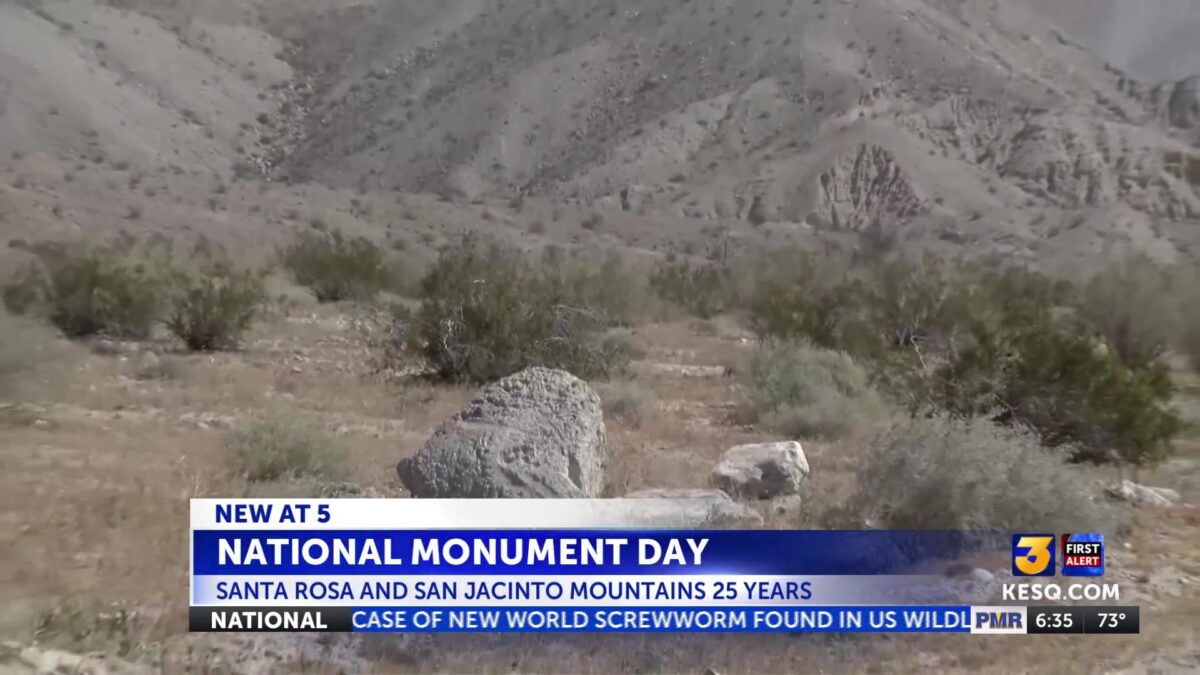
Santa Rosa and San Jacinto Mountains National Monument celebrates 25 years of conservation

Raymond Kalra

PALM DESERT, Calif. (KESQ) – Nearly 280,000 acres of protected land sit right in the Coachella Valley’s backyard. For 25 years, the Santa Rosa and San Jacinto Mountains National Monument has helped preserve some of the region’s most recognizable landscapes.

On Friday, community members, conservation leaders, and those who helped establish the monument gathered in Palm Desert to celebrate its legacy and look ahead to the challenges of protecting the land for future generations.

The celebration at the Santa Rosa and San Jacinto Mountains National Monument Visitor Center featured guided hikes, educational programs, family activities, and a time capsule installation commemorating the milestone.

Established by Congress on October 24, 2000, the national monument protects approximately 280,000 acres of desert landscapes, rugged mountains, wildlife habitats, and culturally significant sites.

Looking back at 25 years of protection

Former Congresswoman Mary Bono, who represented the region when the monument was established, returned Friday to reflect on the effort that brought federal protection to the mountains.

Bono said the designation was made possible through collaboration among environmental advocates, developers, local leaders, and other community stakeholders.

“It was important because there were a lot of people who care deeply about these lands. They wanted to preserve them,” Bono said.

She emphasized that bringing different interests together was an important part of the process.

“We wanted everybody to have a seat at the table,” Bono said. “It’s not only what we did, it’s how we did it. It was such a collaborative process.”

Looking back more than two decades later, Bono said the monument has exceeded her expectations.

“I think the monument has done more than what I’ve envisioned,” Bono said, adding that it has become an attraction for visitors to the region.

Conservation efforts continue across the valley

While the monument’s designation marked a major milestone in protecting the region’s natural resources, local conservation organizations say their work is far from finished.

Tammy Martin, executive director of Friends of the Desert Mountains, said her organization has helped protect more than 63,000 acres throughout the Coachella Valley and currently owns approximately 18,000 acres.

“We’ve helped protect over 63,000 acres here in the valley, and we currently own about 18,000 acres,” Martin said.

Martin said the organization recently completed the acquisition of another ten parcels as part of its ongoing conservation efforts.

She has also witnessed significant changes in public interest and participation over the past two decades.

When she first arrived in the area 22 years ago, Martin said fewer people were visiting the monument and participating in outdoor activities. Today, increased demand has contributed to expanded parking, educational opportunities, and volunteer involvement.

But increased visitation also brings challenges.

Martin identified climate change and illegal dumping as two major concerns facing the region’s protected landscapes.

She said discarded trash, appliances, and other materials can damage the environment that conservation groups have worked to preserve.

The organization continues to focus on educating visitors about native plants, wildlife, and responsible recreation.

Balancing development and conservation

As Palm Desert and the surrounding Coachella Valley continue to grow, local leaders say protecting open space remains an important consideration.

Palm Desert Mayor Evan Trubee said the monument offers residents and visitors access to outdoor recreation while helping preserve the natural landscape surrounding the city.

“Everybody who visits our valley, everybody who lives here gets to wake up and enjoy the splendor of our local mountains,” Trubee said.

The mayor pointed to the Coachella Valley Multiple Species Habitat Conservation Plan as an important tool for balancing development with environmental protection.

Trubee said established conservation boundaries provide greater clarity about where development can take place.

“We’ve already established the boundaries,” Trubee said. “The balance has already been struck, I think. And we’re benefiting from that.”

He also highlighted the city’s partnership with Friends of the Desert Mountains, which helps maintain trails and remove debris within Palm Desert.

According to Trubee, the city contracts with the organization annually to help keep local trails clean and accessible for residents and visitors.

Protecting the next 25 years

For former national monument manager Jim Foote, who began his role in 2006, protecting the landscape has always required cooperation among agencies, conservation organizations, and the public.

Foote recalled the challenges of coordinating management efforts with broader habitat conservation planning throughout the Coachella Valley.

He said one of the most significant changes he has witnessed is the growth of Friends of the Desert Mountains and its volunteer network.

Looking toward the future, Foote hopes residents recognize the importance of preserving the land while continuing to enjoy its recreational opportunities.

“I would hope that people would gain and hold on to that respect and just treat the land gently and leave it as they found it,” Foote said.

Martin said educating younger generations will also play a critical role in protecting the monument over the next 25 years.

Friends of the Desert Mountains operates youth education programs that bring students directly onto protected lands to learn about conservation and the natural environment.

The organization provides transportation and supplies to help students experience the landscape firsthand.

For community member Saida Hernandez, Friday’s celebration was an opportunity to visit the monument’s visitor center for the first time and recognize the natural beauty surrounding the Coachella Valley.

“It means a lot because the thing is, like, it’s the history of the Coachella Valley,” Hernandez said.

She hopes more residents will take advantage of the opportunity to explore the mountains while respecting the land.

“Come out to nature. Like explore your own backyard,” Hernandez said. “It’s free too. So it’s just beautiful.”

As the national monument celebrates its 25th anniversary year, conservation leaders say preserving the landscape for the next generation will require continued education, responsible recreation, and cooperation throughout the Coachella Valley.

Residents can learn more about the Santa Rosa and San Jacinto Mountains National Monument, including hiking opportunities, educational programs, and volunteer opportunities, by visiting DesertMountains.org.

Click here to follow the original article.

Missouri moving to flat, seven-digit license plate

Matthew Sanders

COLUMBIA, Mo. (KMIZ)

Missourians will get flat license plates instead of the current plates with raised numbers and letters, starting in February.

The Missouri Department of Revenue announced the change in a news release Friday. The department says switching away from the current embossed plates “supports greater efficiency” and lays the groundwork for moving to seven-digit license plates.

“We are running out of six-digit configurations for plates; this move not only saves taxpayer dollars but prepares for the future,” DOR Director Trish Vincent said in the news release.

The change will start with the implementation of a new software system called FUSION in February 2027, except for motorcycles and specialty plates. DOR says any plates that are replaced before then will be in the current, six-digit design, but they will be flat.

Click here to follow the original article.

Idaho Fish and Game implements cyber precautions following national PHP vulnerability warning

Seth Ratliff

IDAHO FALLS, Idaho (KIFI) — Following nationwide cybersecurity alerts, the Idaho Department of Fish and Game is taking precautionary measures to secure its website and online services.

Thursday, IDFG announced it had temporarily replaced the site’s full functionality with a minimal, static webpage to minimize the risk of a potential security vulnerability.

The security flaws, dubbed “PHP2Shell,” were originally discovered earlier this year by cybersecurity researchers using AI-assisted analysis tools, who reported the issues to the PHP development team.

On Wednesday, Oct. 21, 2026, open-source software provider PHP, short for PHP: Hypertext Preprocessor, issued an emergency patch to protect from the vulnerabilities. However, by Friday, the provider warned of another unpatched security concern.

In response, the National Security Agency advised organizations, including state agencies, to immediately take vulnerable systems offline, enhance network logging, and retire outdated software.

IDFG is following these national cybersecurity guidelines to safeguard public data and maintain system stability.

What’s Working for Idahoans

Despite temporary site limitations, Fish and Game’s website still provides important information for hunters and anglers, including seasons and rules brochures, public comment opportunities, access to our licensing website, hunter education opportunities, and IDFG contact information.

“Thank you for your patience as we work to ensure the IDFG website remains safe, stable, and reliable,” the agency shared in a statement. “To receive up-to-date information on the status of the website, follow us on Facebook, X, Instagram, and Threads.”

Idahoans with questions or in need of information not currently on the site are encouraged to call or visit their local regional Fish and Game office.

Headquarters (Boise): 600 S. Walnut Street | (208) 334-3700 Panhandle Region (Coeur d’Alene): 2885 W. Kathleen Ave. | (208) 769-1414 Clearwater Region (Lewiston): 3316 16th St. | (208) 799-5010 Southwest Region (Nampa): 15950 N. Gate Blvd. | (208) 465-8465 Southwest Region (McCall): 555 Deinhard Lane | (208) 634-8137 Magic Valley Region (Jerome): 324 South 417 East – Suite 1 | (208) 324-4359 Southeast Region (Pocatello): 1345 Barton Road | (208) 232-4703 Upper Snake Region (Idaho Falls): 4279 Commerce Circle | (208) 525-7290 Salmon Region (Salmon): 99 Hwy. 93 N. | (208) 756-2271 Click here to follow the original article.

Defense lawyers in Charlie Kirk’s killing want a 2029 trial. Kirk’s widow calls that ‘out of line’

CNN Newsource

By Michelle Krupa, Andi Babineau, CNN

Provo, Utah (CNN) — A ruling on the trial date for the man charged with killing conservative activist Charlie Kirk will come next month, a Utah judge declared Friday.

Judge Tony Graf said he had intended to issue his ruling Friday but wanted additional time to analyze new “data points” brought up during Friday’s hearing about a timetable for the trial.

Ahead of the hearing, Kirk’s widow lambasted defendant Tyler Robinson’s request for jury selection to start in the second half of 2029, calling it “grossly out of line.”

The trial should be set for 2027, Erika Kirk’s lawyer wrote in a sharply worded filing asking a state judge in Utah to reject the defense’s proposed timeline.

“Every additional day of delay carries the weight of all that Charlie’s murder has taken from his family, especially his two young children who were just three and one year old when their father was murdered and would be seven and five years old by the time a verdict is handed down under the Defense’s proposed schedule,” Kirk’s motion reads.

The state wants an early 2028 start date for the trial it expects to last 17 weeks, its scheduling memo shows.

Before the hearing, the president took to Truth Social to criticize the judge.

Robinson, 23, who is accused of fatally shooting Charlie Kirk during a 2025 university event for his nonprofit Turning Point USA, has pleaded not guilty to seven counts, including aggravated murder and felony discharge of a firearm causing serious bodily injury.

Prosecutors intend to seek the death penalty if he is convicted of the murder charge.

Robinson’s lawyers want the trial to begin in the third quarter of 2029, with quarterly motion hearings until then “specifically devoted to assessment of the continuing viability of beginning trial during the third quarter of 2029,” they state in a scheduling memo. They need the time, they argue: to meet the high bar of a dual-phase capital case; to prepare for “critical” jury selection; to coordinate with expert witnesses; likely, to spar more over DNA and further ballistics testing; and to sift 31,000 files of evidence.

Erika Kirk takes issue with the last point: “This perverse position, that the more evidence the state has accumulated the more need for delay, is not found in the law,” her request for a speedy trial notes.

Prosecutors, meantime, believe the trial could start much sooner. Citing similar tasks as the defense, they could be ready by October 4, 2027, their court memo states. Still, they propose a start date of January 31, 2028, because “the State does not believe that it is wise to schedule the trial to span the worst of the winter season and the Thanksgiving and Christmas holidays,” their filing says.

Kirk also took issue with another point. “You know who doesn’t get to spend time with their family over the holidays? Charlie,” Kirk’s attorney, Jeffrey Neiman, told the court.

Both parties estimate the trial – from the start of jury selection to the close of any capital punishment phase – will stretch for months: six to seven months, Robinson’s defense has said; four months, per the state.

Graf asked attorneys to submit additional information to him as he considers his ruling, including start and estimated end dates for any other trials they currently have scheduled, when those trials were docketed, and what priority they take in their courtrooms.

The judge scheduled the next hearing for November 9.

This story has been updated with additional information.

The-CNN-Wire™ & © 2026 Cable News Network, Inc., a Warner Bros. Discovery Company. All rights reserved.

Click here to follow the original article.