Stroke survivors, caregivers invited to support summit at UMC

Gabrielle Lopez

EL PASO, Texas (KVIA) — Having a stroke can be a scary experience, which is why University Medical Center of El Paso (UMC) is providing a summit this weekend advocating for better outcomes for stroke survivors.

UMC said the event is free and open to the public for a day of expert education. It will take place Saturday from 9 a.m. to 1 p.m. at the Starlight Event Center (6650 Continental Dr.). While the event is free, UMC provided a website to secure a spot to attend.

The summit is a step forward from what UMC provides in stroke care, the hospital said.

“I think each testimonial will be an inspiration to all of our guests because each experience is unique,” said Carla Escobar from UMC.

Maggie Whittam, a stroke survivor, will bring her perspective on navigating life after a stroke. Whittam survived a brainstem stroke at 33 years old, which resulted in permanent physical and visual disabilities. She’s now working on a documentary, “The Great Now What,” about resilience in the aftermath of a health crisis.

Escobar hopes sharing stroke survivors’ stories at the summit will help other survivors and caregivers.

UMC said it has more than 700 stroke patients. Strokes are a disabling condition that created long-term impairments with up to years of recovery.

Stroke survivors will attend the summit to share their personal journeys to inspire others in rehabilitation.

Beyond the summit, UMC said it has a mobile stroke unit and monthly support groups.

Click here to follow the original article.

Consumer advocates warn Missouri lacks data center cost safeguards, but regulators disagree

Haley Swaino

COLUMBIA, Mo. (KMIZ)

Large-scale data center projects are popping in rural areas of Mid-Missouri, and opposition has formed to battle them.

However, local opponents so far have had little success in stopping tech giants such as Amazon and Google from building in Mid-Missouri.

Among the major concerns cited by opponents of data centers is the huge energy demand of many of these facilities. Will that demand drive up costs for regular consumers?

The Consumers Council of Missouri believes state regulators do not have strong enough safeguards in place to ensure data center power costs are not falling back on the average Missouri ratepayer.

“The decision makers in Missouri have tended to err on the side of promoting data centers rather than protecting the public,” Consumer Council of Missouri Executive Director John Coffman said. “It’s an ongoing regulatory battle.”

Coffman teaches energy utility law as an adjunct professor at Washington University in St. Louis, and represents the Consumers Council as a consumer advocate attorney, fighting for lower electric rates for residential consumers across the state.

“We [the Consumers Council] really hope that everyday residential households are the priority for our electric system,” Coffman said. “But as these data centers are being built out in a very sudden rate, the power companies are trying to plan ahead and building a whole new fleet of power plants. And so we’re expecting many new power plants over the next few years. And that’s going to bring a lot of stresses.”

Coffman has attended several forums and discussions with private utility Ameren Missouri regarding data centers, where he has continued to advocate for tighter utility regulations. He said he is already seeing an increase in power plant demand drive up electric rates.

“There is a demand for power plant component parts. There’s a demand for power plant construction workers. And this is raising the price of building power plants,” Coffman said. “That is happening right now, even before the data centers are online and part of the grid.”

ABC 17 News asked Ameren if recent or near-future spikes in rates are directly or indirectly tied to data centers.

“As we upgrade aging infrastructure, as we harden our system, as technology improves and we can more efficiently run a system that’s more reliable, that obviously takes investment within the system,” Senior Manager of Economic Development for Ameren Missouri James O’Mara said. “And so investing in new poles and wires and switches, more smart equipment, all of that is the investment that’s driving some of those rate adjustments.”

Ameren is seeking a rate hike of about 10% in 2027, it announced in a July 1 press release. Ameren filed a request with the Missouri Public Service Commission for a $343 million annual electric base rate increase that could raise average residential bills by roughly $13 a month.

According to O’Mara, data centers are not the reason for that request.

“That’s just the general upgrades and investment that we’re doing to the grid to ensure we have that reliable and affordable network that our customers need,” O’Mara said.

He noted that rate increases are common, as improvements are being made across the entire grid.

But the Consumers Council said these “improvements” are linked to what’s needed for data centers, and regardless, come at a time when the centers are predicted to drive up demand for energy in Missouri.

“There is an expectation that energy demand is going to double over a very short amount of time and that data centers could be as much as 50% of the load someday,” Coffman said.

With such high data-driven projections, the council has urged state regulators to be precise in planning for the boom.

The role of ‘large-load tariffs’

The biggest point of contention for the council is the requirements outlined in Ameren Missouri’s large-load data center tariff. The Missouri Public Service Commission unanimously approved the contract in November 2025, and it went into effect on Dec. 4.

The agreement aims to shield customers from larger bills that could come from “large load customers” like data centers. The contract defines such customers as using 75 megawatts or more of energy per month.

These are some of the requirements of large load customers outlined in the contract:

Sign a minimum 12-year contract with Ameren, with an option to extend the contract for five more years if the company scales up operations. Cover full grid hookup and infrastructure costs upfront. Pay a monthly demand charge set at 80% of their contracted maximum electric demand, even if they use less electricity than projected. Provide collateral funds equal to two years of minimum monthly bills, in the event of bankruptcy or closure. Give 36 months’ written notice to end service and pay exit and early termination fees.

Similar protections were built into Ameren Missouri’s Powering Missouri Growth Plan. The plan, which was approved by the Public Service Commission in November 2025, is designed to ensure high-usage customers pay their fair share.

But the Consumers Council prefers much stricter rules. The consumer advocacy organization urged the Public Service Commission to require 15- to 20-year contract terms, a monthly demand charge of 95%, and 10 years’ credit and collateral.

Under the large-load tariff, Ameren is also allowed “at its sole discretion” to aggregate loads and to grant variances without PSC approval. The Consumer Council opposes this, citing the need for regulatory oversight.

“There have been some rules, some guardrails put in place to make sure that data centers pay their fair share. But we’re not sure that those guardrails are good enough. We’ve proposed more protective conditions,” Coffman said.

Rich Germinder, senior policy adviser at the PSC, said the White House Ratepayer Protection Pledge and Missouri Senate Bill 4 helped lay the groundwork for consumer protections.

Gov. Mike Kehoe signed Senate Bill 4 into law in April 2025. It changed the way the Public Service Commission deals with electric rates and the adoption of electric facilities in Missouri.

“One of the key components related to Senate Bill 4 was changing the integrated resource planning process,” Germinder said. “Basically, understanding that we’ve, for the first time in several decades, have had large-load growth. So what do we need to do from a planning perspective to be more prepared?”

A critical component of the bill was the adoption of the large-load tariff requirement. The law requires Missouri’s investor-owned utilities to establish a contract with the Public Service Commission for the procurement of utility or electric services. Germinder said the tariff ensures better planning and collaboration upfront.

“How do they deal with these large loads, these really large customers that use a lot of energy, use a lot of resources,” Germinder said. “What are the terms and conditions that we need to have in place in order for those customers to come onto the system to protect other ratepayers?”

Consumer protections are also being discussed at the federal level with the Ratepayer Protection Act.

“It largely follows that same kind of model of establishing parameters for when you have large load come on that requires significant investment,” Germinder said. “That they’re paying their share upfront, that the residential ratepayers or the commercial ratepayers are not being saddled with the cost to serve that additional large load.”

Even though these new laws have outlined some safeguards, Coffman said the rate at which large data centers are popping up across Missouri is worrisome.

Public records detail more than a dozen large-scale data center projects in the Show-Me State, with multiple proposed or under construction across Mid-Missouri.

At least five large-scale centers are already up and running. Two in St. Louis — an H5 data center and a TierPoint data center — and three in Kansas City — two DataBank data centers and a Meta data center.

A Google data center is being built in New Florence in Montgomery County. The project includes a $15 billion infrastructure investment from the tech giant, Kehoe announced in May.

Google also announced a $20 million energy impact fund to support programs to drive down monthly energy bills to households in Missouri, previous reporting says.
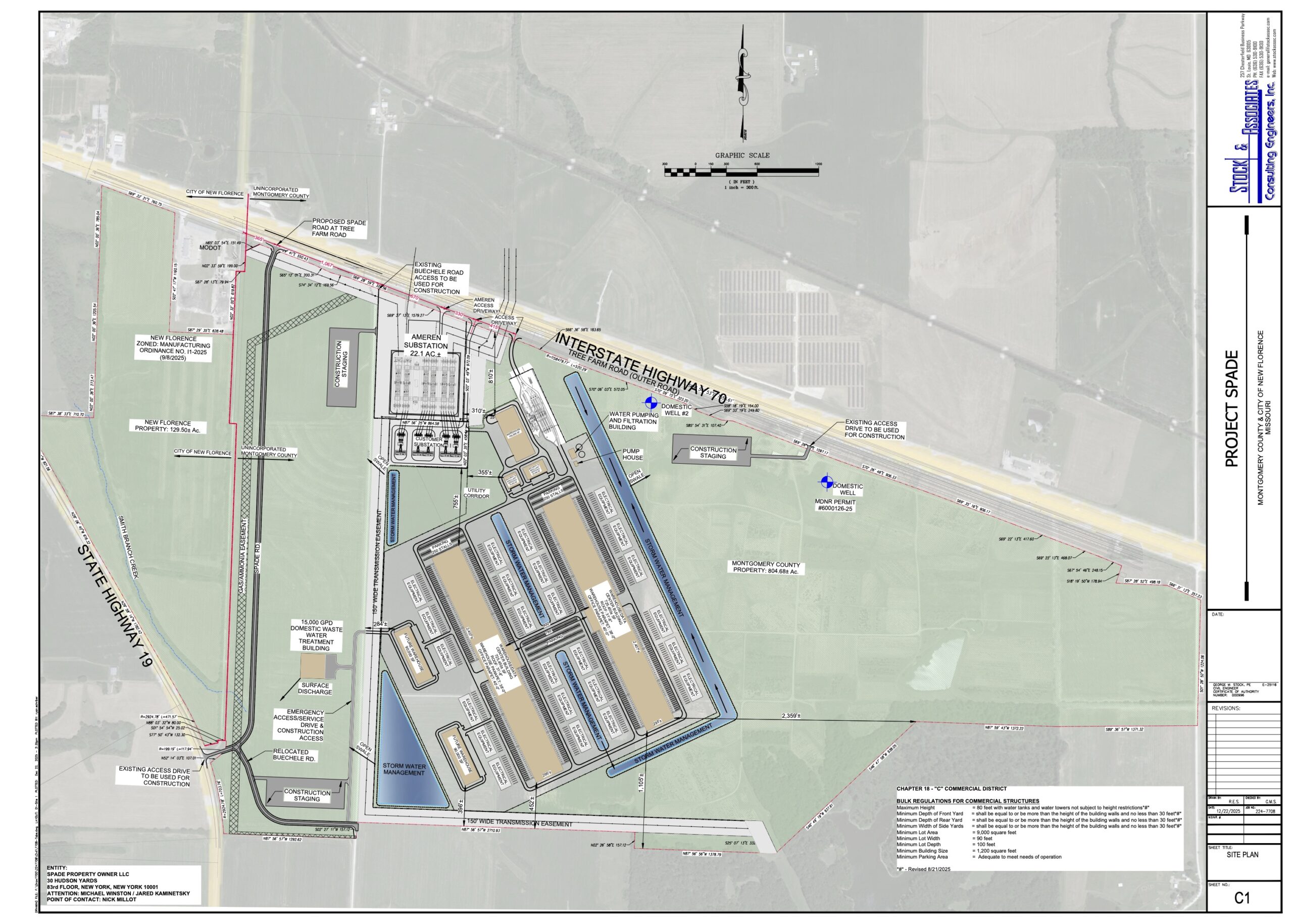
Map detailing plans for Project Spade, a massive, $15 billion data center site in New Florence in Montgomery County. [Courtesy: Project Spade]

The more than 900-acre campus will house about 1.5 million square feet of physical facility space, project documents say. The multi-building operation is set to target a whopping 1.2 gigawatts of utility and power capacity through Ameren.

Construction on Google data center in New Florence in Montgomery County on Oct. 14, 2026. Construction on Google data center in New Florence in Montgomery County on Oct. 14, 2026.
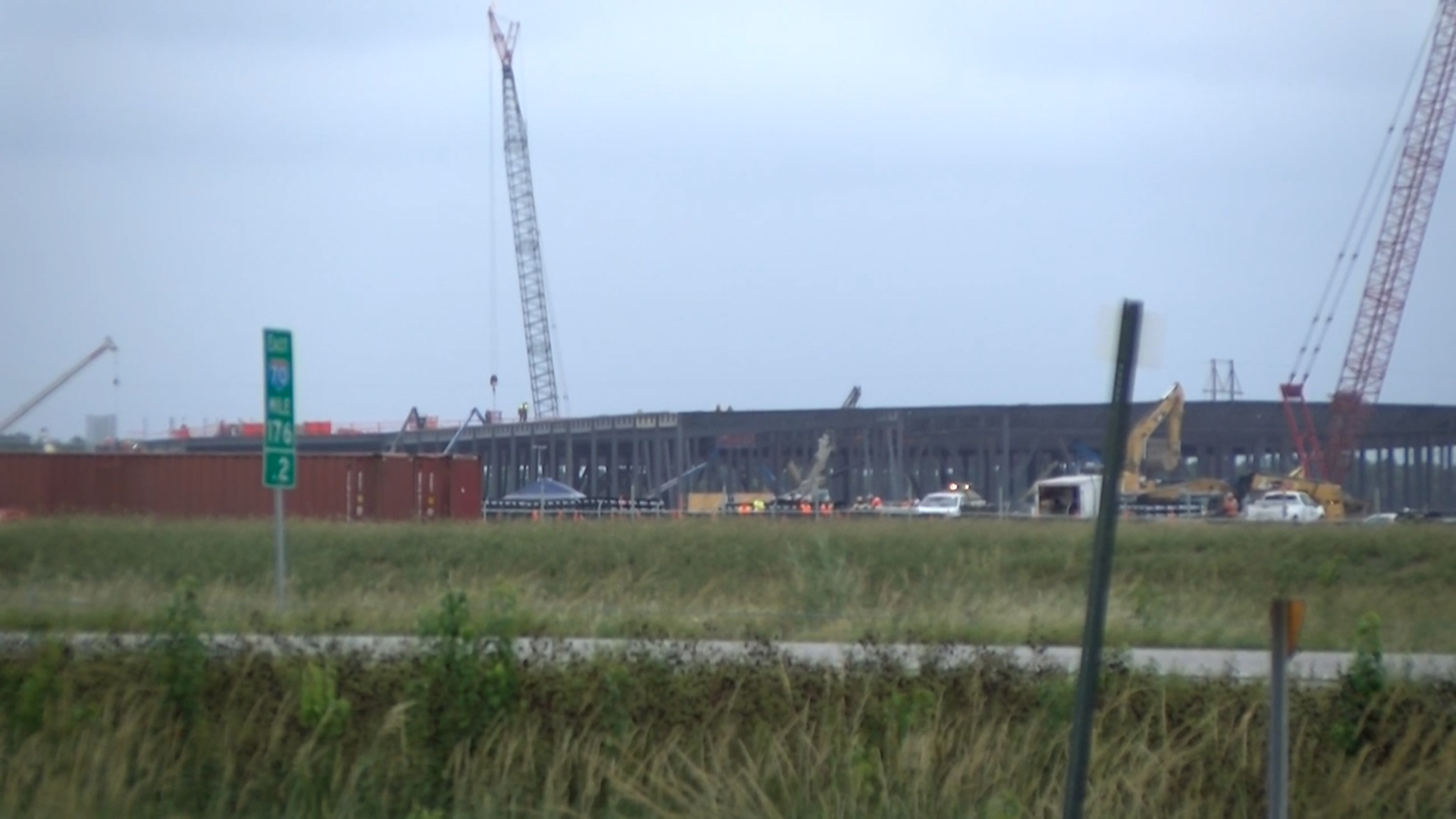
Just across Interstate 70, an Amazon Web Services data center is also under construction in New Florence.
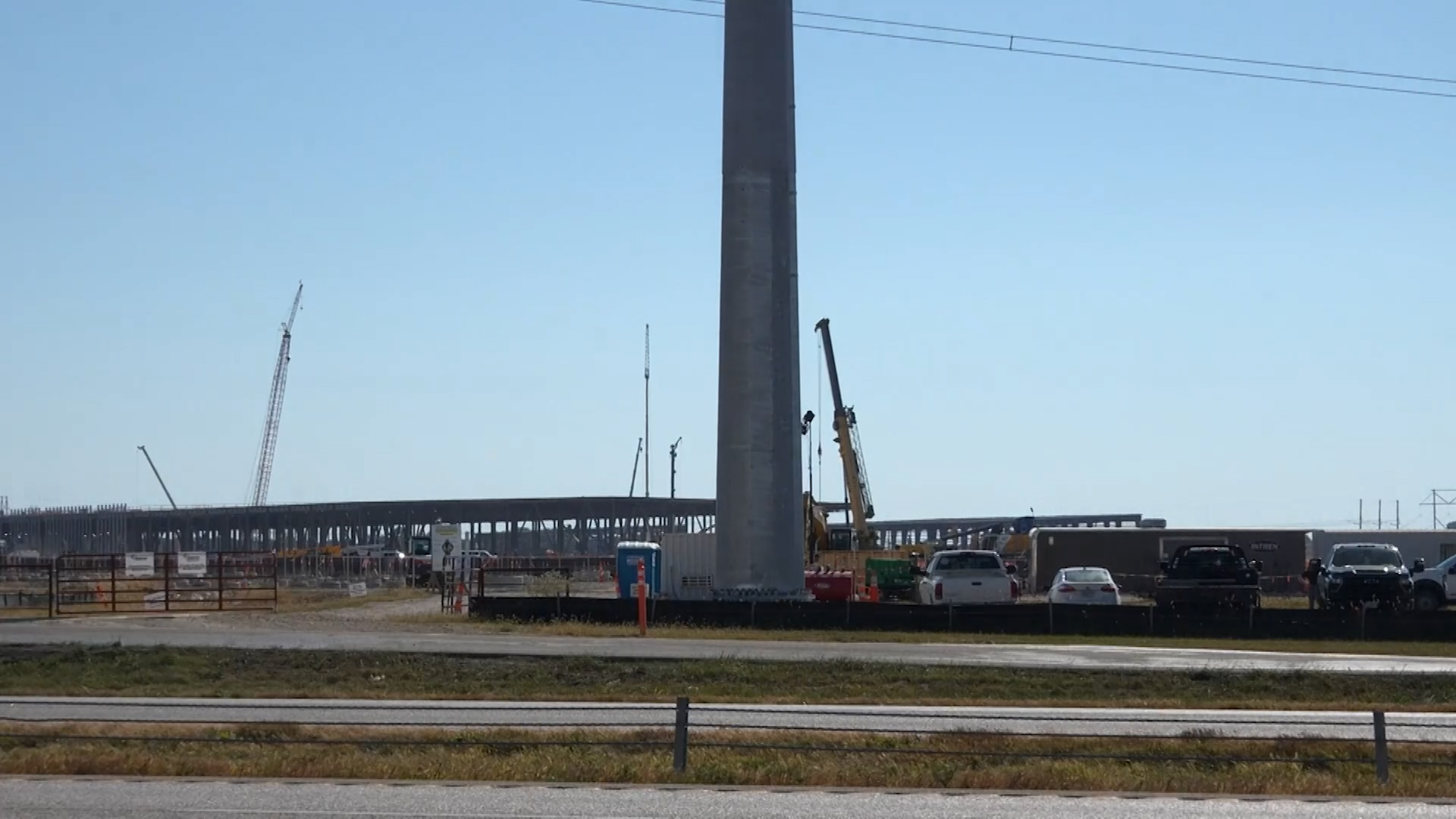
Construction on Amazon data center in New Florence in Montgomery County on Oct. 22, 2026. Construction on Amazon data center in New Florence in Montgomery County on Oct. 22, 2026.
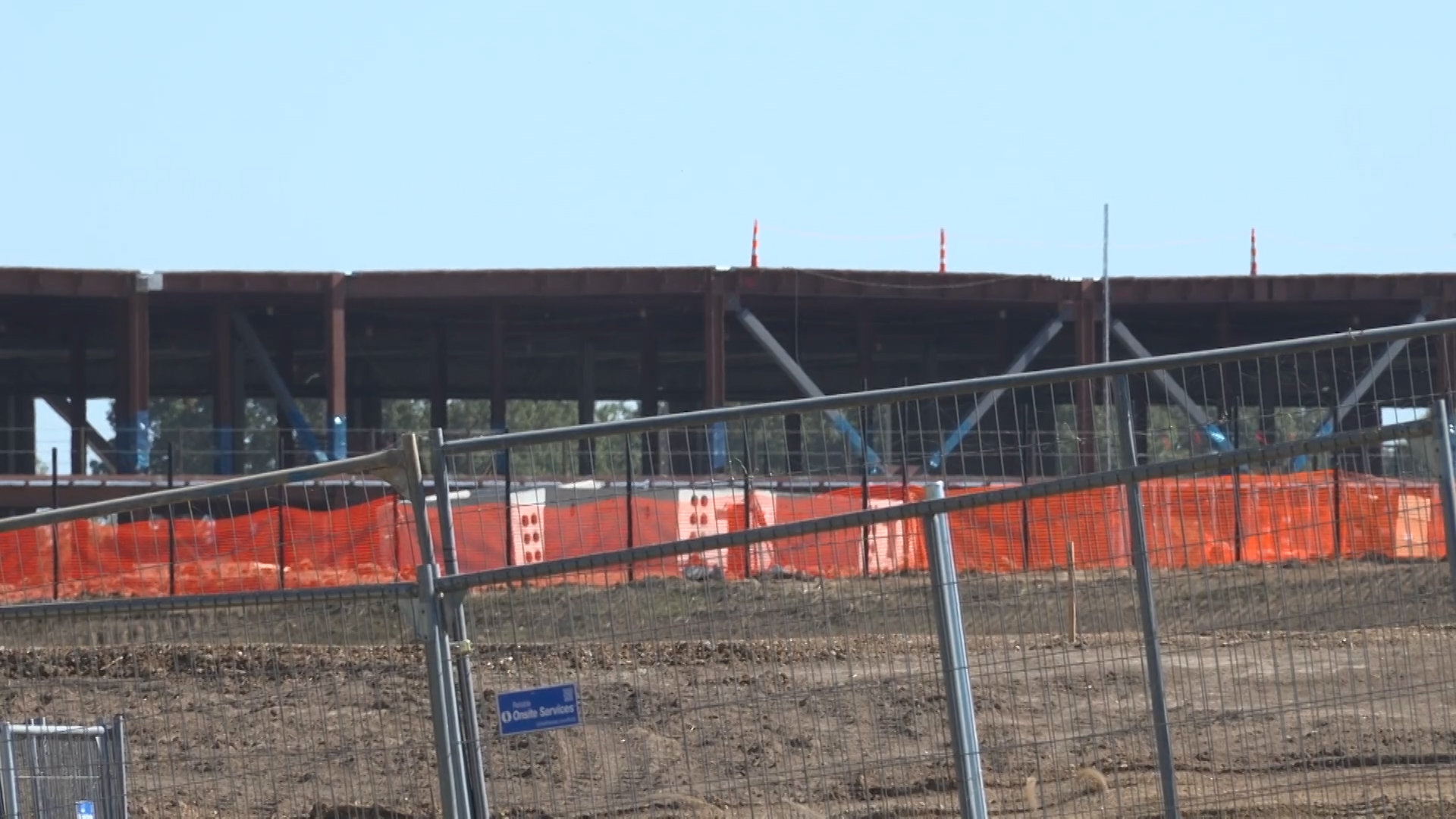
The $10 billion Amazon data center campus spans roughly 1,000 acres, according to project documents.

At least 10 data centers have been proposed in Missouri over the past year:

Amazon Web Services data center near Danville in Montgomery County Crusoe data center in northern Callaway County NSIC6 LLC data center in Warsaw in Benton County Nebius AI data center in Independence in Jackson County NSIC6 LLC data center in Springfield in Greene County Wildwood Ranch data center in Joplin in Jasper County Lumon Solutions data center in Marshfield in Webster County Two data center proposals in Nodaway County Armory Innovation data center at the former Armory site in St. Louis

Coffman said there has been continued controversy surrounding a possible data center near the old St. Louis Armory.

“The city has put in place some protections that are greater actually than any other data center in the state with regard to environmental and noise type issues,” Coffman said.

Coffman said the center would be methodically placed next to a substation.
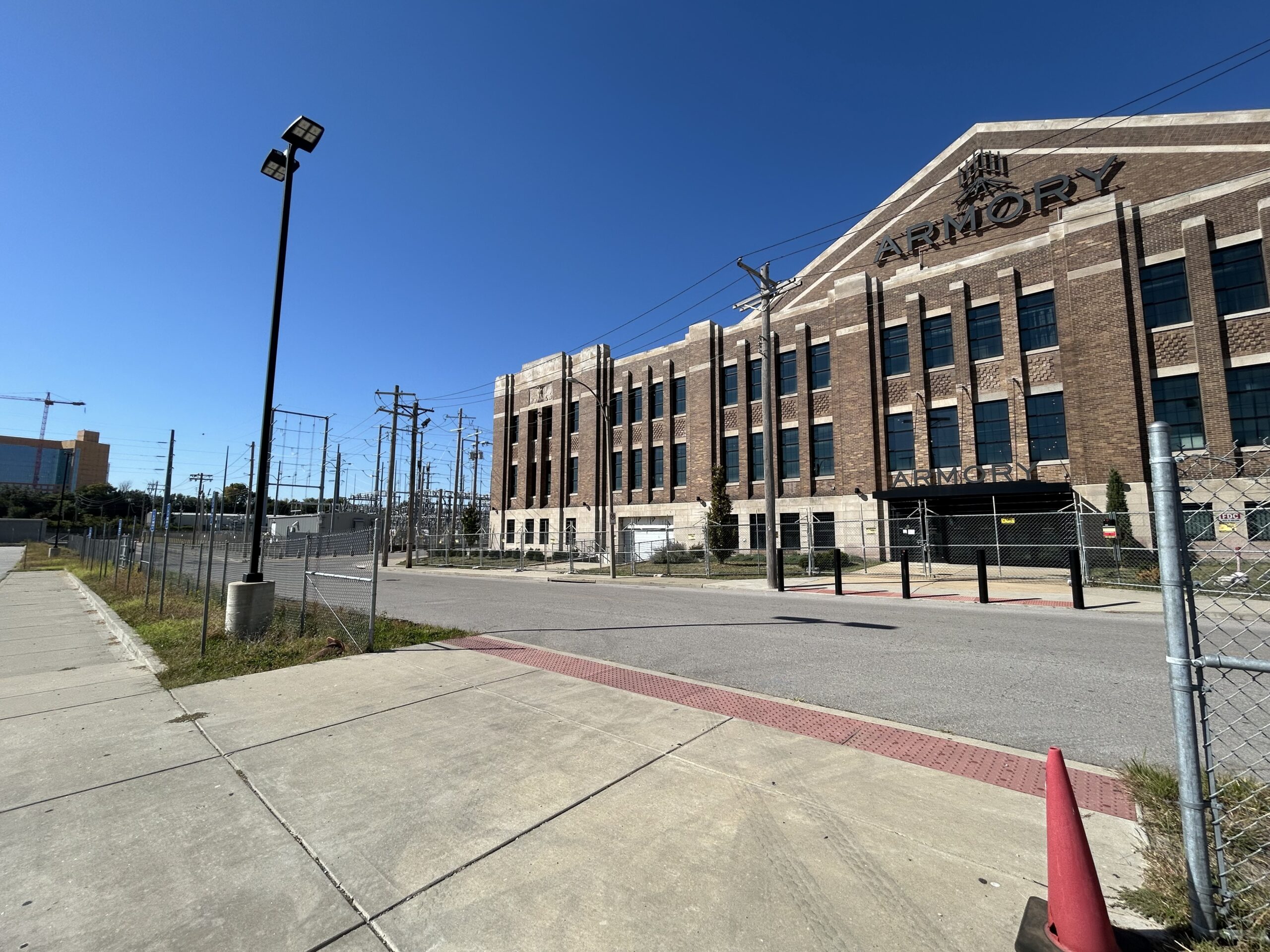
Site of a proposed data center near the historic St. Louis Armory on Oct. 8, 2026. [Haley Swaino/KMIZ]

Under Conditional Use Provisions, the center promises to prioritize the environment, community and finances.

The proposal says the center would source at least 50% of energy from renewables within five years, fully enclose noise equipment in acoustically-treated structures, immediately collect full property tax revenue with no public subsidies and hire St. Louis residents first. Armory Innovation Data Center leaders claim there would be financial penalties for non-compliance.

But across Missouri, who ensures state regulators are in compliance with their safeguard promises?

Ameren and Evergy are regulated by the Public Service Commission.

“They’re ensuring that we’re we’re living up to these agreements. They’re ensuring that we live up to Senate Bill 4 and the law that’s been established. And additionally, we have designated teams that ensure compliance for these customers,” O’Mara with Ameren Missouri said.

‘Left holding the bag’?

ABC 17 News asked the Public Service Commission how cost oversight works there. Germinder said the commission works to ensure fairness across all parties and will hold rate case hearings should need be.

“The large-load tariff dictates out the contract between the utility and the customer,” Germinder said. “And then when the utility company comes in for a rate case, all the intervening parties, the Office of Public Counsel, other parties that are interested in the construction of utility rates for investor-owned utilities in Missouri, would have an opportunity to intervene and have their say on, ‘What is the company proposing to implement in this particular rate case and what do we think is appropriate? Where should those costs be assigned?'”

The commission is considering rules to fully implement the changes to its integrated resource planning process, according to Germinder.

“We’re hoping to get those in place as soon as possible so that when utilities come in with their integrated resource plans, that we are having as robust and thorough and thoughtful conversations around the needs to meet the services and to meet the needs of Missourians,” Germinder said.

Coffman remains unconvinced that state regulators are as prepared as they can be.

“There is a lot of concern about what happens if things don’t go as planned,” Coffman said. “What if not all of the data centers come online or come to fruition? And yet the power plants have already been built to pay for those extra power plants, that extra generation capacity. That’s something that could really come back on the public generally.”

While contractually, large-load customers must provide collateral and three-year notice of closure, Coffman said it’s the power plants that could still leave residents to foot the bill.

Coffman worries the “AI bubble” could burst, creating a risk of a sudden market crash if corporate profits fail to match high spending levels.

“We don’t want to be left holding the bag. We don’t want to have higher rates just because of this big push to data centers,” Coffman said.

Some counties have halted data center discussions until more regulations can be put in place.

In Mid-Missouri, Pettis County recently passed a temporary moratorium on data center development. An Oct. 15 press release from the county commission says the moratorium will remain in place “until an economic development study, an environmental impact study, or both, as determined necessary by the Commission, have been completed and the Commission has had a reasonable opportunity to review the findings and consider recommendations.”

The Public Service Commission said changes to how it approaches planning for large-load customers at the state level have set projects like data centers up for success.

As the integrated resource planning process operates now, when a utility submits a plan to the commission, the commission doesn’t have any authority to approve the plan or to disprove components of the plan. The new process would be a contested one, where the commission would be able to make feedback-driven decisions in determining whether a plan is sufficient to meet the needs of customers, safely and at a reasonable rate.

“If the utility has submitted a plan that is insufficient, there will then be a path to correct those deficiencies or to make sure that the utility doesn’t have the opportunity to move forward,” Germinder said.

Overall, the PSC feels changes made to get ahead of the AI boom will prove sufficient.

“I think it’s going to be interesting to see how the policies that are implemented play out over time. No one can predict the future, but you have to be prepared for it. And so we’ve put in the mechanisms in place to be better prepared,” Germinder said.

Click here to follow the original article.

Man accused of making threats at West Broadway Gerbes

Ryan Shiner

COLUMBIA, Mo. (KMIZ)

A Hallsville man was arrested and charged after he allegedly made threats against employees at the Gerbes on West Broadway in Columbia on Friday.

David Komosa was charged with unlawful use of a weapon, armed criminal action and three counts of misdemeanor fourth-degree assault. His bond was set at $10,000 and he was not listed on the Boone County Jail on Monday.

A condition of his bond is that he is not allowed to be on the premises of any Gerbes store in Columbia, court filings say. An initial court appearance is scheduled for 1:30 p.m. Tuesday, Nov. 17.

The probable cause statement says police were called to the West Broadway Gerbes at 7:38 p.m. Friday.

A security member allegedly told police that Komosa was at the bar at the store when he started “throwing items and breaking things and attempting to fight people,” the statement says. Komosa was described as a “regular at the bar,” and was known by staff.

Three employees escorted Komosa out of the store and he allegedly made additional threats and waved what two people thought was a “long gun,” though police later determined that it was a tire iron “that looks similar to a long revolver,” the statement says. A witness allegedly heard Komosa mention he had a gun in his car while he was being escorted out, court documents say.

Multiple people claimed Komosa threatened to run over one of the victims with his car, court documents say.

The bar manager told officers that Komosa became angry after an argument at the bar and started throwing items and broke his glass, court documents say.

Komosa allegedly told police that he was upset after hearing someone make a joke about someone with mental health issues, the statement says.

Click here to follow the original article.

Mayors’ International Bike Ride celebrates 10 years of bringing communities together

Moses Femino

YUMA, Ariz. (KYMA) – The Mayors’ International Bike Ride celebrated its 10th year Saturday, bringing cyclists and communities together across the U.S.-Mexico border.

The free, family-friendly event began at Desert Hills Golf Course in Yuma, taking riders through communities including Somerton, Gadsden and San Luis before offering participants the opportunity to cross into Mexico and finish in San Luis Río Colorado.

More than 500 riders registered for this year’s event, which brought together cyclists, mayors and elected officials from across the 4FrontED region.

Martin Porchas, chairman of the Yuma County Board of Supervisors, was mayor when the first ride took place. He said the event has grown beyond what organizers initially expected.

“It’s a good event that it brings the whole county together, plus our neighbors across the border,” Porchas said. “I remember we were probably about 100 [riders] when we the first year that we did it. We were excited. We knew it was going to grow, but we didn’t actually, you know, think that it was going to grow this big. But it’s been great.”

What began with approximately 100 riders has developed into a regional tradition focused on bringing people together across city and international borders.

The 10th anniversary highlighted the event’s continued growth and its role in showcasing the communities that make up the Yuma region and its neighboring communities in Mexico.

Click here to follow the original article.

Yuma swimmers shatter two school records at Saturday Night Fever Invite in Chandler

Wesley Williamson

YUMA, Ariz. (KYMA) – Four Yuma High School swimmers broke two school records, while Cibola High School athletes delivered several standout performances at the 2026 Saturday Night Fever Swim Invitational in Chandler Saturday.

Yuma High freshman Marcus Hancock, junior Roman Jacobo, and seniors Alonzo Fierro and Antonio Fierro set a new school record in the 200-yard medley relay, finishing in 1:59.58, topping the previous mark by more than four seconds.

The same foursome then broke the school record in the 200-yard freestyle relay, posting a time of 1:43.91 to beat the previous record by more than three seconds.

All four swimmers are baseball players for Yuma High coach Nick Johnson who joined the swim team to build strength and conditioning ahead of baseball season.

Under head coach Rebecca Treas, the group has shown significant improvement throughout the season as it looks toward a potential state championship appearance.

Meanwhile, the Cibola Raiders competed against a field of more than 30 teams at the invitational, with several swimmers turning in impressive performances.

The boys 400-yard freestyle relay team of Raul Grado, Luis Lopez, Bert Michel and Carlos Aguilar dropped approximately six and a half seconds from its seed time. The team is hoping the performance will be enough to qualify for the state championships.

On the girls side, Eleanor Hauck placed third in both the 200-yard individual medley and the 100-yard butterfly.

Lilly Nguyen finished seventh in the 100-yard butterfly and fourth in the 100-yard backstroke, while Madeline Hauck placed ninth in the 50-yard freestyle. Bailey Dusek also finished 11th in the 200-yard individual medley.

Cibola swimmers continued to make progress throughout the meet, including Olivia Angulo, who dropped more than four seconds in the 100-yard breaststroke to strengthen her chances of qualifying for state. Nicole Lukacinsky also delivered a strong performance in the 100-yard backstroke.

With their regular-season meets complete, the Raiders will now wait for the remaining qualifying results to determine which swimmers advance to the state championships.

The top 40 individual swimmers and top 30 relay teams qualify for the state meet, scheduled for November 6-7 in Mesa, Arizona.

For both Yuma High and Cibola, the invitational provided an opportunity to measure progress against strong competition as swimmers look to finish their seasons on a high note.

Click here to follow the original article.

EPPD issues statement on social media post showing KKK-style robes

Gabrielle Lopez

EL PASO, Texas (KVIA) — Monday, the El Paso Police Department posted a statement regarding a social media post showing a “group of individuals in El Paso dressed in attire resembling.”

EPPD Chief Peter Pacillas issued the following statement below:

“The El Paso Police Department is aware of social media videos and reports of individuals, reportedly including young people, wearing Ku Klux Klan-style robes and allegedly shouting racial slurs while moving through a neighborhood in El Paso.

Symbols and language associated with the Ku Klux Klan represent a history of terror, violence and racial hatred. They have no place in our community. Treating that history as a costume or a joke is unacceptable and contrary to the values of respect and safety that define El Paso.

We are reviewing the available information to determine whether any laws were violated, including disorderly conduct or other applicable offenses. Free expression has limits when it crosses into conduct that threatens public order or safety of others. Anyone with information about this incident is encouraged to contact the El Paso Police Deparmtent.

Parents, families and community members play an essential role in teaching young people that hatred and intimidation have no place here. The EL Paso Police Department remains committed to protecting every resident, regardless of background, and to maintaining the safety and dignity of our neighborhoods.

We will continue to monitor the situation and take appropriate action consistent with the law and department policy.”

ABC-7 hasn’t independently verified the authenticity of the video.

Click here to follow the original article.

Yuma man arrested for alleged fraud scheme

Dillon Fuhrman

YUMA, Ariz. (KYMA) – The Yuma Police Department (YPD) said a man was arrested last week for an alleged fraud scheme.

YPD said they received a report of fraud from a local business back in July of this year.

The business told YPD they suspected a former employee stole over $1 million “through the unauthorized purchasing of mechanical parts from 2024 through mid-2026.”

During the investigation, YPD said their detectives “discovered approximately $2.8 million dollars was spent without authorization on merchandise which was later sold at a greatly reduced price on eBay and through direct delivery with payments through PayPal to individuals located throughout the Hemisphere.”

As a result of the investigation, YPD said they arrested a 40-year-old man Wednesday, October 21.

YPD also said the man was then booked into the Yuma County Detention Center on multiple felony charges, which includes trafficking in stolen property, theft and fraudulent schemes. He is being held on a bond of $200,000.

The investigation is ongoing. If anyone has information regarding the case, call YPD at 928-783-4421, or 78-CRIME at 928-782-7463 to remain anonymous.

Click here to follow the original article.

Against All Odds: Agua Caliente Chairman Jeff Grubbe focuses on tribe’s future

Angela Chen

COACHELLA VALLEY, Calif. (KESQ) — For generations, Native tribes across the Coachella Valley fought to preserve what remained after losing land, language and, in some cases, nearly their entire populations.

The Agua Caliente Band of Cahuilla Indians knows that history well.

Today, the tribe is one of the most influential forces in the Coachella Valley, with approximately 500 members and casino operations in Palm Springs, Cathedral City and Rancho Mirage. Yet Chairman Jeff Grubbe says his focus is not on the tribe’s successes today, but on what comes next.

“We’re not thinking about today. We’re thinking about tomorrow and the next generation,” said Grubbe.

In his first interview since being elected chairman this spring, Grubbe sat down exclusively with KESQ Morning Anchor Angela Chen to discuss his return to tribal leadership, the challenges facing Agua Caliente, and his vision for the future.

For a people who once fought simply to survive, the challenge now is different: How do you preserve prosperity, culture and opportunity for generations still to come?

Grubbe says the answer begins with remembering where the tribe came from.

“It wasn’t too long ago that we didn’t have the opportunities we have today. We have members who still remember living on Sectin 14 on dirt floors,” Grubbe said. “That’s always stayed with us and reminds us to make sure we don’t ever go back to that.”

The success enjoyed by Agua Caliente today stands in stark contrast to the hardships many tribal members experienced within living memory. The tribe’s economic growth over the past several decades has transformed both the reservation and much of the surrounding Coachella Valley.

But Grubbe says preserving culture remains just as important as building businesses.

The former chairman, who previously led the tribe from 2012 to 2022, points to ongoing cultural programs designed to ensure younger generations remain connected to their Cahuilla heritage, including weekly classes on basket making, language, preparing food, making bows and arrows, and more.

“It’s a cool mixture because it is the young ones, but it’s also you know we get some of our elders that start to participate and come back and they can remember things and offer their perspective of of their memories of how things were,” said Grubbe.

Those efforts come at a time when many tribes continue working to preserve traditions and languages that were threatened by generations of government policies aimed at assimilation and cultural eradication. Across the country, Native communities are rebuilding cultural practices that nearly disappeared.

An Unexpected Return

Grubbe’s return to leadership surprised some in the community.

After serving a decade as chairman, he relocated to the Dallas area to be closer to his wife’s family. Then, following Agua Caliente’s elections this past March, he was elected once again.

When asked about the election outcome, Grubbe emphasized that tribal governance is about the collective will of the membership, not any single leader.

“Our elections are are private. You know, we don’t really talk about it outside. And and I’ll say this: that not any one member is more important than any other member of this tribe,” said Grubbe. “It’s a tough question, but I think that it it it’s about the tribe. It’s not about me or any other chairman or any other future chairman, it’s about the tribe and will always be be about the tribe.”

Bringing Ideas Home

Grubbe says his four years away offered a valuable opportunity to observe how other tribal nations are expanding beyond gaming.

When Angela Chen asked what stood out to him while living in Texas and visiting tribes in neighboring states, Grubbe pointed to industries that could help diversify tribal revenue in the future.

“They’re manufacturing,” said Grubbe. “I don’t think we could do the farming type things. Obviously, not here in the desert, unfortunately. Energy energy projects. I think energy, especially in the state of California, there may be an opportunity to to be a player in the energy sector at some point.”

Business diversification is increasingly important as tribal governments look beyond casinos as their sole economic engine.

The Cost of Success

Even with the tribe’s economic strength, Grubbe says affordability remains one of the biggest concerns facing members.

Housing prices throughout the Coachella Valley continue to climb, creating challenges even for tribal members seeking to live within reservation boundaries.

“Our own members can’t afford to buy a home on the reserve within Palm Springs city limits specifically, even by the income that they receive. A 1,700 square foot house is over a million dollars, you know, which equates to a $6,000 house payment,” said Grubbe. “I mean that that blows my mind, you know, especially as a tribal leader. Like, how do we fix that, or what can we do to help that?”

Another concern is the future of the gaming industry itself.

Grubbe says tribes must be prepared for rapidly changing technologies and the growth of illegal online sports betting.

“There’s illegal sports baiting being operated in the state now, and it may have a minimal effect on on our businesses. But at some point, it’s it’s going to transition to that. So we need to be ready. We need to look, be prepared to, I think flip a switch where we will be offering online gaming at some point to be able to compete.”

As gaming evolves, Agua Caliente leadership is evaluating how to protect one of the tribe’s most important economic foundations while exploring new opportunities for growth.

Looking Ahead

The issues facing Agua Caliente today are dramatically different from those faced by previous generations. Instead of fighting for recognition or basic survival, tribal leaders are confronting questions about housing, economic diversification, energy development, gaming and groundwater rights.

Yet Grubbe says understanding the tribe’s history remains essential to understanding its future.

“it’s important for people to to learn and understand that you know we weren’t discovered. We’ve been here forever,” said Grubbe. “Coachella Valley is a big part of who we are, and we think every decision we make is how we can make this Coachella Valley better for not just the tribe but for everyone.”

For a tribe that survived centuries of hardship, the focus now is on ensuring the next generation inherits not only economic success, but a thriving culture, a strong community and a lasting connection to the land they have always called home.

Click here to follow the original article.

Crash with motorcycle shuts down downtown Columbia intersection

Ryan Shiner

COLUMBIA, Mo. (KMIZ)

A crash with a motorcycle led to a busy downtown Columbia intersection to be shut down on Monday afternoon.

Several emergency responders were at the corner of College Avenue and East Walnut Street after the crash. Boone County Joint Communications sent a notification indicating Walnut Street was closed at 2:07 p.m.

A Columbia police officer at the scene told ABC 17 News that the crash involved the motorcycle and another vehicle. An ABC 17 News reporter saw an SUV-type vehicle next to a damaged motorcycle that was on the ground.

A patient was being evaluated at the scene.

Police asked residents on social media to avoid the closed intersection.

Click here to follow the original article.

Multiple injured in rollover crash on Fourth Avenue in Yuma

Wesley Williamson

YUMA, Ariz. (KYMA) – Multiple people were injured after a rollover crash in Yuma Saturday morning. 

According to a press release by YPD, speed and intoxication appear to be a contributing factor in the crash.

The crash happened at 8:30 a.m. in the of Fourth Avenue and 18th Street, near Chevron.

YPD said a Honda driven by a 19-year-old man crashed into the rear of truck and then hit a curb, causing the car to roll onto its side and slide into another vehicle that was waiting to exit the Chevron parking lot.

The driver of the Honda was taken to Onvida Health and then flown to a Phoenix area hospital with non-life-threatening injuries.

The people in the other vehicle were taken to Onvida Health where they were treated and released.

There were no other reported injuries.

YPD encourages anyone with any information about this case to call 928-783-4421 or 78-CRIME at 928-782-7463 to remain anonymous.

Injury Collision 1800 Blk S 4th Ave 26-80046Download

Click here to follow the original article.