Friends of the Desert Mountains release 2025 impact report

City News Service

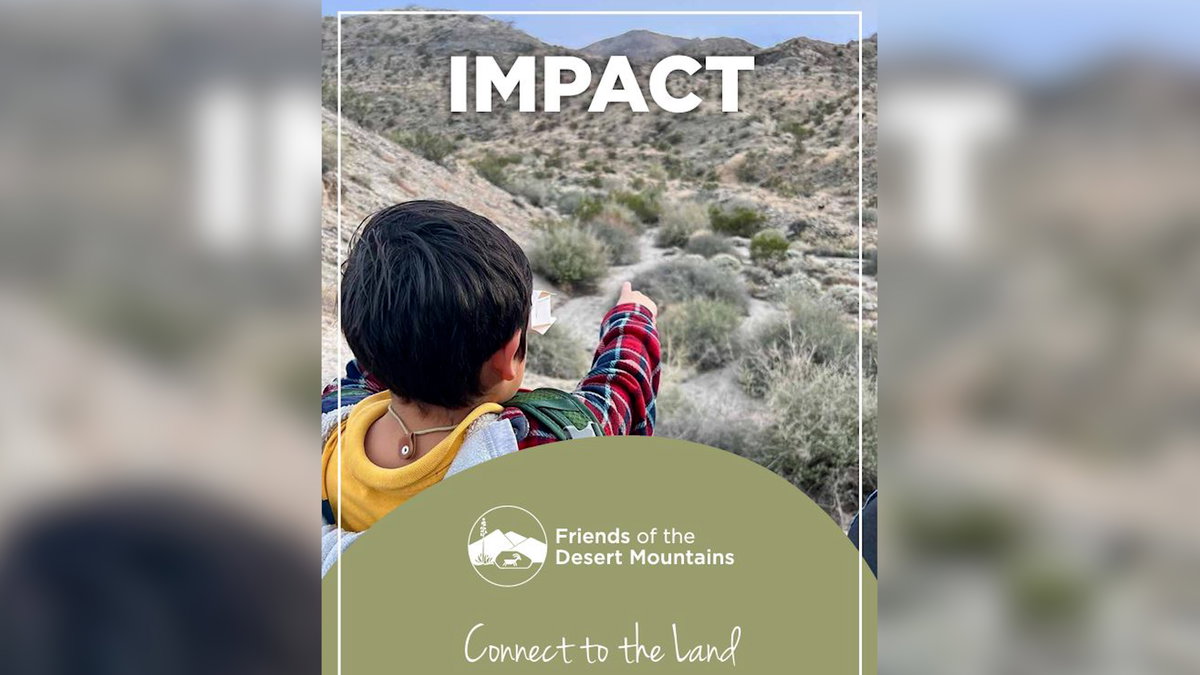
PALM DESERT, Calif. (KESQ) – A 2025 impact report released Tuesday revealed Friends of the Desert Mountains, a nonprofit organization dedicated to land conservation, offered hundreds of free public hikes and talks, generated more than a $1 million in revenue and returned 1,073 acres of land to the Agua Caliente Band of Cahuilla Indians among other factors.

“Our work is ultimately about connection,” Tammy Martin, executive director of the nonprofit, said in a statement. “When people spend time on the land, learn from it, care for it and see themselves as part of its future, conservation becomes something we do together.”

The report highlighted a few key accomplishments, including offering 502 free public hikes and talks, volunteers contributed 5,800 hours, and the organization, with assistance from Coachella Valley Mountains Conservancy, returned thousands of acres to the local tribe, which included two parcels consisting of 936 acres and 137 acres purchased by the tribe from Friends.

“Preservation of our homelands is essential to maintaining our cultural heritage,” Tribal Chairman Jeff Grubbe of the Agua Caliente Band of Cahuilla Indians said in the report.

“Who better to care for these lands than the original stewards who have been doing so since time immemorial,” Martin said.

Friends_2025_AnnualReport-tmDownload

Additionally, more than 500 students participated in Friends’ education programs and the organization generated $1,119,058 in revenue last year through fundraising efforts, programs and grants and admin fees.

“Every person who connects to the land becomes part of its future,” the report concludes.

Click here to follow the original article.

Wall Street hits records ahead of Fed minutes

By Jacqueline Policastro | Quincy News Correspondent

Click here for updates on this story

    Washington (Quincy News) — Market Recap: U.S. stocks closed higher Tuesday, with the S&P 500 and Nasdaq both reaching record highs as Treasury yields eased and oil prices stabilized after weeks of inflation-driven volatility. The S&P 500 gained 0.6%, the Nasdaq rose 0.5% and the Dow climbed 0.5%.

The 10-year Treasury yield fell about 3 basis points to 5.28%, pulling back from a 24-year high reached earlier in the week, while the 30-year yield eased to 5.65%. Oil remained elevated but relatively steady, with Brent crude settling at $100.58 a barrel and U.S. crude at $89.44. Tuesday’s trade report also showed the U.S. deficit widened 13.7% in August to $105.6 billion as imports hit a record high.

Today’s Focus: The Federal Reserve takes center stage Wednesday with the release of minutes from its September meeting at 2 p.m. ET. Policymakers voted unanimously at that meeting to raise interest rates by a quarter percentage point to a range of 3.75% to 4%, the Fed’s first rate hike in three years.

Investors will be looking for clues about how strongly officials favored additional tightening and what could trigger the Fed’s next move. Several policymakers have recently signaled they may want more evidence before raising rates again, making the minutes an important look at the debate ahead of the Fed’s October 27-28 meeting.

Treasury markets will also remain in focus. The government is scheduled to auction $39 billion in 10-year notes at 1 p.m., a closely watched test of investor demand after the recent surge in long-term borrowing costs.

ON THE SCHEDULE FOR WEDNESDAY, OCTOBER 7, 2026

-10:30 a.m. ET – EIA weekly petroleum report

-1 p.m. ET – Treasury 10-year note reopening

-2 p.m. ET – Minutes from the Fed’s September 15-16 meeting

-3 p.m. ET – August consumer credit

-Thursday, 8:30 a.m. ET – Weekly jobless claims

-Thursday, 1 p.m. ET – Treasury 30-year bond reopening

-Thursday, 1:40 p.m. ET – Treasury buyback covering 20- to 30-year securities

-Friday, 10 a.m. ET – Preliminary October University of Michigan consumer sentiment index

Please note: This story was provided to CNN Wire by an affiliate and does not contain original CNN reporting. This content carries a strict local market embargo. If you share the same market as the contributor of this article, you may not use it on any platform.

‘When the river runs short:’ Legislator dives into water woes and solutions at CEI

David Pace

IDAHO FALLS, Idaho (KIFI) – Water in Idaho is in short supply and the coming El Niño could make next year even worse.

State Representative Britt Raybould, (R)-Rexburg, recently graduated from Boise State University with her Ph.D. in public policy and administration.

“We just don’t have as much water as we’re used to having, and I think that lack of just the total amount of water is going to be something that is a challenge for all water users in Idaho – not just in East Idaho,” Raybould said.

Her dissertation centered on the competing water rights demands in the Colorado River Basin, which holds valuable lessons for Idaho water users facing similar pressures of scarcity.

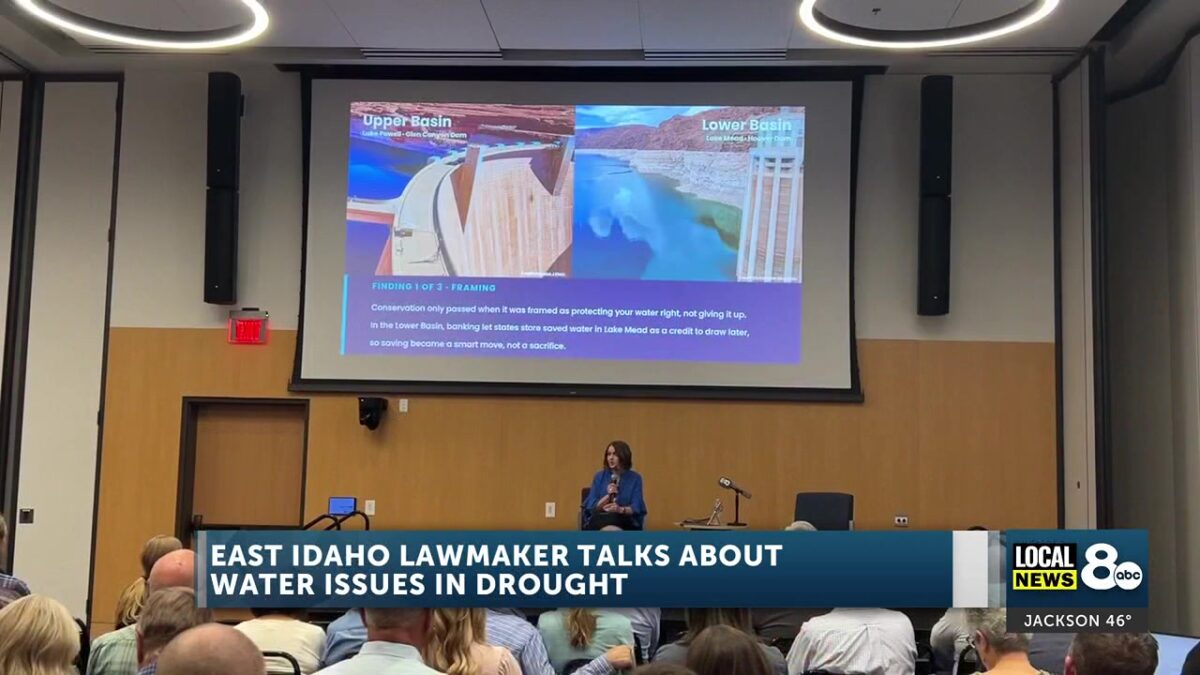
Raybould met with farmers and policymakers at College of Eastern Idaho Tuesday to discuss key takeaways and solutions for water users as limited resources are increasingly strained by drought.

“This year was a tough water situation. We came off of one of the lowest-ever snowpacks that we’ve had in the state,” said Adam Young, a wheat, alfalfa and barley farmer in Bingham County. “We came off of I believe it was the warmest winter and early spring that we’ve had on record. There were a lot of concerns that came with that. There were a lot of real struggles. There were things that had to be, that had to be managed or had to be shifted to be able to make it through the year.”

Young said next year is likely to again face higher than normal temperatures, impacting the snowpack.

“When you face multiple years of low snowpack or drought conditions, it’s a very difficult thing to face,” he said.

This pattern of drought pressures water users across the state – particularly those with junior water rights.

“We have to take into account as well that prior appropriation is in Idaho’s Constitution,” Raybould said.  “So we need to be respectful of the fact that when someone has a water right, we need to the best of our ability and the system’s capacity to fulfill that right. But we also need to look for avenues that we maybe haven’t considered before that help us find a balance during times of scarcity.”

This year, “Snake River flows approached the minimum required by a 1984 Swan Falls agreement for the first time,” she presented.

Implementing any changes to address less water requires the convergence of three factors, she shared:

“A problem you can’t ignore – reservoirs falling, a looming shortage.” “A fix that works – one that is affordable, legal and doable.” “Political will – enough of the right people willing to say yes.”

One solution involves addressing users’ fears that if they conserve water, they could lose some of their water rights.

“This is one of the hidden secrets in water policy that we need to spend more time on. It’s how can we encourage conservation while ensuring that people don’t lose that water right, because that’s important,” Raybould said. “I don’t want people to feel like there is a consequence for having done the right thing by the water system as a whole.”

She urged water users to work collaboratively and see each other’s perspectives to make the hard decisions while facing declining water levels.

Click here to follow the original article.

Deadly pursuit crash raises questions about safety

Gavin Nguyen

INDIO, Calif. (KESQ) – Top law enforcement officials are speaking out about safety after a deadly pursuit crash Monday night.

The person who died was identified as a 42-year-old Cherry Valley man. Police say he was running from police when he turned onto Interstate 10, heading the wrong direction, and triggered a head-on crash. The man was pronounced dead at the scene. Two women from Indio were also injured in the crash.

Video shared with News Channel 3 from a Tesla following the two women who were struck showed them make an evasive turn to the right in an effort to avoid the oncoming car. The vehicle being pursued turned in the same direction — then, the two collided.

California Highway Patrol officer David Torres said the women did everything right in that situation.

“We ask you to make an evasive movement and pay attention,” he said. “It looks like they were paying attention. Unfortunately, the other vehicle was traveling really fast. He was going the wrong way and there was nothing they could do.”

In the aftermath of that crash, we asked the top law enforcement officials at Indio Police Department’s National Night Out on Tuesday night.

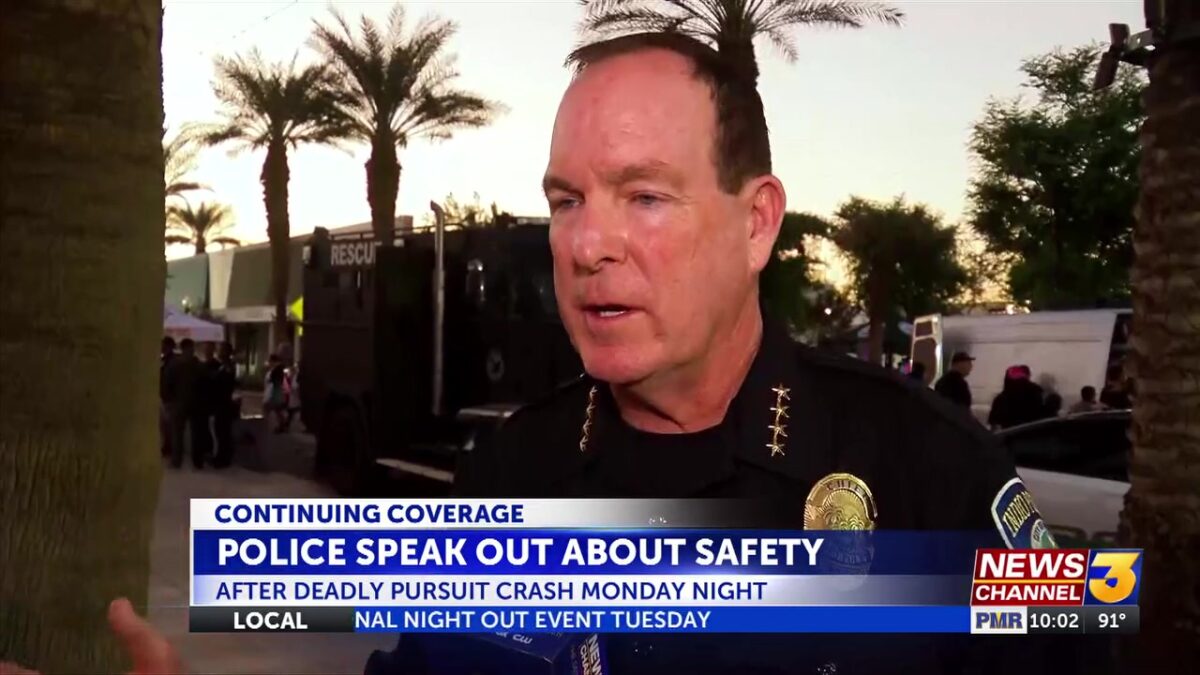
While the pursuit did not involve his officers, we asked Indio Police Chief Brian Tully, “How can you assure the public that they’re safe from these types of pursuit crashes?”

“What we’re doing and what you and I are doing right now is educating the public,” he said, gesturing to the gathering around him. “We’re constantly educating how to prevent or or be aware of certain things that could occur or could put you in danger. The most important thing is we’re trying to keep people from being victims.”

Officers from Indio PD and CHP had similar answers when it came to pursuit policy. Chief Tully outlined how they only pursue for serious crimes, and if officers assess a situation is becoming too dangerous to the public, his officers back off. He said they employ technology, like drones and automatic license plate readers (ALPR cameras) to track suspects, rather than put the public at risk.

He added, though, “We have to keep in mind – and the community is concerned – we always have to balance public safety and privacy rights.”

Chief Tully pointed out that events that educate and engage the public, like National Night Out, were critical in helping bridge that gap.

Click here to follow the original article.

Man was likely dead for ‘several weeks’ before being found in Johnson County, sheriff’s office says

Ryan Shiner

COLUMBIA, Mo. (KMIZ)

The Johnson County Sheriff’s Office says a man who was found dead on Tuesday had likely died several weeks before being found.

The sheriff’s office wrote on its social media that Missouri Department of Transportation workers found human remains near Highway 50, west of Route FF in Knob Noster. The sheriff’s office says the man who was found was a 70-year-old Raytown man.

The name of the man was not publicly released, but authorities say no foul play is suspected at this time. The family of the man has been notified.

“Initial investigations indicate the individual had likely been deceased for several weeks prior to discovery,” the post says.

Click here to follow the original article.

Man charged after allegedly using fence post to seriously injure victim in Rolla

Ryan Shiner

COLUMBIA, Mo. (KMIZ)

A St. James man was charged with multiple felonies after he was accused of seriously injuring another man during a Sunday night attack.

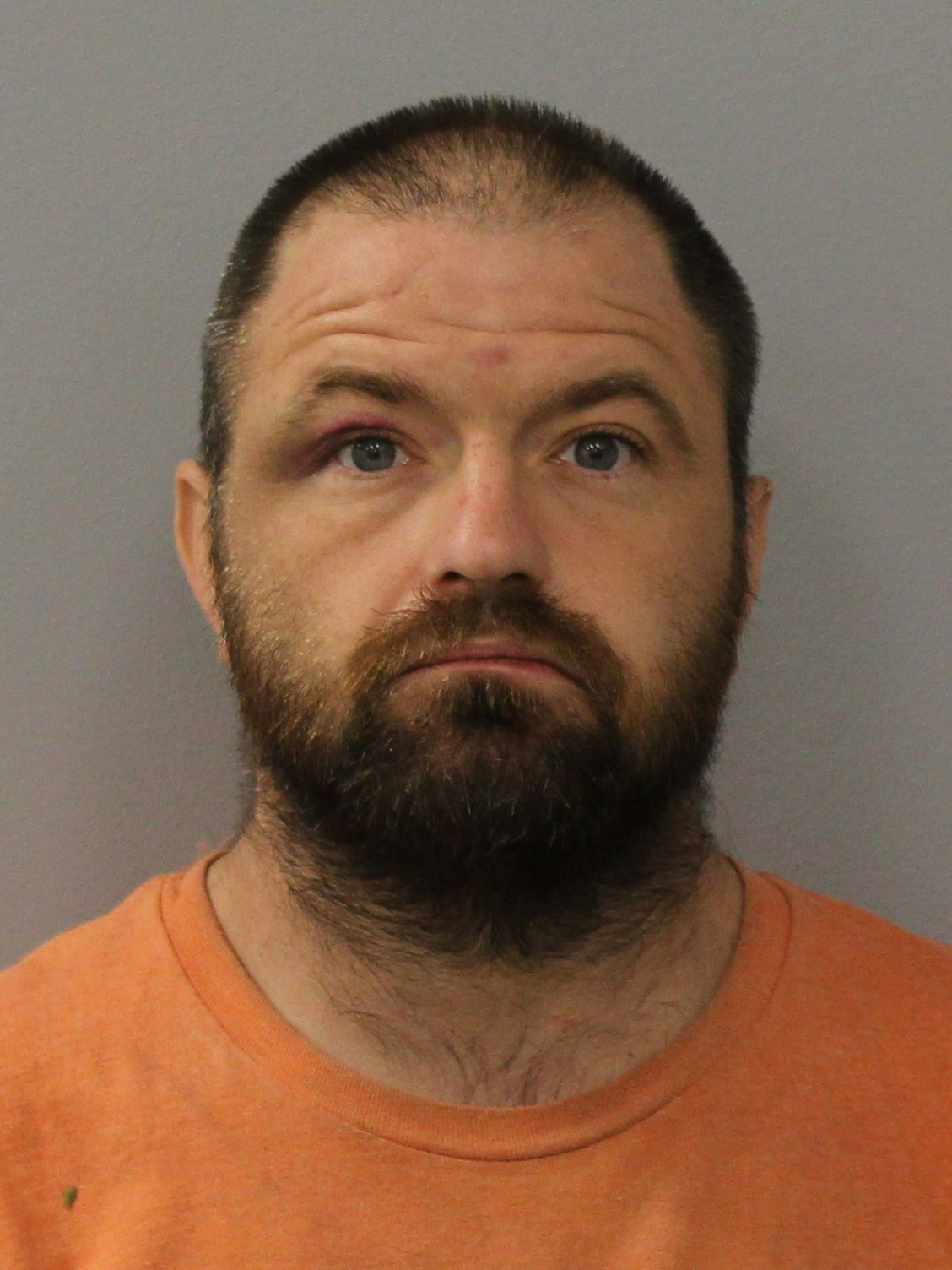
Stacey Cameron Johnson, 37, was charged in Phelps County with first-degree assault, armed criminal action and drug possession. He is being held at the Phelps County Jail without bond. A court date has not been set.

The probable cause statement says law enforcement was called to Dicky Bub Farm and Home in Rolla at 8:40 p.m. Sunday for an assault. Witnesses performed CPR on the victim while first responders were en route, the statement says.

The victim had a severe head injury and police noted seeing “suspected brain matter and skull fragments” in the roadway, the statement says. The victim was flown to University Hospital, according to the report.

Witnesses allegedly told police they saw Johnson use a metal fence post to assault the victim. A roommate of the victim had allegedly told police the next day that Johnson was the attacker, the statement says.

Video footage allegedly showed Johnson holding the fence post and confronting the victim before hitting him, the statement says. After the victim was on the ground, Johnson allegedly hit the victim six more time, police wrote.

Johnson eventually sent an apology message to the victim’s girlfriend through the social media application SnapChat, the statement says.

Johnson was found in a camper on Highway 8 in St. James and police allegedly found a baggie of methamphetamine during the arrest, the statement says.

Click here to follow the original article.

Boys and Girls Club unveil new center to help teens for the future

Connor Emery

YUMA, Ariz. (KYMA) – The Yuma Rotary and Boys and Girls clubs unveiled their new AZ-Youth-Force Center Tuesday. 

“You are on the road to success.” That is the motto of the new center. The center is possible thanks to a $4,000 grant the Rotary Club received.

They also matched it with contributions and volunteer hours totaling it at $20,000.

“There was just a half railing up here and so they weren’t using it fully. We worked with the staff here at the Boys and Girls Club to really identify the needs of the project. So you can kind of look around and see the improvements, but we turned it into a space that’s actually usable with a full enclosed wall,” Jennifer Reichelt, president of the Rotary Club said.

AZ-Youth-Force is originally from Phoenix, but the program will allow Yuma teens to try new internships that can help build their future career. 

“What we found is that it really helps our teams develop those essential skills they need to be successful in any career, and it helps them actually connect the dots between education and the workforce. And they’re all paid internships. So more importantly it’s helping them take care of themselves and their family,” Josh Stine vice-president of external affairs of the Boys and Girls Club said.

When the Boys and Girls reopened in 2022, there were only about 30 kids. Now there are over 200.

“The teen program that we’re trying to grow right now will make it possible for us to really give the teens space for them to do resumes, mock interviews, as they prepare to join the workforce industry,” Rowena Regalado, Branch Director for the Yuma Boys and Girls Club, said.

Rotary members and volunteers spent five Saturdays renovating the space.

Click here to follow the original article.

University of Arizona researchers search for new ways to protect lettuce from Fusarium wilt

Manoah Tuiasosopo

YUMA, Ariz. (KYMA) – Lettuce growers in the Southwest are constantly battling challenges that can threaten an entire crop. One of those threats is Fusarium wilt, a soil-borne disease that can cause devastating losses in affected fields.

Researchers at the University of Arizona are testing new ways to fight the disease and give desert growers more options to protect their lettuce crops.

The research is taking place on 11 acres of test fields that have been dedicated to Fusarium research for nearly a decade.

The long-term research has created an environment with high disease pressure, giving scientists an opportunity to test potential solutions under difficult conditions.

“We’ve got trials set up in ground that has been dedicated to Fusarium research for almost a decade now,” said Dr. Chris Detranaltes, an associate in extension in plant pathology with U of A Cooperative Extension. “So it gives us a unique opportunity to really test what we want to see may be effective against that disease in really high-pressure ground.”

The research team is testing several strategies aimed at reducing the impact of Fusarium wilt.

One area of research focuses on genetic resistance. Scientists are evaluating lettuce varieties and breeding material to identify plants that may be better able to withstand the disease.

Researchers are also studying lower-cost fumigation methods that could provide growers with another tool for managing Fusarium in contaminated soil.

Another approach involves RNA interference, a biological strategy researchers are investigating as a potential way to limit the growth of Fusarium around lettuce roots.

The goal is to find treatments and management practices that are effective, while also being practical and affordable for commercial growers.

Fusarium wilt is caused by a soil-borne pathogen that can remain in the soil and threaten future lettuce plantings.

Researchers say affected fields can experience up to 100% crop loss when the disease takes hold.

Weather can also play a role in how severe the disease becomes. Hotter, unseasonal conditions can increase the impact, while cooler weather can reduce disease pressure.

For growers in the desert Southwest, finding effective ways to manage Fusarium is especially important because lettuce is a major part of the region’s agricultural industry.

The U of A research team will continue testing different strategies in the field, with the goal of identifying solutions that can eventually make their way to commercial lettuce growers.

The research could help provide growers with more tools to protect their crops before Fusarium has a chance to take hold.

Click here to follow the original article.

Former AG Bailey takes swipe at Buffaloe, shows support for new jail during speech for Boone County Pachyderm Club

Mitchell Kaminski

COLUMBIA, Mo. (KMIZ) 

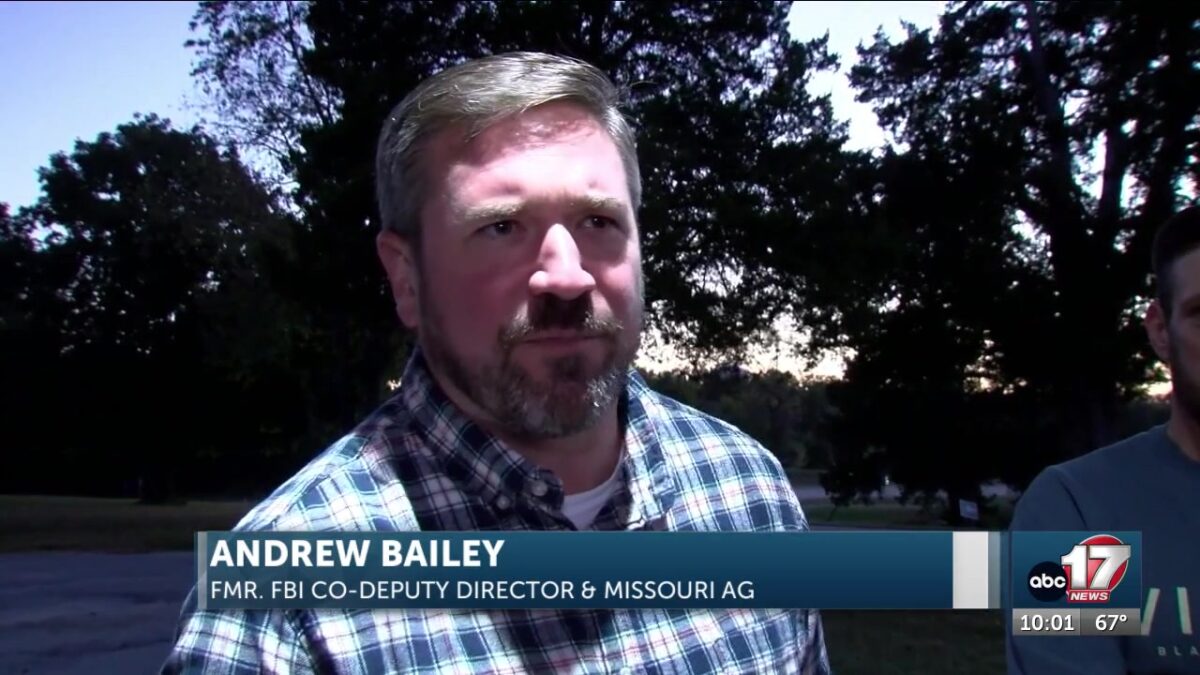
Former Missouri Attorney General Andrew Bailey took aim at Columbia Mayor Barbara Buffaloe during a Tuesday night speech, accusing her of undermining law enforcement and the city, while also voicing support for a proposed new Boone County Jail.

Bailey made the comments while serving as the featured keynote speaker at the Columbia Pachyderm Club’s annual Chili Supper at the American Legion, one of his first public appearances in Missouri since resigning last week as co-deputy director of the FBI.

During the speech, Bailey addressed public safety in Columbia and criticized Buffloe for “not giving law enforcement enough support,” while calling for greater state involvement in the city.

“The great purple-headed Buffaloe is doing everything she can to run down the police and ruin this community. We can’t let that happen. The state of Missouri at some point is going to have to step in because we can’t let the great purple-headed Buffaloe destroy a vital state institution like the University of Missouri,” Bailey said during his speech. “Your kids should be able to go downtown and you should be able to go downtown. Alumni should be able to come to this community and go downtown on the Friday night without fear, of getting mugged. The businesses deserve that. The people deserve that.”

After the speech, Bailey doubled down on his criticism when asked what more he would like to see Buffaloe and Columbia leaders do to improve downtown safety.

“More support for our law enforcement officers. At the end of the day, the leadership in Columbia is more focused on DEI programs and drag shows for kids and porno books in libraries, than they are actually securing downtown and ensuring public safety and justice for victims,” Bailey told ABC 17 News.

Bailey also expressed support for Proposition L, a 3/8-cent sales tax that Boone County voters will consider Nov. 3. The measure would help fund construction of a new Boone County Jail and has been given a sunset date of Dec. 31, 2042.

“It doesn’t matter if the cops arrest people, if they don’t have a place to lock them up. You don’t have a place to lock folks up. It doesn’t matter how many police you have on the street, you got to have a place to lock them up,” Bailey said during the speech. “You’re paying a lot of money right now to ship prisoners out of county. That’s called a new jail at some point. So I want you all to consider that and think about the criminal justice system, how that’s the cornerstone of prosperous communities.”

Bailey’s comments in Columbia came about a week after he announced his resignation from the FBI. His resignation took effect Oct. 2, and he said in a post on X that he was leaving to return to his family in Missouri. He reiterated that statement during Tuesday’s speech. FBI Director Kash Patel later thanked Bailey for “answering the call to serve.”

Bailey joined the FBI after leaving the Missouri attorney general’s office. He was appointed attorney general by Gov. Mike Parson in 2022 and won a full term in 2024. Just one year into that term, Bailey left Missouri’s top law enforcement post to join Patel at the FBI.

He became co-deputy director, a position that marked the first time in the FBI’s history that the bureau had two people sharing the role. Bailey initially served alongside Dan Bongino and later alongside Christopher Raia after Bongino left the bureau.

Despite the sudden resignations, Bailey described his time at the FBI positively when asked by ABC 17 News how the unusual co-deputy director arrangement worked.

“That was great. Look, there’s enough work to be done for everybody and rooting out the deep state, implementing the president’s policy objectives. That takes hard work, dedication, tireless effort, and so plenty of work to go around,” Bailey said.

During his roughly one-year tenure, Bailey was involved in several high-profile operations, including “Operation VIPER,” a federal effort targeting violent crime in St. Louis that resulted in 91 arrests.

He was also involved in a January operation in Fulton County, Georgia, where federal agents searched the county’s main election facility in Union City for records related to the 2020 presidential election. Bailey had been overseeing election-related investigations at the FBI.

During Tuesday’s speech, Bailey said the FBI increased its number of voter fraud investigations by 500% during his time at the bureau.

“During my time at the FBI, proud of the work we did to make sure that America’s elections are secure so that our constitutional right to vote isn’t silenced by criminal behavior elsewhere,” Bailey told ABC 17 News. “There’s been numerous prosecute investigations leading to arrest and prosecution. And I refer you to the FBI’s Twitter feed or press releases on those.”

Bailey joined the FBI when there was tension surrounding the department regarding the release of the Epstein Files. ABC 17 News asked Bailey if he would had any regrets about how the FBI handled it. 

“That all happened before I took office. It was largely concluded. It’s not an issue I ever dealt with, but what I tell you what I would tell you is this, I’m always going to stand up for justice for victims. I think public transparency is important,” Bailey said. “As Missouri attorney general, I enforce the sunshine law. And sometimes you have to do that against friends. Sometimes you have to do that against municipalities that are trying to do the right thing but get it wrong. And so transparency is always important in maintaining and restoring public trust in public institutions.” 

Bailey also spoke about his support for Amendment 3 — which would reinstate an abortion ban in the state — and the personal experience that helped shape his strong anti-abortion stance. Bailey’s wife became pregnant in 2018. Bailey said doctors told the couple during their first ultrasound that the baby would not survive.

“We named her Grace because by the grace of God, I got to hold her for one hour, one hour before the good Lord took her home. But that hour I got to spend with my daughter taught me that all life has value. Period. I will never surrender, never retreat, as a pro-life advocate. Amendment three is a battle we have to win. It’s not the final battle in this fight. It’s not going to win the war in total, but it’s a critical battle that we can’t afford to lose. We have to win,” Bailey said during the speech.

When asked about his future plans during a media scrum, Bailey reiterated that he wants to spend more time with his children. Asked what he plans to do next in Missouri, Bailey said his focus is on Amendment 3 and spending time with his family.

The Columbia Pachyderm Club event also featured other Missouri political figures and candidates, including Secretary of State Denny Hoskins, representatives of State Auditor Scott Fitzpatrick, state Rep. John Martin and Boone County associate circuit judge candidate James Egan.

Click here to follow the original article.

Imperial County explores ballot measure to shift data center approvals to the public

Lynette Niebla

IMPERIAL COUNTY, Calif. (KYMA) – The debate over massive tech infrastructure in Imperial County reached a new turning point Tuesday morning, as local leaders discussed a sweeping proposal that could strip government officials of their sole approval power and give voters the final say on future data center developments.

The Imperial County Board of Supervisors gathered to debate the framework of a potential future ballot initiative.

The proposed measure aims to transition large-scale technology project approvals away from politicians and directly into the hands of the general public.

Because the item was placed on the agenda for discussion only, no official votes or actions were taken during the meeting.

The proposed initiative represents a significant shift in local governance. If eventually placed on a ballot and approved by voters, it would alter county law to require public approval for large-scale technology developments.

Supporters argue that a future “yes” vote from the board to advance the plan signals a commitment to public transparency.

Conversely, a “no” vote would mean keeping data center approvals entirely within the jurisdiction of local government officials.

“We talked about getting this to a moratorium, we talked about then doing a data center advisory group, and now this seems to be the next step in this process when it comes to data centers,” said District 2 Supervisor Martha Cardenas-Singh, who helped bring the item forward.

Dozens of local residents packed the chambers in El Centro to voice their opinions during the public comment period, with a commanding majority echoing the call for direct democratic oversight.

Though, not all supervisors were on board with pushing the issue to a public vote. Some members argued that the county’s recently established Data Center Advisory Committee should be allowed to complete its evaluation before the board considers a public ballot measure.

District 3 Supervisor Peggy Price urged patience, stating that committee representatives need time to evaluate the technical impacts of these projects.

“Let them do the research. Let them talk to the experts and then let them bring back their recommendations to the board,” Price said.

Financial concerns regarding a special election also took center stage.

District 4 Supervisor Ryan E. Kelley strongly opposed moving forward with a standalone ballot measure due to the strain it would place on the county’s budget.

“I would not see us going forward with the ballot measure, especially under a special election cost,” Kelley said. “That would cost half a million dollars, and I do not believe that that is an appropriate use at this time.”

In response to fiscal concerns, District 1 Supervisor Jesus Eduardo Escobar, who brought the discussion item forward alongside Supervisor Cardenas-Singh, countered with a compromised timeline.

Escobar proposed delaying the initiative to align with the March 2028 Super Tuesday ballot.

The 15-month runway would eliminate the steep costs associated with a special election while giving the Data Center Advisory Committee ample time to finalize its investigation.

“You need to put the power back to the people,” Escobar argued. “If we are worried about cost, we can wait 15 months to make sure that the advisory committee is fully vested… and then they can prepare an opinion based on those facts moving forward.”

Because Tuesday’s proceedings were strictly exploratory, the issue remains open.

The Board of Supervisors retains the right to bring the item back for a formal vote or further debate at any scheduled meeting in the future.

Click here to follow the original article.