Tribal leaders gather in Palm Springs to raise concerns over proposed federal changes to sacred site protections

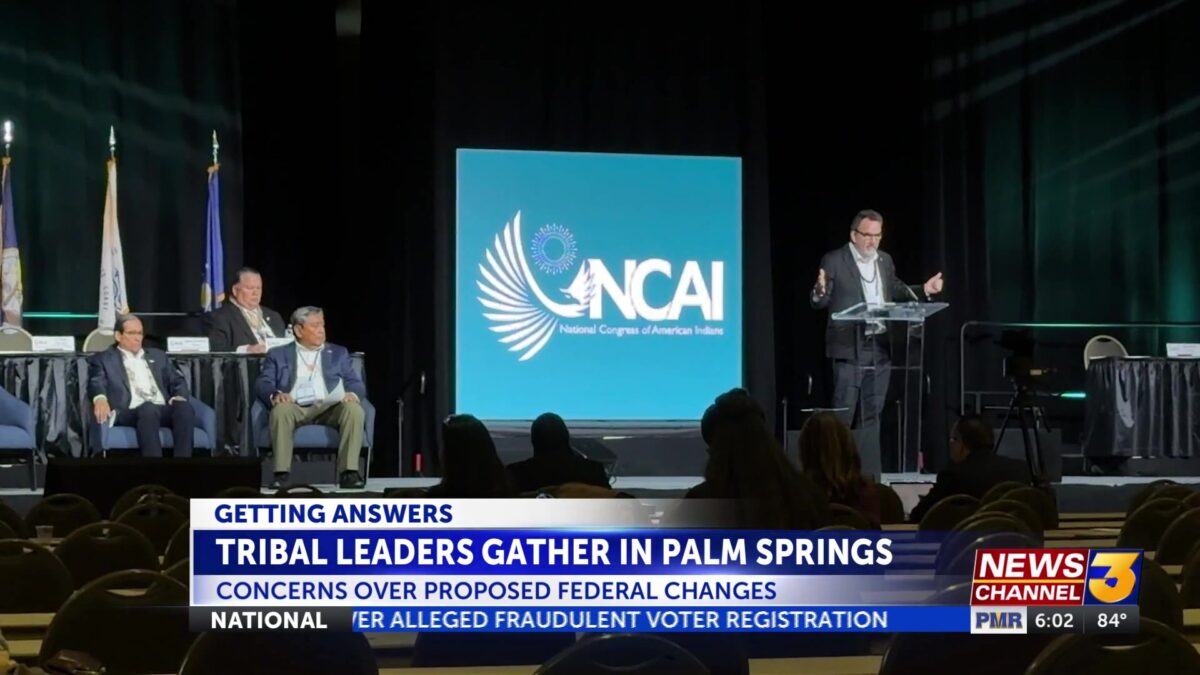
PALM SPRINGS, Calif. (KESQ) – Tribal leaders from across the country gathered in Palm Springs Monday, raising concerns over proposed federal changes they say could weaken protections for sacred sites, ancestral lands and generations of cultural history.
The National Congress of American Indians (NCAI) held a news conference Monday afternoon at the Palm Springs Convention Center as part of its 83rd Annual Convention and Marketplace, bringing together Tribal leaders to discuss proposed changes to Section 106 of the National Historic Preservation Act.
The federal law requires agencies to consider how certain federally involved projects could affect historic properties and consult with Tribal Nations when those projects could impact places of religious or cultural significance.
Tribal leaders warn that proposed changes in Washington could reduce their involvement in decisions about development and infrastructure projects, potentially putting culturally significant places at risk.
Pueblo of Acoma Governor Charles Riley told News Channel 3 that preserving these places goes far beyond protecting physical landmarks.
“It’s part of us. It’s not an object. It’s not a landscape. All those things are part of who we are. And that’s what people fail to understand,” Riley said.
“Our ancestors were there a long time ago, wherever it’s at, and they placed all their prayers, hopes and dreams in those places for us to have a better life later on, for those that are unborn to have a better life later on,” Riley added.
Riley said protecting those places is a responsibility passed down through generations.
“We have to be good ancestors for those unborn into the future,” he said.
What is Section 106, and why are Tribal leaders concerned?Section 106 is part of the National Historic Preservation Act of 1966. It establishes a process for federal agencies to identify and consider the effects of certain projects on historic properties, including archaeological sites, traditional cultural places and locations significant to Tribal Nations.
The process requires consultation with affected Tribal Nations when applicable, allowing them to identify culturally significant places and raise concerns before federal decisions are made.
The proposed Bipartisan American Affordability and Jobs Act of 2026, introduced in the U.S. Senate as S. 5653, includes provisions that Tribal organizations say would weaken those requirements.
NCAI and other Tribal organizations are calling on Congress to withdraw Title III of the legislation.
According to NCAI, the proposed changes could narrow the circumstances requiring historic preservation reviews, reduce opportunities for Tribal consultation, increase federal oversight of Tribal Historic Preservation Offices and limit legal challenges to certain federal decisions.
Supporters of federal permitting reform have emphasized the need to streamline regulatory reviews and help infrastructure and development projects move forward more efficiently.
However, Tribal leaders argue that reducing consultation requirements could create additional conflict and potentially threaten important cultural resources.
Suquamish Tribe Chairman Leonard Forsman, who also serves as president of the Affiliated Tribes of Northwest Indians, told News Channel 3 that the consequences of insufficient consultation can be permanent.
“Burial grounds have been desecrated, important archeological places have been destroyed, and also important sacred landscapes have been altered and desecrated,” Forsman said.
Forsman explained that many culturally significant places are connected to Tribal identity, spirituality, ceremonies and histories spanning thousands of years.
He said Tribal Nations have a responsibility to protect those places for future generations.
Tribal leaders say development and preservation can work togetherDespite their opposition to the proposed changes, Tribal leaders emphasized that they are not against infrastructure development.
Instead, they say early and meaningful consultation can help developers identify culturally significant locations, avoid disturbing sacred sites and complete projects without unnecessary delays.
During Monday’s news conference, Governor Riley described a pipeline project involving Kinder Morgan that he said demonstrated the benefits of early Tribal involvement.
Riley said the project involved a roughly 214-mile pipeline crossing trust lands.
Rather than attempting to stop construction, he said Tribal representatives worked with the company to make relatively small adjustments to the project’s route, helping protect sacred sites.
Cultural monitors also worked alongside company archaeologists and anthropologists to identify areas of concern.
According to Riley, that cooperation helped reduce project costs and allowed construction to finish earlier.
“We don’t hold up projects. We try and make it much more easier for us to communicate, show them, take them on the field, show them the different places so that we can talk about those places even before the project begins,” Riley told News Channel 3.
Forsman also described examples where consultation helped Tribal communities and developers identify and protect archaeological resources while allowing construction to proceed.
He said Section 106 creates opportunities for collaboration rather than automatically preventing projects from moving forward.
During the news conference, Forsman emphasized that the consultation process has been used successfully on thousands of projects.
He also argued that problems can arise when Tribal Nations are contacted too late in the planning process, after important decisions have already been made.
What could the proposed changes mean for the Coachella Valley?News Channel 3 submitted a question during Monday’s news conference asking how the proposed changes could affect Tribal Nations in California, particularly here in the Coachella Valley.
NCAI President Mark Macarro addressed the question, connecting the national debate to decades of development across Southern California.
Macarro, who also serves as Tribal Chairman of the Pechanga Band of Indians, pointed to population growth and the expansion of residential developments, transportation corridors and energy infrastructure throughout the region.
He said those projects have transformed landscapes that hold cultural and religious significance for Tribal Nations.
Macarro specifically referenced development across the Coachella Valley and toward the Salton Sea, including transportation infrastructure, wind energy and solar projects.
He explained that many sacred and ancestral places extend beyond the boundaries of modern reservations, meaning federal consultation can be especially important when development occurs on lands outside a Tribe’s direct jurisdiction.
Macarro said protecting those places is not always as simple as identifying a single location on a map.
Entire mountain ranges, ridgelines and landscapes can hold cultural and religious importance.
He described how early consultation can allow Tribal representatives to work with developers on alternative routes for projects such as power lines, helping avoid significant places while still allowing needed infrastructure to be constructed.
Macarro warned that moving forward without those conversations could result in additional damage to culturally significant landscapes.
“We end up with this erasure of our cultural landscapes. And so that’s what’s at stake,” Macarro said.
He argued that consultation provides an opportunity for Tribal Nations to explain the significance of places that federal agencies or developers might not otherwise recognize.
Macarro also acknowledged the demand for new infrastructure in Southern California, but emphasized that development should not come at the expense of Tribal cultural heritage.
The discussion raises questions about how proposed federal changes could affect preservation efforts across the Coachella Valley, home to multiple Tribal Nations with deep ancestral and cultural connections to the surrounding desert landscapes.
However, the precise impact on individual local projects would depend on the circumstances of each project and whether federal historic preservation requirements apply.
Concerns over Tribal sovereignty and historic preservation officesGovernor Riley also raised concerns about proposed changes affecting Tribal Historic Preservation Offices, which play an important role in identifying, documenting and protecting cultural resources.
During his interview with News Channel 3, Riley expressed concern that proposed funding and oversight requirements could place additional pressure on offices already operating with limited resources.
He said new deadlines and federal oversight provisions could potentially diminish Tribal control over preservation activities.
In his remarks at the news conference, Riley also warned that the proposed legislation could change how federal agencies evaluate impacts on historic and culturally significant places.
He argued that limiting consideration of certain indirect or cumulative impacts could fail to account for how Tribal communities understand sacred landscapes.
For some Tribal Nations, he explained, the significance of an ancestral mountain or cultural landscape cannot necessarily be reduced to one specific location where an event occurred.
He also emphasized that early consultation can help prevent disputes that might otherwise delay development projects.
What happens next?The Bipartisan American Affordability and Jobs Act of 2026 was introduced in the U.S. Senate on September 30 and referred to the Senate Committee on Energy and Natural Resources.
The proposed changes have not been enacted into law.
NCAI and other Tribal organizations are urging Congress to reconsider the historic preservation provisions and consult directly with Tribal Nations before moving forward with changes to the federal review process.
Tribal leaders say they support practical permitting reforms but want those changes to preserve meaningful consultation and protections for culturally significant places.
For Forsman, the issue ultimately comes down to preserving history and ensuring future generations maintain a connection to their ancestral lands.
He told News Channel 3 that Tribal Nations have a responsibility to protect those places in honor of generations that came before them and those who will follow.
As discussions continue in Washington, Tribal leaders gathering in Palm Springs say protecting sacred places and allowing responsible development do not have to be competing priorities.
They argue that early consultation can help accomplish both.
The National Congress of American Indians’ 83rd Annual Convention and Marketplace continues through October 22 at the Palm Springs Convention Center.
Click here to follow the original article.