‘It’s a waste of our time:’ Frustrations at Marathon Refinery public meeting


EL PASO, Texas (KVIA) — After two months of waiting, El Paso residents were invited by the Marathon Refinery in South-Central El Paso to a meet-and-greet presentation and forum organized at Riverside High School in the Lower Valley on Tuesday night.
Elected officials at the city and state level from Mayor Renard Johnson to State Rep. Vincent Perez were present and spoke to attendees who hoped to receive accountability from the company, according to them.
But to the hundreds of residents who attended, and even other city officials, the entire event was not what they had hoped out of Marathon.
El Paso’s Marathon Refinery general manager spoke with reporters before the meeting started, but didn’t take any questions.
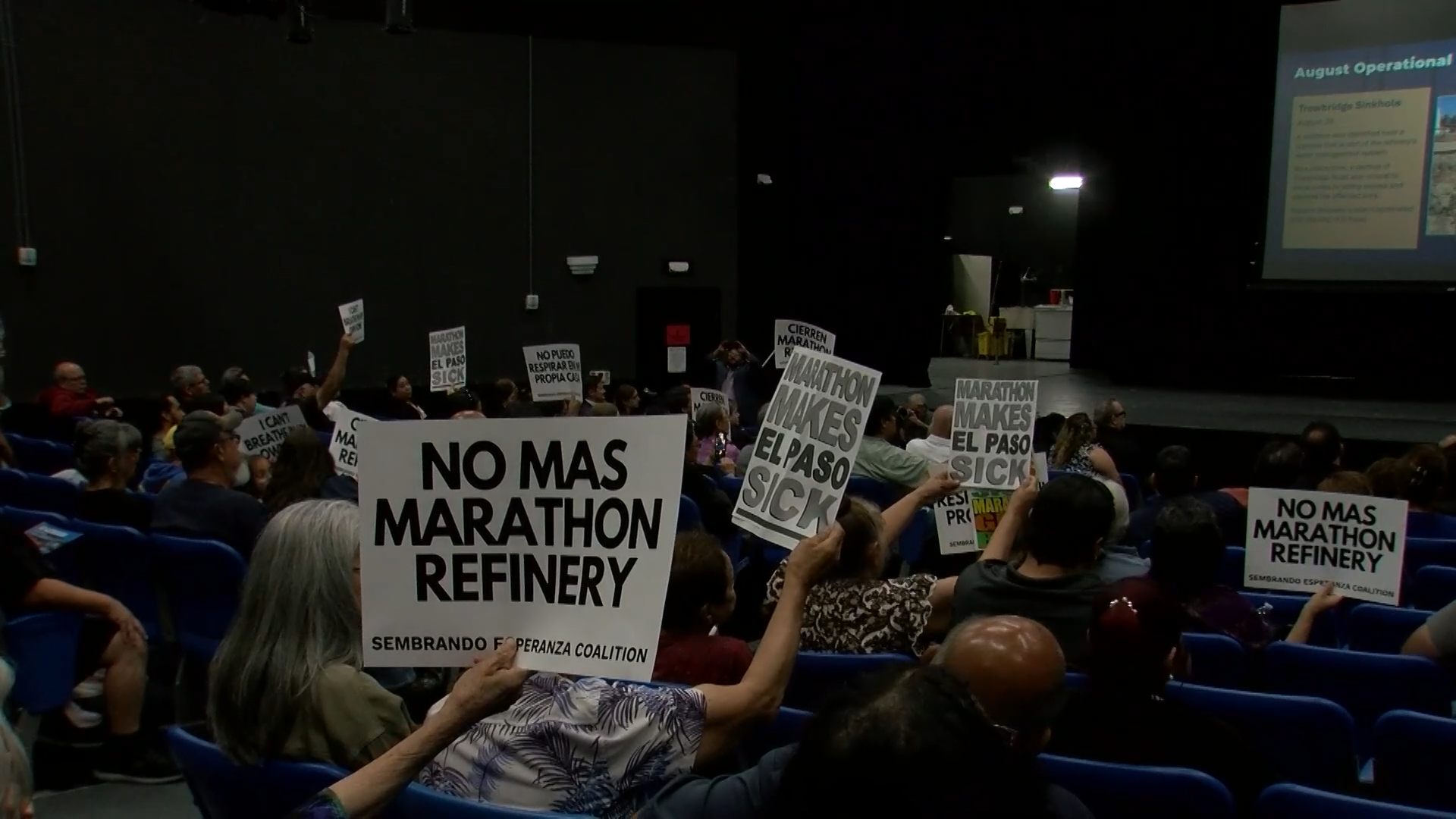 Marathon Refinery officials shared details about an “odor event” that happened Aug. 4. (Courtesy: KVIA)
“I had very low expectations for tonight, and it didn’t even meet that,” City Representative Josh Acevedo said.
For nearly an hour, Marathon officials shared details of the Aug. 4 incident — which they referred to as an “odor event.”
Preliminary reports show that the El Paso Marathon Refinery released more than 15 tons of pollutants on August 4, and now residents are encouraged to join their public meeting on Tuesday to learn about the investigation results.
The Texas Commission on Environmental Quality previously reported that the refinery released 20 air contaminant compounds, including nearly 4,000 pounds of carbon monoxide, over 1,000 pounds of sulfur dioxide, and more than 10,000 pounds of propylene.
The El Paso Hispanic Chamber says the meeting is expected to discuss the air monitoring results, operational changes, improvements to community notification and details of the release of contaminants.
Some nearby residents said the gases irritated their eyes and caused nausea, and several others even reported smelling a strong odor during the incident.
Sisters Connie and Josie Hernandez have lived in El Paso for over 60 years and currently reside just a few blocks from the Marathon Refinery, and they say they have every intention of attending this meeting to demand transparency.
“I’m hoping that this meeting will bring some sort of commitment, accountability from them to place safety features,” said Josie. “Because it’s our lives, it’s our lives, and I think most of us did not realize that until this big flare up happened.”
The sisters told ABC-7 they remember working outside at the time of the flare-up, and smelling what they called “toxic air.”
Now, Josie says they’re concerned for their health, knowing now what’s in the fumes and realizing that they’re ingesting the fumes daily.
She told ABC-7 exactly what she experienced that moment while doing her yard work.
“I noticed that the flame was like really roaring, and I called Connie and I said ‘Look at this thing!” Josie says. “It was dark with the orange flame and it was really nasty looking, but I didn’t know what had happened until I heard the news later on that night. So when I found out, I said ‘Gee, that’s a lot of stuff that we ingested’ and we’re like maybe three blocks away from it.”
At Tuesday’s meeting, some residents said they didn’t get the answers they wanted.
“We know that nothing’s really going to happen, they keep saying if it happens again, it’s going to happen again. We know it’s going to happen again,” Chris Telles said.
Rep. Acevedo said Marathon could have gone in a different direction about the incident report.
“They could have had a map in sight that said, if you want to go talk about the emissions, go over here: the pollution, the health scare, or whatever. They did this as a very performative measure, something to check the box.” Acevedo said.
Marathon declined an interview with ABC-7 prior to Tuesday.
Marathon Refinery leadership, including Vice President Les Davis and Operations Director Bryan Hass offered an official apology to Lower Valley residents and presented a detailed breakdown of the August 4 chemical release.
Company executives outlined how a mechanical failure escalated into a widespread chemical odor event and disclosed official emergency response timelines and air monitoring readings.
How the Release Happened
According to Marathon, the incident originated at the refinery’s Fluid Catalytic Cracker (FCC) described by officials as the “heart of the refinery” that breaks down crude oil into gasoline and diesel.
3:00 PM: An internal electrical glitch caused the FCC charge pumps to trip, triggering an automated emergency shutdown. 5:20 PM – 5:30 PM: Engineers made adjustments and attempted a unit restart. However, pressure and temperature issues in the gas recovery section caused Liquid Petroleum Gas (LPG) to mix improperly with gasoline. Hydrocarbon Leak: The volatile mixture was routed into Tank 4118. Unable to contain the LPG vapor, airborne hydrocarbons escaped into the surrounding neighborhood, creating strong odors. System Changes: Marathon confirmed Tank 4118 has since been removed from service to prevent future leaks.Emergency Response & Communication Delays
Community members raised sharp questions regarding the hours-long delay between the initial internal failure and public notification.
Time Event / Action Taken 3:00 PM Initial electrical failure occurs; FCC shuts down automatically. 8:29 PM Facility personnel begin formal investigation of hydrocarbon odor. 8:45 PM El Paso Fire Department (EPFD) is notified. 8:55 PM Initial contact made with 911 dispatch. 9:19 PM On-site industrial emergency response team deploys (125 industrial firefighters). 9:44 PM First community 911 call logged. 10:30 PM Local elected officials and news media are officially notified.Marathon leadership acknowledged severe communication breakdowns, admitting their phone systems failed after being flooded with over 500 resident calls. Executives conceded the facility was unprepared for the volume, leaving hundreds of calls unanswered, a delay community members labeled unacceptable.
Air Quality Readings vs. Resident Health ConcernsMarathon presented air monitoring data collected during the incident, arguing that volatile organic compound (VOC) levels remained well below established industrial hazard guidelines (such as the American Industrial Hygiene Association threshold of 200 PPM over 8 hours).
Volatile Organic Compounds (VOCs): Out of 628 air readings, monitors detected VOCs 4 times, with levels ranging between 0.4 PPM and 6.1 PPM. Hydrogen Sulfide: 0 detections across 623 readings. Sulfur Dioxide: 0 detections across 304 readings.Health experts note that inhaling concentrated VOCs can trigger nausea, headaches, dizziness, and severe respiratory symptoms in asthmatics.
Click here to follow the original article.