TikTok cracks down on ‘get-paid-to’ scam ads on the platform

COLUMBIA, Mo. (KMIZ)
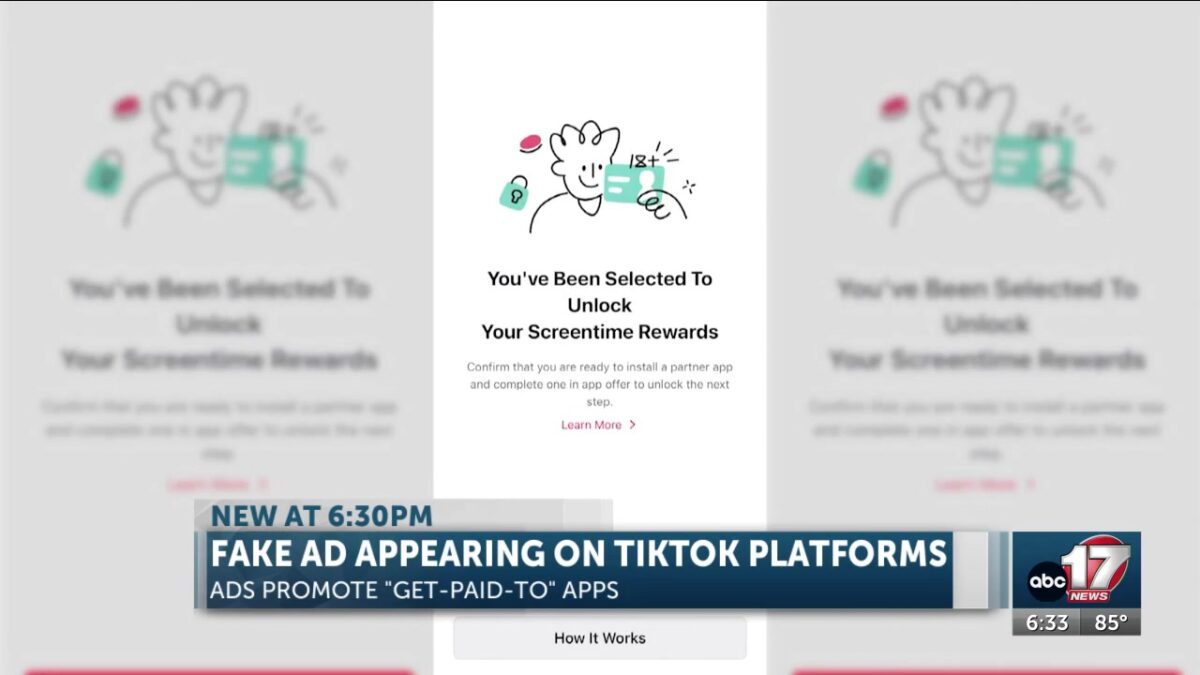
Advertisements seemingly part of TikTok’s company have been popping up in users’ feeds, leading people to third-party apps with the promise of payment.
The ads appear differently than typical TikTok Shop or other mainstream retailers.
The font and graphics are in a similar style to TikTok’s app design and often prevent users from returning to the app by taking up the full screen and removing the app’s bottom menu options.
The advertisement explicitly refers to itself as a “partner app.” It also suggests that users 13 years old and older are eligible to earn more than $100 per hour through the app.
 Screenshots of a ‘get-paid-to’ advertisement on TikTok.
The Better Business Bureau has seen similar ads trying to blend into other platforms and calls similar ploys “get-paid-to” scams. Users may be encouraged to play games, take surveys or use a social media platform to earn money.
“You’re scrolling and you’re into your phone or whatever you’re doing, and then this ad pops up in a kind of seamless way, announcing that, ‘Oh, congratulations, we saw your resume or we saw your profile somewhere and you’re going to be awarded this job,'” BBB’s Columbia Region Director Khesha Duncan said. “It’s flexible, it’s remote, you’ll get to use your phone and like, follow, subscribe, boost videos, etc., and then you find out it’s not real.”
An ABC 17 News peporter downloaded the suggested app from the viral ad, Freecash, which focuses on tracking and earning money from third-party game apps that the user has to also download. These games included Pixel Flow, Monopoly GO and Solitaire Doll.
On Freecash, users will be prompted to input their age and connect either PayPal, Visa, Amazon or bank account to the app to receive “payouts.” Similar activity management apps like Freecash included “Just Play” and “Swagbucks.”
Simple interactions like navigating either the Freecash app or game apps resulted in low payouts, around 10 cents to around $10. Payouts increase to around $15 to thousands if the user pays to enter a leaderboard with other players. Users can then play the games to earn the most points to win the leaderboard prize.
On both the Freecash app and game apps, the user often needs to earn a preset amount of money before they are able to cash out, which is where users typically lose their winnings.
The BBB’s scam tracker has several reports on Freecash. The most recent post was from Sept. 28, with a user reportedly losing $916.
“I was able to make $700 doing this. However, as I continued to use my time and money to be successful on this app and make some income, my cashouts were suddenly put on hold. Now, they’re saying there’s nothing I can do to fight it or prove my identity, so over $900 that I made through their tasks are inaccessible to me,” a user wrote in the report.
“You’re ready to get your payout, they tell you they can’t pay you because you went through the levels ‘too quickly’ or you violated a policy of some kind that you didn’t even know existed in the first place, or worse, they’ll ask you to send them money to be able to cash out,” Duncan said.
Smaller payouts can sometimes go through, but it depends on the app and should not be relied on.
“There are some scammers out there that may be just barely walking up to the line of what’s a legal employer versus isn’t,” Duncan said.
Duncan added that interaction is often the main goal for scammers.
“Your personal information is just as valuable to them, and they see that as currency, just like they do actual money,” Duncan said. “They want to get your name, any information they can, where you live, phone number, anything that they can get to, maybe plan to use it in an identity theft situation.”
TikTok confirmed in a statement Wednesday that the Freecash ad is not their brand or part of a product campaign.
“We’ve removed content and accounts for violating our policies against deceptive practices and misleading content, and are continuing to take action against this content. TikTok prohibits fraudulent activity in both advertising and user-generated content, and we continuously remove such content and accounts as they’re detected or reported,” a TikTok spokesperson said in a statement.
Duncan advises users who run into a suspected ad to turn off their phone or reset the app. She adds that most scams involve companies leading users to a third-party, off-platform app.
Officials also report that TikTok’s monetization program for video creators is the only form of payment users can participate in.
Parents can also use UNICEF’s Digital Parenting initiative as a resource when informing their children on internet safety.
“Anything that you see on your phone or text or even email, it sounds too good to be true, it usually is too good to be true, and if it requires such urgent language and they’re trying to force you to make a deal, make a decision to participate right now, or the opportunities is going to go away, that’s usually a scam as well,” Duncan said.
Click here to follow the original article.