Physical therapist creates affordable crawling device for children with disabilities

By Crystal Flintrop
Click here for updates on this story
HILLSBORO, Wisconsin (WXOW) — A physical therapist at Emplify Health by Gundersen is helping make an important developmental milestone more accessible for children with disabilities after years of seeing existing mobility devices fall short of her patients’ needs.
Cassidy Sanchez has worked in pediatric therapy for 25 years. Over that time, she has treated children who need help developing head control, walking or crawling.
According to Sanchez, crawling can help children develop hip and shoulder stability, depth perception and coordination. But she found many of the devices designed to help children practice the movement were expensive, difficult to use or did not provide enough head support.
“I really feel that everyone has the right to learn and grow and feel a sense of belonging,” Sanchez said. “What I wanted, was something that could help these kids that have more complex needs to be able to flourish in their environments.”
One of those children is 3-year-old Emerald Richardson.
Emerald was diagnosed with Glutaric Aciduria Type 1 after her newborn screening came back when she was 5 days old. According to her mother, Maranda Richardson, the rare metabolic disorder is life-threatening.
The family recently moved to Tomah and travels about an hour to Hillsboro each week for Emerald’s therapy. Richardson said they have been making the weekly trip for about two years.
During Emerald’s time with Sanchez, therapy has focused on skills including walking, crawling, independent head control, sitting and reaching for toys.
Sanchez said Emerald has made progress, including improved head control and a greater tolerance for being on her stomach. She has also started using her arms and legs more, putting weight on them and keeping her head closer to midline.
Richardson said the relationship with Sanchez and the rest of Emerald’s therapy team goes beyond the time they spend in appointments.
“They all see Emerald for Emerald,” Richardson said. “A lot of people look at Emerald and they don’t see her as a normal three-year-old girl. But she is, like cognitively, she is a normal three-year-old girl. I’ve never had to express that, or fight for her to have equal treatment with them.”
Richardson recalled Sanchez looking at food labels on her own time to find options compatible with Emerald’s protein-restricted diet. During another appointment in La Crosse, Emerald suddenly developed a 103-degree fever. Richardson said Sanchez ran with the family to the emergency room while carrying the crawling devices they had been testing.
“Cassidy in particular, I feel like she thinks about my kid day in and day out,” Richardson said. “I know she loves Emerald, and she loves us.”
That connection also helped drive Sanchez to find a better way to help children like Emerald practice crawling.
“We’re all kind of MacGyver-ish,” Sanchez said. “We’re using straps and Velcro and bands and tape and whatever we might come up with to try to make something work for children. But I also know my limitations, and I am not an engineer.”
Sanchez reached out to the University of Wisconsin-Madison Grainger Engineering Design Innovation Lab. She told the team what she liked about existing devices, what did not work and what she wanted a new device to accomplish.
Peter Noonan and a team of students developed an initial design, beginning the process that eventually produced the Coggon Crawler, named for Sanchez’s maiden name.
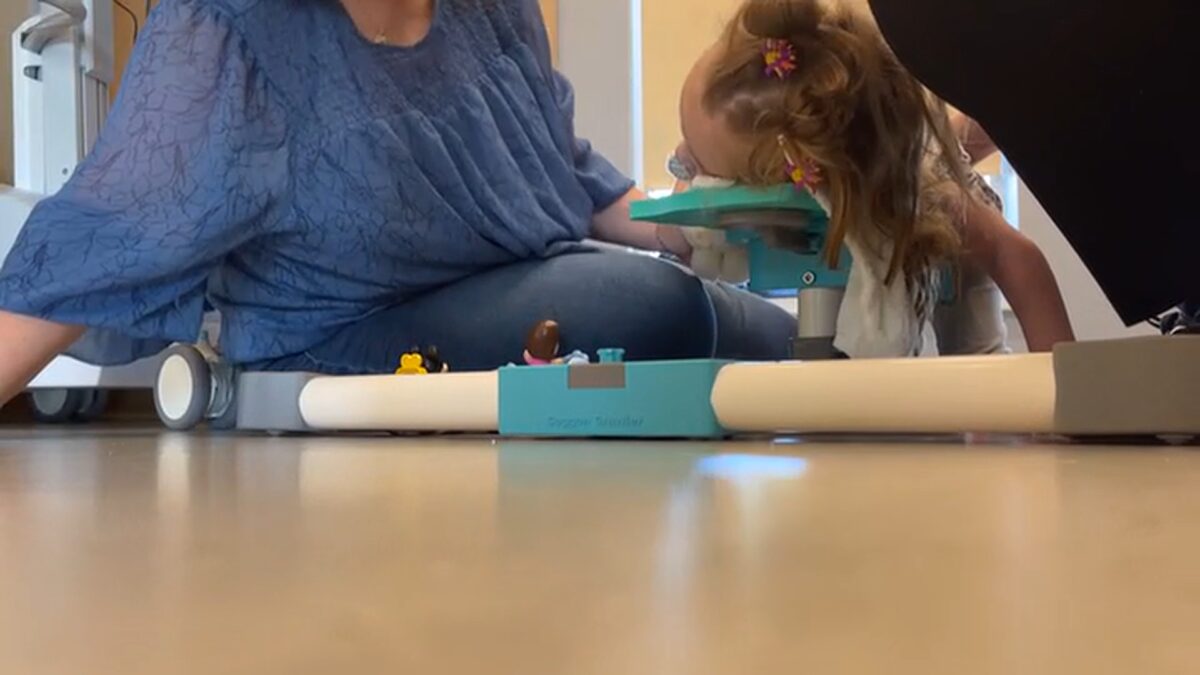
The device supports a child in a hands-and-knees position. It uses ball bearings to help keep children’s fingers from getting caught underneath, has places for straps to keep them from rolling off and includes a headrest.
“The parents’ hands are free so that they can encourage them and play with them and present toys to help encourage that crawling,” Sanchez said.
The Coggon Crawler is an open-source design built with 3D-printed pieces and PVC pipe.
The length of the PVC determines the height of the bed the child lies on, allowing the device to be adjusted as a child grows.
“People are able to open-source print the 3D products themselves and build it themselves for, hopefully, less than about $100,” Sanchez said. “It has been just so cool to see it be able to be in use.”
Sanchez said she wanted the device to be affordable for families already dealing with the costs of devices, therapies, travel and time off work.
She said the biggest barrier to getting the crawler into more clinics and homes is finding somewhere to reliably print it, particularly on a printer capable of PETG printing.
That need reached Eric Johnston, a supervisor in facility operations at Emplify Health by Gundersen in La Crosse.
Johnston’s department got its 3D printer in February after years of considering the technology. It was initially intended to produce discontinued or expensive parts used throughout the health system.
Johnston said one plastic gear inside a door motor costs about 25 cents to print. When that gear fails, a refurbished motor costs about $1,800.
As word of the printer spread, the department began receiving requests for other projects. Then Sanchez reached out.
Johnston said a piece for the lab was in the middle of printing when Sanchez called. He canceled it.
“When she called and said what this was for, there was no question in my mind that that’s going to be our main focus for the foreseeable future,” Johnston said.
Printing a crawler takes about a week, he said, and one piece alone takes about 18 hours.
Sanchez knew Johnston was working on the project. She did not know how far he had taken it.
During one of Emerald’s weekly appointments, Johnston brought in a finished crawler and told Sanchez the team had already made four.
“Oh my goodness,” Sanchez said as she saw the device. “And it says Coggon Crawler on there.”
Johnston told her the team was not finished. While Sanchez had asked for one, he said they hope to make about a dozen.
“I knew I had somebody working on maybe one. I didn’t know that we were gonna have all of this come today,” Sanchez said afterward. “This is so exciting.”
Several of the crawlers may already have a destination.
Sanchez said she has received at least six requests from colleagues within the Emplify Health system, including therapists in Iowa, La Crosse and Onalaska.
For Emerald’s family, the project is about more than one piece of therapy equipment.
“It just means the world to have someone that loves your kid enough to develop something like that,” Richardson said. “That’s life changing for so many kids.”
The Coggon Crawler continues to evolve.
Sanchez has also connected with TOM Global, an organization working on revisions, research and ways to increase the device’s usability.
A future version is expected to include a more robust headrest for children who need additional support.
Please note: This story was provided to CNN Wire by an affiliate and does not contain original CNN reporting. This content carries a strict local market embargo. If you share the same market as the contributor of this article, you may not use it on any platform.