Boca Raton was ground zero for 2001 anthrax attack. Here’s what happened

By Rachael Perry
Click here for updates on this story
BOCA RATON, Florida (WPBF) — Twenty-five years ago, Boca Raton suddenly found itself at the center of a terrifying chapter in American history.
Just weeks after the Sept. 11 attacks, an anthrax-tainted letter was opened inside the American Media Inc. building in Boca Raton, then home to publications including the National Enquirer. The attack killed photo editor Robert Stevens, sickened others and ultimately became part of what the FBI describes as the worst biological attack in U.S. history.
For Steven Abrams, Boca Raton’s mayor at the time, the memory remains remarkably vivid.
“It was a very scary one,” Abrams told WPBF.
He was just months into his first term as mayor when the city manager called him around midnight.
“He told me it was anthrax,” Abrams said.
Abrams called his father, a doctor, to ask what anthrax was.
“He was asleep. He said, why are you calling me about Amtrak? It’s a train, I don’t know,” Abrams said.
The moment would become the beginning of a crisis that stretched far beyond one Boca Raton office building.
The anthrax discovery came at an especially frightening time in the country.
The Sept. 11 terrorist attacks had happened less than a month earlier. Americans were already on edge when letters containing anthrax began appearing in the mail.
According to the FBI, five people ultimately died, and 17 others had gotten sick from the bacteria. The first victim was Stevens, who was exposed at the AMI building and died Oct. 5, 2001.
Abrams said Boca Raton’s first priority was dealing with the immediate threat.
“We had to respond to the immediate threat with our fire rescue and our police department,” he said.
Local first responders sealed off the area before federal agencies arrived.
“We were the first responders. People forget that it’s your local first responders that have to take immediate action,” Abrams said.
The FBI and Centers for Disease Control and Prevention eventually became involved, but Abrams said their roles created a difficult communication challenge.
“It was a health emergency” at the same time it was “a criminal investigation,” he said.
Public health officials wanted to communicate information to the public, while law enforcement wanted to protect information that could help solve the crime.
“Then, of course, the media descended, and there was a lot of confusion because of the conflicting information that was being given out by FBI and CDC,” Abrams said.
The fear wasn’t limited to the AMI building. Abrams remembers police and firefighters working inside the perimeter and seeing the uncertainty on their faces.
“Although they performed with great skill and bravery, you could definitely see in their eyes,” he said.
Postal workers were also among those Abrams wanted to reassure. And then there were residents demanding antibiotics.
He remembers people coming to him saying, “I want my Cipro shot. Where can you get me one?”
The response was happening as anthrax cases began appearing elsewhere in the country.
Letters were sent to media organizations and members of Congress in New York and Washington, D.C. The FBI ultimately recovered four anthrax-tainted parcels connected to the attacks.
Abrams said mayors in other communities began calling him for advice because Boca Raton had already been dealing with the crisis.
“Mayor, you have now experienced this for a couple of weeks. Do you have any advice for us?” Abrams recalled them asking.
The attack also created an unexpected problem for a city heavily dependent on tourism.
Television trucks lined the street outside the AMI building, while images of the building were repeatedly broadcast across the country.
“On national TV, 24 hours a day initially was a picture of that building with the heading Boca Raton, AMI Building Anthrax. That was a big problem,” Abrams said.
The effect was immediate.
“We rely a lot on tourism,” Abrams said.
The Boca Raton Resort, now known as The Boca Raton, began receiving cancellations.
“People just thought there was anthrax just floating all around the air in Boca Raton,” he said.
Abrams gathered local public relations professionals to help communicate a message he said was critical: The anthrax contamination was a confined problem, and Boca Raton remained open.
The city’s reputation eventually recovered. But the physical site of the attack would take years to fully return to normal.
The AMI building was contaminated and remained closed for years.
Abrams said city officials worked with local members of Congress and U.S. senators to pursue federal funding for cleanup before a private company ultimately took on the decontamination.
Once the work was completed, the building could return to the market.
“It was fortunate that the building did not have to be destroyed,” Abrams said.
Some pieces of history inside, however, were lost.
AMI had extensive archives, including historic photographs.
“There were National Enquirer archives in the building, like the original photo of Elvis in his coffin and other that ended up being destroyed when the interior of the building was decontaminated,” Abrams said.
The building itself survived.
Today, Abrams said, business continues there much as it did before but under new ownership.
“This has always been a very successful office park and so business goes on as usual, and our city continues to thrive,” he said.
The FBI investigation, known as Amerithrax, became one of the largest and most complex investigations in the agency’s history. Investigators conducted more than 10,000 interviews, executed 80 searches and collected thousands of pieces of potential evidence.
The FBI eventually identified Army biodefense researcher Bruce Ivins as responsible for the attacks. Ivins died by suicide in 2008, before charges could be filed. The Justice Department and FBI formally closed the investigation in 2010.
In the years after the attack, the family of Robert Stevens also sued the federal government, alleging the government failed to adequately safeguard anthrax at the U.S. Army laboratory where the FBI said the attack strain originated.
The case ended in a $2.5 million settlement in 2011.
A federal judge also questioned why certain records in the case remained sealed, including personnel records related to Ivins and documents concerning security procedures at the Maryland laboratory.
Abrams said he didn’t really have time to process what was happening in 2001.
“I was a young mayor. I was 40 years old, I think,” he said.
Events were unfolding so quickly that he was focused almost entirely on the next problem.
“At one point, things were progressing so quickly that you really didn’t have time to think about it,” Abrams said.
It wasn’t until months later that he could begin to contemplate what had happened.
“At the time, you’re just trying to deal with events that are occurring literally minute by minute, and you don’t have time to stop and think,” Abrams told WPBF.
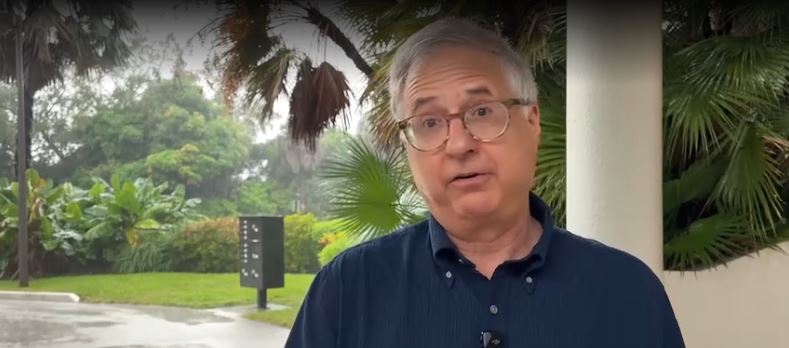
Now, 25 years later, Abrams returned to the office park where the attack began, and the memories came rushing back.
“It was so long ago, yet when I stand here in front of the building it just seems like yesterday,” he said.
He said the building itself doesn’t look dramatically different, and that’s part of what makes the memory so striking.
“It does bring back all of these memories, and when it does, recreating the scene, it literally feels like it happened yesterday,” he said.
25 years later, Abrams said the anniversary should not simply be about the investigation or the headlines. Five people died, and Abrams said that should not be forgotten.
“We don’t want to forget them, and we don’t want to forget what occurred here,” he said.
The attack that began with a letter inside a Boca Raton office building quickly became a national crisis, but Abrams said one of the biggest lessons came from what happened locally.
“When there is a national incident, it’s really the local government and the first responders that are the answer, that come to the forefront and have to ensure that the public is safe,” he said.
And 25 years later, he believes the most fitting description of Boca Raton’s story is one word: “Resiliency.”
The city, he said, recovered, and the building where it all began is still standing.
Please note: This story was provided to CNN Wire by an affiliate and does not contain original CNN reporting. This content carries a strict local market embargo. If you share the same market as the contributor of this article, you may not use it on any platform.