Imperial County urges Gov. Newsom to veto Air District expansion bill

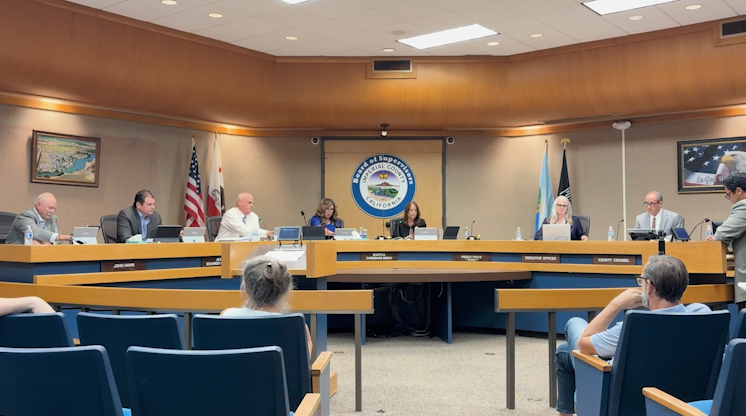
IMPERIAL COUNTY, Calif. (KYMA) – A major piece of legislation aimed at restructuring the Imperial County Air Pollution Control Board is officially on the governor’s desk, but local county leaders are ramping up a final fight to stop it.
Senate Bill (SB) 675 has cleared the State Legislature, passing the Senate in a 30-to-10 vote and securing a 58-to-19 victory in the Assembly.
While the bill represents a major legislative milestone for its author, State Sen. Steve Padilla (D-District 18), local officials warn it carries an immense, unfunded financial burden that could hurt rural communities.
Introduced by State Sen. Padilla, SB 675 seeks to expand the current air pollution board from five county supervisors to an 11-member panel.
Proponents argue that the expansion is critical to increasing public transparency and bringing needed structural diversity to the district.
“It makes sure that there are people sitting on the board who actually have some professional credentials and background in the science of dealing with air pollution,” Padilla said.
However, local county leaders push back on the premise, arguing that the existing five-supervisor panel is highly efficient and already inherently diverse.
“Right now, we have an office that runs smoothly,” said Imperial County District 5 Supervisor John Hawk. “Why not leave it alone? Why expand this whole thing, give us more government, and then turn around and tax the heck out of us?”
Supervisor Hawk emphasized that local representation is already built into the current county framework.
“Every supervisor is different. We’re all different. We all have different needs…We look at things very differently, but we come together. Each supervisor has a district, so we all look at the air quality within our districts,” he said.
The conflict surrounding the bill has shifted heavily from a question of governance to one of local economics.
An independent third-party audit commissioned by Imperial County concluded that the changes mandated by Sacramento would force the local air district to secure a dramatic increase in resources.
According to the analysis, implementing SB 675 would require over $1 million in one-time technology upgrades, paired with nearly $5 million annually in ongoing staffing, legal, administrative, and expanded air monitoring costs.
“There was a third-party audit that looked at this and said yes, you do have financial, administrative, and technological staffing that needs to be in that office,” Hawk said.
Padilla, however, has sharply dismissed the report’s multi-million dollar estimates.
“Some of the folks out there who have been arguing about cost have been throwing around big, wild, crazy numbers that have no basis in reality at all,” Padilla countered.
Because the state legislation provides no funding mechanism to implement these changes, county officials persist that the mandate behaves like a hidden tax on local municipalities. If permit fees cannot cover the ongoing millions, the financial obligation may fall onto city budgets.
“Cities are already struggling, our county is struggling,” Hawk warned. “These funds that we take from cities now will compete with fire, fire needs, with our public health, with our roads, and other things that we’re already paying for. Why would we add more bureaucracy to something that is functioning well?”
Imperial County has formally requested that Gov. Gavin Newsom (D-Calif.) veto the legislation, insisting that any structural air district reform must come with a realistic timeline and dedicated state funding.
The final decision now rests entirely with the governor, who has until the end of September to act. Under the California Constitution, the state operates under a “pocket signature” rule. If Governor Newsom chooses to do nothing and leaves the bill unsigned, it automatically becomes law without his signature once the deadline passes.
To prevent SB 675 from taking effect, Newsom must issue an explicit, formal veto.
“Let’s move forward with what we have. It’s working,” Hawk concluded. “We think Mr. Padilla should listen to our concerns and Governor Newsom should veto this legislation.”
Click here to follow the original article.