El Paso ISD school board to vote on up to $480 million bond election


El Paso Matters

by Claudia Lorena Silva

The El Paso Independent School District Board of Trustees will decide Tuesday whether to call for nearly half a billion dollars’ worth of bond propositions during the Nov. 3 election to bring updated cooling systems and other improvements to its campuses.

District officials are expected to present three bond options to the board, ranging from nearly $209 million to about $481 million, each with four propositions, according to documents posted to the district’s website.

If approved, the proposals would be among the first steps needed for EPISD to begin work on a $1 billion long-range master plan that would address the district’s needs and desired improvements. The plan was developed by the district’s Citizens Bond Steering Committee, made of parents, local residents and school employees, among others.

The decision whether to call for the district’s first bond proposal in a decade comes less than a week after the board appointed Matthew Reza and Brian Kelley to represent Districts 6 and 7, respectively. The seats were left vacant after Daniel Call and Valerie Ganelon Beals resigned in June after the board declared financial exigency, which allowed the district to lay off dozens of employees to cut costs.

El Paso ISD officials didn’t return requests for comment on Tuesday’s meeting.

EPISD has over 46,000 students across over 70 campuses that on average are over 49 years old.

If the board calls for the bond election, early voting would run Oct. 19-30, with Election Day being Nov. 3. The last day to register to vote is Oct. 5.

What is being proposed?

Option 1 asks voters for $208.9 million under four propositions:

Proposition A: $159.2 million to upgrade air conditioning, make safety and transportation improvements and to renovate vacant properties

Proposition B:  $10.6 million for new technology for students

Proposition C: $25.6 million for athletic stadium renovations

Proposition D: $13.5 million to refinance the district’s debt

Option 2 totals $445.8 million and includes everything from Option 1, plus additional improvements that increase Proposition A to $396 million.

Option 3 would cost $480.8 million and include everything from the previous options, plus additional deferred maintenance costs.

The presentation did not specify which campuses would get improvements under the propositions, but the district has made converting all evaporative coolers into refrigerated air conditioning within the next two years one of its top priorities.

What options does the board have?

The board can vote to adopt a resolution calling for an election, vote not to – or do nothing.

The board has until Aug. 17 to call for a bond election to be placed on the Nov. 3 ballot. 

Otherwise, the district will need to wait until May to hold a bond election. The deadline to call for a bond election in the May uniform election is in February. 

How would a bond impact taxes?

District officials have not publicly stated the impact the different scenarios would have on tax bills on the average-priced home in the district, only discussing tax rates – the amount charged per $100 property valuation.

If voters approve the first two options, EPISD plans to maintain a tax rate of $1.08 per $100 valuation, which would likely still lead homeowners to see increases in the district’s portion of their tax bill as home valuations rise.

The third option would raise EPISD’s tax rate by one cent to $1.09 per $100 valuation, further increasing those tax bills.

Homeowners age 65 and older have their school taxes frozen and won’t see an increase in their tax bill regardless if the bond passes.

EPISD published a tax impact estimator on its website to help homeowners determine how the bond may affect their tax bill, but does not specify the tax rate or which propositions were included in the calculations. The district didn’t respond to questions about the estimator.

Click here to follow the original article.


Borderland Innovator Launches NeuroStack AIOS

Nichole Gomez

El Paso, TX (KVIA-TV)-Orlando Sapien grew up in El Paso and works as an IT professional and photographer. He created NeuroStack AIOS, an AI ‘second brain’ app developed right here in the Borderland. Sapien says this homegrown tech helps people handle the daily overload of things to remember. It’s easy to show off: just speak to your phone, and it quickly turns your thoughts into neat, organized notes. The app is currently in beta with a local group of founding testers.

For more information, visit neurostackaios.com

Click here to follow the original article.

El Paso Launches 2026 Veterans Survey

Nichole Gomez

El Paso, TX (KVIA-TV)-The City of El Paso is launching its 2026 Veterans Needs Assessment to understand better the evolving needs of veterans, active-duty service members, military-connected families, caregivers, and the organizations that support them throughout the Borderland.

As home to Fort Bliss—recently named the Army’s Best Garrison for Fiscal Year 2026 and recipient of the 2026 Commander in Chief’s Annual Award for Installation Excellence—El Paso has long shared a strong connection with the military community.

The online assessment opened Monday, Aug. 10, and will remain available for approximately six weeks. The survey will gather input on the current needs, challenges, and priorities of veterans, service members, and military-connected families to help guide future programs, partnerships, resource allocation, and strategic planning.

Veterans, active-duty service members, National Guard and Reserve members, military spouses and family members, caregivers, survivors, and organizations that serve the military and veteran community are encouraged to participate.

Survey responses will be kept confidential and analyzed in aggregate to identify trends, service gaps, and opportunities to strengthen support for veterans and military-connected families throughout the Borderland.

The survey is available online at: https://tinyurl.com/2s3d8f5n

Click here to follow the original article.

Service restored after power outage hits ABC-7 transmitter

Gabrielle Lopez

UPDATE (10:03 a.m.): El Paso Electric restored power and ABC-7 is back on the air.

EL PASO, Texas (KVIA) — ABC-7 and other broadcasters are experiencing a power outage at the transmitter site atop the Franklin Mountains overnight. Crews are working with El Paso Electric to restore service to our viewers. 

To watch ABC-7 newscasts, you can use the free KVIA News app or go to Livestream Newscasts.

We will provide service updates as we get them.

Click here to follow the original article.

Cow Creek Umpqua Indian Foundation awards $7,500 to Family Access Network

Adrielle Hasara

Bend, ORE. (KTVZ) — The Cow Creek Umpqua Indian Foundation awarded $7,500 to the Family Access Network to support basic-needs services for families in Deschutes County, Ore. The grant will support up to 30 local children during the school year.

The Family Access Network calculates that providing services to one child for an entire school year costs approximately $250. Advocates stationed directly in schools link children and their families to essential local resources.

Julie Lyche, executive director of FAN, highlighted the impact of the grant. “CCUIF has been a longtime supporter of FAN and our services in Deschutes County,” Lyche said. “We are thankful for their partnership and dedication to improving the lives of children and families throughout our community.”

Founded in 1993, FAN employs 28 advocates stationed across 66 sites in Deschutes, Crook and Jefferson counties. Advocates work directly within schools to connect families to community resources, assisting more than 7,600 children and family members annually across the region.

The Cow Creek Umpqua Indian Foundation was founded in 1997 and began its grantmaking in 1998. In its most recent round of funding, the foundation awarded $606,815 to 87 Oregon charities, targeting support toward education, youth and family programs and basic necessities such as food and shelter.

Click here to follow the original article.

‘Hondo’s Little Potato’: Pittsburgh Zoo unveils lion cub ‘Kiazi’ in homage to her Idaho roots

Seth Ratliff

PITTSBURG (KIFI) — A lion cub halfway across the nation, but beloved by Idahoans, made her public debut at the Pittsburgh Zoo & Aquarium on Monday with a name that permanently connects her to her father’s home state.

Timed with World Lion Day on August 10, the zoo officially introduced four-month-old “Kiazi” to visitors. The name, which means “potato” in Swahili, honors both the African lion’s native range and serves as a nod to her father, Hondo, who came to Pittsburgh from the Idaho Falls Zoo.

RELATED: Former Idaho Falls Zoo lion becomes first-time father at Pittsburgh Zoo

“Since she is Hondo’s first offspring and he is from Idaho, keepers loved the name,” said Assistant Curator of Mammals Karen Vacco in a post announcing the naming. “Hondo’s little Idaho potato!”

Born on April 5, Kiazi is the cub for Hondo and mother Scarlett as part of a strategic breeding recommendation through the Association of Zoos and Aquariums’ (AZA) Species Survival Plan. African lions are considered vulnerable, and numbers have declined by 50 percent over the last 25 years due to habitat loss, loss of prey, and human-lion conflict. 

“Every lion cub birth is vital to the long-term survival of the species, and each one represents hope for the future,” says Vacco. “We hope Kiazi inspires Zoo guests to learn more about lions and protect them in the wild.”

To name the playful cub, the zoo turned to the public. Pittsburgh Zoo friends submitted over 1000 name suggestions during a fundraising initiative that generated $5,705. The proceeds will directly support Kiazi, the lion pride, and wildlife care initiatives across the facility.

Caregivers report that Kiazi is in peak health. While she will eventually transfer to another accredited zoo in a few years to establish her own pride, keepers are enjoying her early years in Pittsburgh, according to reports by KDKA.

Click here to follow the original article.

Denver Zoo head veterinarian discusses recent deaths of animals, explains zoo’s “whole life care” philosophy

By Kelly Werthmann

Click here for updates on this story

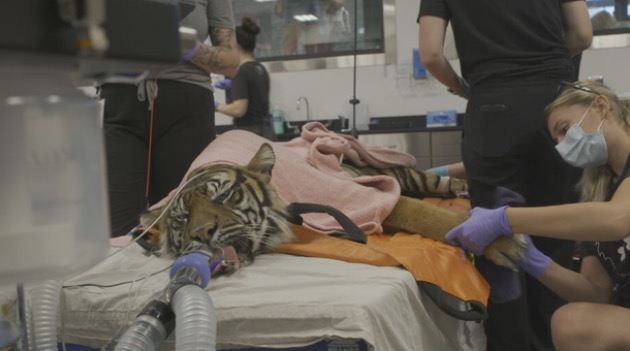
    DENVER (KCNC) — Under bright lights inside the Denver Zoo’s animal hospital, 12-year-old Sumatran tiger ChloJo lies on an operating table Tuesday morning as veterinarians remove a small mass from her back.

It’s not an emergency — it’s preventive care. And for head veterinarian Dr. Jimmy Johnson, it’s part of a philosophy that guides every decision made for the zoo’s roughly 3,000 animals representing 450 species.

“We tend to refer to that as ‘whole life care,’ which is a huge part of what we do here at Denver Zoo Conservation Alliance,” Johnson said.

That care includes everything from birth and routine checkups to aging, chronic illness, and, when necessary, end-of-life decisions.

“Ensuring they have a really enriched and fulfilling life throughout their time here in our care, and that does include, unfortunately but inevitably, end of life care as well,” Johnson said.

The topic has drawn increased attention this year following several high-profile animal deaths at the zoo.

In May, the zoo euthanized Rudy, a 32-year-old black rhinoceros, after chronic health conditions and age-related mobility issues continued to progress. In June, staff said goodbye to Indy, a 46-year-old Egyptian vulture believed to be among the oldest of her species in human care. July brought the loss of Kai, a Cape buffalo calf born earlier this year, after veterinary teams determined his kidney failure could not be treated. Days later, Hagrid, a critically endangered Bactrian camel, died unexpectedly after suffering acute gastrointestinal complications.

Kai’s case remains especially difficult for the zoo’s animal care team.

“As he grew, his kidneys were not able to keep up, and that unfortunately is a condition we were not able to cure and allow him to continue to grow and lead a meaningful quality of life,” Johnson explained.

Two other animal deaths this year resulted from human error; two Malayan tapirs died after receiving toxic levels of a copper supplement. The zoo said an investigation found a medication preparation error and prompted an internal review of its procedures. Additional safeguards have since been implemented to help prevent a similar mistake from happening again.

Johnson said every loss is difficult for staff members who spend years caring for the animals.

“It is hard, and it’s hard because we care,” he said.

Still, he said the number of animal passings this year is not too unusual for a zoological institution with thousands of animals and hundreds of species, each with different lifespans, health challenges and aging processes. When an animal develops a terminal or untreatable condition, Johnson said the animal care teams focus on quality of life rather than simply extending life.

“We always ask ourselves, just because we can, should we, and what does the outlook for that animal look like?” he said. “We don’t focus just on quantity of life; we focus on quality of life as well.”

That philosophy, he explained, guides euthanasia decisions.

“Euthanasia in itself means ‘good death’, and it’s a part of the care we provide,” Johnson said. “It’s not giving up. It is not an absolute last resort. It is a part of a thoughtful end of life care plan because we want every animal to have a comfortable and dignified end of their life.”

Johnson added care teams do all they can to make those decisions before animals experience significant pain or suffering.

“An animal’s last day does not need to be their worst day,” he said.

And the work does not stop when an animal dies. The zoo’s board-certified pathologist performs a necropsy and reviews diagnostic information following every animal death. Johnson said those examinations help veterinarians better understand diseases, improve animal care, and contribute to conservation efforts around the world.

“It’s a silver lining, but a very positive silver lining, in that even though we’ve lost an animal and that’s hard, that animal is contributing to our understanding and allowing us to continue to advance the already high-quality care that we provide,” he said.

For visitors, the zoo experience is often measured in moments spent watching animals in their habitats. Behind the scenes, Johnson said, the work is measured across a lifetime. And sometimes, he said, caring well for an animal means making one of the hardest decisions a veterinarian can face.

“I have euthanized animals throughout my career, it doesn’t get any easier,” he said. “But I think what really reaffirms my commitment to our animals in this profession and my love of animals is knowing that the animals that live at Denver Zoo have the absolute best care possible, and that includes end of life care as well.”

Please note: This story was provided to CNN Wire by an affiliate and does not contain original CNN reporting. This content carries a strict local market embargo. If you share the same market as the contributor of this article, you may not use it on any platform.

Beat the heat: Iceplex offers cool summer escape

Dakota Makinen

PALM DESERT, Calif. (KESQ) — With temperatures climbing into the triple digits across the Coachella Valley, finding a way to stay cool and active can be a challenge.

But inside the Iceplex at Acrisure Arena, it’s a completely different world.

The indoor rink gives residents a chance to escape the summer heat while staying active through ice skating, hockey and other programs.

Officials with the Iceplex say there are opportunities for people of different ages and skill levels — including those who have never skated before.

The Iceplex also offers a way for people to try a new sport during the summer, with programs designed for both skating and hockey.

And while the temperatures outside may be soaring, keeping the ice frozen in the middle of the desert takes plenty of work.

Iceplex staff monitor and maintain the rink throughout the day to keep conditions consistent for skaters and hockey players.

Click here to follow the original article.

Man arrested for stealing over 100 avocados from Miami-Dade grove, police say

By Ana Maria Soler

Click here for updates on this story

    MIAMI (WFOR) — A Hialeah man was arrested after a Miami-Dade deputy found over 140 stolen avocados in his truck at a southwest Miami-Dade grove.

According to the arrest report, the deputy was checking the Brooks Tropical property located at Southwest 200th Street and 152nd Avenue at around 11:17 p.m. on Sunday when he saw a white pickup truck parked at the end of the driveway. The deputy turned on his emergency lights and went to investigate.

The arrest report said that Duniel Arecesgonzalez, 37, approached the deputy during the investigation, so the deputy detained him and confirmed that Arecesgonzalez owned the truck.

The deputy noted in the report that he found 17 avocados in the truck bed. Four black construction trash bags filled with avocados were also found next to the truck, and two more black bags filled with avocados were found inside the grove.

In total, 142 avocados were recovered, valued at $852, according to the report.

The report then said that when an investigator tried to interview Arecesgonzalez at the Agricultural Patrol Section office, he said, “Why do I need to speak to you? I was caught stealing avocados.” The report noted that he then refused to answer any other questions.

Arecesgonzalez was booked into Turner Guilford Knight Correctional Center, where his total bond was set at $3000. He posted the bond amount and was released the next day, on Monday.

Please note: This story was provided to CNN Wire by an affiliate and does not contain original CNN reporting. This content carries a strict local market embargo. If you share the same market as the contributor of this article, you may not use it on any platform.

Georgia deputy kills man accused of pulling out gun in McDonald’s drive-thru, GBI says

By Dan Raby

Click here for updates on this story

    BARTOW COUNTY, Georgia (WUPA) — A Bartow County deputy has shot and killed a man who officials say was accused of pointing a gun at a McDonald’s employee.

The Georgia Bureau of Investigation says the incident began around 6:30 a.m. on Tuesday when deputies were sent to a McDonald’s on the 1300 block of Joe Frank Harris Parkway SE in Cartersville. According to the authorities, the law enforcement agency received a report that a man had pulled a weapon on an employee in the fast food restaurant’s drive-thru.

A deputy that arrived on scene found the man, identified as 31-year-old Marcus Maurice Williams, in a nearby parking lot holding the gun, the GBI reports.

When the deputy gave Williams commands, officials say he refuse to comply, instead pointing the gun and firing at the deputy. The deputy fired at least one shot, hitting Williams.

Medics rushed the man to a local hospital, where he died from his injuries. The deputy was not injured.

The investigation remain ongoing, and the GBI is asking anyone with information to call the agency’s Regional Investigative Office in Calhoun at (706) 624-1424 for its tipline at 800-597-8477.

This incident is the 51st shooting involving law enforcement in the state since the beginning of the year. Thirty of those have ended with a suspect killed, GBI data reveals.

Please note: This story was provided to CNN Wire by an affiliate and does not contain original CNN reporting. This content carries a strict local market embargo. If you share the same market as the contributor of this article, you may not use it on any platform.